DBMS -> unit 3 -> ER MODEL
 Call Kai
 Learn
Learn Practice Test
 Spaced Repetition
 Match
Match Flashcards
 Knowt Play
1/19

There's no tags or description
Looks like no tags are added yet.
Name | Mastery | Learn | Test | Matching | Spaced | Call with Kai | Chat |
|---|
No analytics yet
Send a link to your students to track their progress
20 Terms
ER model tells about 3 things-? what are they
entity, attribute and relationshiop
• Entity: An object that is stored as data. E.g: Student, Course, or Company
.• Attribute: Properties that describe an entity. E.g: StudentID, CourseName, orEmployeeEmail
.• Relationship: A connection between entities. E.g: Student enrolls in a Course.
what are the types of entities, attributes and relationshiops?( hint → diagram)
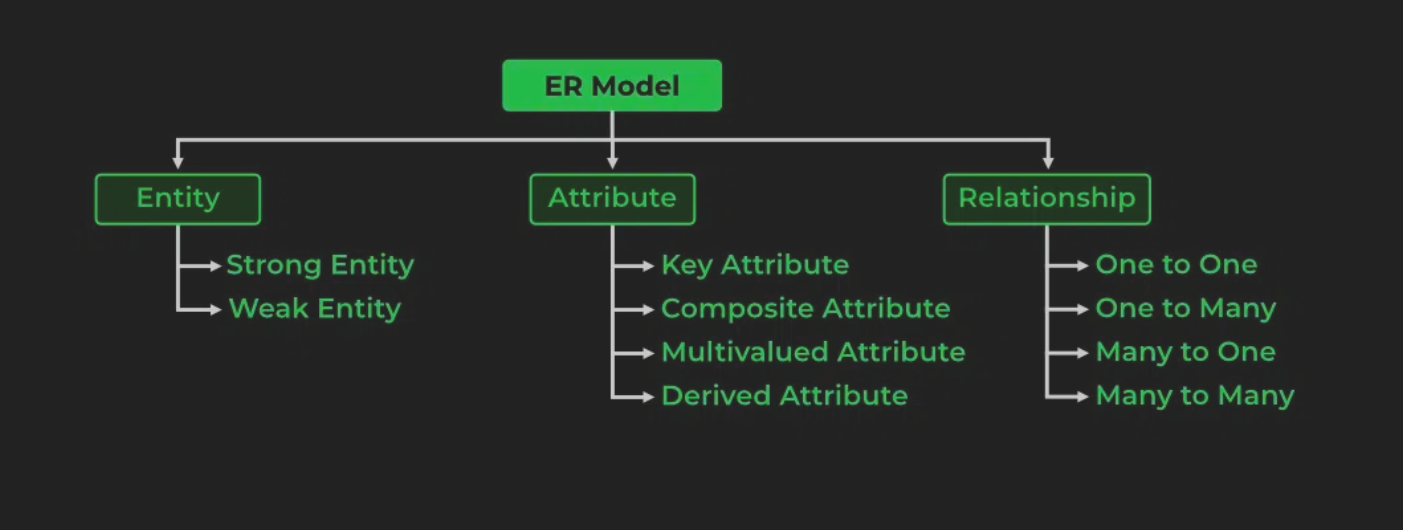
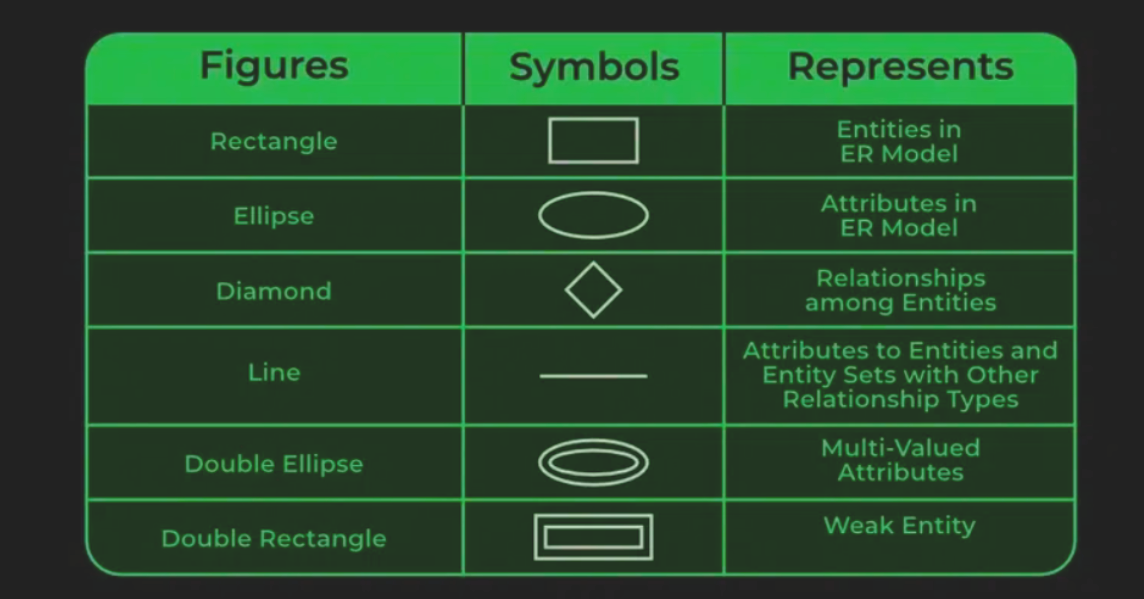
what are the symbols used in an ER diagram??
what are the types of entitites
strong entity and weak entity
what’s a strong entity
A strong entity is one which has a key attributes that can uniquely identify each instance of that entity. It does not depend on other entities for it’s identification. represented by a rectangle in the ER diagram
what is a weak entity? what is identifying relationship? give example
it cannot be identified by it’s attributes alone, it depends on a strong entity to be defined.
represented by double rectangle
participation of weak entities is always total
relationship between weak entity type and it’s identifying strong entity type is called identifying relationship, represented by a double diamond

what is entity type?
A class of entities. ex→ student, employee ( generally the table name)
what is attribute? what are the 4 types of attributes? what are their symbols
features of an entity are called it’s attributes
types→
Key attribute → an attribute that uniquely identifies an entity(oval with attribute’s named un`derlined)
composite attribute → an attribute that is composed of other attributes . ex - address composed of house no. , street no, city, state country - (oval connected to other ovals)
multi valued attribute → an attribute that may consist of more than one value for a given entity, (ex→ phone no of student) - (double oval)
derived attribute → an attribute that can be calculated/derived from another attribute, (ex→ age can be calculated from DOB) - (dashed oval)
what is a relationship, relationship type, relationship set?
relationship type→ association between two entities (student “enrolled” in” course)
relationship set → collection of all relationshps of the same type( all “enrollments” in the course")
what is degree of a relationship?
what are the types
number of entity sets participating in a relationship set.
1. unary/recursive relationship- > one person is married to one person
Binary relationship → student enrolled in course
ternary relationship → student enrolled in course taught by instructor
N-ary relationshiop → n number of entities

what is cardinality? what are it’s types?
number of times an entity of an entity set participates in a relationship set.
one to one → each entity in the entity set can participate only once, one person issued one passport
one to many → one teacher teacher many courses
many to one → one surgeon can do many surgeries, but one surgery can be done by only one surgeon
many to many → one programmer can contribute to multiple programs, one program can be written by multiple users
what are the participation constraints ?
total participation → each entity in the entitiy set must participate in the relationship, shown by double lines
partial participation → it is not necessary for an entity in the entity set to participate in the relationship

make a diagram of entity set student and courses, and relationship set “enrolled”, total participation constraint on student entity set, partial participation constraint on course set

write steps of making an ER diagram

what is enhanced/extended entity model? what are the 3 concepts it includes?
EER is an advanced form of ER model that includes the following concepts →
1. specialization
generalization
aggregation
what is specialization? show diagramatic representation
top down approach
high level entity is divided into lower-level entities based on certain characterisitcs
higher level entity is aka superclass
lower level entities are aka subclass
IS-A relationship is present between super class and sub class

what is generalization? show diagrammatic representation
bottom up approach in which multiple lower level entities with common characteristics are group into one higher level entitiy
higher level entity is aka superclass
lower level entities are aka subclass
IS-A relationship is present between super class and sub class

what is disjoint and overlapping in this context→
disjoint → a higher level entity can belong to only one lower level entity
overlapping → a higher level entity can belong to multiple higher level entity
what is total and partial generalization/specialization
total → each higher level entity must belong to a lower level entity
partial → eveySS higher level entity need not belong to a lower level entity

what is aggregation? what is the digrammatic representation
type of abstraction in which a relationship between entities is treated as a higher level entity,
