Cell Bio Unit 1
 Call Kai
 Learn
Learn Practice Test
 Spaced Repetition
 Match
Match Flashcards
 Knowt Play
1/95

There's no tags or description
Looks like no tags are added yet.
Name | Mastery | Learn | Test | Matching | Spaced | Call with Kai | Chat |
|---|
No analytics yet
Send a link to your students to track their progress
96 Terms
Describe how thermodynamics function in cellular processes.
Determines if a reaction will occur and how energy is transferred between reactions. Cells then use energy from favorable reactions to drive unfavorable processes
Define free energy
the portion of the system’s energy that is available for reactions
How is free energy useful in predicting the outcomes of reactions?
A positive free energy indicates that the system is nonspontaneous and requires an input of energy
A negative free energy allows for reactions to occur, it is spontaneous
A free energy level of 0 means the system is at equilibrium
Explain why energetically unfavorable reactions require coupling to favorable ones
Only reactions with a negative Gibbs free energy will occur, so coupling a reaction with a positive Gibbs free energy with a reaction with a negative Gibbs free energy will allow the reaction to proceed.
What role do proteins have in cells?
Proteins are the building blocks of the cell
Function of enzymes.
catalyze covalent bond breakage or formation
Function of Structural proteins
provide mechanical support to cells and tissues
Function of Transport proteins
Carry small molecules or ions
function of motor proteins
generate movement in cells and tissues
Function of Storage proteins
store amino acids or ions
Function of Signal proteins
carry signals from cell to cell
Function of Receptor proteins
Detect signals and transmit them to the cell’s response machinery
Function of Transcription regulators
bind to switch genes on or off
How are shapes of proteins determined?
Each position of each amino acid determines the three-dimensional conformation, or shape, of the protein, which is then stabilized by noncovalent interactions between different parts of the molecules
how are shape and function linked for proteins.
Different structures and shapes of proteins determine the function
Describe how covalent bonds contribute to the structure of proteins.
A peptide bond forms between the carbon of the carboxyl group on one amino acid shares electrons with the next amino acids nitrogen. This forms the backbone of an amino acid and multiple of these amino acids bonded together makes a polypeptide chain.
Describe how Van der Waals contribute to the structure of proteins.
create short range electrical attractions between atoms
Describe how hydrogen bonds contribute to the structure of proteins.
form between adjacent regions of a folded polypeptide chain to stabilize the folded shape of a protein
Describe how ionic bonds contribute to the structure of proteins.
aka salt bridges, provide electrostatic attractions between oppositely charged amino acid side chains to stabilize 3D structure
Describe how hydrophobic interactions contribute to the structure of proteins.
Help protein folding, the polar amino acid side chains are on the outside, then the nonpolar amino acids are hidden to form a tightly packed hydrophobic core.
Describe A-helices
An ordered repeating form made up of a N-h group of one amino acid is hydrogen bonded to the C=O group on an amino acid that's 4 amino acids away
Describe B-sheets
Several strands of an individual polypeptide chain that is held together by hydrogen bonds between peptide bonds in adjacent strands. Each amino acid side chain in each chain alternates being above or below the sheet.
Describe Filaments
Individual protein monomers joining together with noncovalent bonds into a long repeating chain.
Describe Spheres.
Individual protein subunits associate in sheets and curve and close in on themselves. Can be cages or tubes too.
Describe Primary structure.
structure with only the amino acid sequence of a protein
Describe Secondary structure.
alpha helixes and beta sheets
Describe Tertiary structure.
complete three dimensional structure of a fully folded protein
Describe Quaternary structure.
multiple interacting polypeptide chains that form a larger protein complex
Describe what a protein domain is.
Segment of a polypeptide chain that can fold into a compact stable structure and that often carries out a specific function
Describe Anfinsen's experiment that was performed.
Treated RNase A with urea and beta-mercaptoethanol to break the disulfide bonds and make the protein unfold and lose activity. Then removed the urea and Beta-mercaptoethanol, which allowed the disulfide bonds to reform and protein to immediately refold and become active.
Why was Anfinsen's experiment important.
Showed that the RNase did not need to read other proteins receive outside information to refold, so it must contain the information needed for proper folding
Explain how Hsp60 chaperone proteins function.
Hsp60 chaperones act later and are larger, barrel-shaped structures where unfolded or partially folded proteins are delivered for processing.
Explain how Hsp70 chaperone proteins function.
act early in binding to exposed hydrophobic patches on proteins with the cytosol, mitochondria and ER forms
What are enzymes
Proteins that speed up chemical reactions in cells without being consumed in the reaction.
What are enzymes?
proteins that act as catalysts to speed up chemical reactions in living things
Explain the properties of enzymes.
Have an active site, which is a specific pocket or region where the substrate binds. Shape determines what substrate they can bind to.
Define the term "ligand"
A substance that is bound by a protein.
Describe the general logic for how ligand binding sites work.
A cavity in the protein surface is formed by a particular arrangement of amino acid side chains. The ligand must fit precisely into the protein's binding site to allow for the noncovalent interactions to occur.
How are proteins regulated?
Ligand binding interactions, allosteric regulation, co-factors and binding proteins, proteolytic processes, and nucleotide regulation.
What are Ligand binding interactions?
When a ligand binds to a protein and changes its activity or function.
What is allosteric regulation?
When reactants or products bind to a protein at a site other than the active site and change its activity.
What are Co-factors and binding proteins?
When other molecules or proteins bind to an enzyme and help regulate or activate it.
What is proteolytic processing?
A protein is cut by a protease, which can activate or inactivate it.
What is nucleotide regulation?
The cellular process that controls how cells make, break down, and balance the building blocks of DNA and RNA.
How are proteins degraded?
Ubiquitination, proteasomes and lysosomes.
What is Ubiquitination?
When a signal is attached to the protein, marking it for degradation.
How do proteasomes degrade proteins?
When the ubiquitin-tagged protein is recognized and broken down into smaller peptides.
How do lysosomes break down proteins?
Proteins broken down by digestive enzymes.
Predict what effects a posttranslational modifications, like phosphorylation, ubiquitination may have on a protein.
Change the proteins activity, shape, location, or mark it for degradation
Describe how misfolded proteins can arise.
When proteins lose their native shape and expose the hydrophobic interior, they repel the water and bind to other exposed hydrophobic regions, which build up to form amyloid structures.
How are misfolded proteins handled in the cell?
They can either be corrected by chaperone proteins, degraded, or they form the amyloid fibrils
How can misfolded proteins cause disease?
A protein undergoes a conformational change that produces an abnormally folded prion. That prion can bind to regularly formed prions, converting it to an abnormal prion form. These prions can build up to form amyloid fibrils, which then lead to disease.
What is the molecular basis of disease?
The specific breakdown in molecules, like DNA, RNA, or proteins that causes normal cells to stop working correctly
What does Differential centrifugation do?
Separation and isolation of cellular components by size and density during application of gravity
What does Ultracentrifugation do?
separation and isolation of cellular components of mass and buoyancy during application of gravity
What does Velocity Sedimentation do?
separates particles based on their sediment rate and how fast they move through a solution. Larger particles move faster
What does Equilibrium Sedimentation do?
Separates particles based on buoyant density. Particles move until they reach the position where their density matches their surrounding solution.
What does Chromatography do?
separate molecules based on how they interact with a stationary phase and mobile phase
What does ion-exchange chromatography do?
Separates molecules based on charge
What does gel-filtration chromatography do?
separates molecules based on size
What does Affinity Chromatography do?
separates molecules based on specific binding interactions
What does Column chromatography do?
the stationary phase is packed into a column and the sample passes through it
What does a SDS-Page do?
Separate proteins primarily based on molecular weight and size. It tells if protein is present and gives you info about size, not the identity.
What does Western Blotting do?
detect a specific protein in a sample
What do antibodies do?
specifically recognize and bind to particular proteins
What are monoclonal and polyclonal antibodies?
An antibody is a protein made by the immune system that recognizes and binds to a specific antigen, such as a protein on a cell.
What are monoclonal antibodies?
antibodies that all recognize the same epitope (specific part of an antigen).
What are polyclonal antibodies?
a mixture of antibodies that recognize different epitopes on the same antigen.
Describe how primary and secondary antibodies are used.
Primary antibodies are used to attach to specific proteins, and secondary antibodies are used to detect primary antibodies
What is GFP?
a naturally glowing biological marker that emits bright green light when exposed to blue or ultraviolet light
How is GFP used?
attach the gene to a protein of interest then watch the glowing protein move throughout the cell.
Describe the functions of cell membranes.
They act as selective barriers controlling entry into and exit out of the cell, as well as separating the molecules inside from their environment.
What is the role of the lipid bilayer in the cell membrane?
Control what enters and exits the cells.
What is the lipid bilayer?
hydrophilic heads and hydrophobic tails align so two molecules are tail to tail, hiding the hydrophobic tails and exposing the hydrophilic heads to surrounding water.
What is the role of transporter and channels in the cell membrane
transport specific molecules in and out of the cell
What is the role of anchors in the cell membrane?
tether to cells, extracellular matrix, or cytoskeleton and gives polarity
What is the role of receptors in the cell membrane?
receive signals
What is the role of enzymes in the cell membrane?
act as a catalyst
What are the integral membrane proteins?
embedded into the membrane
What are the peripheral membrane proteins?
proteins attached to proteins in the membrane
Explain the fluid mosaic model.
Cell membrane is a flexible, two-dimensional liquid where molecules float and drift among a double membrane
What are the types of mobility exhibited by lipids.
Lateral diffusion, flection, rotation, and flip-flop.
Why is lipid mobility important?
adds flexibility and fluidity to the membrane
What is lateral diffusion?
when a lipid moves side to side within the same layer of the membrane
What is flexion?
When the fatty acid tails of a lipid bend and move.
What is Rotation?
When the lipid rotates on its own axis.
What is flip-flopping?
when one lipid moves from one side of the bilayer to the other side
Describe the role of cholesterol in the plasma membrane.
Stiffens the cell membrane by fitting into the gaps between the phospholipids in the lipid bilayer, which can make it less flexible and less permeable.
Describe the function and composition of lipid rafts.
microdomains within cell membranes that concentrate specific lipids and proteins to regulate cellular signaling and trafficking
What are the two different types of asymmetry that exists in membranes?
protein asymmetry/absolute asymmetry and lipid asymmetry/non-absolute asymmetry
What is the function of asymmetry in the cell membrane?
allows each side to do a specific job and specialize in different tasks.
What is the purpose of Glycolipids
cellular recognition, interactions, protection and insulation
where are glycolipids
extracellular surfaces
What is the purpose of Phosphatidylserine?
interactions with protein kinases

What structure is this in FirstGlance?
Alpha Helices
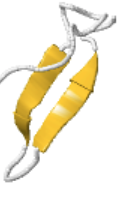
What structure is this in FirstGlance?
Beta Sheets