Immune System - Lecture Notes
 Call Kai
 Learn
Learn Practice Test
 Spaced Repetition
 Match
Match Flashcards
 Knowt Play
1/62

There's no tags or description
Looks like no tags are added yet.
Name | Mastery | Learn | Test | Matching | Spaced | Call with Kai | Chat |
|---|
No analytics yet
Send a link to your students to track their progress
63 Terms
Infectious agents
Can damage or kill a host
Pathogenic agents are one that cause harm
Five major categories
Bacteria
Viruses
Fungi
Protozoans
Multicellular parasites
Bacteria
Single-celled prokaryotes, some harmless, others virulent (e.g., Clostridium tetani, Streptococcus)
Small (1 to 2 µm) cell with both a membrane and a cell wall
•Varied types: spherical (cocci), rodlike (bacilli), or coiled (spirilla)
Virulent bacteria may have a pili, capsule, or release toxins or damaging enzymes

Viruses
Non-living DNA or RNA in a protein shell
They are not cells - they are much smaller, about one-hundredth of a micrometer
Obligate intracellular parasite
Must enter host cells to reproduce (e.g., cold, Ebola, chickenpox)
Infected cells make copies of nucleic acid and capsid (shell)
Virus or immune response may kill the host cell

Fungi
Eukaryotic cells with membrane and cell wall
Include molds, yeasts, multicellular fungi that produce spores
Release proteolytic enzymes inducing inflammation
Can cause superficial (ringworms) or internal infections (histoplamosis)
Can infect mucosal linings (for example, vaginal yeast infections)

Protozoans
Eukaryotic cells without cell walls
Intracellular and extracellular parasites
Disease examples: malaria and trichomonoiasis

Multicellular parasites
Non-microscopic
Takes nourishment from host they live in
For example: tapeworm

Prions
Fragments of infectious proteins
Neither cells nor viruses
Causes disease in nervous tissue
Example: Variant Creutzfeldt-Jakob disease (“mad cow disease”)
Can be spread from cows to humans by consuming infected meat
Which pathogen must enter a cell to replicate? Which type of pathogen is composed of prokaryotic cells?
Viruses; bacteria
Leukocytes (white blood cells)
Formed in the red bone marrow, including:
Granulocytes: neutrophils, eosinophils, basophils
Monocytes: Become macrophages when they leave blood and enter tissues
Lymphocytes: B-lymphocytes, T-lymphocytes, NK (natural killer) cells
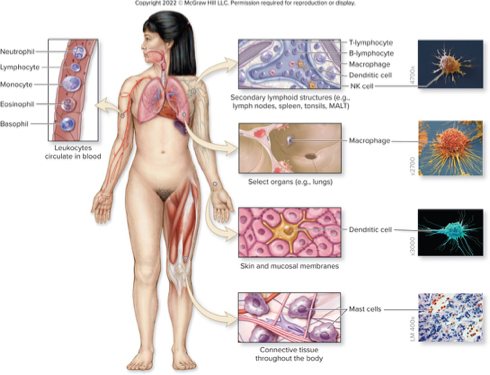
Immune cells and their locations
Structures that house immune system cells
Most leukocytes are in body tissues (instead of blood)
Secondary Lymphoid Structures
T- and B-lymphocytes, macrophages, dendritic cells, and NK cells housed in lymph nodes, spleen, tonsils, MALT, lymphoid nodules
Select Organs
House macrophages
May be permanent residents of the organ, or migrating macrophages
Some permanent ones named for location (for example, alveolar macrophages)
Epithelial layers of skin and mucosal membranes
House dendritic cells
These dendritic cells are usually derived from monocytes
Engulf pathogens and migrate into lymph
Connective Tissue
Houses mast cells
Typically in close proximity to small blood vessels
Abundant in dermis and mucosa of respiratory, GI, and urogenital tracts
Also found in connective tissue of organs (example, endomysium of muscle)
Primary Location of Immune Cells
Cytokines
Small proteins that regulate immune activity,
Produced by cells of both innate and adaptive immune system
Chemical messengers release from one cell that bind to receptors of target cells
Can act on cell that released it (autocrine); on local cells (paracrine); or on distant cells after circulating through blood (endocrine)
Have short half-life
Cytokines Effects
Signaling cells (including non-immune cells, for example, neurons)
Controlling development and behavior of immune cells
Regulating inflammatory response
Destroying cells
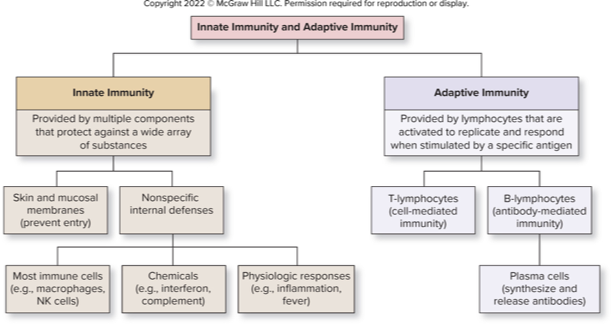
Two types of immunity differ based on
Cells involved
Specificity of cell response
Mechanisms of eliminating harmful substances
Amount of time for response
Although innate and adaptive immunities are distinct, they work together in body defense
Innate Immunity
Present at birth
Protect against variety of different substances (non-specific)
No prior exposure to substance necessary
Includes barriers of skin and mucosal membranes, non-specific cellular and molecular internal defenses
Respond immediately to potentially harmful agents

Characteristics of Innate Immunity
Prevents entry of potentially harmful substances
Responds nonspecifically to harmful substances
First line of defense is skin and mucosal membranes
Second line of defense involves internal processes
Activities of neutrophils, macrophages, dendritic cells, eosinophils, basophils, and NK cells
Chemicals such as interferon and complement
Physiological processes such as inflammation and fever
First line of defense
Skin: Physical barrier with antimicrobial secretions (epidermis and dermis)
Secretions from sweat glands and sebaceous glands (Dermicidin, lysozyme, sebum, defensins)
Mucous Membranes: Trap pathogens, produce mucus, and release antimicrobial substances (Defensins, lysozymes, IgA)
Respiratory tract contains cilia to help remove trapped microbes; the GI tract utilizes saliva and stomach acid to kill ingested microbes
Adaptive immunity
Acquired/specific immunity
Response to antigen involves specific T- and B-lymphocytes
A particular cell responds to one specific foreign substance but not another
Takes several days to be effective

Commensal microflora (normal microflora)
Microorganisms that reside on body surfaces (for example, skin, GI tract)
Nonpathogenic
Interfere with attachment of potentially pathogenic organisms
Second Line of Defense: Nonspecific Internal Defenses
Should pathogens pass the first line of defense, the second line of defense (nonspecific internal defenses) is initiated
Nonspecific internal defenses include
Selected immune cells
Antimicrobial proteins
Inflammation
Fever
Second line of defense
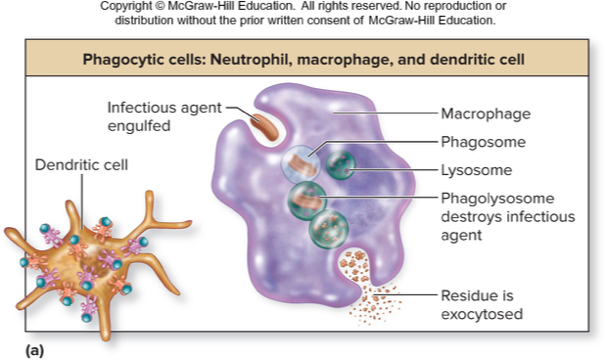
Phagocytic Cells: Neutrophils, macrophages, and dendritic cells engulf pathogens
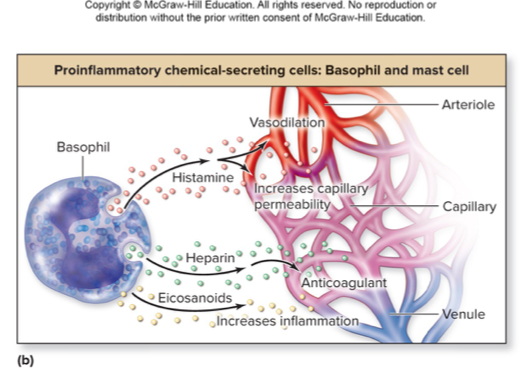
Proinflammatory Cells: Basophils and mast cells release histamine and heparin
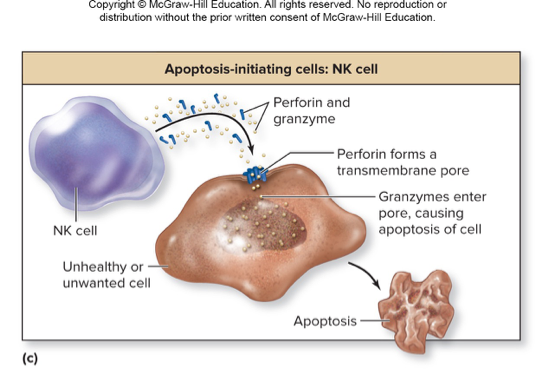
Apoptosis-Initiating Cells: NK cells destroy virus-infected and cancer cells
Parasite-Destroying Cells: Eosinophils release cytotoxins against parasites
Neutrophils and Macrophages (Nonspecific)
Destroy engulfed particles
Intake vesicles fuse with lysosomes, forming a phagolysosome
Digestive enzymes break down the unwanted substances
Respiratory burst produces reactive oxygen-containing molecules that help destroy the microbes
Degraded residue is released by exocytosis
Dendritic Cells (Nonspecific)
Destroy particles and then present fragments
Antigens are presented on dendritic cell surface T-lymphocytes
Necessary for initiating adaptive immunity
Macrophages can also perform antigen presentation

Basophils (Nonspecific)
Pro-inflammatory chemical-secreting cells; promote inflammation
Basophils circulate in the blood
Mast Cells (Nonspecific)
Reside in connective tissue, mucosa, internal organs
They release granules containing chemicals
Chemicals increase movement of fluid from blood to injured tissue
They serve as chemotaxis chemicals - they attract immune cells
Histamine increases vasodilation and capillary permeability
Heparin acts as an anticoagulant
Eicosanoids released from their plasma membrane also increase inflammation

Natural Killer (NK) Cells (Nonspecific)
Destroy unhealthy/unwanted cells
Formed in bone marrow, circulate in blood and accumulate in secondary lymphoid structures
Perform immune surveillance - patrols body, detect unhealthy cells
Destroy virus-infected cells, bacteria-infected cells, tumor cells, cells of transplanted tissue

NK Cells Cytotoxic Chemicals
They release cytotoxic chemicals to kill bacteria
Perforin creates a transmembrane pore in unwanted cell
Granzymes enter pore and cause apoptosis of cell
Apoptosis is cell death that cause shriveling rather than lysis
Eosinophils (Nonspecific)
Attack multicellular parasites
Degranulate, release enzymes and other toxic substances
Can release proteins that form transmembrane pores in parasite’s cells
Participate in immune responses of allergy and asthma
Engage in phagocytosis of antigen-antibody complexes
Cells of innate immune system recognize microbes as foreign because of receptors
Pattern recognition receptors (toll-like receptors) on cell surface bind to patterns on microbe surface

Antimicrobial Proteins
are molecules that function against microbes
Antimicrobial proteins: Interferons
Class of cytokines that prevent viral spread
IFN-α and IFN-β produced by leukocytes and virus-infected cells
Bind to neighboring cells and prevent their infection
Triggers synthesis of enzymes that destroys viral nucleic acids, and inhibit synthesis of viral proteins
Stimulate NK cells
IFN-g produce by T-lymphocytes and NK cells
Stimulates macrophages

Antimicrobial proteins: Complement System
Enhances inflammation, opsonization, cytolysis
Over 30 plasma proteins that work along with antibodies
Identified with letter “C” and number (example: C2)
Synthesized by liver, continuously released in inactive form
Activation occurs by enzyme cascade
Complement activation follows pathogen entry:
Classical and alternative pathway
Especially potent against bacterial infections
Complement System: Classical Pathway
Antibody attaches to foreign substance, then complement binds to antibody
Complement System: Alternative Pathway
Complement binds to polysaccharides of bacterial or fungal cell wall
Effects of activated Complement: Inflammation
Enhanced by complement
Activates mast cells and basophils
Attracts neutrophils and macrophages
Effects of activated Complement: Opsonization
Effects of activated Complement:
Effects of activated Complement: