Derm FINAL Exam: Yamaki Burns
 Call Kai
 Learn
Learn Practice Test
 Spaced Repetition
 Match
Match Flashcards
 Knowt Play
1/29

There's no tags or description
Looks like no tags are added yet.
Name | Mastery | Learn | Test | Matching | Spaced | Call with Kai | Chat |
|---|
No analytics yet
Send a link to your students to track their progress
30 Terms
_____-degree
Superficial-thickness burn
Injury to the superficial cells of the epidermis; does not form blisters, but it does become erythematous and mildly painful.
Heal within 3 to 7 days without scarring.
Example: Sunburn
1st
_____-Degree
Superficial partial-thickness, depending on the depth of dermal involvement.
Superficial second-degree burns involve the _____ and the _____.
Erythematous, blistered, weeping, painful and very sensitive to stimuli.
Heal spontaneously within 3 weeks with little scarring.
Deep second-degree burns
Involves the deeper elements of the dermis and may be difficult to distinguish from third-degree burns
Burn area is pale, feels indurated or boggy , and dose not blanch with pressure.
Less painful
Healing occurs slowly over the course of about 35 days with possible severe scarring and permanent loss of hair follicles and sweat and sebaceous gland
2nd, epidermis, upper layer of the dermis
_____-degree
Full thickness deep burn
Entail complete destruction of the _____ of the skin including all skin elements.
Appear pearly white, gray, or brown and is dry and inelastic.
Pain is only sensed when _____ is applied.
Healing over the course of several months and are repaired most often by _____ and _____ of the wound to prevent contractures of the skin.
3rd, full thickness, deep pressure, excision, grafting
_____-degree
Similar to third degree burns except that devitalized tissue extends into the subcutaneous tissue, fascia, and bone (full-thickness).
Appears blackened, dry, _____ because of destruction of nerve endings
Great risk of _____
4th, painless, infection
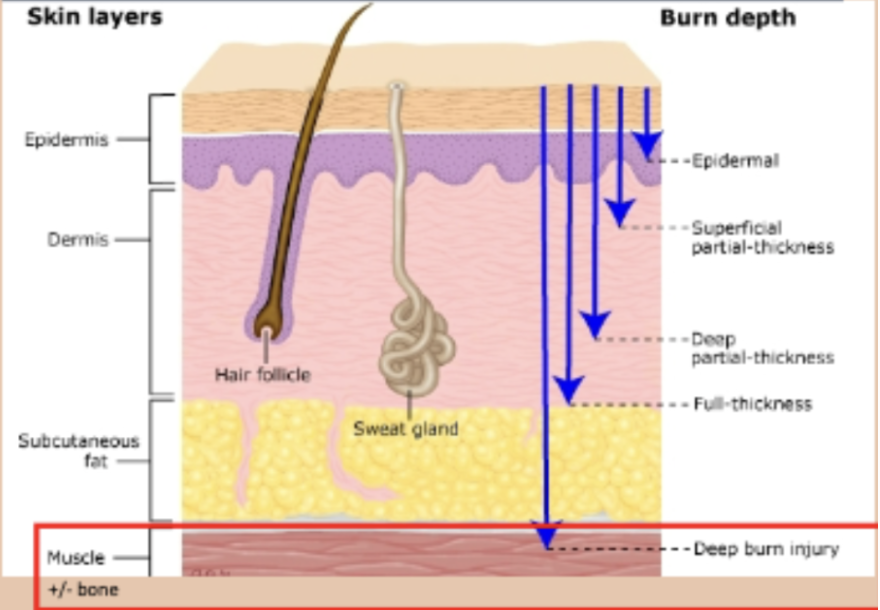
KNOW IMAGE
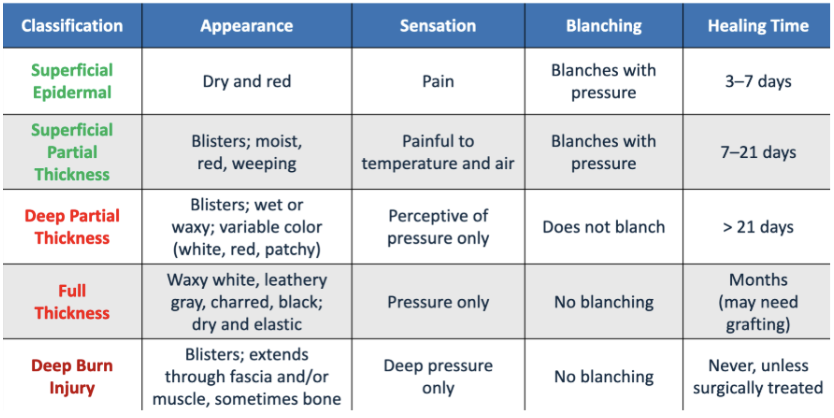
Superficial Epidermal Burn Characteristics
_____ appearance
Blanches with pressure
Sensation of pain
Healing time: 3-7 days
Superficial → was first degree
dry and red
Superficial Partial Thickness Burn Characteristics
_____, _____, _____
_____
_____ to temperature and air
moist, red, weeping, blanches with pressure, painful
Deep Partial Thickness Burn Characteristics
_____ or _____
_____
wet, waxy, does not blank with pressure
Full Thickness Burn Characteristics
_____
_____, _____, _____, _____
blisters, waxy white, leather gray, charred, black
_____ Injury
Blisters
Extends through fascia and/or muscle. Sometimes.
Bone even.
Deep pressure
Healing: never, unless surgical treated
Deep Burn
Pharm Rec → _____
Superficial Burns
Cooling of Burns
_____ or still water applied for no longer than _____ to avoid wound maceration
Wound may be covered with wet gauze or towels at room temperature for up to _____
Do NOT apply _____ or _____ directly on wound due to risk of increasing burn depth
cool running water, 5 mins, 30 mins, ice, iced water
Xeroform Dressing
_____, sterile, wound dressing
_____ properties
Non-adherent, occlusive
Adaptic Dressing
_____ dressing
Knitted cellulose acetate fabric
Impregnated with petrolatum emulsion
_____ properties
Non-adherent, occlusive
Mepitel Dressing
_____ and can be removed without harming new epithelial cells
does not adhere to moist wounds
Treatment of Superficial Burn Wounds
Maintain a _____ environment
_____ that assist with the healing process and promote re-epithelialization
Topical antimicrobial agents to consider _____ is present:
Combo antimicrobial agent: polysporin (Bacitracin and Polymyxin B)
_____: Xeroform, Adaptic, Mepitel
moist, covered with dressings, only if infection, non-adhesive dressings
Antibiotics for Burns
Microbial colonization _____ mean infection
Prophylaxis of infection _____
_____ antibiotic use for clinically _____ wounds
Cellulitis, malodor, gangrenous, purulence (pus)
Fever, chills, hypotension, leukocytosis, confusion
does not, not necessary, Reserve, infected
Antimicrobial Ointments
Polysporin® (OTC)
Bacitracin and polymyxin B
Mupirocin (Rx)
Bactroban®
_____ areas or suspicion of _____
MRSA infected, resistant infection
Silver containing agents: Silver Sulfadiazine
Development of _____ can occur and requires debridement
pseudoeschar
Chlorhexadine
_____ prevent _____ of wound
Does not, re-epithelialization
Povidone-Iodine
Efficacious but not first-line d/t _____ and _____ in re-epithelialization at wound site
Must be applied 4X/day and therefore requires several wound dressings (increased _____, decreased _____)
cytotoxicity, delay, pain, adhearence
Dakin’s Solution
Efficacy has been shown _____ for resistant bacterial infections such as MRSA and Vancomycin resistant Enterococcus. Consider only for resistant organisms
anecdotally
Honey
_____ relatively safe and inexpensive
Manuka honey
Management of Superficial Partial Thickness Burns
Maintain _____ environment
Appropriate _____
Consider antimicrobial agent if infection is suspected (difficult to fully assess extent of injury)
_____ if _____ organisms suspected
_____ if MRSA or suspicion of resistance or colonization with _____ organism
moist, dressings, Polysporin, no resistant, Mupirocin, resistant
Management of Full Thickness & Deep Burns
_____ of wound _____
Assists in healing process, removal of damaged tissue, assists in preventing infection
Debridement, necessary
Early Excision of Deep Burns
_____ prevents _____ of medication
Must _____ and _____ wound initially to get medication to _____
RCT and meta-analyses have demonstrated improved _____ and _____ with early eschar removal and debridement
Eschar, penetration, remove, debride, site of action, healing, decreased length of hospital stay
Management of Itching with Burns
1st-Line → _____ (1st Gen and 2nd Gen Agents)
_____ (If AHs fail)
Should only be used _____ occurs NOT on unhealed wounds
AHs, Topical Low Potency Glucocorticoids, after re-epithelialization
Non-pharmacological therapy for Pruritus Associated with Burns
_____
_____
AVOID products containing _____
This is for _____ healing has occurred or burns with skin intact
Aloe Vera, AHs, Lanolin, after
Case Vignette 1
KL is a 28-year old male who suffered a burn to his forearm after exposure to a heated oven at 450 degrees Fahrenheit. It has been several hours since the burn occurred, and he is in significant pain (7/10) which he describes as a deep sense of pressure. KL used ice cubes to cool the wound and following this he noticed immediate blister formation and swelling of the site of injury. How should his wound be managed?
Wound dressing? → YES
How to properly cool wounds? Pt used ice = worsens, rec → cool water for no more than 5 mins
Antibiotics? → NO, they just got the wound
Need for referral? → Only on forearm and only blistered when ice was added → NO
KNOW
Case Vignette 2
DR is a 54-year old female with a history of hypertension, diabetes, and plaque psoriasis that flares around her forearms, elbows, and hands. She currently uses hydrocortisone 2.5% cream on her elbows and hands every other day to control her psoriasis and also uses methotrexate to prevent severe flare ups.
While fixing a fuse in her home an electrical spark injured her hand and over the last 72 hours, she has noticed her hand has a white, red and patchy appearance. The injury appears waxy, is painful if any pressure is applied and seems to be of variable depth. She also noticed that a thick scab has developed that is warm to the touch, erythematous, and is raised with a purulent core.
She has been applying polysporin to the injury site to prevent infection as well as her hydrocortisone cream to alleviate pruritis. She has been wrapping it with dry gauze to keep it clean and covered.
Please develop a treatment plan while considering her current medical history, current medications and recent injury.
How would we classify her burn? → In between superficial partial and deep partial
How should her burn be initially managed?
Dressings? → Dressings is dry gauze (sticks to wound) and not wet/occlusive
Antibiotics? → YES bc it’s red, she has a fever, and wound has pus
How do her other medical conditions contribute to the management of her burn? → Methotrexate and hydrocortisone (immunosuppressants) → NEED REFERRAL (remove scab)
KNOW