9.11 Enzyme Regulation and Bioenergetics
 Call Kai
 Learn
Learn Practice Test
 Spaced Repetition
 Match
Match Flashcards
 Knowt Play
1/17

There's no tags or description
Looks like no tags are added yet.
Name | Mastery | Learn | Test | Matching | Spaced | Call with Kai | Chat |
|---|
No analytics yet
Send a link to your students to track their progress
18 Terms
Catabolic pathway
Enzymes in pathway that breaks down molecules and release energy
Anabolic pathway
Enzymes in pathway that can make complex biomolecules from small precursors
Metabolic pathways consists of ______ _________ _______, which is why _______ _____ are needed
Numerous interconnecting pathways; regulatory enzymes
Regulatory enzymes
Responds to certain signals and reduces/increases catalytic activity
How are unfavorable reactions driven forward in pathways
More favorable reactions within the pathway will help drive the unfavorable reaction forward
How are pathways regulated
Substrates or products of one step can interact with a pathway enzyme to affect activity (down/upregulated)
Which enzyme is often the regulatory enzyme
E1; the regulatory enzyme typically doesn’t follow Michaelis-Menten kinetics; often multi-subunit proteins
Modulation of regulatory enzymes
Allosteric enzymes: Reversible noncovalent binding of allosteric modulators or allosteric effectors
Reversible covalent modification
Binding of separate regulatory proteins
Removal of peptide segment by proteolytic cleavage
Positive vs negative regulators
Increases vs decreases activity
Homotrophic regulator enzymes
Substrate and modulators are identical
Heterotrophic regulator enzymes
Modulator is a molecule other than the substrate
Aspartate transcarbamoylase (ATCase)
Catalyzes the formation of carbamoyl aspartate, an early step in pyrimidine biosynthesis
Regulated via ATP concentration, High ATP = Activated (R-state), Low ATP/High CTP = Inactivated (T-state)
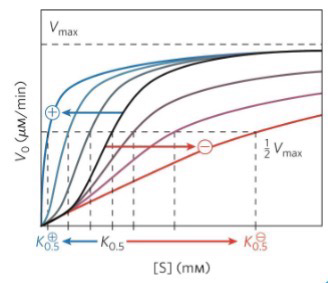
Typical activity of allosteric enzyme
Typically more S-shaped; Sigmoidal curve of a homotrophic enzyme; Activators makes curve more hyperbolic, inhibitors makes curve more sigmoidal
Reversible covalent modification
For example; protein (phosphorylase) kinases catalyzes the attachment of phosphoryl groups to Ser, Thr, Tyr, His; Phosphoprotein phosphatases/protein phosphatases will remove these groups
Zymogen
Inactive precursor that is cleaved to form active protease enzyme
Proprotein/proenzyme
Precursors that are cleaved to form other proteins
Regulatory cascade
Mechanism allows for greater sensitivity for a molecular signal and greater amplification of the resulting response
Example of regulatory cascade
Blood clot formation from exposure of collagen to blood