C7/8: Efficiency Externality
 Call Kai
 Learn
Learn Practice Test
 Spaced Repetition
 Match
Match Flashcards
 Knowt Play
1/15

There's no tags or description
Looks like no tags are added yet.
Name | Mastery | Learn | Test | Matching | Spaced | Call with Kai | Chat |
|---|
No analytics yet
Send a link to your students to track their progress
16 Terms
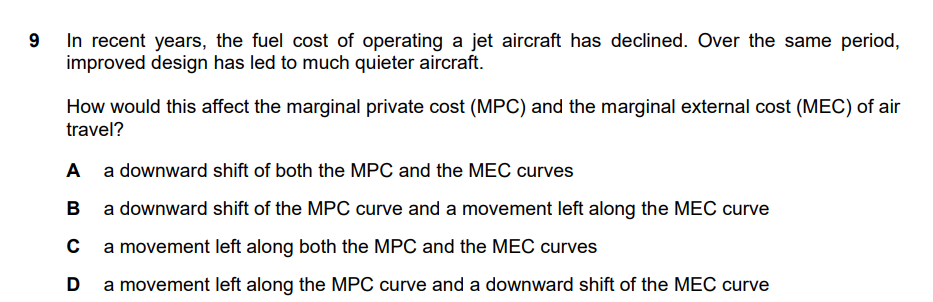
A.
*Just treat MEC curve as the same curve as MPC.
*Shift when it’s non price factor, movement when it’s price factor affect the qty.
Decrease in fuel cost, shift down the MPC, non price factor
Improved design, quieter aircraft, shift down the MEC, non price factor
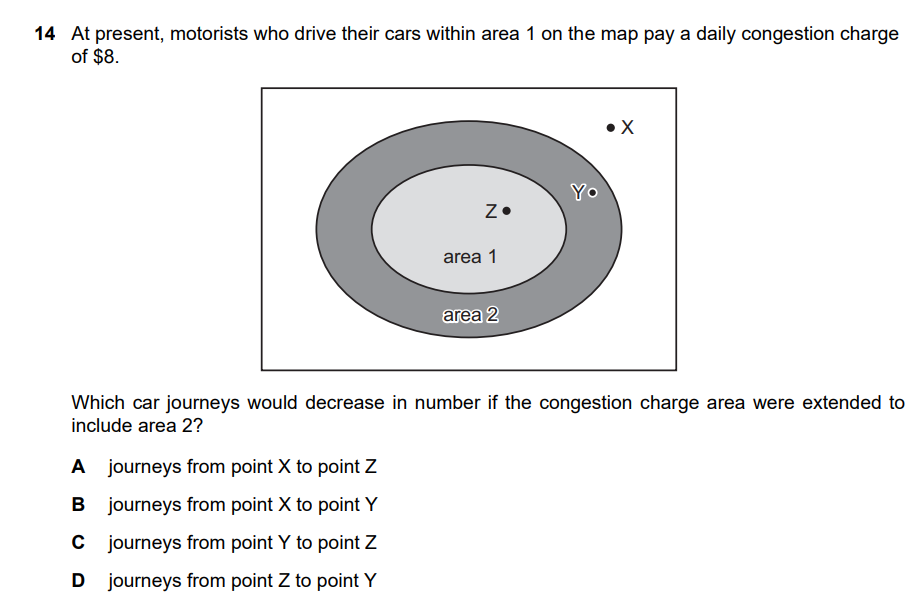
B
The question means that the area increase to area 2, if you are at area 2 you have to pay $8, when you go from Y to Z, just $8 charge
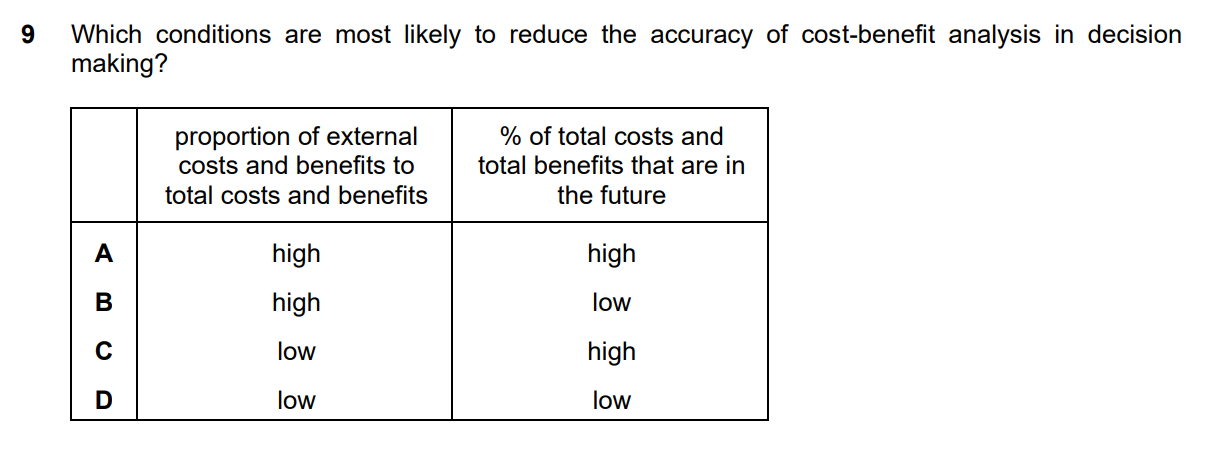
A
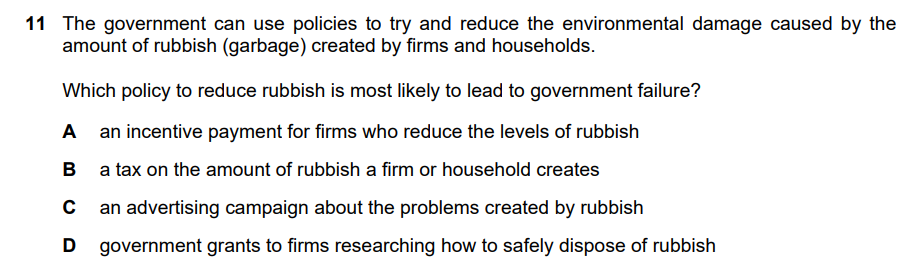
B
Firm will try to dispose the rubbish before it is tax.
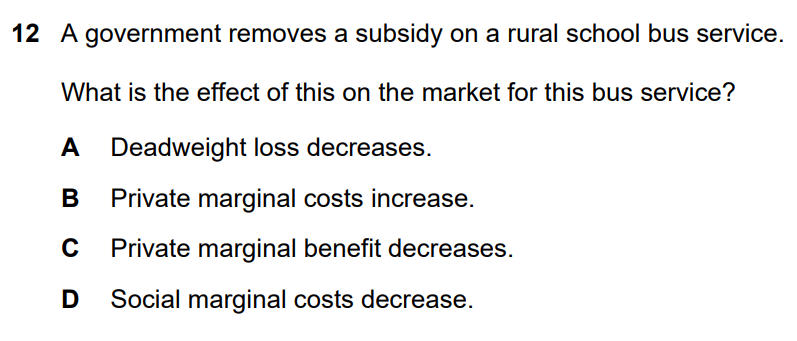
B
Remove subsidy means a increase in cost of production, private cost increase
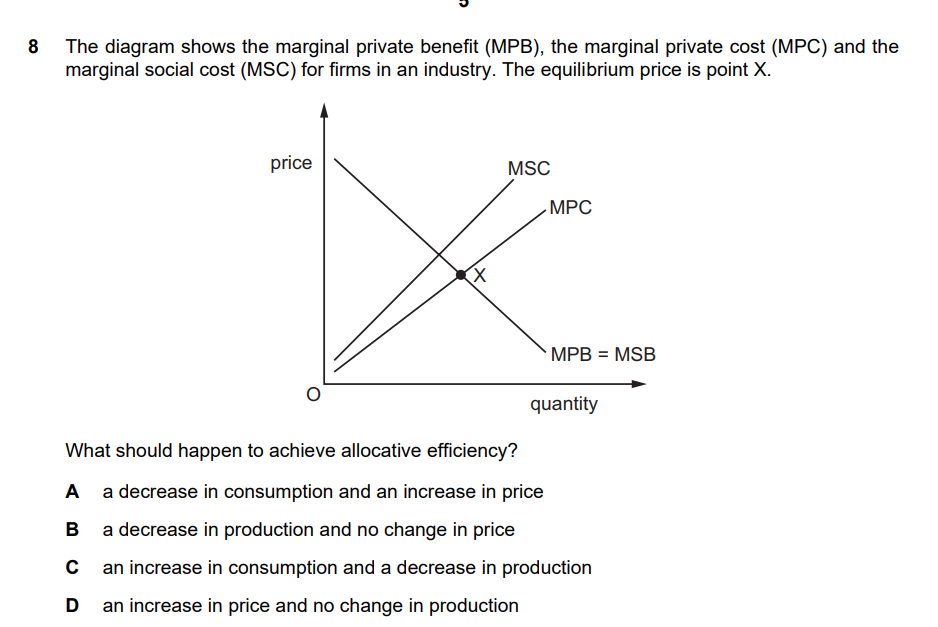
A
Allocative efficiency is achieved when MSB = MSC
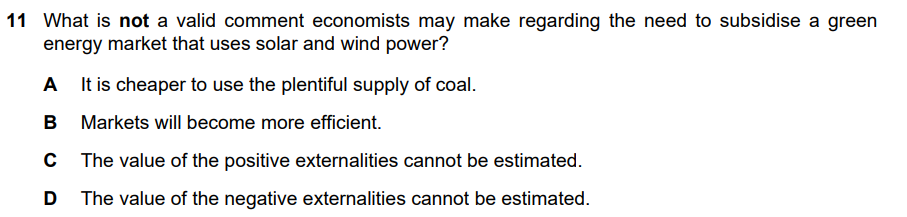
B
B. economist always look at both side, there’s limitation of subsidies, can’t guarantee say market become efficient.
D. Even tho ques is saying subsidies, but we always need to look at both side, positive and negative externality
James grow fruit trees in his garden. They attract butterflies and bees.
What is not an externality?
A. Neighbours may be stung by the bees that pollinate the trees.
B. Neighbours may buy food more cheaply from James than supermarket.
C. Neighbours may enjoy better air quality as tree grows.
D. Neighbours may like to watch the activity of wildlife at no cost.
B
B involves economic activity, which means neighbours are no longer third party anymore. So not externality.
In deciding whether to invest in a new project, what would be taken into account in government cost-benefit analysis but not a private company?
A. Consultation fees
B. Consumer surplus
C. Interest charges
D. Tax payments
B.
Consumer surplus is the extra benefit to consumer.
Government always want to maximise welfare of society, they consider cost to society and benefit to society, not the cost that incurred for them.
So government consider the consumer surplus”benefit” to consumer, while producer only profit motivated, will not consider this.
Which is not an example of externality?
A. The establishment of new firm in an area increases wage rate.
B. Flower planted gives pressure to the neighbours.
C. The immunisation of children against smallpox reduces danger of infection to others.
D. Installation of security cameras results in an increase in thefts elsewhere.
A. It involves economic activity.
When can economy said to be economically inefficient?
A. when it is possible to make some people better off without making other people worse off.
B. When distribution of income is socially unacceptable.
C. When the government sector is growing at the expense of private sector.
D. When wage rate rise faster than production.
A. This is the point inside PPC. Pareto optimality is not achieved.
What does not pose a threat to achievement of allocative efficiency?
A. imperfect information on the part of consumer.
B. income inequality.
C. The existance of externality
D. Presence of monopoly.
B
Allocative efficiency occurs when resources are distributed in a way that maximizes total societal satisfaction based on current market demand.
In economics, "demand" is defined as the willingness and ability to pay.
If income inequality is high, rich people have more votes (dollars) in the market, meaning resources will be allocated toward luxury goods rather than basic necessities for the poor.
While this outcome might be unfair or inequitable, it can still be perfectly allocatively efficient in an economic sense, because the market is perfectly matching the existing demand.
Efficiency vs. Equity: Allocative efficiency is about maximizing the size of the economic pie based on prices; it does not care how fairly that pie is sliced.
A.
*Just treat MEC curve as the same curve as MPC.
*Shift when it’s non price factor, movement when it’s price factor affect the qty.
Decrease in fuel cost, shift down the MPC, non price factor
Improved design, quieter aircraft, shift down the MEC, non price factor
B
The question means that the area increase to area 2, if you are at area 2 you have to pay $8, when you go from Y to Z, just $8 charge
A

C.
The question says “movement towards Pareto Optimality“
So still not yet achieve pareto optimality, it possible to make someone better off w/o making someone else worse off