Chem Chp 2
 Call Kai
 Learn
Learn Practice Test
 Spaced Repetition
 Match
Match Flashcards
 Knowt Play
1/23

There's no tags or description
Looks like no tags are added yet.
Name | Mastery | Learn | Test | Matching | Spaced | Call with Kai | Chat |
|---|
No analytics yet
Send a link to your students to track their progress
24 Terms
What is wavelength?
The distance between two consecutive peaks or troughs in a wave

What is frequency?
The number of successive wavelengths that pass a given point in a unit time

What is amplitude?
One half the distance between two peaks and troughs

Rank these from lowest to highest energy: Microwave, Ultraviolet, Infrared, Gamma Ray, Radio, X-Ray, Visible
Radio, Microwave, Infrared, Visible, Ultraviolet, X-ray Gamma ray
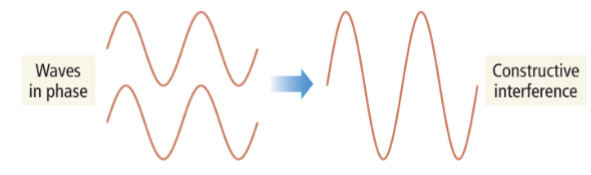
What is constructive interference?
When two waves in phase meet and combine, adding their amplitudes
What is destructive interference?
When two waves out of phase meet and cancel each other out, making the wave smaller or flat

Wave diffraction vs particle behavior passing through a narrow slit?
Waves diffract (bend and spread out)
Particles travel straight through in a narrow beam.

In a double-slit experiment, what causes a bright spot?
Constructive interference occurs. Waves arrive in phase and path lengths are equal or differ by integer wavelengths (∆L=mλ)
In a double-slit experiment, what causes a dark spot?
Destructive interference occurs. Waves arrive out of phase and path lengths differ by half a wavelength (∆L=λ/2) or (∆L=m+1/2)
When light passes through two narrow slits, what is observed on a screen and why?
An interference pattern of alternating bright and dark bands because the diffracted waves overlap and interfere both constructively and destructively
What is the photoelectric effect?
The release of electrons from a metal surface when light shines on it.
What is threshold frequency? (v0)
The minimum frequency of light needed to knock electrons off a metal surface
What is work function? (Φ)
The minimum energy a photon must have to eject an electron. (in J or eV)
Each emission line on a line spectrum represents what?
A single wavelength of light
What does the light emitted by a gas consist of?
A set of discrete energies
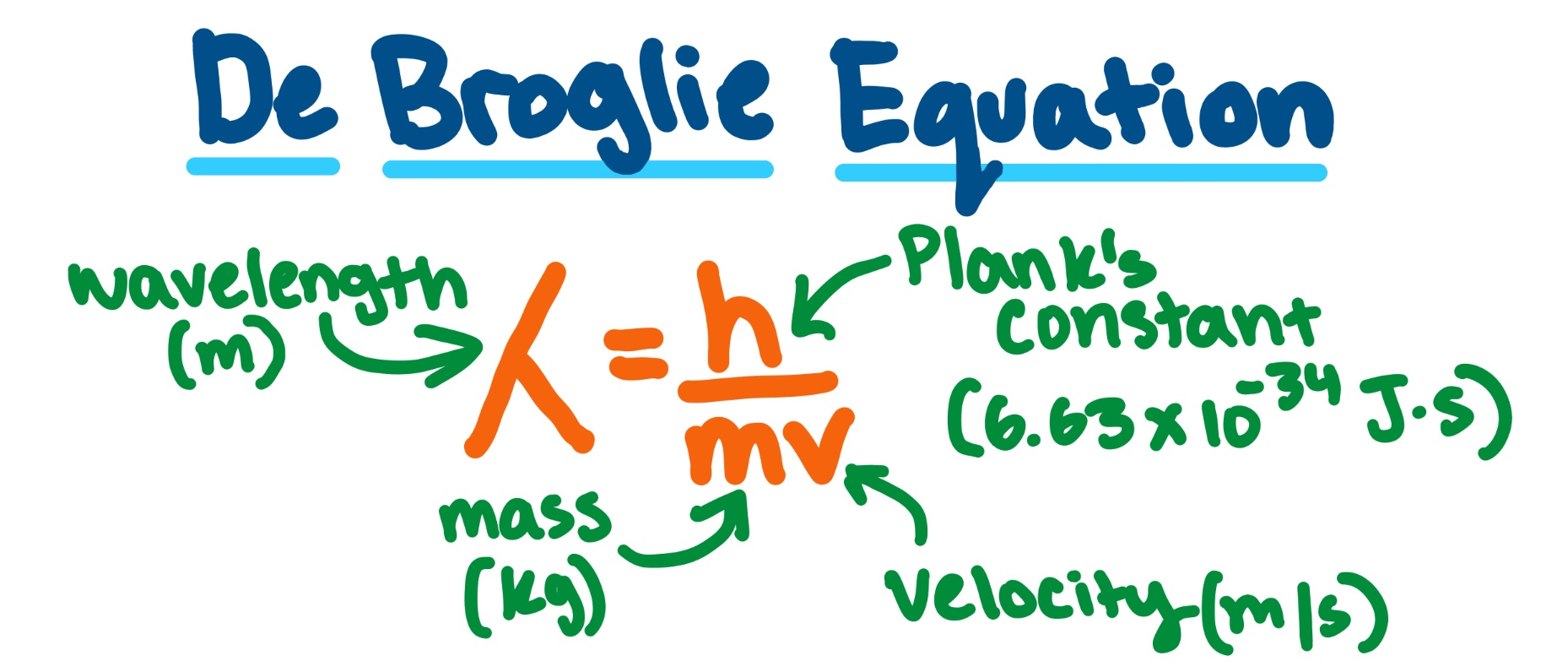
What is the de Broglie equation?
What is Shrodinger’s equation?

What type of equation does electrons’ motion follow?
Probability distribution
What is the Heisenberg Uncertainty Principle?
It is impossible to determine simultaneously and exactly both the momentum and position of a particle
What does the quantum number n stand for ?
Principal quantum number, electron shell, location of energy level
What does the quantum number l stand for?
n-1. Orbital angular momentum, shape of the subshell
What does the quantum number ml stand for?
Magnetic quantum number, 3D orientation in space
What does the quantum number ms stand for?
Spin of the electron up or down
What is a radial node? How can you find it?
The distance (radius) from the nucleus where the probability density of finding an electron located in a particular orbital is zero.
The value of the wavefunction is zero at this distance for this orbital
n- l - 1