biol& 160 ch 5
 Call Kai
 Learn
Learn Practice Test
 Spaced Repetition
 Match
Match Flashcards
 Knowt Play
1/32

There's no tags or description
Looks like no tags are added yet.
Name | Mastery | Learn | Test | Matching | Spaced | Call with Kai | Chat |
|---|
No analytics yet
Send a link to your students to track their progress
33 Terms
describe the makeup of the cell membrane
a phospholipid bilayer with hydrophilic heads facing outward and hydrophobic tails facing inward. Contains proteins, cholesterol, and carbohydrates
what molecules are permeable to the cell membrane? why?
small, nonpolar molecules (O₂, CO₂) because they can pass through the hydrophobic membrane
how do impermeable molecules cross the membrane?
through transport proteins (channels/carriers) or vesicles (endocytosis/exocytosis)
simple diffusion vs. facilitated diffusion
simple: no protein, high → low concentration
facilitated: uses a transport protein, high → low concentration
carrier proteins vs. channel proteins
carrier: changes shape to move molecules
channel: forms a tunnel for molecules or ions
diffusion vs. osmosis
diffusion: Movement of solutes from high → low concentration
osmosis: Movement of water across a membrane from low solute → high solute concentration
plant vs. animal cells in different solutions
Hypotonic: animal cells swell/burst; plant cells become turgid
Hypertonic: animal cells shrink; plant cells plasmolyze
Isotonic: animal cells stay normal; plant cells become flaccid
active vs. passive transport
active: requires ATP, moves low → high concentration
passive: no ATP, moves high → low concentration
primary vs. secondary active transport
primary: uses ATP directly
secondary: uses energy from another molecule's gradient
exocytosis vs. endocytosis
exocytosis: moves materials out of the cell
endocytosis: moves materials into the cell
What is ATP and how is it used for energy?
ATP stores energy. Hydrolysis breaks ATP into ADP + Pi and releases energy. Dehydration joins ADP + Pi to make ATP
Exergonic vs. endergonic reactions
Exergonic: Releases energy
Endergonic: Requires energy
Why doesn't glucose break down without enzymes?
The reaction has a high activation energy. Enzymes lower the activation energy
What are enzymes?
Proteins that speed up chemical reactions by lowering activation energy without being used up
Cofactors vs. coenzymes
Cofactor: Inorganic helper (example: Zn²⁺ or Mg²⁺).
Coenzyme: Organic helper (example: NAD⁺ or vitamin B-derived molecules)
Feedback inhibition
The final product stops an earlier enzyme to prevent making too much product
Competitive vs. noncompetitive inhibition
Competitive: Inhibitor blocks the active site
Noncompetitive: Inhibitor binds elsewhere and changes the enzyme's shape
Why is noncompetitive inhibition called allosteric inhibition?
Because the inhibitor binds to the allosteric site, not the active site
What is enzyme denaturation? What causes it?
Denaturation changes an enzyme's shape so it no longer works. Causes include high temperature, extreme pH, and some chemicals
solvent
the substance that dissolves the solute (usually water)
solution
a homogeneous mixture of a solvent and one or more solutes
describe tonicity
a measure of the osmotic gradient of two solutions separated by a semipermeable membrane. it’s the tendency of a cell to lose or gain water in solution
explain the types of osmotic concentrations
isotonic: when 2 solutions have the same osmotic concentrations
hypertonic: the solution with the higher solute concentration (shriveled cell, no water)
hypotonic: the solution with the lower solute concentration (bursting cell/lyse, too much water)
law of thermodynamics
energy can be changed from one form to another but cannot be created or destroyed. some energy lost as heat
why do reactions need activation energy?
all chemical reactions cannot occur without overcoming their activation energy. energy input is required to initiate the reaction
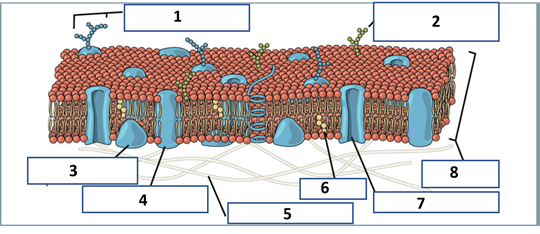
label this cell membrane
glycoprotein
glycolipid
peripheral membrane protein
integral membrane protein
cytoskeleton
cholesterol
protein channel
phospholipid bilayer
The cell membrane is considered a fluid because
The molecules are separate but loosely attached and can therefore float or move somewhat with respect to one another
What factors need to be in place for osmosis to occur?
a semipermeable membrane, different concentrations of water and solute on both sides of the membrane
match the state of a plant cell with this extracellular solution:
hypotonic
hypertonic
isotonic
turgid
plasmolyzed
flaccid
match the state of a animal cell with this extracellular solution:
hypotonic
hypertonic
isotonic
lyse
shrink/shrivel
normal
Why do plant and animal cells behave differently in hypotonic solutions?
Plants have a cell wall, and animal cells don't
Bulk transport mechanisms involve the movement of vesicles in the transport of materials across the cell membrane. This includes which of the following transport mechanisms?
exocytosis + endocytosis
Where is energy stored in an ATP molecule that is released during hydrolysis?
In the bonds formed between phosphates