Quiz 2 - Biology (Chemical bonds.. Chapter 4)
 Call Kai
 Learn
Learn Practice Test
 Spaced Repetition
 Match
Match Flashcards
 Knowt Play
1/55

Earn XP
Description and Tags
ionic vs covalent bonds, hydrogen bonds, electronegativity, electron, chemical reactions
Name | Mastery | Learn | Test | Matching | Spaced | Call with Kai | Chat |
|---|
No analytics yet
Send a link to your students to track their progress
56 Terms
Recall… what’s the mass number of a lithium atom with 3 protons and 4 neutrons?
7
recall… what is true about all anions?
atom has more electrons than protons
recall.. why would an atom have no electric charge?
protons = electrons
What does the electron distribution diagram look like?
Nucleus + valence shells and the electrons
What does potential energy mean?
the energy that matter possesses because of its location or
structure, due to their distance from the nucleus
***electrons have it
what are electron shells
different “rings” (not acc in rings) that electrons go to
they have varying average distance (from the nucleus) and potential energy level
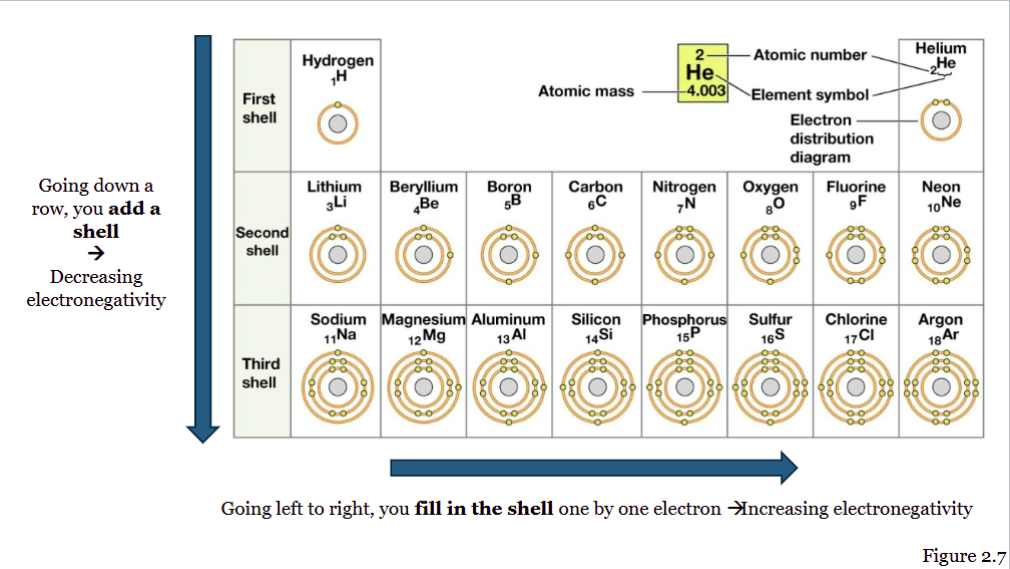
What does the period ic portray?
the electron distribution of each element
What happens to electron # going from left to right a periodic table?
add one
What happens to electron SHELL # going from up to down a periodic table?
add one
going to the right on a periodic table = add an electron = add one more electron to the shell
What are Valence Electrons?
electrons on the outermost shells
What are valence shells?
the outermost shells
The chemical behavior of an atom is mostly determined by…
*# of valence electrons
Full shell = no need for more valence electrons = inert/chill atom
Not full shell = needs valence electrons = UNSTABLE wants more/less to have a full valence
How many electrons can the 1st shell have?
2 electrons
How many electrons can the 2nd shell (and up) have?
8 electrons
What is the UN-simplified way of electron shells
orbitals
2 electrons per orbital

What is an orbital?
the 3 dimensional space where a electron is 90% in


How many electrons does fluorine have? How many electron shells? How many electrons are needed to complete the valence shell?
has = 9
shells # = 2
needs how many electrons to complete valence shell = 1
only ___ are directly involved in chemical reations
electrons
**Atoms with incomplete valence shells can share or transfer valence electrons with certain other atoms
what are chemical bonds?
the result of atoms interacting and staying close to each other
**hold attractions
what are the different types of chemical bonds? (2 main)
ionic and covalent
Ionic bonds do what with electrons and make the atoms into what?
atoms in ionic bonds YOINK electrons from each other
thievery :3
makes atoms into ions
Cation (pos)
anion (neg)
Compounds formed by ionic bonds are called what?
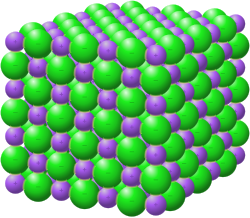
ionic compounds OR SALTS/CRYSTALS
ex: NaCl (sodium Chloride) = table salt
** salts = stable when dry but can dissociate/break easy when with water
The formula for an ionic compound indicates the ____ of ___ in a crystal of the salt
ratio : elements
covalent bonds
share the valence electrons - with 2 atoms
** the shared electron = part of each atom’s valence shell
what is a molecule
atoms held together by a COVALENT BOND
single bond vs doubles bond vs triple bond
amount of electron pairs that are shared
what is a structural formula?
the notation to represent atoms and bonding
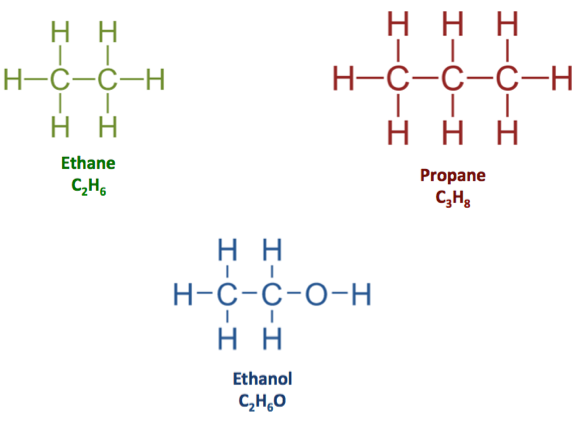
An example of the molecular formula
Abreviated form of structural formula
EX: H-H equals ….. H₂
What diagram displays Electron sharing with dots that represent valence electrons
the Lewis Dot Structure

What is an atom’s bonding capacity called?
VALENCE
Each atom that can share ___ ____ has a ___ ___ corresponding to the number of ____ ___ the atom can form
valence electrons : bonding capacity : covalent bonds
molecule vs compound
molecule - same element OR different
USUALLY FOR COVALENT BONDED atoms
Compound - two or more just DIFFERENT elements
** All compounds are molecules, but not all molecules are compounds
The Possible Number of __ __ Depends on
the Number of Missing __ __
Covalent bonds : Valence electrons
What is electronegativity?
an atom’s attraction for electrons in a covalent bond
more electronegative an atom = stronger pull on shared electrons towards itself
***atoms in a molecule attract electrons in varying degrees
Electronegativity increases in what direction in the periodic table
Down to up - less shells = electrons are less far from the nucleus
Left to right = more electrons are added - atomic radius decreases
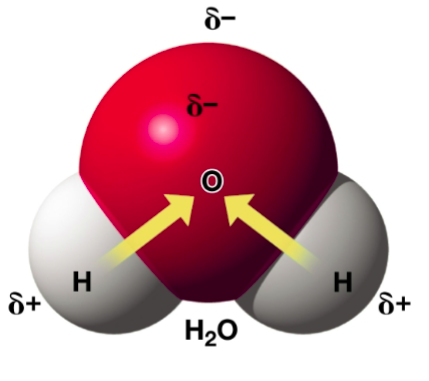
non polar vs polar covalent bonds
NON - electrons shared equally
POLAR - electrons not shared equally + one atom is more electronegative → causes a partial positive or negative charge for each atom or molecule
EX: H20
usually the strongest bonds are …
covalent bonds - helps form cell’s molecules
weak bond/”interaction” contribute greatly to what?
the emergent properties of life
reversable → 2 molecules affect each other briefly and then separate
** many larged biological molecules are held int heir functional form by these week interactions (… carbs and lipids??)
Example of a weak bonds/interaction
hydrogen bonds
What are Hydrogen Bonds?
when hydrogen atoms are covalently bonded to a electronegative atom AND is also attracted to another electronegative atom
Basically a guy is in a healthy relationship but decides to “eye” up another girl
in living cells .. it’s usually oxygen or nitrogen
What are Van der Waals interactions?
Dipole - creates a negative side and a pos side… and influences another molecule to do the same
they turn until on pos side and one neg side get attracted to each other
like a bipolar girl… transforming her friend into a bipolar guy and then getting attracted to each other getting attracted to each other
attractions between molecules that are close together as a result of molecule with electrons that weren’t evenly distributed
accumulated in 1 side

Molecular size and shape are key to its ______
function
Shape - if complimentary, 2 molecules can bind temporarily
Ex: Opiates (morphine/ natural endorphins) have similar shapes, receptors, and effects/functions
molecular shape is determined by __________
its atom orbital positions
what happens when atom forms covalent bonds?
the orbitals in its valence shells get rearrange
What shape does a orbital shape look like when both s and p orbitals are filled?
four new hybrid orbitals shaped like identical teardrops extending from the atomic nucleus (like one of Ms. veronica’s balloon structures before its added to the big rainbow)
Molecules like methane (CH4) … has what shape?
TETRAHEDRON
share all four of their hybrid orbitals with another atom

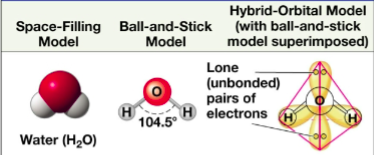
Molecules like water has what shape?
a “V” - 2 covalent bonds at an angle of 104.5 degrees
H20 = lone pairs of electrons on the oxygen atom occupies 2 of the hybrid orbitals
Chemical reactions… ___ or ___ bonds
make : break
results in composition of matter to change
Parts of a chemical reaction
reactants - starting molecules (on the left side)
products - resulting molecules (on the right side)
Coefficients - number of molecules (not elements)

What is another way of saying “Matter is conserved in a chemical reaction“
Reactions cannot create or destroy atoms but can only rearrange (redistribute) them
All atoms of the reactants must be accounted for in the products
All chemical reactions are theoretically….
reversable : two opposite headed arrows indicate a reaction is reversable

The concentration of the ____ impacts the rate of ____ ___
reactants : chemical reactions
**higher concentration = more frequently do the molecules collide with each other → more chance to react and form products
How is chemical equilibrium reached?
when the forward and reverse reactions happen simultaneously
the concentrations of reactants and products don’t change
Check understanding : The reactivity of an atom arises from…
(A) the average distance of the outermost electron shell from the nucleus.
(B) the existence of unpaired electrons in the valence shell.
(C) the sum of the potential energies of all the electron shells.
(D) the potential energy of the valence shell.
B → the existence of unpaired electrons in the valence shell
full = not reactive
not full = reactive
they want to take/remove electrons to become stable :)))
Not a → it’s for electronegativity (how strong an attraction is has) not how reactive it is → EX: noble gases (great distance from nucleus BUT not reactive.. cause it’s full)
not c → the total sum of the potential energies across all electron shells dictates the overall electronic structural stability of the atom, rather than its specific inclination to participate in external chemical interactions
not d - while the potential energy of a valence shell is a distinct property based on its distance from the nucleus, static potential energy alone does not force an atom to react. A full valence shell still contains high potential energy but results in an inert, non-reactive element
Check understanding :
An atom of oxygen has an atomic number of 8. How
many electrons are in the first, second, and third
electron shells, respectively?
(A) 2, 3, 3
(B) 2, 6, 0
(C) 8, 0, 0
(D) 0, 4, 4
(E) none of the above
B → 1st shell only carries 2 , the rest carry 8! (in other words its valence shell is not full… it’s reactive)
Check understanding:
Which of the following statements correctly describes
any chemical reaction that has reached equilibrium?
(A) The concentrations of products and reactants are equal.
(B) The reaction is now irreversible.
(C) Both forward and reverse reactions have halted.
(D) The rates of the forward and reverse reactions are equal.
D!
NOT A → just because they are in equilibrium doesn’t mean their CONCENTRATION (how much per stuff) is the same
their concentration is CONSTANT/unchanged, but not equal (in #)
Ex: more products are made than reactants provided (vise versa)