Science Olympiad Designer Genes 26
 Call Kai
 Learn
Learn Practice Test
 Spaced Repetition
 Match
Match Flashcards
 Knowt Play
1/27

Earn XP
Description and Tags
Vocab from Science Olympiad's event Designer Genes. Made for school year 25-26.
Name | Mastery | Learn | Test | Matching | Spaced | Call with Kai |
|---|
No analytics yet
Send a link to your students to track their progress
28 Terms
Purine
Thes have a two-ringed structure consisting of a nine-membered molecule with four nitrogen atoms. Ex. adenine + guanine
Pyrimidine
These have one single ring, which has just six members and two nitrogen atoms.
Ex. cytosine, thymine, uracil
Law of Segregation
The two alleles for each gene separate during gamete (sperm/egg) formation, so each gamete receives only one allele. This aligns with meiosis, where homologous chromosomes (carrying the alleles) split.
In other words: Organisms have 2 forms of a gene (each is an allele) that separate such that each resultant gamete has only 1 of the alleles. This happens in Anaphase I.
Law of Independent Assortment
Alleles for different genes (on different chromosomes) are distributed to gametes independently of one another. The inheritance of seed shape is separate from the inheritance of seed color. This holds true unless genes are physically linked on the same chromosome.
Epistasis
A circumstance where the expression of one gene is modified (e.g., masked, inhibited or suppressed) by the expression of one or more other genes.
Haploid
These cells contain a single set of chromosomes (n).
Diploid
These cells contain two sets, one from each parent (2n).
Tetrad
This is a structure formed during Prophase I, consisting of four chromatids (two homologous chromosomes paired together) that undergo synapsis and crossing over. This paired structure is crucial for genetic recombination and ensures proper chromosome separation into four genetically unique haploid gametes
DNA vs RNA
DNA is double stranded, RNA single stranded
DNA has deoxyribose sugar and RNA has ribose
DNA has thymine and RNA has uracil
Introns
These are non-coding segments of DNA within genes that are transcribed into pre-mRNA but removed during RNA splicing, leaving only protein-coding exons. They enable alternative splicing to generate protein diversity, regulate gene expression, and are found in eukaryotic genomes.
Exons
These are the protein-coding sequences of a gene that remain in mature mRNA after splicing, acting as the "expressed" regions used to create proteins. They represent specific, functional genetic instructions (e.g., coding for amino acids in actin or myosin)
Transcription
This is the first step of gene expression where a specific DNA sequence is copied into a complementary RNA molecule (mRNA) by the enzyme RNA polymerase. Its purpose is to transfer genetic information from DNA to the cytoplasm for protein synthesis. The three main steps are initiation, elongation, and termination, creating a portable RNA copy.
Translation
This is the biological process where ribosomes in the cytoplasm or rough ER synthesize proteins by decoding messenger RNA (mRNA) sequences into amino acid chains (polypeptides). It is the second step of gene expression, converting the mRNA genetic code into functional proteins using transfer RNA (tRNA) to add specific amino acids.
Transfer RNA
This translates genetic information from mRNA into proteins by delivering specific amino acids to the ribosome.
Ribosomal RNA
This is a major component of ribosome which allows mRNA and tRNA to connect so amino acids can connect.
Messenger RNA
Carries blueprint into the cytoplasm and serves as the template for protein synthesis
AUG
The codon for amino acid Methionine, a start codon.
Codon
This is a sequence of three consecutive nucleotides on mRNA that encodes a specific amino acid or signals the start/stop of protein synthesis.
Prokaryotic DNA Replication
This is a fast, simple process occurring in the cytoplasm with one origin. These organisms have small, circular, naked DNA.
Eukaryotic DNA Replication
This is a slower and more complex process that occurs in the nucleus with multiple origins during the S-Phase. It uses large, linear DNA wrapped around histone proteins.
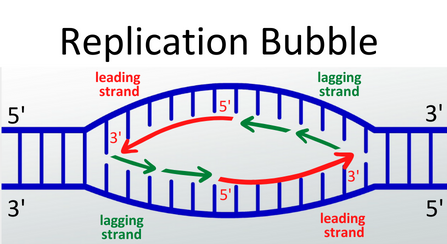
Leading Strand
This is produced continuously (5’ to 3’) towards the replication fork.
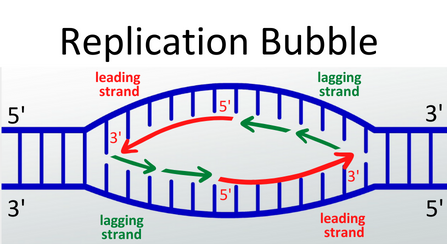
Lagging Strand
This is produced discontinuously (5' to 3') away from the fork in short Okazaki fragments.
Helicase
Enzyme in the DNA replication process that separates the two strands of DNA. They use energy from ATP hydrolysis.
Primase
These are an essential enzyme in DNA replication that synthesizes short RNA primers (typically 5–15 nucleotides long) on single-stranded DNA templates.
DNA Polymerase
This synthesizes new DNA molecules by adding nucleotides—the building blocks of DNA—to a growing strand during replication. It works by reading existing template strands and ensuring accurate pairing (A-T, C-G) to create two identical DNA copies from one, while also providing proofreading to correct mistakes
DNA ligase
This repairs and connects DNA strands by catalyzing the formation of phosphodiester bonds between adjacent 3′-hydroxyl and 5′-phosphate ends. It acts as a "molecular glue" to seal nicks in the backbone, crucial for DNA replication (joining Okazaki fragments), repair, and genetic recombination.

