France: Notable Policies and Documents
 Call Kai
 Learn
Learn Practice Test
 Spaced Repetition
 Match
Match Flashcards
 Knowt Play
1/11

There's no tags or description
Looks like no tags are added yet.
Name | Mastery | Learn | Test | Matching | Spaced | Call with Kai | Chat |
|---|
No analytics yet
Send a link to your students to track their progress
12 Terms
1438 - Pragmatic Sanction of Bourges (All Facts)
Promulgated by King Charles VII of France,
it limited papal authority over French bishops and gave the king a say in the appointment of prelates
1532 - Edict of Union (All Facts)
Incorporated Brittany into France
1539 - Ordinance of Villers-Cotterêts (All Facts)
Decree issued by King Francis, it
ordered all legal decisions and documents to be drawn up thereafter in French, not Latin
instructed all priests to keep a record of all baptisms and deaths in France
ended paralyzing strikes of the printing industry in Paris and Lyons
1561 - Edict of July / First Edict of St. Germain (All Facts)
Decree issued by Catherine de Medici, it
gave Huguenots qualified toleration
was passed as a result of the Colloquy of Peace talks organized by Catherine de Medici
1562 - Edict of January / Edict of St. Germain (All Facts)
Decree issued by Catherine de Medici, it
gave Huguenots qualified toleration
obligated Huguenots to practice their religion outside town walls
French (Catholic) Parliament refused to recognize or register the edict, which precipitated the French Wars of Religion
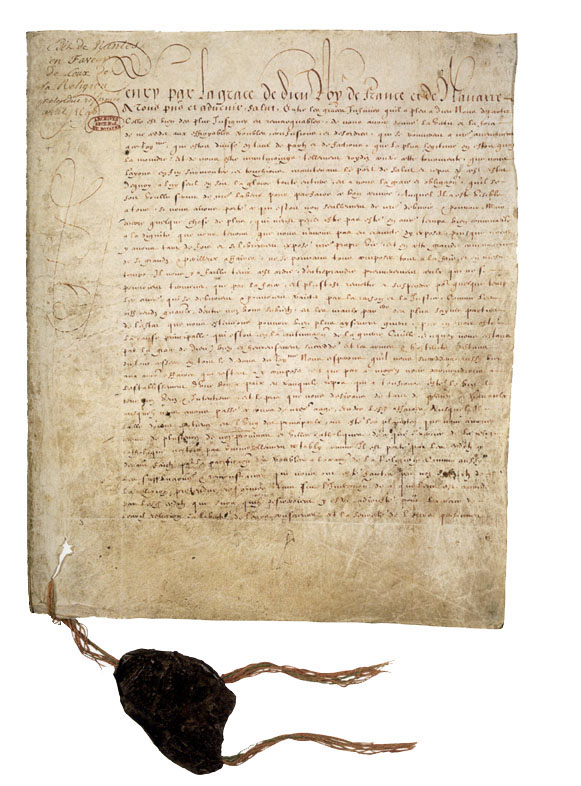
1598 - Edict of Nantes (All Facts)
Decree issued by King Henry IV,
it
granted Huguenots and other Protestants (a large measure of) religious freedom (freedom of conscience) throughout the kingdom of France
restored old places of worship for Huguenots and other Protestants
granted Huguenots and other Protestants permission to build new places of worship
provided Huguenots and other Protestants with civic rights equal to their Catholic counterparts
allowed Huguenots and other Protestants access to all public posts
granted full amnesty to all those who fought in and during the French Wars of Religion
assigned 100 towns to Huguenots and other Protestants as “towns of refuge”
was passed in order to promote “union, concord, and tranquility” between French Roman Catholics and Huguenots and other French Protestants
was considered “perpetual and irrevocable”
it
was not received well by Catholics, but they were willing to accept its terms in return for peace due to their war-weariness from the past century
was received well by Huguenots, who returned their support for King Henry IV after he had betrayed them upon his conversion to Catholicism and his declaration that “Paris is worth a mass”
1604 - Edict of Paulette (All Facts)
Decree issued by King Henry IV, it
established a tax on the hereditary holding of offices
thus institutionalized the sale of government offices
1617 - Edict of 1617 (All Facts)
Decree issued by King Louis XIII, it
made the province of Bearn become a part of the kingdom of France
reinstated Catholicism across France, allowing for the military to be used to force Protestants to hand back former ecclesiastical property that had been secularized half a century prior
1626 - Edict of 1626 (All Facts)
Decree issued by Cardinal Richelieu, it
ordered the destruction of all fortified castles throughout the kingdom of France
forbade dueling throughout the kingdom of France
brought the nobles to heel, preventing them from rebelling any further
consolidated King Louis XIII and Richelieu’s royal power
1628 - Royal Decree of 1628 (All Facts)
Decree issued by King Louis XIII / Cardinal Richelieu, it
barred Huguenots from settling in New France
sent Huguenots to English colonies instead
1629 - Michau Code (All Facts)
Series of internal reforms for France drawn up by Michel de Marillac