astro 355: exam 1 topics
 Call Kai
 Learn
Learn Practice Test
 Spaced Repetition
 Match
Match Flashcards
 Knowt Play
1/41

Earn XP
Description and Tags
stuff from lecture and notes over the course of beginning of semester to first exam
Name | Mastery | Learn | Test | Matching | Spaced | Call with Kai | Chat |
|---|
No analytics yet
Send a link to your students to track their progress
42 Terms
definition of light
electromagnetic wave, consisting of oscillations in the electric and magnetic fields. These oscillations are caused by accelerating charges. Light speed is related to wavelength and frequency.
explain how light as a particle (photon) behaves via the photoelectric effect
The photoelectric effect experiment showed that electrons are held onto 5metal with a certain binding energy. No matter how much light (i.e., brightness) shines on metals, electrons are only released if the light’s wavelength corresponds to Erad = hc/λ > Ebinding. This can only happen if light is quantized into individual energy packets (photons).
Whether as a wave or particle, light carries _____ energy that depends on wavelength and frequency.
radiative
what is luminosity
the total energy output per time, usually given in W = J/s
what does a spectrograph do
that spread light into a spectrum, which shows the amount of light per wavelength/frequency.
what is a blackbody spectrum, and what are the two fundamental facts about how it’s related to a certain property
a continuous spectrum of light emitted across every possible wavelength. A blackbody spectrum depends on Temperature of the surface by:
1. A hotter spectrum peaks at shorter/bluer
wavelengths.
2. A hotter blackbody emits much more light at all
wavelengths.
explain the sun’s effective temperature
what we think of as its surface temperature. It is the corresponding best-fit blackbody spectrum to match its actual spectrum

what is a blackbody, give examples
an ideal thermal emitter (dense thermal source) that emits a continuous spectrum following a well-defined functional form. while stars, planets and humans are blackbodies, they aren’t perfect blackbodies.
what is radiation
the emission of energy in the form of waves / particles
what does Wien’s displacement law describe
a hotter blackbody’s spectrum peaks at shorter wavelengths

what doesn Stefan-Boltzmann’s law describe
a hotter blackbody emits much more light at all wavelengths
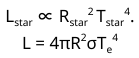
what does Planck’s Law describe
the spectrum of emitted light from a blackbody
radiative flux
amount of light (Erad) passing through an area or incident upon a surface, per unit of time, with units W m-2
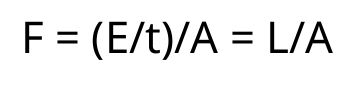
describe the inverse square law of light
Astronomical objects are so far away that their apparent brightness is very dim and related to their intrinsic (physical) absolute brightness, which equals luminosity by the inverse square law of light.

why is it difficult to measure total flux from astronomical detectors and what is done instead?
it’s difficult to measure Ftot because astronomical detectors only work in narrow wavelength ranges. instead, we compare light from two stars at matched wavelengths.
explain the magnitude system
a system where we are quantifying the ratio of brightness between two stars. magnitude is a unitless quantity of physical brightness, and a greater magnitude is always fainter.

true or false: Quantifying the relative brightness between two stars works the same for either apparent brightness (F) or for absolute brightness (L).
true
In every case, the form of the magnitude equation is _______
the same
distance modules
relates a single star’s distance [in parsecs] to its apparent magnitude m and its absolute magnitude M, defined as the mag of the star if it was at a fixed distance of d = 10 pc.
![<p>relates a single star’s distance [in parsecs] to its apparent magnitude m and its absolute magnitude M, defined as the mag of the star if it was at a fixed distance of d = 10 pc.</p>](https://assets.knowt.com/user-attachments/af82d9ae-6044-480c-8318-450575126dbf.png)
color index + equation u need to know
the mag unit quantity that astronomers use to represent the ratio of blue vs. red light. works with flux or luminosity

star color relates to ________ primarily at _______ wavelengths
surface temperature, visible
Astronomers use CCDs to collect light passing through different wavelength filters (i.e., they measure FΔλ in different well-defined Δλ ranges called ________
bandwidths
Stellar magnitudes decrease with increasing brightness; consequently, a star with a smaller B - V color index is _____ than a star with a larger value of B - V.
bluer
what are the color index letters going from bluer to redder wavelengths
u g r i z. it’s always blue divided/subtracted by red
what equation can be used to find luminosity of a star with it’s M relative to the Sun
except dan flipped sun and star on both sides

spectroscopy
ability to disperse light into brightness as a function of wavelength
what is kirchoff’s spectrums of light in spectroscopy
1. continuous spectrum- light emitted form a hot and dense matter, featuring unbroken light across all wavelengths
2.emission spectrum- light emitted from a warm, low density gas, featuring distinct, bright lines at specific wavelengths
3.absorption spectrum- light emitted from passing through a cool, low-density gas, featuring dark lines over a continuous background.
key. hot dense interior just below a star’s photosphere (aka atmosphere) emits a __________ blackbody spectrum
continuous
the thin photosphere is _____ on the outside due to _______ to space, it can absorb light from a ______ stellar interior
cooler, energy loss, warmer
what is the cause of spectral features (emission / absorption lines)
interaction between (radiative) energy and atoms/molecules.
key: specific energy photons will interact with atoms and produce features at a corresponding discrete _________
wavelength
balmer lines
visible wavelength hydrogen spectral lines
when Bohr modeled the Hydrogen atom, he used a semi-classical approach. what two aspects were not like classical physics?
1.angular momenta of the electron orbits were quantized. it’s restricted to discrete, quantized integer multiples of Planck's reduced constant where n = principal quantum number.
2.an orbiting (accelerating) electron doesn’t emit light as Maxwell’s classical laws of E&M dictate. Electrons can revolve only in specific orbits without radiating energy. Light is emitted or absorbed only when an electron makes a discrete transition between two levels.
quantized energy levels
Discrete energy states of bound electrons where transitions emit or absorb photons with ΔE=hf.
explain reading an energy level diagram and how an atom can transition between them
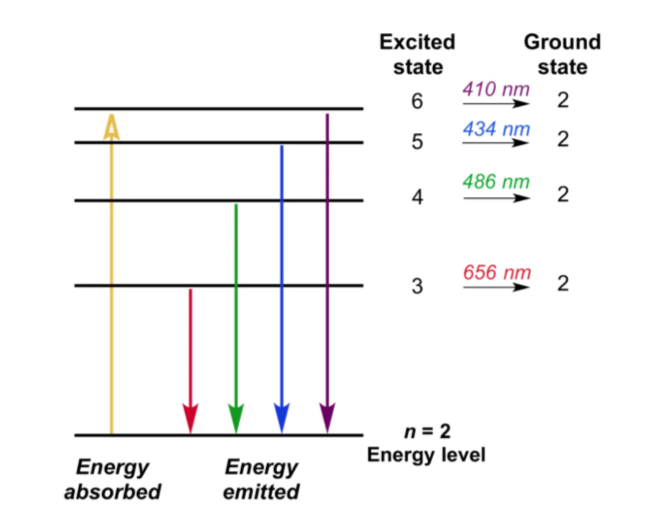
each energy level has a discrete E. the most bound level is n=1. an excited H atom can either absorb photons to transition to n>3 (H*n=3) or emit a photon of a certain energy and transition to a lower energy level.
key: an exact change in energy from n to n’ corresponds to _________
exact change in wavelength from n to n’
what are the names of the three main spectral series of electron transitions, their EMS range, and principal quantum number
Lyman (UV, n=1)
Balmer (visible, n=2)
Pashen (IR, n=3)
spontaneous emission
atoms de-excite rapidly back to ground state through emission of photons
key: each hydrogen atom emits a _____ in a ______ direction
photon, random
ionization
liberating a previously bound electron from an atom, creating a free electron and an ion
photons with a wavelength shorter than a specific limit (series limit) will do what to an atom
ionize

define the 4 lines of the Balmer series including the wavelength
656 nm (Hα), 486 nm (Hβ), 434 nm (Hγ), 410 nm (Hδ)