2.1.4-Steps to Action Potential and Mnemonic Hacks
 Call Kai
 Learn
Learn Practice Test
 Spaced Repetition
 Match
Match Flashcards
 Knowt Play
1/17

There's no tags or description
Looks like no tags are added yet.
Name | Mastery | Learn | Test | Matching | Spaced | Call with Kai | Chat |
|---|
No analytics yet
Send a link to your students to track their progress
18 Terms
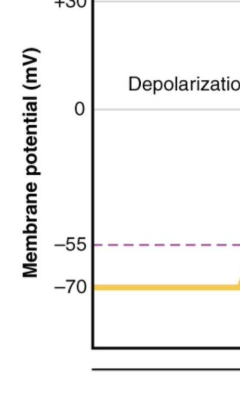
What is the first step called and what is it resting membrane potential?-Banana
The first step is called the resting potential and its resting membrane potential -70mV.
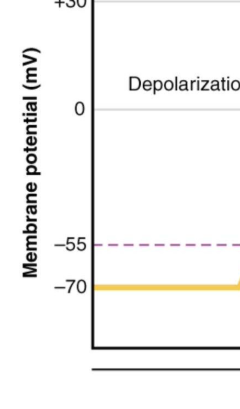
Are the gates closed at resting potential and is the pump active?-Banana
The gates are closed and the pump is active.
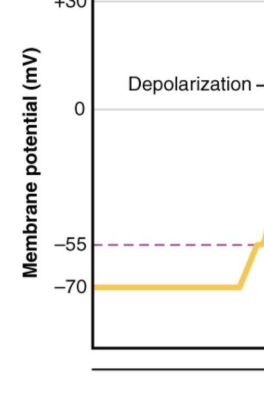
What is the second step called and what is its threshold potential?-Banana
The second step is called stimulus and threshold. The threshold potential is -55mV.
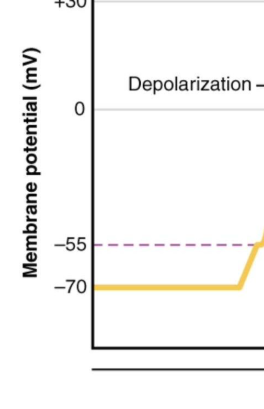
What happens during the stimulus and threshold.-Banana
A stimulus (like a neurotransmitter) arrives at the dendrites.
If the stimulus is strong enough, it raises the charge to the Threshold level (around -55mV).
This is an "all-or-nothing" event. If it doesn't hit the threshold, nothing happens. If it does, the action potential fires.
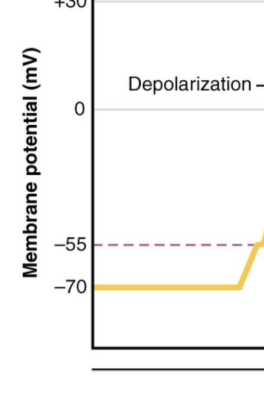
Are any ions gates opened because of stimulus and threshold?-Banana
No,but it aids in the next step doing it
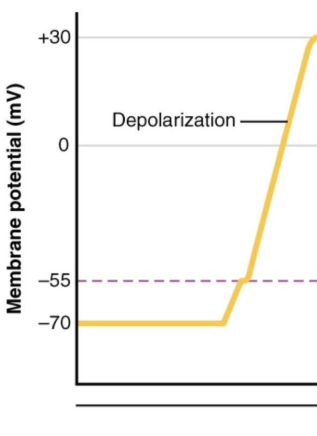
What is another word for the rising phase?-salty banana
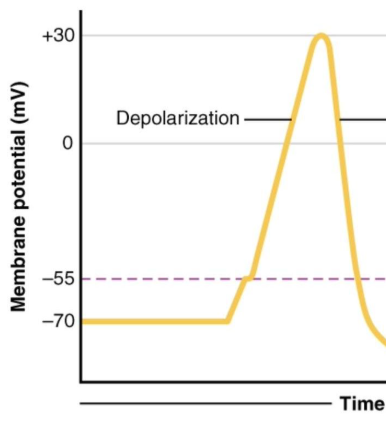
Depolarization
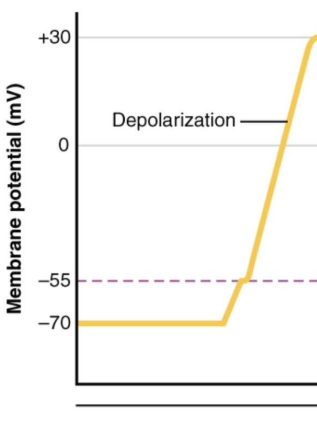
What happens once the threshold potential is met?-salty banana
The sodium gates opens and sodium rushes in.
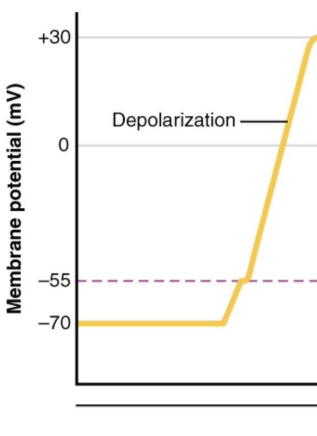
What doe this massive influx of positive charge or sodium mean for the cell?
It makes the cell very positive up to 30 mV.
What channels stay closed in depolarization?-Salty banana
Potassium
What is another name for the falling phase?-salty
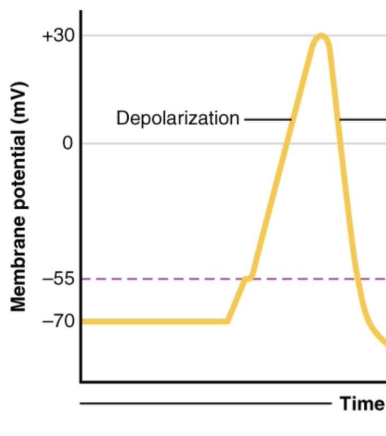
Repolarization
What channels close and open?-salty
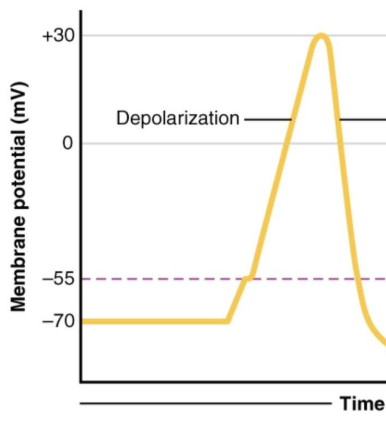
At its peak at 30 mV the Na+ channels close and the K+ channels open. Since K+ ions rush out of the cell it makes the cell more negative again.
explanation of cell-for salty
Here is the key: In Step 4, Na+ (sodium) is NOT the ion that's moving.
Look at the notes for Step 3 and Step 4 again:
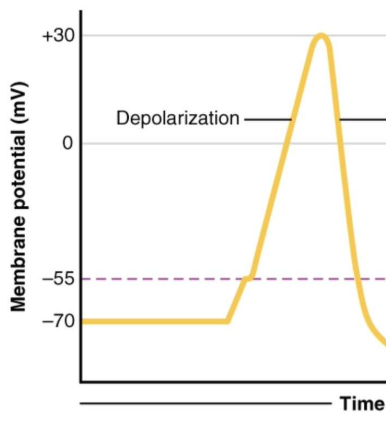
Step 3 (Depolarization): The Na+ gates OPEN. Positive Na+ ions rush IN. This makes the cell positive. (You are correct about this!)
Step 4 (Repolarization): The Na+ gates CLOSE. A different ion, K+ (Potassium), takes over. The K+ gates OPEN.
Now, K+ is also a positive ion, but it's rushing OUT of the cell.
Think of it this way:
If positive charge rushes IN, the cell becomes positive.
If positive charge rushes OUT, the cell becomes negative.
So, in Step 4, the cell gets negative again not because of sodium, but because positive potassium (K+) is leaving.
What does this rushing out of in repolarization cause?-salty
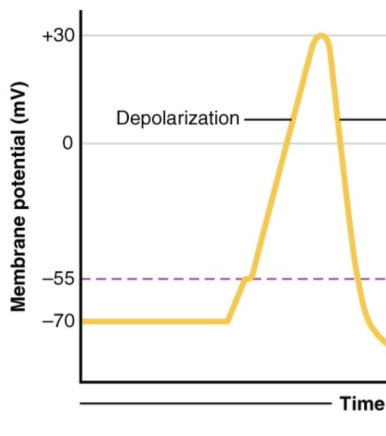
Potassium ions rush OUT of the cell, taking their positive charge with them.This causes the charge to "re-polarize" and become negative again.
What is another word for the undershoot?-to much salty
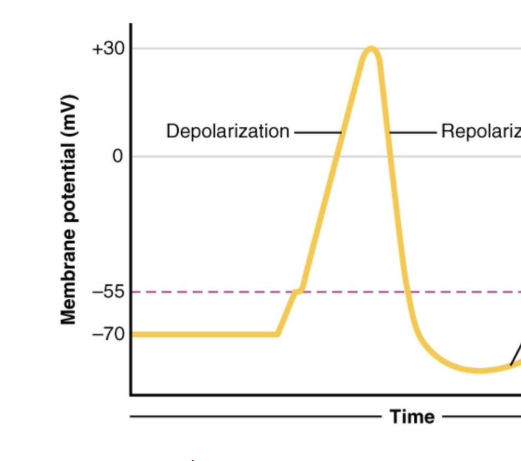
Hyperpolarization
What is hyperpolarization?-to much salty
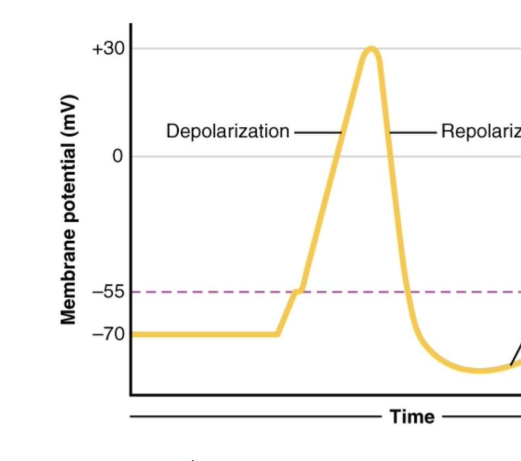
The potassium channels are slow to close, so too much potassium leaks out.The charge briefly becomes more negative than resting potential (e.g., -75mV).
What does the return to rest consist of?-banana
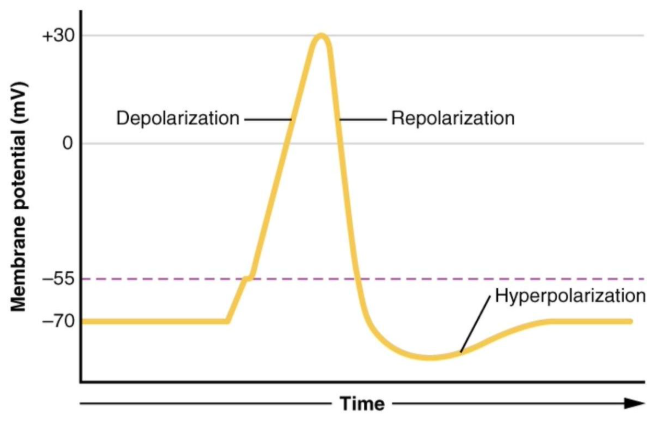
The potassium channels fully close.
The sodium-potassium Pump (which you labeled "Return") does its job:
It pumps 3 sodium OUT
It pumps 2 potassium IN
This re-establishes the original resting state concentrations, readying the neuron to fire again.
What is the refractory period and what is so important about it?
This the time that a new signal cannot come in.
Absolute Refractory Period: During Depolarization/Repolarization. It is IMPOSSIBLE for the neuron to fire again (because the sodium channels are inactive).
Relative Refractory Period: During Hyperpolarization. It is DIFFICULT (but not impossible) for the neuron to fire; it just requires a much stronger stimulus.
Charge:
You are correct: "Charge is comparing in relation to outside." It's always a relative difference.
The inside is negative at rest because positive ions potassium are allowed to leak out, and the pump pumps more positives 3 sodium out than it brings in 2 potassium.
Mrs.Rosevear is old→Y2K new millennium→2 potassium in(new)
jb