MSE265 Equations
 Call Kai
 Learn
Learn Practice Test
 Spaced Repetition
 Match
Match Flashcards
 Knowt Play
1/38

There's no tags or description
Looks like no tags are added yet.
Name | Mastery | Learn | Test | Matching | Spaced | Call with Kai | Chat |
|---|
No analytics yet
Send a link to your students to track their progress
39 Terms
Fundamental Thermodynamic Equation
dE = TdS - PdV +udN
E(S,V,N)
Enthalpy H: definition, differential, natural variables
H = E + PV
dH = TdS + VdP + udN
H(S,P,N)
Gibbs free energy G: definition, differential, natural variables
G = E + PV - TS = H - TS
dG = -SdT + VdP + udN
G(T,P,N)
Helmholtz free energy A: definition, differential, natural variables
A = E - TS
dA = -SdT - PdV + udN
A(T,V,N)
Which free energy is minimized at equilibrium
T, V, N fixed = A minimized
T, P, N fixed = G minimized
How do I derive a Maxwell relation
Write thermodynamic potential
Read off first derivatives from coefficients
Cross-differentiate with respect to the other natural variable
Set mixed second derivatives equal
Maxwell relation from E
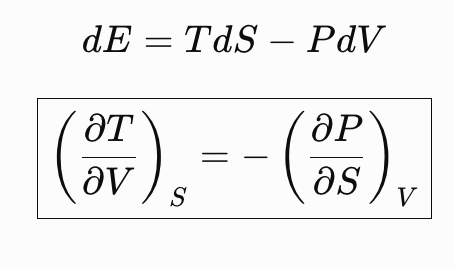
Maxwell relation from H

Maxwell relation from A
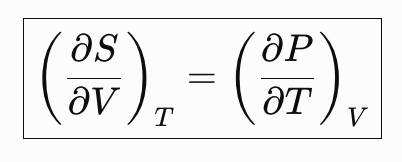
Maxwell relation from G
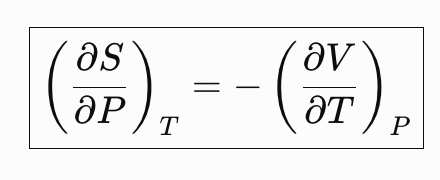
Definitions of Cv and CP
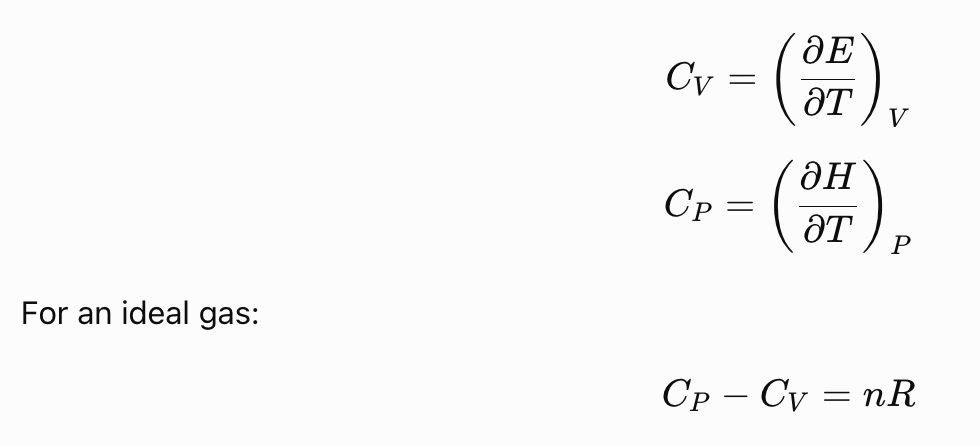
Ideal-gas entropy change using T,V
I
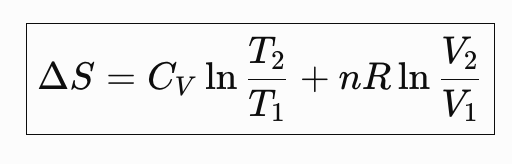
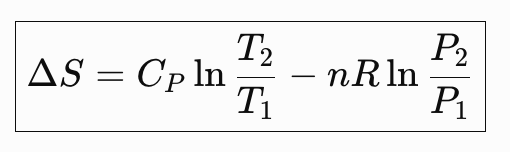
Ideal-gas entropy change using T, P
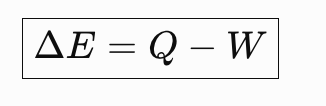
First law sign convention
Q > 0: heat enters system. W > 0: system does work on surroundings
Expansion vs compression work signs
Expansion: W > 0 | Compression: W < 0
Reversible vs irreversible etnropy

Microcanonical vs canonical ensemble
Micro: E,V,N isolated | Canonical: T,V, N energy exchange with reservoir
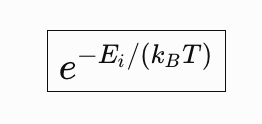
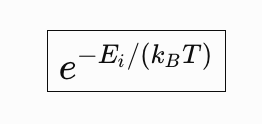
Boltzmann factor
Lower E → greater statistical weight
Canonical partition function
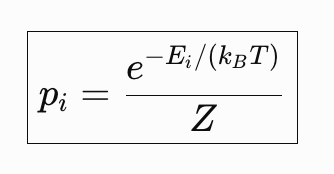
Probability of state i
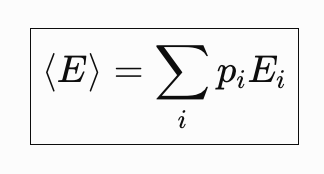
Average Energy
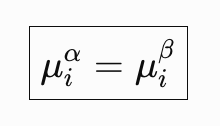
Chemical potential equilibrium condition
Compare the same component across phases
Gibbs Phase Rule

Clapeyron equation
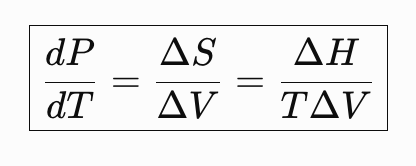
Phase transition at equilibrium
Delta G = 0 → Delta H = TDeltaS
Ideal-solution assumption
DeltaHmix = 0
Ideal entropy of mixing
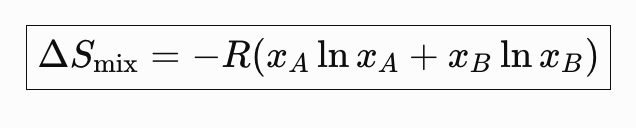
Ideal Gibbs free energy of mixing

Regular-solution enthalpy of mixing
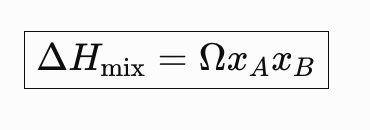
Regular-solution Gibbs free energy of mixing

Meaning of Omega
Omega > 0 = unfavorable A-B interactions → phase separation favored | Omega < 0 = favorable A-B interactions → mixing favored | Omega = 0 →ideal solution limit
General chemical potential/activity equation
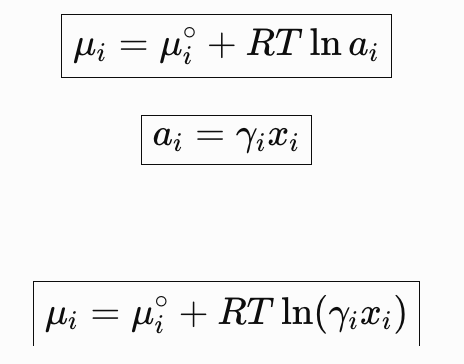
Ideal solution activity coefficient
E
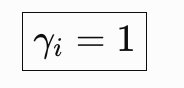
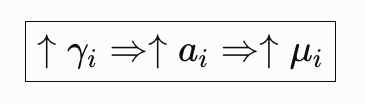
Effect of gammai on mui at fixed xi
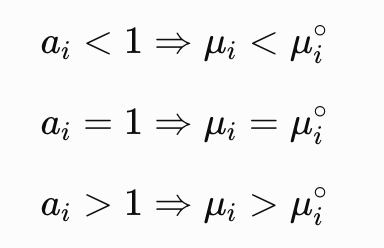
Activity vs standard-state chemical potential
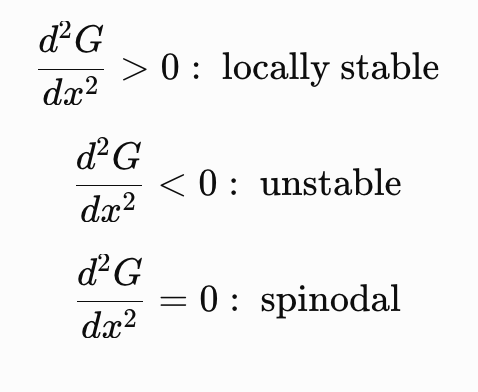
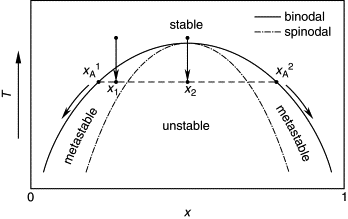
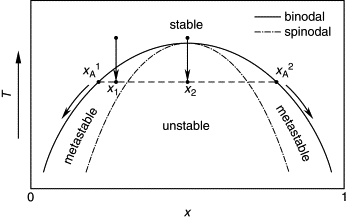
Stability from curvature of G(x)
Spinodal vs binodal
Inside spinodal → unstable, no nucleation barrier | Between spinodal and binodal →metastable, nucleation required | Outside binoday → stable
Multiplicity for binary lattice
Boltzmann Entropy
S = kb ln Omega