NEW parasitology exam flashcards 1,2,3
 Call Kai
 Learn
Learn Practice Test
 Spaced Repetition
 Match
Match Flashcards
 Knowt Play
1/41

There's no tags or description
Looks like no tags are added yet.
Name | Mastery | Learn | Test | Matching | Spaced | Call with Kai | Chat |
|---|
No analytics yet
Send a link to your students to track their progress
42 Terms
The reason for why we study parasitology
To promote public health, food safety, environmental health, prevent disease in animals, prevent and control zoonotic disease, and human animal bond.
The reason for why we use the Linnaean classification system
We use it so we are all talking about the same thing
Veterinary client patient relationship (VCPR) definition
The veterinarian-client-patient relationship (VCPR) is the basis for interaction between veterinarians, their clients, and their
patients and is critical to the health of the animal.
Important things in the VCPR
The vet and client are in agreement, The vet has seen the patient in the last year, The vet is readily available for follow up evaluation, and records are maintained.
The 5 kingdoms
Plantae, Animalia, Protista, Monera (Eubacteria and Archaebacteria), Fungi
The 2 kingdoms of interest in vet medicine
Animalia, and Protista
The phylum of interest in the Kingdom of Animalia
Platyhelminths (Flatworms), Nematoda (Roundworms), and Arthropoda.
Helminths
The worms- the platyhelminths and the nematodes
Nematodes are known as what
Roundworms
The amount of developmental stages larvae have
5
Nematode identification
Based on their type of egg or larval stage
Oviparous eggs
Ascaroid or ascarid, Trichinelloid or trichuroid, Trichostrongyle(Morula)
Ovoviviparous egg name
Spiruroid or spiruria
Larviparous (Larvel stages)
Microfilariae(pre larval), Lungworm(Kinked tail), Dracunculoid(long-tailed larvae)
Rule for larval stage
The 3rd larval stage is the infective stage
Platyhelminths
Flatworms
Class Trematoda is called
Flukes
Class Cestoda is called
Tapeworms
Subclass Eucestoda is called
true tapeworms
Subclass Cotyloda is called
pseudo tapeworms

Flukeworm Image
Flat, leaf shaped
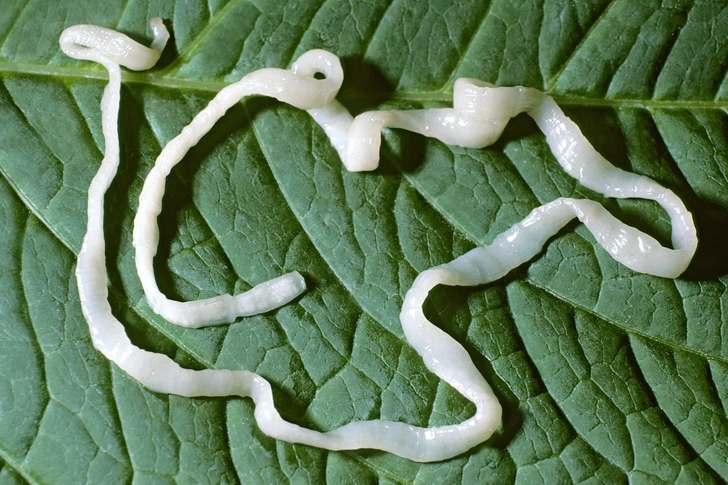
Tapeworm Image
ribbon-like
The reason why arthropods are problematic (includes mites, ticks, and insects)
They directly threaten human health, food security, and infrastructure through their evolutionary resilience.
Casual agents (why arthropods are problems)
Flea anemia, saracoptic manage
Intermediate host (why arthropods are problematic)
For helminths and protozoans
Vectors (why arthropods are a problem)
Bacteria, viruses, spirochetes, Rickettsiae, chlamydial, other
Flagellates
Move using flagella (Giardia)
Amoebae
Move using pseudopodia (Entamoeba)
Apicomplexans
Non motile adults use apical complex to invade cells (Coccidia)
Ciliates
Move using cilia (Balantidium)
These phyla are based on
locomotion
Big or Tiny (Protozoa)
Tiny
Life cycle stages
Switch between active breeding
Protozoa
microscopic, single-celledliving things that have a nucleus and act like tiny animals
Symbiont
2 organisms of different species in a relationship
5 types of symbiosis
Predator-prey, phoresis, mutualism, commensalism, parasitism
Insecticides treat this
Arthropoda (All insects, mosquitos, fleas, flies etc,
Antihelmintics treat this
Nematodes and platyhelminths (roundworm, tapeworm, flukes, thorny head worms)
Acaricides treat this
Arthropoda (mites, ticks)
Antiprotozoals
Protozoa (Coccodia, Giarda)
Most succeptible to get parasitic infections
Children and elderly