Airway drugs
 Call Kai
 Learn
Learn Practice Test
 Spaced Repetition
 Match
Match Flashcards
 Knowt Play
1/10

There's no tags or description
Looks like no tags are added yet.
Name | Mastery | Learn | Test | Matching | Spaced | Call with Kai | Chat |
|---|
No analytics yet
Send a link to your students to track their progress
11 Terms
Allergic asthma vs allergic rhinitis
Allergic asthma affects the lower airways
Allergic rhinitis affects the upper airways
Both allergic rhinitis and allergic asthma run on the same Type I hypersensitivity pathway.
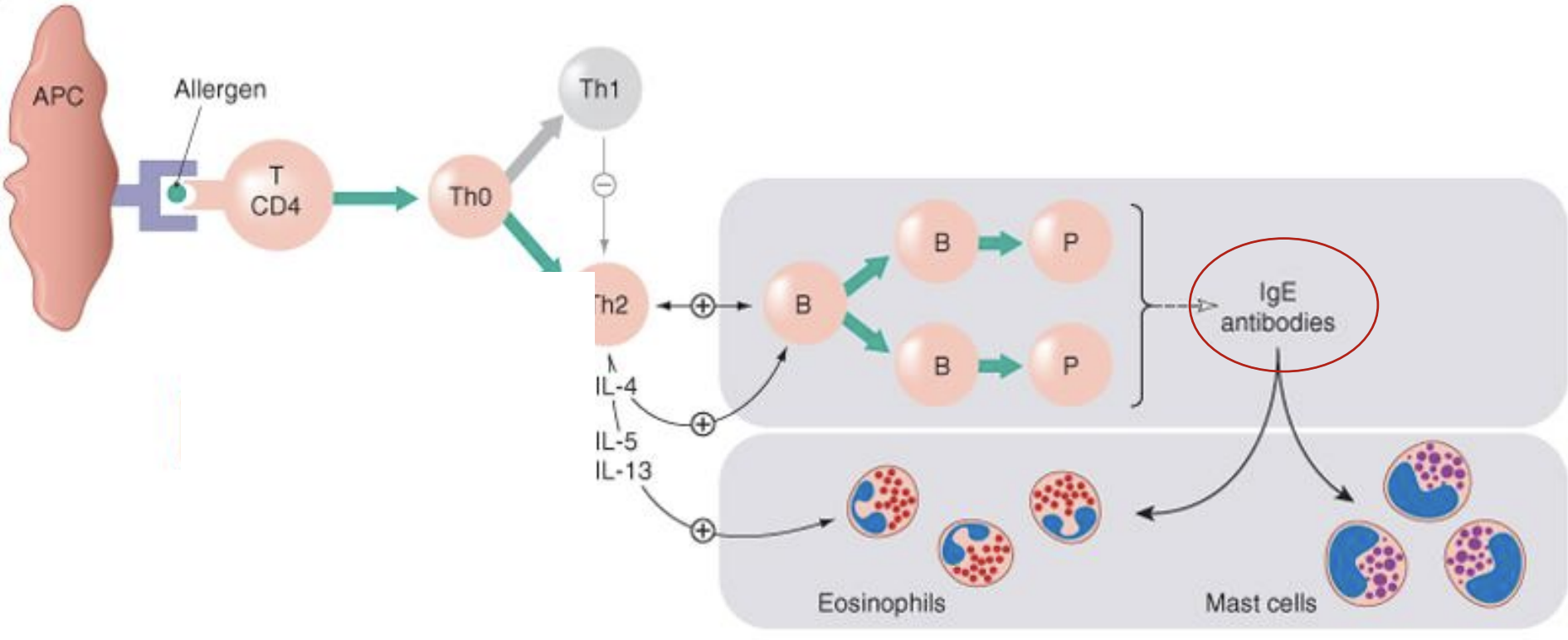
What are the steps of the Type I hypersensitivity pathway?
APCs recognise the allergen and presents it to Th0
Th0 differentiates to Th2, which releases IL-4, IL-5, IL-13
The cytokine signalling drives B cells to become plasma cells, which produce IgE
IgE coats mast cells/eosinophils, which are abundant in the mucosa of the airways
Upon re-exposure, the allergen cross-links IgE, triggering mast cell degranulation (histamine. leukotrienes, prostaglandin, cytokine release), leading to inflammation and symptoms, such as sneezing, itchy nose/eyes, runny nose
Drugs can target different points in this pathway to prevent the symptoms of obstructed airflow.
Why does asthma need two drug classes to be countered?
Because allergen exposure impacts lung function twice:
Early phase (0–3h): mast cell degranulation → histamine/leukotrienes → immediate bronchospasm
Late phase (3–8h): eosinophil/cell infiltration → deeper, more prolonged inflammatory drop in lung function
This is why two drugs are needed, one drug per phase, not one drug doing both jobs. For example: a bronchodilator (β2-agonist) only treats the early, spasm-driven phase. It does nothing for the late inflammatory phase.
Differences in 1st gen and 2nd gen antihistamines?
First generation - causes sedation as it easily crosses the blood-brain barrier; also used to treat motion sickness, as it blocks histamine in the CNS, reducing nausea and dizziness
Second generation - non-sedating as it doesn’t cross the BBB, more selective for peripheral H1 receptors, avoiding CNS effects
Loratadine
First-line treatment of allergic rhinitis
H1 receptor antagonist
Only blocks histamine from binding to receptor in target tissue, not the release of histamine
2nd generation antihistamine: doesn't cross the BBB → non-sedating
Salbutamol
most commonly used bronchodilator
β2-adrenergic agonist
Mechanism: Binds β2 receptor (Gs-coupled GPCR) on airway smooth muscle → activates adenylate cyclase → increased cAMP → activates PKA → smooth muscle relaxation → bronchodilation
Salbutamol is a SABA (short-acting β2-adrenergic agonist), often combined with LABA (long-acting) such as salmeterol (paired with Inhaled Corticosteroid (ICS), as it’s dangerous to take the LABA alone)
Administration: inhaled, but only 10–20% actually reaches the lungs, the rest is swallowed, absorbed via GI, undergoes first-pass metabolism, and the bit that reaches systemic circulation causes side effects, including:
tremor (skeletal muscle β2)
tachycardia (cardiac β)
possible receptor downregulation with chronic use
Budesonide
Inhaled glucocorticoid (ICS)
Used for allergy and allergic rhinitis
Mechanism: (i) binds to intracellular glucocorticoid receptor, displacing HSP70/90 chaperones, (ii) receptor-ligand complex translocates to nucleus and binds DNA, (iii) alters gene transcription (up or down), (iv) altered protein synthesis → altered cell function
This drug is slow and genomic → not useful for acute relief, only for long-term control, which is why do you need both a bronchodilator and a corticosteroid
Cellular effects: ↓eosinophils (↑apoptosis), ↓cytokines from T-cells/macrophages/epithelium, ↓mast cell numbers, ↓vascular leak, ↓mucus secretion, and importantly ↑β2-receptor expression on smooth muscle (this is why ICS + LABA combos work synergistically)
Side effects: hoarseness; oral candidiasis (thrush) due to local immunosuppression in the mouth/throat as inhaled steroid deposits there; nosebleeds if taken as a nose spray
Omalizumab
Anti-IgE monoclonal antibody
Mechanism: binds free circulating IgE (not IgE already bound to mast cells) → decreases free/cell-bound IgE → decreases expression of the high-affinity IgE receptor (FcεRI) on mast cells/basophils → decreases mediator release → decreases allergic inflammation
Used as add-on therapy for severe allergic asthma (passive immunisation), not first-line
Give an example of an "add-on medication" with a different mechanism than the standard β2-agonist
Cholinergic (muscarinic) antagonists — e.g. ipratropium, tiotropium
ACh normally acts on M1/M3 receptors on airway smooth muscle/mucus glands, resulting in contraction + mucus secretion
Antagonist blocks this, causing bronchodilation + less mucus.
Low systemic bioavailability when inhaled (limiting side effects, which is good).
Main side effect: dry mouth
Give an example of an add-on drug that act as Leukotriene antagonists.
oral drug (not inhaled)
Stimulated CysLT1 receptors result in bronchoconstriction, mucus secretion, vascular permeability, eosinophil recruitment
Drug blocks the CysLT1 receptor → blocks all of the above
Summary
Asthma | Allergic rhinitis |
|
|
Add on/alternative:
| Add on/alternative:
|