universe & the earth pt. 2 (mod #2)
 Call Kai
 Learn
Learn Practice Test
 Spaced Repetition
 Match
Match Flashcards
 Knowt Play
1/34

Earn XP
Description and Tags
🍂
Name | Mastery | Learn | Test | Matching | Spaced | Call with Kai | Chat |
|---|
No analytics yet
Send a link to your students to track their progress
35 Terms
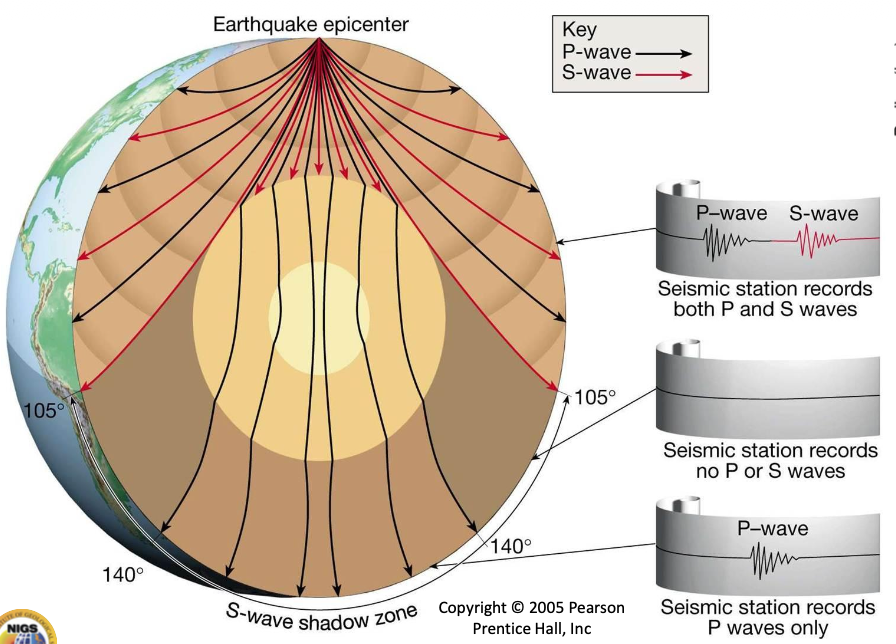
body waves
surface waves
2 TYPES OF SEISMIC WAVES:
these travel through the interior of the earth
move only along earth’s crust
p-waves / primary / pressure waves;
2 TYPES OF BODY WAVES:
Formed from alternating compressions and rarefaction;
Arrives first;
Travels through gases, liquids and solids
s-waves / secondary/ shear waves
2 TYPES OF BODY WAVES:
Formed from oscillation perpendicular to wave direction;
Dependent on shear stress;
Arrives second
Love waves
Rayleigh waves
2 TYPES OF SURFACE WAVES:
fastest surface wave, side to side
rolling, up-down, most shaking
xenoliths
EARTH’S LAYER (EVIDENCE):
Inclusions in igneous rocks during emplacement and eruption that typically originate from the upper mantle;
provides information about the composition of the mantle
xenocryst
EARTH’S LAYER (EVIDENCE):
Individual foreign crystal included within an igneous rock
meteorites
EARTH’S LAYER (EVIDENCE):
Debris or material on a surface of a planet (Earth) that originated from outer space;
May come from meteoroids, asteroids, comets, moons or planets;
TYPES OF METEORITES:
undifferentiated (contains chondrules)
TYPES OF METEORITES:
round grains that formed from molten (/partially) droplets
Achondrite
TYPES OF METEORITES:
differentiated (depleted in meteoric iron mafic/ultramafic)
Stony iron meteorites
TYPES OF METEORITES:
differentiated (equal meteoric iron and silicates)
Iron meteorites
TYPES OF METEORITES:
differentiated (planetesimal cores)
stony meteorites
TYPES OF METEORITES:
consists largely of silicates
continents
EARTH’S LARGE SCALE FEATURES:
very large landmasses, exposed above sea level;
includes mountain belts and plains up to the continental shelves
associated with continental crust & lithosphere
continents, 29.1%, Mt. Everest
EARTH’S LARGE SCALE FEATURES:
Area: 148,647,000 km2
this accounts for ____% of Earth’s surface area
• Highest Point: 8,848 m (_____ – Nepal)
mountain belts
EARTH’S LARGE SCALE FEATURES:
Chain of mountains that were formed from the same event (orogeny)
orogeny, orogenesis
EARTH’S LARGE SCALE FEATURES:
mountain-building event;
deformation of the lithosphere along convergent margin;
thickening, crumpling associated with volcanism
process: ______
ocean basins, 70.8%
EARTH’S LARGE SCALE FEATURES:
areas below sea level;
Area: 361,132,000 km2
Accounts for ____% of Earth’s surface area
ocean basins, Challenger’s Deep - Mariana Trench
EARTH’S LARGE SCALE FEATURES:
Includes abyssal plains, seamounts, trenches and mid-ocean ridges;
associated with Oceanic crust and lithosphere
deepest Point: 10,929 m (_____ ____ - _____ ______)
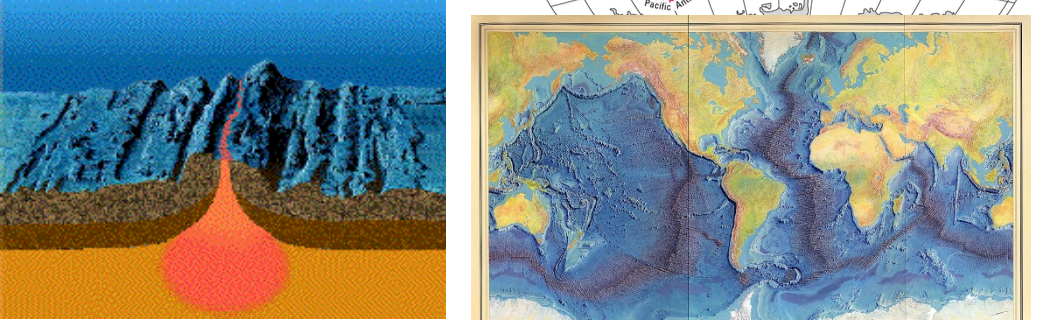
mid-oceanic ridges; divergent
Submarine mountain chain;
________ Plate Boundaries (Oceanic) – seafloor spreading
Length: 65,000 km
Global (interconnected)
oceanic trench
Elongate submarine depressions and deepest parts of the oceans;
convergent plate boundaries (Subduction Zones);
located parallel to volcanic and island arcs
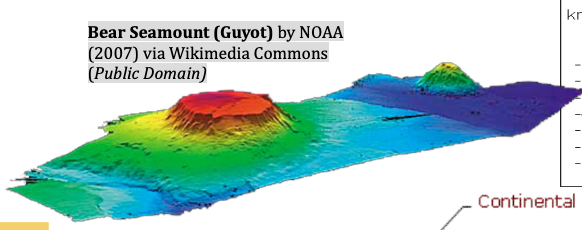
seamounts
Elevated submarine structure;
Form from extinct volcanoes;
Typically conical
ex. Bear ____ (Guyot)
guyot
flat-topped seamount
abyssal plains
EARTH’S LARGE-SCALE FEATURES:
submarine plain between the continental rise & mid-ocean ridges;
depth: 3000-6000m
principle of isostasy
Isostatic Equilibrium;
low-density crust “floats” above the high-density mantle rocks;
Continental mountain belts have roots that are mostly “submerged”

isostatic adjustment
process of establishing a new gravitational balance in response to loading or unloading

Airy-Heiskanen model
Crust with constant density;
Topographic heights accommodated by changes in crustal thickness;
iceberg analogy
root & antiroot
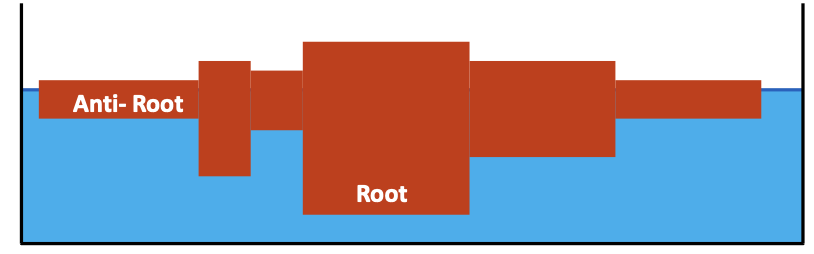
root
anti-root
TYPES OF ROOTS:
under mountains (deep)
under oceans (shallow)
Pratt-Hayford Model
Lithosphere with equal depth;
Crust with varying density;
topographic heights accommodated by lateral changes in density;
Isostatic Compensation

Vening Meinesz Model
Flexural Isostasy Model;
Regional Isostasy;
elastic lithosphere
downwarp & rebound

downwarp
rebound
2 OF EARTH’S VERTICAL MOVEMENT:
addition of load (ice sheet, orogen)
removal of load (deglaciation, erosion)
no isostasy
KINDS OF ISOSTASY:
Te > λ
elastic thickness Te of the lithosphere is greater than the wavelength (λ) of an applied surface load, meaning the tectonic plate is rigid enough to support the load without flexing significantly
regional/flexural isostasy
KINDS OF ISOSTASY:
Te ≈ λ
how the Earth’s outer rigid shell—the lithosphere—bends like an elastic plate under massive surface
this strength allows the plate to distribute weight across a broader area, supporting loads through a combination of buoyancy and elastic forces
low flexural rigidity (otw to local isostasy)
KINDS OF ISOSTASY:
Te « λ
means that the lithosphere behaves as if it has virtually no mechanical strength
lithosphere cannot support the load elastically.
weight is compensated purely locally directly beneath the load.
Large scale continents or wide plateaus.
local isostasy
KINDS OF ISOSTASY:
Te ≈ 0
the lithosphere behaves like a completely broken, segmented, or infinitely flexible sheet.
Any geological load placed on the surface is compensated entirely locally by pure hydrostatic equilibrium (buoyancy) alone