2015 fr final
 Studied by 0 people
 Call Kai
 Learn
Learn Practice Test
 Spaced Repetition
 Match
Match Flashcards
 Knowt Play
1/92

There's no tags or description
Looks like no tags are added yet.
Name | Mastery | Learn | Test | Matching | Spaced |
|---|
No study sessions yet.
93 Terms
function of emotions
help people adapt to their environments
fear leads to avoiding anger
happiness strengthens relationships
disgust keeps people away from things that make them ill
basic emotions
Consists of universal subjective feeling (E.g: sadness disgust)
from birth to 9 months
self concious/Complex emotions
emotions such as pride, guilt, embarrassment
appear later 18-24 months
social smiles
appears in infants at 2-3 months
Seems to express an infants happiness at interacting
stranger wariness
appears around 6 months
healthy sign of attachement
Experiencing and expressing emotions
By age 9 children experience relief and regret appropriately
cultures differ in:
events that trigger emotions
extent in which emotional expression is encouraged (e. Emotional restraint valued in Asian societies)
Recognizing and utilizing emotions
by 4-6 months, infants can identity facial expressions
During elementary school children understand people have mixed feelings and learn display rules /social norms
Social referencing
In unfamiliar or ambiguous environments infants rely on caregivers for cues for interpretation
Regulating emotions
begins in infancy, improves with age using mental strategies and being less reliant on others
Children who don’t do as well tend to have problems interacting with peers and have adjustment problems
Temperament
behavioural styles that are fairly stable across situations and biologically based
- Thomas and chess 3 patterns:
- Easy 2. Difficult 3.Slow to warm up
9 dimensions (all rituals allow any inhumane methods. die professor, slowly.)
activity level
childs general movement
regularity/rythmicity
predictability of biological functions
approach/withdraw
lnitial reaction to new people or situations
adaptability
ease or difficulty in adjusting to changes in routine/enviornment
intensity
energy level of emotional response
mood
general disposition (positive or negative)
distractability
how easily a childs attention is diverted by external stimuli
persistence
the ability to stay on task despite difficulty or interruption
sensory threshold
the level of sensory stimulation needed to provoke response
Temperament: environmental contributions
heredity influence: identical twins are more alike in aspects of temperament than fraternal twins
Impact of heredity depends on temperamental dimensions
Temperament in development
aspects of temperament are related to school success, peer interactions, compliance
children who resist control are less likely to have behavior problems
Children with positive temperaments are less affected by stressors
Attachement
Relies upon infants growing perceptual and cognitive skills
By 7 months infants in western societies have identified a single attachment figure
children usually attach to mothers first then fathers (Prefers to play with fathers but prefer mother for comfort however these differences have come smaller)
Attachment: indigenous societies
traditionally, fathers were considered pregnant alongside the mother
Father involvement challenges due to colonialism
Quality of Attachment - SST
ainsworth strange situation task - Baby is put through a series of situations :
parent present/absent
Stranger present/absent
In each situation baby's reactions are measured to test the quality of attachment
Quality of Attachment Structure
secure:
may be upset when parent leaves but stops crying upon return
most common form and to positive social relationships due to trust establishment
Insecure/avoidant:
not upset when parent leaves
ignores parent on return
Insecure/resistant:
upset when parent leaves
angry and inconsolable on return
Insecure/disorganised:
confused when parent leaves
Consistent Internal Working Model
predictable, responsive parenting is necessary for secure attachement
Secure adults are more likely to provide better caregiving and have securely attached infants
Quality of Attachment cont
- self awareness is an important factor in intergenerational attachment
- Training can help mothers respond more effectively
- Childcare does not necessarily affect the quality of attachment
Origins of self recognition
by 15 months infants show self recognition through mirror tasks (touching own nose)
At 18-24 months children look at photos of self more than others and refer to themselves
Self concept comes from self awareness
evolving self concept
preschoolers: concrete characteristics
schoolage: social groups, comparison to others
adolescents: attitudes, personality, personal beliefs
Search for identity
adolescents use hypothetical reasoning to experiment with selves
adolescent is characterized by:
self absorption, imaginary audience, personality fable, ego centrism
stages of identity (DFMA):
diffusion: state of aimelessness
foreclosure: commitment to an idenity
moratorium: active exploration
achievement: making choice and commitment to identity
Search for identity: ethnic groups
- achieving an identity may be challenging for adolescents belonging to an ethnic minority group
- many maintain strong ties to both ethnic and mainstream culture others find identifying with mainstream weakens ethnic ties and creates conflict with parents
- Strong ethnic identity benefits self esteem and relationships
- Nature of ethnic identity changes of generations of assimilations
Developmental change in self esteem
differentiated view of themselves by elementary school
Four areas of self esteem emerge in elementary school years while others are added in adolescence:
Scholastic competence
Athletic competence
Social
Physical appearance
Self esteem in some domains contributes more than others to overall sense of worth
self esteem changes throughout development
self esteem is highest in preschoolers
Social comparisons lead to drop in self esteem in the beginning of elementary school
Self esteem usually stabilizes by the end of elementary school but sometimes drops during the move to high school
Self esteem cultural variations
Self worth varies with diff ethnic background Individuals e.g Asian cultures are more likely to emphasize modesty, admit weakness, and avoid social comparisons
Sources of self esteem
praise should focus on effort rather than ability
When faced with setback:
Children praised for effort will work harder
Children praised for their ability will not try as hard
low self esteem: consequences
children with low self esteem are more likely to:
Have problems with peers
Have psychological disorders
Be bullies
Do poorly in school
low self esteem causes
- combo fo future harmul outcomes and consequence of past difficulties
- inflated self worth can lead to aggression/bullying
Describing others
children begin with a focus on concrete characteristics
adolescentes are more abstract and emphasize psychological traits
until age 10 children demonstrate bias for seeing positive traits
Understanding what others think
perspective taking increases with age and depend on cognitive development
also linked to theory of mind
children with good perspective taking skills get along better with peers
Selmans Stages Of Perspective Taking (USSTS)
undifferentiated (3-6)
aware that self and others can have different thoughts but can confuse the 2
social informational (4-9)
aware that perspectives differ b/c of peoples different access to info
self reflective (7-12)
children can display empathy and know others can too
third person (10-15)
can understand a third perspective view of themselves and others
societal (14 to adult)
understand that a third persons perspective is influenced by many contexts
prejudice
negative view of others based on group membership
increases in adolescents due to internalization of society and increased preference of own group
making children work together toward a common goal reduces it
reducing prejudice
- ensuring equality for all
- encouraging friendly contact
- engaging children in role playing activities
- ensuring adults support the goal of reduction
Beginnings of self control
1 year: aware that others impose demands
2 year: have internalized some control
By this point, many children
have enough self-control that
they are able to resist stealing from other children
3 years: is capable of self regulation
Preschoolers self control is a predicts outcomes
Improving self control
remind children long term goals > short term goals
Make tempting events less appealing
Children who handle temptation are better at resisting
Piagets stages: moral development (PMM)
Premoral (0 to 4)
No concept of morals
Moral realism (5 to 7)
Rules must be followed
Heteronormous morality
Absolute rules handed down
Immanent justice
Belief that breaking rules leads to punishment
Moral relativism (8 years+)
Understanding that rules are made for peace
Autonomous morality
Many people work together to create rules
Based on free will
Piagets contribution
Moral reasoning progresses through stages that are driven by cognitive development + social interaction
kohlbergers stages of moral development
preconventional / punishment and reward
Obey authority
Behave nicely for future favors
Contentional / social norms
Live up to others expectations
Maintain social order
Postconventional / moral codes
Abstract principles
Gilligian: ethic of care
the most advanced level of moral reasoning is understanding that caring is the cornerstone of all relationships
Both justice and care serve as a basis for moral reasoning in men and women
Social judgements and morality
social conventions: standards of
behaviour agreed to within a grouppersonal domains: choices about one’s own body, friends, and activities
These domains vary across cultures
Role of emotion in morals
emotions and cognition interact in the development of morals
Repeated exposure to event leads to forming scripts about emotional consequences of said event
Pro social behavior
actions that benefit others
Altruism: helps others with no direct benefit of the individual
pro social intentions and strategies increase with age
Pro social behavior: underlying skills
perspective taking
Empathy
Moral reasoning
Altruism: situational influence
children help when:
They feel competent
Good mood
Not much cost to helping
They feel responsible for person in need
children with with less emotional regulation skills are less likely to help
Pro social behavior environmental factors
identical twins are more alike in prosocial behavior than fraternal
Oxytocin hormonal influence has been linked to specific genes
Socializing pro social behavior
model prosocial behavior:
Be warm
Set guidelines
Give children feedback to understand impact of actions
Children and adolescents
need to routinely be given the
opportunity to help and
cooperate with others
Types of agression (IHRR)
instrumental aggression
to achieve a goal
Hostile aggression
unprovoked with intention to harass or intimidate
Reactive aggression
one child’s behavior leads to another one’s
Relational agression
trying to hurt others by undermining social relationships
Aggression: roots
biological risk factors
Parenting risk factors
Agression: socioeconomic factors
media (characters)
Agressive peers
School failures
More common in areas of Poverty
Exposure to violent cultures
Theories of aggression
social info processing theory: aggressive children mispercieve interactions
cascading risks
socialized aggression: when expected within a situation
social role
cultural guidelines about how one should behave with other people
gender role
culturally prescribed behaviors considered appropriate for males and females
gender identity
refers to whether people identity with their biological sex, the other, or with neither
gender stereotypes
beliefs about how males and females differ in personality traits, interests, and behaviors
in north america, men are seen as instrumental (goal-oriented, independent) and women as expressive (emphasize emotion and nurture)
learning gender stereotypes
by age 4, children have knowledge of gender-stereotyped activities
during elementary school years, children learn traits and occupations associated with males have higher status
older children see stereotypes as general non-binding guidellines
girls tend to be more flexible about stereotypes.
adolescents from the middle class have more flexible ideas about gender than lower class
differences in physical development and behavior
boys tend to be bigger, stronger, faster, more active
girls tend to be healthier and better on tasks requiring fine motor coordination
differences in intellectual abilities
spatial ability: boys tend to surpass girls at mental rotation and determining relations between objects
may be due to playing video games at a higher rate
spatial memory: girls tend to have better memory for locations of objects
These differences emerge in infancy, but it is not clear whether male and female brains are different in wiring/specialization or due to differences in experiences
differences in intellectual achievements
mathematics
girls tend to preform better in elementary school
Historically, boys have preformed better in high school
memory
girls remember identity, location of objects, faces more accurately, and provide more detail when describing past events
may be tied to better language and emotion recognition; it may also be linked to a larger hippocampus
differences in personality and social behavior
boys
more likely to be physically aggressive
aggressive male models in media
parents more tolerant of aggression in boys
girls
tend to use relational aggression
better at expressing and interpreting emotions
skilled at effortful control
more likely to engage in rumination and ultimately be depressed
gender differences conclusions
gender differences represent differences in average scores, which are often small and overlapped
many abilities and behaviors don’t show gender differences
socializing influences of gender
parents treat sons and daughters alike, except for behavior related to gender roles
parents are more positive when children play with toys typical for their sex
fathers are more likely to encourage behavior associated with gender stereotypes
many teachers interact more with the boys than the girls
Early segregation of playmates means that boys learn primarily from boys and girls from girls
male peers tend to be critical of cross-gender play
female interactions tend to be enabling and boys tend to be constricting
TV often depicts stereotypes
cognitive theories of gender identity
gender identity develops gradually
gender schema theory: once children learn their gender, they pay more attention to objects and activities that are considered gender appropriate
biological influences on gender
evolutionary adaptation may influence gender differences
amount of testosterone in amniotic fluid predicts a child's preference for masculine typed activities
dynamic systems theory
biology, socializing influence, and childs own effort all interact
emerging gender roles: androgynous
high in both expressive and instrumental traits
A balance of both of these may be adaptive
often better adjusted than when gender roles are enforced
benefits girls self self-esteem more than boys
combating gender roles
Children can be taught to have fewer stereotypes of occupations and household activities
Accomplishing change over the long term is more challenging due to evolutionary imperatives
Parents should base decisions about toys, activities, and chores based on the individual, not sex
can also encourage critical thinking about gender
the family as a system
influential to both children and parents
family system is influenced by other individuals (extended family) and institutions.
Indigenous families
collectivist communities where they play a role in raising children
styles of parenting
2 primary dimensions
warmth/responsiveness
control
involves setting age-appropriate standards, consistent enforcement of rules, and good communication
high levels of warmth + moderate control are ideal
dimensions of styles of parenting (control/involvement)
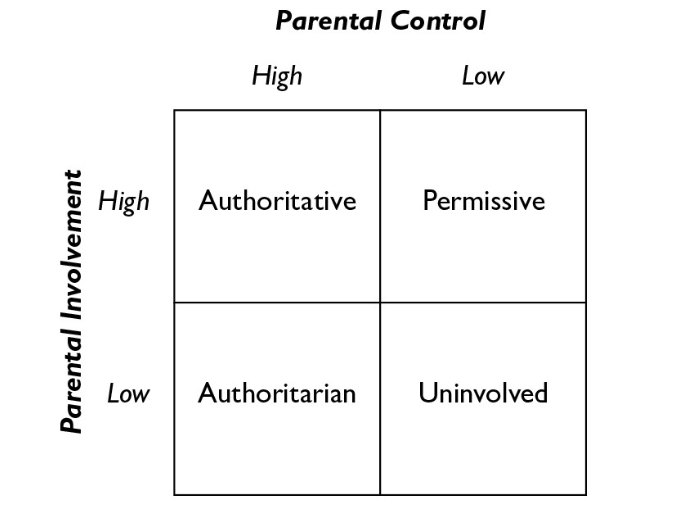
uninvolved parenting often leads to the most damage in children
authoritative parenting is ideal
higher self-esteem in children and preform well academically
variations in parental style
views about ‘proper’ amount of warmth and control vary by culture
varied by parents’ socioeconomic status and stress level
3 parenting styles (DOF)
direct instruction
telling a child what to do, when and why
observing
learning what should not be done
feedback
indicate when a behavior is appropriate and should continue or stop
Influence of Marital System
chronic parental conflict is harmul for children
parents should work together in a coordinated manner toward shared goals for the child's development
lack od teamwork, competition for childs attention, and gatekeeping often causes problems
Children’s Contributions
influence between parents and children is reciprocal
Parents behave differently depending on childs specific behavior (may become more controlling with ‘difficult’ child)
Impact of divorce on children
boys are more effected
losing touch with fathers, keeping emotion in
affects childrens school achievement, adjustment, self concept, and relationship with parents
risk of emotional/behavioral problems is higher for children of divorce but the majority will not experience long-term effects
negative effects of divorce are related to parental absence, economic hardship, and conflict between parents
blended families
as divorce became more common in the 20th century so did blended families
Preferential treatement for bio over stepchildren will almost always lead to conflict
with effort, blended families can be beneficial
the role of grandparents (ISAPD)
grandparenting styles:
influential
supportive
authority-oriented
passive
detached
children benefit from their active involvement
often take on the parental role in immigrant and minority children
children of LGBT parents
no indication that they are less effective as parents
develop much like children raised by hetero parents
firstborn, laterborn, and only children
first born
deal with the stricter parents
generally have higher intelligence scores and more likely to attend uni
more willing to conform to adult request
later born
parents have more realistic expectations
tend to be funnier, more popular, and innovative
only children
more likely to succeed in school, have higher levels of intelligence and self esteem
dont differ in popularity, adjustment, or personality
adopted children
develop within typical range
problems are more likely to occur when children are adopted after infancy and when their care pre-adoption was poor
today, open adoption is common
have contact with birth families
these individuals are well adjusted as they tend to have a deeper identity than as an adoptee
qualities of siblings relationship
avoid distress with birth of new sibling by being responsive to older sibling
sibling relations tend to be established early and remain consistent
development of peer interactions
parallel play, associative play, cooperative play
solitary play can be important for childrens cognitive development
secure maternal attachment relationship contributes to positive peer relationships
at elementary school age children become more skilled at maintaining peer relationships
friendships
become more complex with age
having good friends affects children positively (for self esteem)
friendships can be negative (co-rumination)
romantic relationships
sexual exploration is an important part of romantic relationships in early adolescence
comprehensive sex education programs are important or reducing risky sexual behavior
the roots of attraction to members of the same sex are not yet well understood
some evidence suggests that heredity and hormones influence sexual orientation
groups/peer influence
cliques and crowds are common during adolescence
most groups have a dominance hierarchy
negative examples: gangs
peer influence is strongest when:
youth are younger and more socially anxious
peer have higher status
peer are friends
standards for appropriate behavior are unclear
popularity and rejection (PRCAN)
most children fall into one of 5 categories:
popular - many students will say they like this child
rejected - many students do not like this child
can be taught social skills
repeated rejection in childhood can have long term consequences
controversial - alot say they like and alot do not
average
neglected - no votes and left out
childcare and afterschool activities
high quality childcare has positive effects on cognitive and social-emotional development
can improve school readiness for low income families
children and adolescents who participate in structured after-school activities are often better adjusted, have higher self-esteem, and are more likely to participate in further education
neighborhoods
children who live in economically advantaged and stable neighborhoods tend to preform better academically and are less prone to behavioral and emotional problems.
local healthcare, recreational opprotunities, and high quality childcare contribute to positive development
school
successful schools:
orientation to academic excellenc
safe and nurturing climate
parenting involvement
encourage parents to tutor students
progress is monitored
several factors of teachers are also critical
maltreatment and its consequences
abused children face alot of developmental issues
adults who were abused are more prone to suicide and to abuse their own spouses and children
children who are ego-resilient exhibit fewer negative consequences
causes of maltreatment
cultural and social factors
cultural attitudes, poverty, stress from absent parent(s)
parental factors
abusive parents often faced abuse themselves, inadequate parenting skills, dysfunctional marriages
child factors
“challenging”, ill, stepchildren, and young children are often abuse victims
preventing maltreatment
change societal attitudes toward acceptable punishment
eliminating poverty and other stressors
providing parents with better education child development, parenting, coping skills, and social support