1.1 Solving Linear and Rational Equations
 Call Kai
 Learn
Learn Practice Test
 Spaced Repetition
 Match
Match Flashcards
 Knowt Play
1/10

Earn XP
Description and Tags
Vocabulary and strategy flashcards covering linear equations, clearing fractions and decimals, identifying restrictions, and solving rational equations.
Name | Mastery | Learn | Test | Matching | Spaced | Call with Kai | Chat |
|---|
No analytics yet
Send a link to your students to track their progress
11 Terms
Linear Equation
An equation where the variable has a highest exponent of 1, does not sit in a denominator, and is not multiplied by itself, generally taking the form ax+b=cx+d.
Strategy for Linear Equations with Integer Coefficients
The basic four-step strategy to get x by itself: Simplify (distribute before combining terms) → Move variable terms together → Move constants together → Divide.
No Solution (Linear Equations)
An outcome that occurs when variable terms cancel out completely during solving, leaving an impossible statement such as 4=9.
Infinitely Many Solutions (Linear Equations)
An outcome that occurs when variable terms cancel out completely during solving, leaving an identity or statement that is always true, such as 4=4.
LCD Method for Equations with Fractions
The technique of clearing fractions by multiplying every single term on both sides of an equation by the Least Common Denominator (LCD).
Decimal Elimination Strategy
The method of clearing decimals from an equation by multiplying every term by 10 (for one decimal place) or 100 (for two decimal places).
Rational Equation
An equation containing one or more rational expressions where a variable appears in a denominator (for example, x2=5).
Restrictions (Rational Equations)
Values that the variable cannot equal because they would make a denominator in a rational equation equal to zero (for example, x=2 for x−25).
Strategy for Rational Equations Leading to Linear Equations
The complete step-by-step procedure: Restrictions → LCD → Multiply every term → Solve → Check restrictions.

Cheat Sheet: Sections 1–3 Summary
A summary chart detailing recognition and actions for linear equation fundamentals: 1. Recognizing linear equations (Variable only to 1st power → Identify whether linear); 2. Integer coefficients (No fractions/decimals → Simplify, isolate x); 3. Fractions (Fractions in equation → Multiply by LCD).
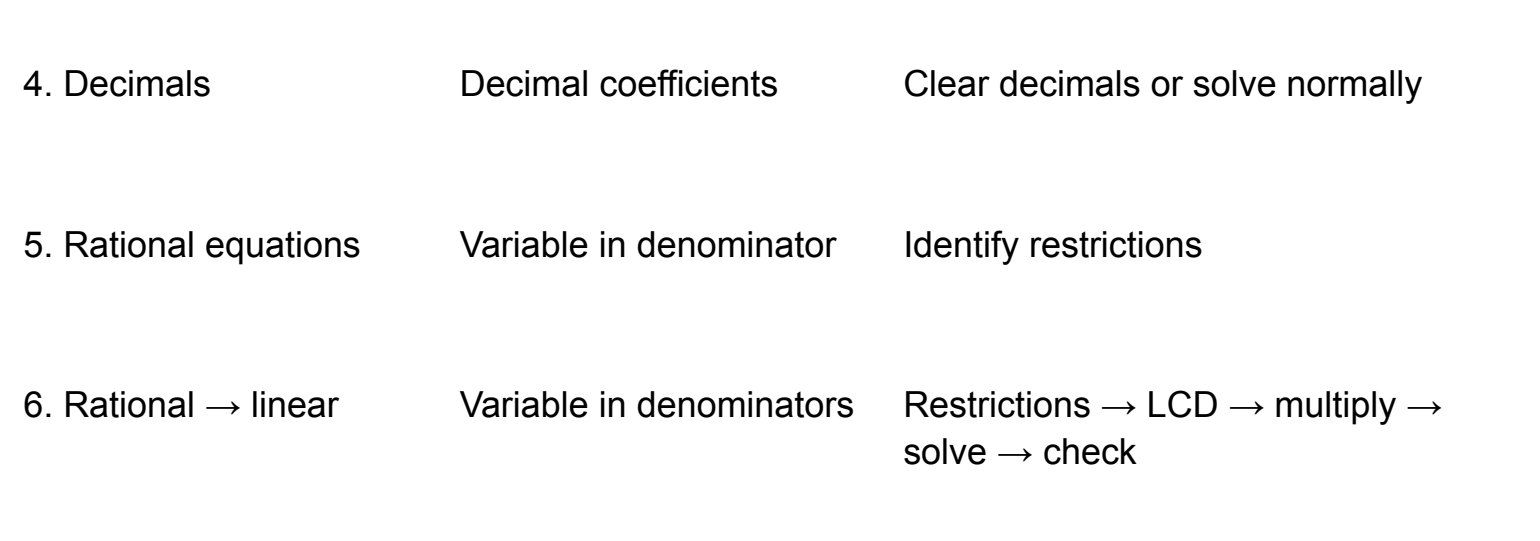
Cheat Sheet: Sections 4–6 Summary
A summary chart detailing recognition and actions for decimals and rational equations: 4. Decimals (Decimal coefficients → Clear decimals or solve normally); 5. Rational equations (Variable in denominator → Identify restrictions); 6. Rational → linear (Variable in denominators → Restrictions → LCD → multiply → solve → check).