Physio lecture body fluid compartments and transport
 Call Kai
 Learn
Learn Practice Test
 Spaced Repetition
 Match
Match Flashcards
 Knowt Play
1/28

There's no tags or description
Looks like no tags are added yet.
Name | Mastery | Learn | Test | Matching | Spaced | Call with Kai | Chat |
|---|
No analytics yet
Send a link to your students to track their progress
29 Terms
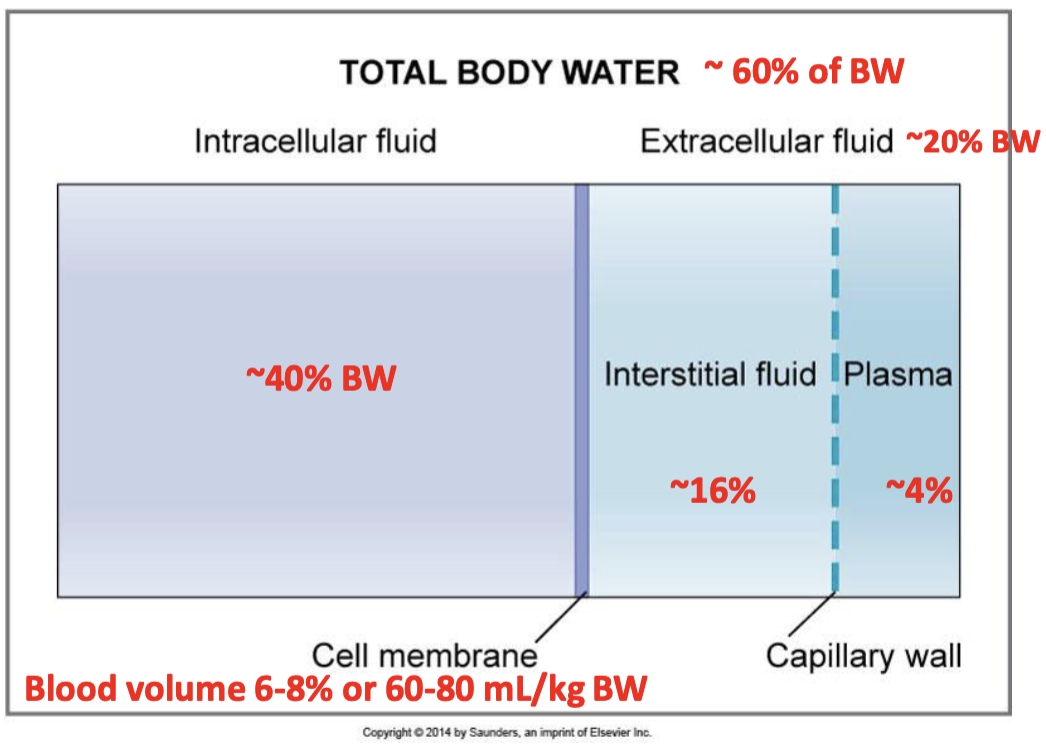
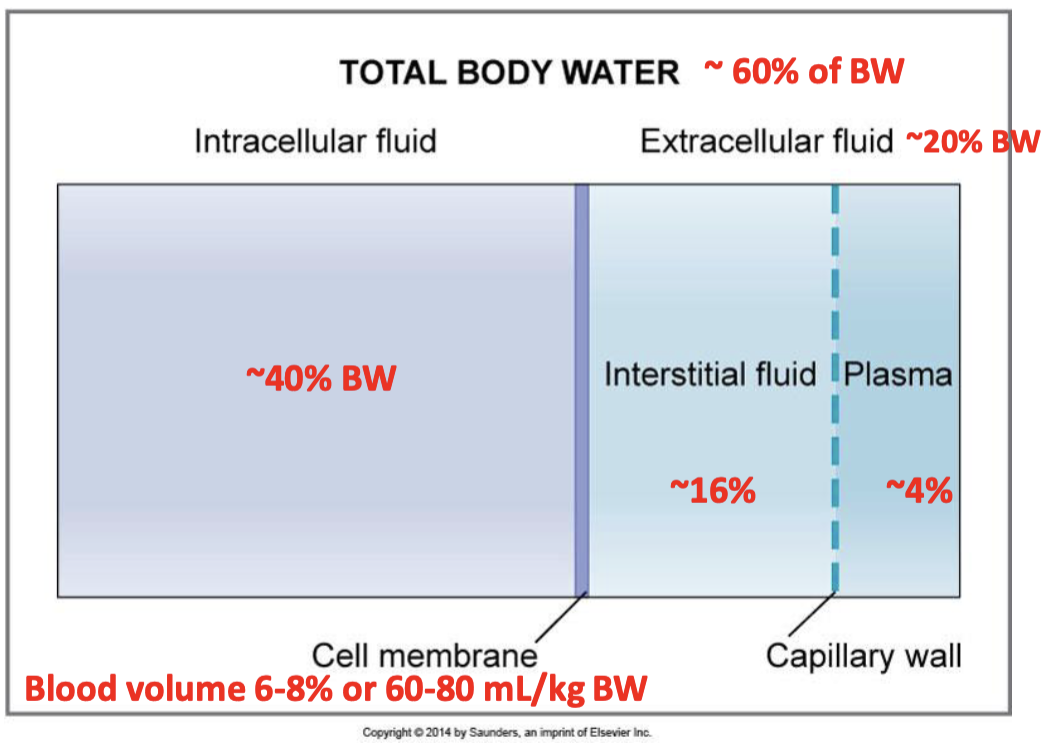
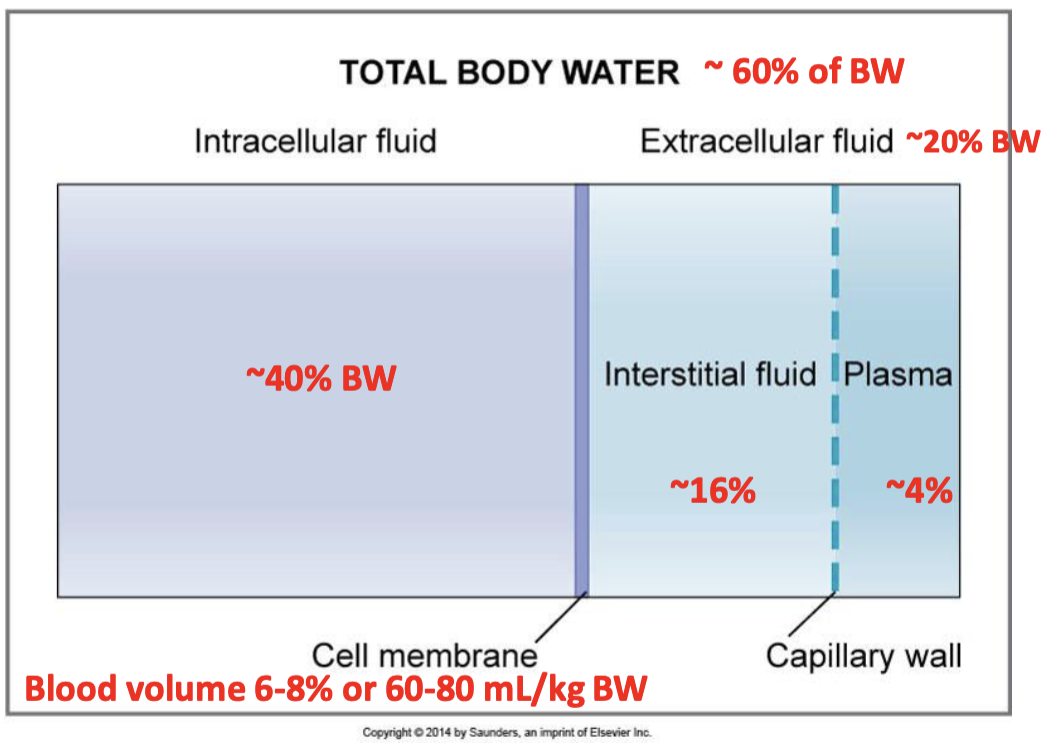
Total Body Water =?
60% of BW
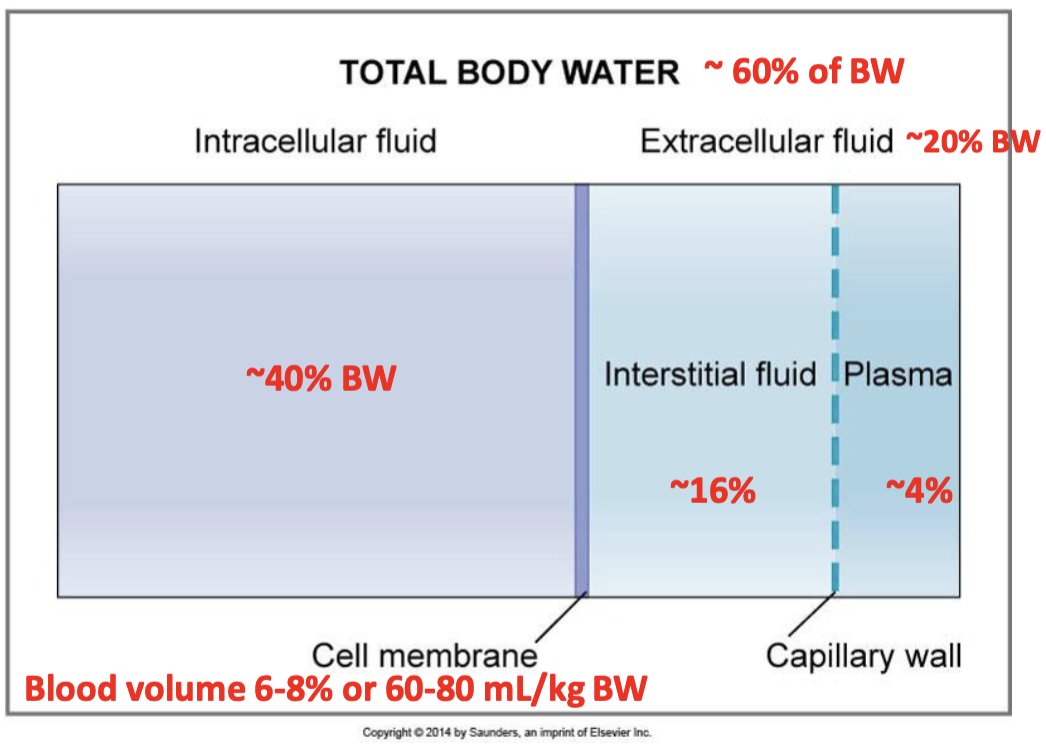
How much total body water does a 20 kg dog have?
20kg x 0.6 = 12kg =12 L (liters or mL because talking about a fluid)
Intracellular fluid = ?
40% of BW
Lean animals have a higher have a ____________ amount of body water than obese animals
higher
Extracellular fluid =?
20% BW
(Within extracellular fluid) interstitial fluid?
16%
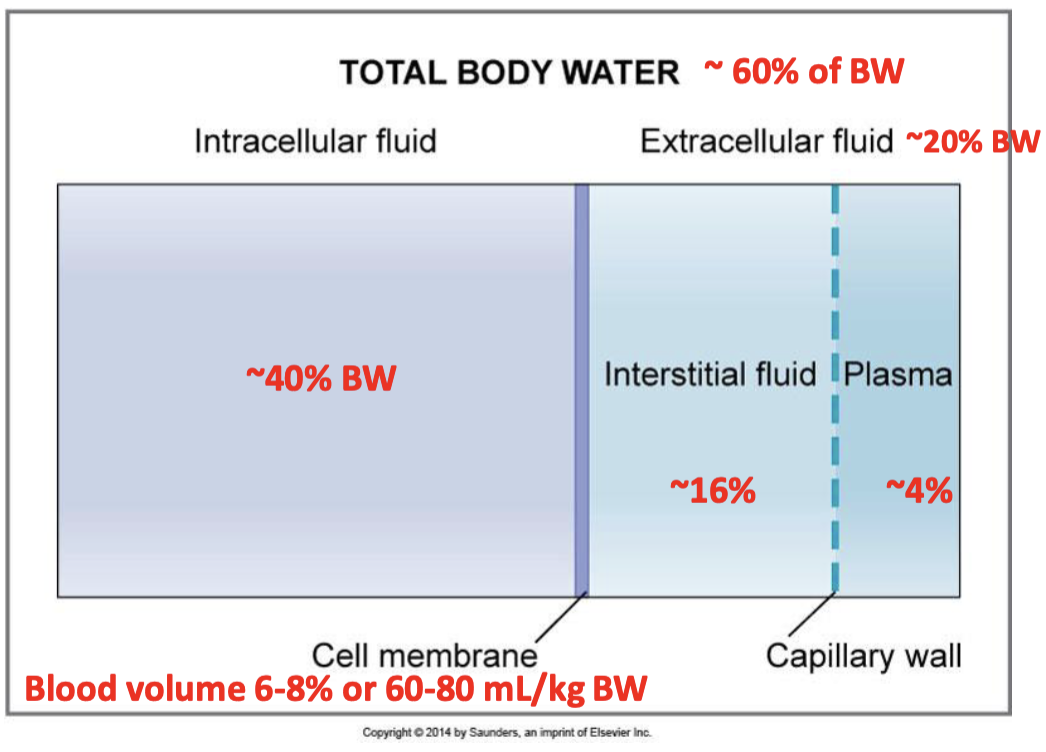
(Within extracellular fluid) plasma=?
4%
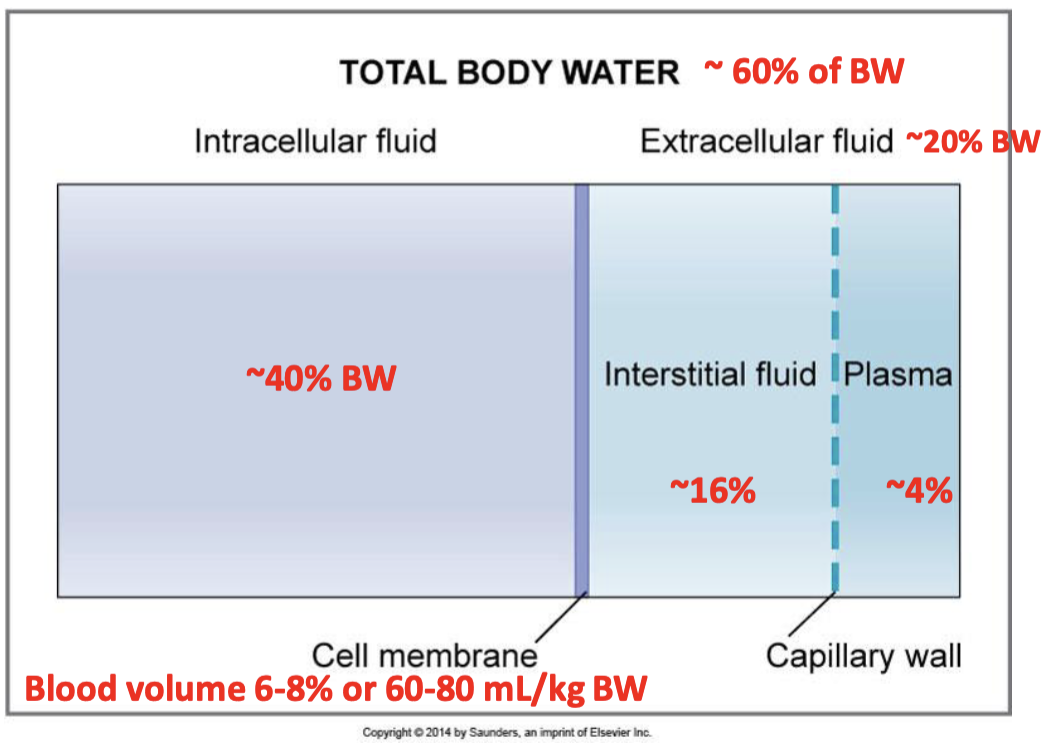
Body volume = ?
6-8% or 60-80 mL/Kg BW
What is the ECF volume of a 105kg pig?
105kg x .2 = 21L or 21,000 mL
Average blood volume =?
70 mL/Kg BW
Memorize Numbers in the chart important **
Mole =
Amount of substance
Equivalent=
Amount of electrical charge
Osmole=?
Number of dissolved particles
Important ** Measure CONCENTRATIONS in mol/L or mmol/L, mEq/L, Osm/L or mOsm/L
Know this
What does osmolarity determine clincially
Determines water movement between compartments
What is electroneutrality
When each body fluid compartment, total positive charges must equal total negative charges.
major ions in ECF
Cations=
Anions=
Na+
Cl- and HCO3 -
Major ions in ICF
Cations=
Anions=
K+
Proteins and organic phosphates
**** slide 6 Osmolarity same in ECF and ICF —> electroneutrality maintained
290- 300 mOsm/L
Na+/K+ ATPase pump does what (uses ATP)
Pumps Na+ out of the cell
Ca2+/ATPase pump (uses ATP)
Pumps a out of cells
What allows nerve and muscle cells to have a resting membrane potentials
K+ difference
What allows upstroke of action potentials in nerve and muscle cells, and absorption of nutrients due to
Na+ differences
Excitation contration coupling in muscle cells depends of what
Ca2+ differences
cell membranes are ______ permeable
Selectively
ransporters for glucose, amino acids, Ca2+, H+ utilize Na+ gradient, but dont directly use energy→ ?
secondary transporters
Cell membrane characteristics
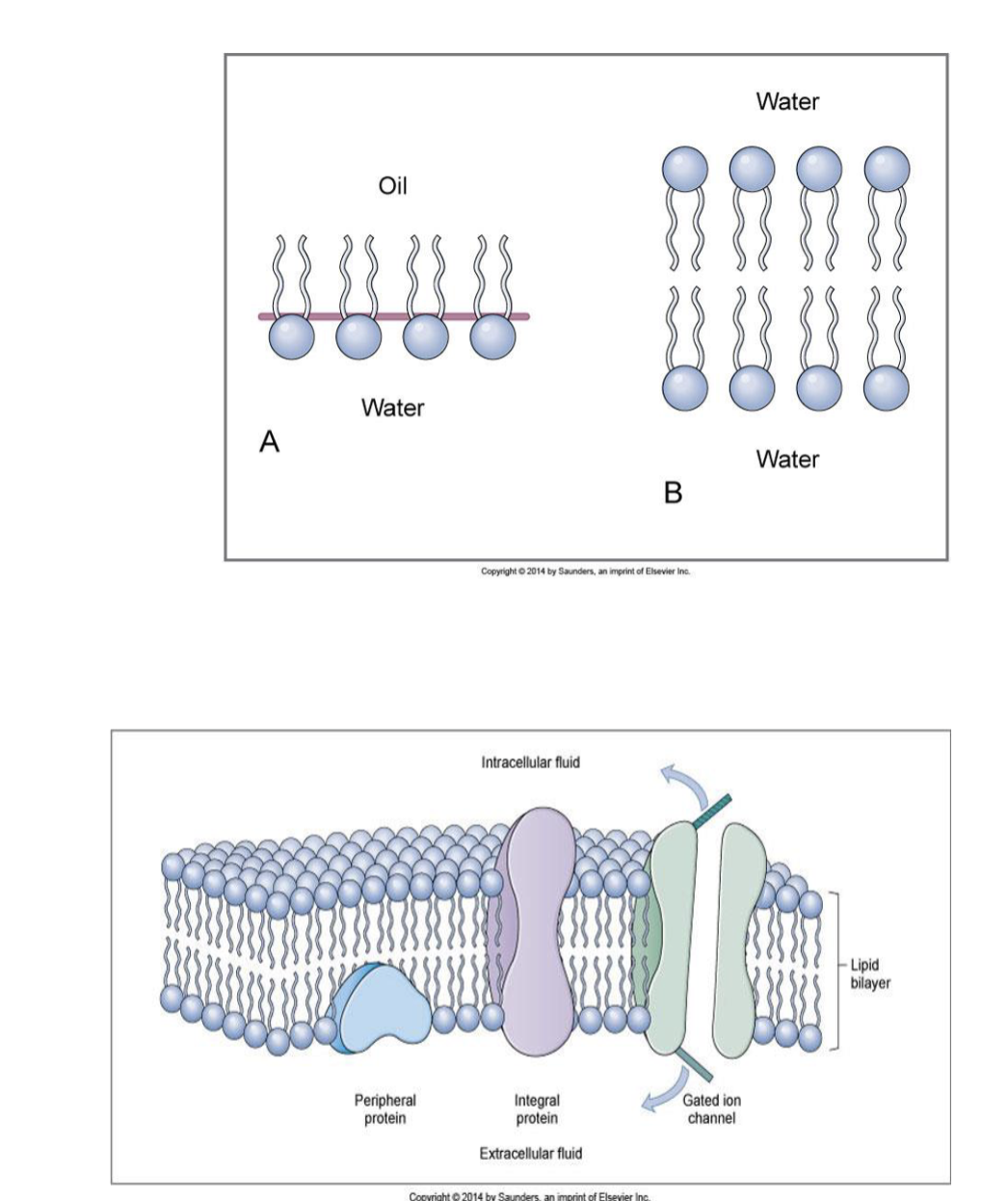
Composed of lipids and proteins