Infants (1month-1yr) & Communicable Diseases
 Call Kai
 Learn
Learn Practice Test
 Spaced Repetition
 Match
Match Flashcards
 Knowt Play
1/63

Earn XP
Description and Tags
Infants (1month-1yr) & Communicable Diseases
Name | Mastery | Learn | Test | Matching | Spaced | Call with Kai | Chat |
|---|
No analytics yet
Send a link to your students to track their progress
64 Terms
What are the growth charts used for biological development?
Birth → <2 years = WHO
2 → 20 years = CDC
Weight gain:
6 months → 2x birth weight
12 months → 3x birth weight
Daily weight gain:
0-3 months = 30 g/day
3-6 months = 20 g/day
6-12 months = 10 g/day
Length growth
Birth → 6 months = 1 in/month
6-12 months = ½ in/month
Important physical changes during infancy time
Posterior fontanel closes by 2 months
Breathing:
Slowly start breathing via nose + mouth
Reflexes:
Moro, Stepping, Rooting fade by 4-6 months
Teeth:
Deciduous (primary) teeth begin to erupt
Begins growing chewing/biting skills
Gross motor skills: Utilizes large muscle groups
Rolling
Sitting
Crawling
Standing
Walking
Infant develops from head to toes
Cephacaudal/Proximodistal
Arm → Hand → Fingers
Gross Motor Milestones:
1 month → Turn head while supine
Head lag: poor head control when turning infant from lying to other position
2 month → Hold head up while on tummy; moves arms & legs
4 months → Holds head w/out support; pushes onto elbows/forearms
Commando crawling: use of arms/upper body to move along floor
6 months → Rolls tummy → back; pushes up w/straight arms; supports self w/hands while sitting
9 months → Goes sitting position by self; sits w/out support
12 months → pulls to stand; cruises along furniture
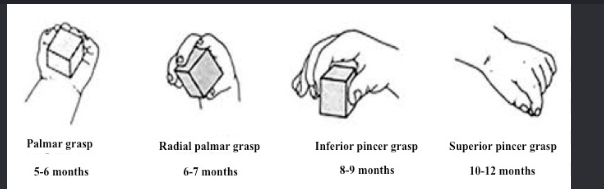
Grasp progression:
1 month → tight fist
2 month → briefly opens hands
4 months → crude palmar grasp
Using palm w/out thumb to grasp objects
Hold toys placed in hand
Brings hand to mouth
7 months → radial palmar grasp
fingers + opposing thumb
8 months → scissors grasp
Side of index fingers + thumb
9 months → transfer from hand to hand
Uses fingers to rake food
11 months → shake + throw objects
12 months → pincer grasp
Thumbs + index fingers
drinks from uncovered cup
When does stranger anxiety ususally occur and what they do?
9 months
Shy, clingy, cry, fearful
Object permannce?
Understanding that a person/object keeps existing despite it not being seen
Peek-a boo
6-12 months
Psychosocial milestones:
2 months → relaxes when picked up or spoken too
smiles socially
looks at faces
4 months → Smiles for attention, chuckles
Makes sounds/things to keep attention
6 months → recognizes people
enjoys mirror
laughts
9 months → Stranger anxiety
Facial expressions
Responds to name
Separation reaction
Understands & enjoys peek-a-boo
12 months → Plays interactive games (pat-a-cake)
proto-imperative pointing
Aka “I want THAT”
Starts also developing memory, language, reasoning, thinking, attention
If i do X → Y happens “cause and effect”
Screen time:
AAP: no screen time up to 18 months
WHO: none till 2 years or more
Cognitive Development Milestones:
1-2 months:
Optical focal length of ~10 inches
Responds to stimuli changes; fixates on objects (tracks them horizontally and slightly beyond midline”
Uses sucking and grasping reflex to interact
2-6 months:
Begins exploring via touch
Stares at hands, touches body, explores senses = all contribute to cause/effect learning
6-12 months:
Reaches for, inspects, holds, drops, manipulates, uses for purpose, mouth places objects
Language development + milestones
Hearing → interaction → association → communication
More infant hears, more it develops
Parent interaction:
Talking/Reading/Responding to them
Labeling objects
MIlestones:
2 months: makes sounds other than crying
Reacts to LOUD sounds
4 months: Cooing; makes sounds back; turns toward voices
6 months: Takes turns making sounds
Blows raspberries
Squeals
9 months: mamamama/babababba
Raises arms to be picked up
12 months:
waves bye
“Mama/dada”
Understands “no”
Play in Infants
Social smile: first sign of play
Develops at 4-6 weeks
After 4 months → regular smiling +cooing
3-6 months → seeks interaction and play
Avoid teasing and throwing things during this age
PPD:
Sadness, Guilt, Imcompetence, Anhedonia, Anxiety, Self-harm
May lead to:
Developmental, Emotional, Language, Cognitive Delays
Poor bonding
Interventions:
Provide support
Sleep routines
Self-help
Separation Anxiety:
Normal dev stage
6 months → 3 years
9 months = strongest anxiety
Appears suddenly → intensifies → gradually resolves
Crying, Screaming, Clinging, Refusal to separate
Prolonged can lead to:
Constant fear, loss of securiy
poor bonding and social interactions
Poor feeding
Interventions: Gradual separation
Leave for a short period
Use a trusted caregiver
Keep infant in familiar place
Gradually increase time away
Return
Bowlby’s Attachment Theory:
Attachment-related stress → physical response
Tachycardia
Foundation of Infant Health Promotion:
Safety:
Risks:
Suffocation, Falls, Burns, Chocking, Drowning
Interventions:
Cover outlets, pad sharp edges, locks, supervise
CPR and hemlicks
Alternating back blows + chest thrusts
Nutrition:
Birth → 4-6 months
Formula feeding: 18-20 kcal/oz
use w/in 2 hrs of mixing OR keep in fridge for up to 1 day
Breast feeding: 18-20 kcal/oz
Always discard left overs as it can grow bacteria
~6 months: slowly transition to solid food
Tongue-thrust reflex slowly decreases
One new fee q3-5 days
Sippy cup: water is good when infant can use palmar graps
Honey → ^ r/x for botulism
Food sensitivity
Cow’s milk, Eggs, Peanuts, Soy, Wheat → GI upset, ezcema, asthma
When introducing new foods, wait 3-5 days
AVOID HONEY when <1 year
Nutrition needs Infants:
100kcal/kg/day
40-60kcal/kg/day for metabolic processes
Premature, illness, genetic disorders → ^ energy needs
Start 20-30 mL/kg → increase w/in 7-10 days
colostrum → breast milk
Food Aversion:
Pain + Trauma + Fear
GERD: feeding → pain → aversion
NICU: mouth swabbing, pacifiers, oral procedures
Fear
Intervention:
Non-nutritive sucking → Pacifier
Breast for non-nutritive sucking
Cue-based feeding
Sweet taste to milk
Improve positive oral experiences at home
Vitamins + Minerals for Infants:
Iron:
Helps for hemo and myoglobin formation
v = cognitive and psychomotor issues
Iron deficiency common in:
Premature infants
Exclusively breastfed
Non-iron fortified formula
START GIVING AT 4 months
Until iron-fortified cereal or meats are added to diet
Ferrous sulfate:
Prevents/treats iron deficiency anemia
A/E:
Constipation, Diarrhea
Nausea & Vomiting
Abd pain, Green/Dark stools
Anorexia, Gas
Toom much iron = fatal
Vitamin D:
Deficiency most common in exclusively breastfed infants
Uses:
Calcium, phosphate absorption and uptake
Increases Calcium availability in blood
Start supplementing right after birth
Use a dropper to avoid dosing errors
Toxicity A/E: “hypervitaminosis D”
Nausea, Vomiting
Irritable, Fatigue
Poor feeding, weak, weight loss, dehydration
Vitamin B12:
May require ife parents are vegan/vegitarian diet
Sleep for infants and alterations in them:
Normal amount for sleep:
< 3 months = 16-17 hours
6 months - 1 year = 13-14 hours
Sleep amount factors:
Temperament
Poor self-soothing
Cries often
Environment:
Loud, crowded, activity, no routines
Allow opportunities for infant to self sooth
Don’t necessarly rush to soothe for every cry
Faliure to Thrive:
When infant does not effectively or receive enery for growth
Low intake
High energy expenditure
Low Absorption
Causes:
Malabsorption syndrome
CF, Congenital heart defects
Respiratory or Metabolic Disorders
Neglect, poor parent educatiion
Possible Post partum depression occuring
D/x:
Anthropometric Z-scores:
Compares weight for length AND BMI for age
The more negative z score it is = greater malnutrition degree
Sudden Unexpected Infant Death (SUID):
Umbrella term for unexpected intant death (<1 years old)
SIDS:
Accidental suffocation and strangulation in Bed
Risk:
Maternal:
Age <20
Smokes, Lack of prenatal care
Infant:
Premature, Low birth weight, Overheating
2ndhand smoke, eating too much
Prone sleeping, soft mattress, loose bedding
Sleeping on cushined surface (couch)
Pacifiers may help despite not being fully understood why
PN Scope of Practice regarding Immunizations:
Collect screening data & help find missed/upcomming ones
Assist w/immunizations
Reinforce education
Monitor A/E
Maintain records
Nationally Notifiable Diseases:
Resp/Neuro:
Diphteria
Pertussis
Meningoccall disease
H. Influenza
Poliovirus
Hepatitis:
A,B,C
Vaccine Preventable ones:
Rubella
Tetanus
Varicella
Diphtheria
Pertussis
Poliovirus
Precaution’s Examples:
Contact:
Scabies, excessive wound drainage
C.diff
VRE, MRSA
Droplet:
Pertussis, INfluenza
Menignitis, Adenovirus
Rhinovirus
Group A Strep
Airborne:
TB,SARS-CoV
Rubeola
Varicella
Donning + Doffing PPE
1⃣ Hand hygiene → 2⃣ Gown → 3⃣ Mask/respirator → 4⃣ Goggles/face shield → 5⃣ Gloves
Gloves → Goggles/Face shield → Gown →Mask → Hand Hygiene
Varicella/Chicken Pox
Spread via airborn droplets
Fluid from vesicles
AIRBORNE + CONTACT
Pregnant nurses should avoid caring for these childs
Usually remains latent in sensory nerves and later reactivated as shingles
S/s:
Itchy fluid-filled vessicles → scabs
Chest, back face
Later → mouth, eyelids, g3nitals, scalp
Fever, fatigue, sore throat, headache
T/x:
Acetaminophen → fever/pain
Calamine lotion, Oatmeal baths
Antihistamine → itching
Benadryl A/E:
Drowsy, Dry mouth, v BP
Avoid combination of oral w/topical dyphenhydramine
Fluid intake
Edu:
Avoid scratching via:
Keep nails short, cotton clothing, avoid overheating
Fluid intake, cool baths
Varicella is no longer contagious when → all lesions are crusted and dried
Take vaccine in 2 doses
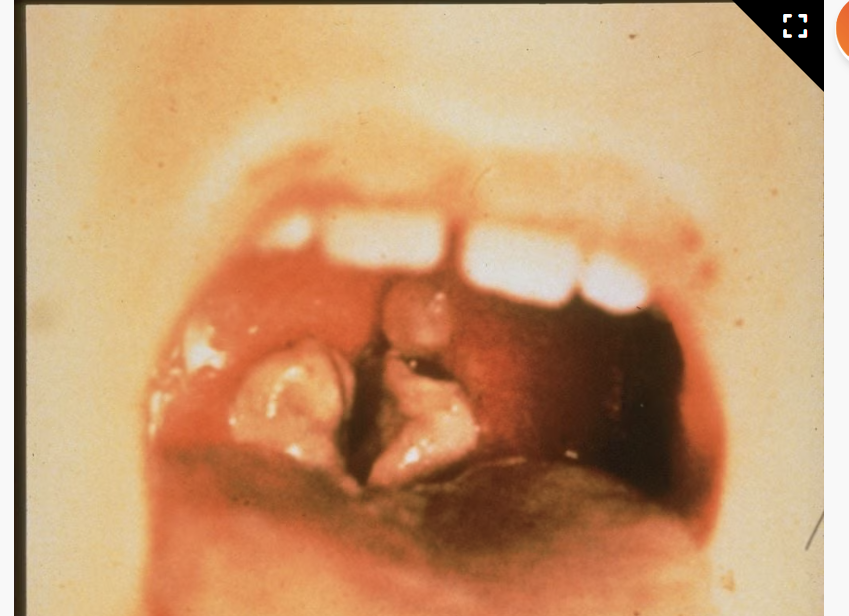
Diphetheria:
Produces a strong exotoxin →
Local inflammation, Sore throat, fever, cervical lymphadenopathy
Gray pseudomebrane: takes around 2-5 days for incubation
Throat, Tonsils, Pharynx → thickens → Airway obstruction
Myocarditis, Neuritis
D/x:
Throat culture, PCR, toxin testing
T/x:
Isolation → Antibiotics → Diphtheria antitoxin (DAT)
Ezythromycin & Penicillin G
Before giving DAT, a/x hypersensitivity → ^ r/x for anaphylaxis
Urticaria risk too
Edu:
Soft diet due to odynophagia
Fluids, quiet/restful place
Keep airway open
Mumps:
From paramyxovirus via respiratory droplets, contact w/saliva, or fomites
7-21 days for incubation
MMR vaccine to prevent
Contagious when:
1-2 days before s/s
5 days after s/s
S/s:
Parotitis: swelling of parotid glands; uni/bilateral
Fever, Headaches, Fatigue, Myalgia, Anorexia
May lead to:
Orchitis, Meningitis, Encephalitis
D/x:
Buccal swab
IgM serology
T/x: none
Rest, Hydration, Analgesics
Warm/Cold compress → parotitis
Cold compress + elevation → orchitis
Soft foods
Measles (Rubeola)
Transmitted via: (highly contagious)
Respiratory, Direct Contact, or AIrbone (2 hours)
MMR vaccine
3 Cs (Cough, Coryza, Conjuctivitis) →Koplik spots (red spots w/white centers on buccal mucosa) → Rash (hairline; moves DOWN) → LOW Vitamin A
D/x:
IgM
PCR
Plaque reduction neutralization assay: Gold standard
T/x: supportive
Hydration, nutrition, rest
fever and infection control
Vitamin A for 2 days
Poliomyelitis
Fecal → oral transmition → replicates in oropharynx & GI → remains in stool for weaks
Contact precautions & IPV and OPV vaccines
Polio = Paralysis
Muscle weakness, paralysis
Often in legs
May lead to → respiratory failure
D/x:
Throat swab, stool, and CSF
MRI, EMG
T/x: supportive
PT, OT, resp support
Nutrition, Hydration
COVID 19:
Leads to inflammatory immune response → severe → cytokine storm → widespread inflammation
S/s:
Fever, Cough, Resp problems
Possibly Asymptomatic
Multisystem Inflammatory Syndrome:
Happens weeks after infection → heart, lyngs, kidneys, gi system issues
Possibly lingering s/s:
Fatigue, Neuro and Resp issues
D/x:
PCR, rapid antigen testing
Swab thing
T/x:
Remdesivir: blocks its RNA polymerase
A/E:
Rash, Nauses, Anaphylaxis, v BP
Vaccines
Airpurification
Meningitis:
Viral:
Enteror, Herpes, Adenovirus
Droplet, Hydration
S/s:
Young:
Hypothermia
Fever, Irritable, vomiting, difficult to arous
Bulging anterior fontanel
Old:
Fever, Headahche, N/V, Photophobia
Nuchal rigidity
Diplopia, Irritable, Lethargic
Risk for SIADH → hyponateria, seizures, etc.
D/x:
Lumbar puncture → CSF
WBC, protein, glucose, culture
PCR if viral suspected
T/x:
Collect specimens → start empiric antibiotics → stop if u find out if it is viral→ IV acyclovir
Bacteria:
N. meningitis, Strep. Pneumoniae
MORE SEVERE → sepsis, heariling loss, hydrocephalus, death
S/s:
Fever, hypothermia, Irritable, Vomiting
Bulging Fontanel, Kernig & Brudzinski
T/x:
Empiric antibiotics, antipyretics, analgesis, hydration
Dark, quiet, HOB >30
Neutral body alignment
Meningitis CSF:
Finding | Viral | Bacterial |
|---|---|---|
WBC | >100/mm³ | >1,000/mm³ |
Protein | Normal → mildly elevated | Elevated |
Glucose | Normal → mildly low | <40 mg/dL |
Meningitis Precautions:
Droplet precautions
Continue until:
24 hours after IV antibiotics have been administered.
Close Contacts
Certain close contacts may require prophylactic antibiotics.
Hepatitis:
A:
N/V, Diarrhea, Fever, Fatigue
Jaundice
T/x:
Hydration, supportive liver care
HAV, sanitation
B:
Prodormal phase:
Malaise, v appetite, RUQ pain
Icteric phase:
Jaundice, Yellow sclera, Hepatomegaly, Dark urine
Pale stools
D/x:
HBsAG, IgB testing
T/x:
Supportive care if Acute
Antivital Therapy if Chronic
HBV
C:
Asymptomatic or malaise + v appetite
May lead to chronic infection
Infectious Mononucleosis:
Epstein Bar virus
Saliva Transmission “Kissing disease”
3-6 wks incubation
Often occurs in 15-24 yr olds
S/s:
Fatigue
Pharyngitis
Lymphadenopathy
Headache, Maialse, Fever
Splenegomegaly → Splenic rupture
Edu:
Avoid strenuous activities or contact sports
D/x:
Monospot antibody testing
^ WBC
T/x: supportive
Rest, Hydration, NSAIDs
Cool/soft food
Salt water gargles
Throat lozenges
Roseola Infantum
from HHV-6 → reproduces in leukocytes and salivary glands → disrupts blood-brain barrier → febrile seizures
No current vaccine for it
Respiratory droplets + saliva contact
Mostly around 6-12 months females
Children w/older siblings at higher risk aound spring to fall
S/s:
Phase 1: High fever >104/40 for 3-5 days
irritable, periorbital edema
Otalgia, Anorexia, COugh
Cervical Lymphadenopathy
DEHYDRATION
Phase 2: Rash
Rose pink, maculopapular, nonpruritic → neck, face, extremities
Fever disappears
T/x: supportive:
Hydration, v fever meds, rest, lightweight clothing
Avoid overheating, breast milk + E+ solutions
May return to normal life after 24 hr fever subsides
Fifth Disease:
Parvovirus B19; around 5-15 years in spring → early summer
Via resp droplets, blood exposure, & direct contact
S/s:
Early:
Fever, Malaise, Headache, Myalgia, N/V, Diarrhea
Most contagious phase
Then → slapped cheeck rash → lacy/net like rash]
Nonpruritic around trunk and extremities
No longer contagious, asymptomatic
Arthropathy: common in females
High risk population:
Pregnancy, Hemolytic (sickle cell), Immuno compromised
D/x:
Parvovirus B19 IgM antibodies
T/x: supportive
Rest, Hydration, Fever + Pain management
Join pain control
Hand, Foot & Mouth disease:
Due to human enterovirus + Coxsackie Virus
<5 yrs; MOST contagious in first 7 days
Fecal oral (diaper changes); resp/oral secretions; direct contact from vesicle fluid; indirect fcontact (fomites)
Can remain in poop for 6 weeks → oropharyngeal shedding around 4 weeks (CONTACT PRECAUTIONS)
Always maintaine hygiene even after child improves
S/s:
Early → low grade fever, sore throat, malaise
Painful shallow ulcers
Red borders w//white bases → odynophagia and paonful water drinking
Hands + Feeet → rashes
Also in buttocks, perineum, extremities
May lead to: Vital meningitis & encephalitis
D/x: clinical
T/x: supportive care for 7-10 days
Fluids, NSAIDS, soft foods, cold nutrition
No current vaccine
Impetigo:
Highly contagious bacterial infection w/honey colored crusts; fibronectin receptors exposes → colonization
Staph aureus, Group A strep
Around 2-5 years; summer → fall
Infants are more likely for bullous impetigo
Nonbullous:
Vesicles rupture → honey colored crust
Face & mouth; lymphadenopathy
BUllous:
Small vesicles merge → large bullae → clear/yellow → purulent & dark
Fever + Lymphadenopathy
T/x:
Nonbullous → Mupirocin topical; use oral if more systemic s/s or more lesions present
Apply 3x/day small amount
Before, use soap + water to soften/remove crusts
Bullous → oral antibiotics (Cephalexin)
Give w/w/out food and shake oral suspension; use accurate measuring device
Nonadherence to meds leads to →
Rheumatic fever
Acute post-strep glomerulonephritis
Conjuctivitis:
Bacterial:
Moraxela, strep. pneumonia, H. Influenza
Contact → touches eye
S/s:
Red sclera, thick purulent drainage, itchy
Eyelashes → crust, mat, cant open
T/x: supportive for 7-10 days
Topical antibiotics (Ciprofloxacin opthalmic)
May be temporary burning or stinging or blurry vision = OK!
Compresses, sterile saline, avoid rubbing eyes
Viral:
Most common; adenovirus/HSV/Enterovirus
S/s:
REd + watery sclera w/discharge
Itching + Tearing
Sore throat + Rhinorrhea
UPPER RESP INFECTIONS
HSV may lead to blindness
T/x: supportive
Compresses, artificial tears, avoid eye rubbing
Acyclovir
Allergic:
Pollen, pet dander, air pollution
S/s:
Intense itching, edness, tearing, eyelid edema
Both eyes, NO discharge
T/x:
v exposure
Topical antihistamines + Mast cell stabilizers
Epinastine ophtalmic
Remove lenese, wait 10 mins before switching them
Air purifier, cool compresses, rinse w/water/saline
Foreign-body:
Sudden redness, excessive tearing, urge to rub → removal → redness + tearing + v pain → for 24-48 hours
T/x:
Flush w/sater, saline, fake tears
iF chemical: flush
Stomatitis:
Inflammaito of moral/oral tissues
Herpetic Gingivostomatits:
HSV-1
DIrect contact w/saliva or lesions; HIGHLY CONTAGIOUS
S/s:
Painful oral lesions in gums, toungues, inside cheeks
Bleeding gums, high fever,
Poor nutrition & dehydration
D/x:
VIral culture of tissue = GOLD STANDARD
T/x:
Acyclovir w/in 72 hrs of infection
Aphthous Stomatitis:
>10 years
T-cell immune dysregulation from stress, malnutrition, trauma, genes → v Vitamin D, C & zinc
NOT CONTAGIOUS
S/s:
Painful, flat, round sores in inner lips, cheeks, toungue and floor of mouth
T/x:
v pain + inflammation
Corticostreioids like acetonide (topical)
Cool liquids, hydration, soft foods, gentle oral hygiene, saline warm rinses
Antibody/Immunoglobin:
Y-shaped protein made by B cells
Neutralize, Osponize (tag), Activate complement, ADCC
Types:
IgM: First one introduced during infection
IgG: most abundant in blood stream; important for long term immunity
IgA: Bodily secretions; localized protection
IgE: Allergic reactions + defense against parasites
IgD: Found on B-cell surfaces
M = Made first
G = Greatest amount in blood
A = At secretions
E = Eczema/allergies
D = Development/surface of B cells
Antigen Types:
Exogenous: outsid eof the body
Bacteria, Viruses, Pollen, Food proteins
Autoantigen: from own
Autoimmune disease
Important Immunology Terms:
Antitoxin: neutralizes
Botulism, Tetanus, Snake bite uses
Immediate passive immunity effect: providing ready antibodies to use
Attenuation: weakening pathogen while making it capable of making a immune response
live-vaccines “varicella vaccines”
Cocooning: protecting immunocompromised ppl by immunizing group circle
Innate immunity: immediate nonspecific defense one is born with
Skin, Mucous
Macrophages, Neutrophils, NK cells
INFLAMMATION
Adaptive:
B + T lymphocytes
Immunomodulators: meds that modify it
Suppress or enhance immune activity
Monoclonal antibodies: Lab produced antibodies
For cancer, AI, Infectious disease
T-cell therapy: use of own immune cells + new ones to destroy cancer or pathogens
Immunization types:
Immunoglobulin Therapy: giving donor antibodies
IVIG → IV
SCIG → subcut
HBIG → IM
Provides passive immunity
Toxoids: inactivated toxins to stimulate immune response
Diphtheria or Tetanus toxoids
Vaccines:
Combination vaccines
COnjugate vaccines: polysaccharide antigen attached to carrier protein → stronger response
Helps kids develop antibodies
Strep. pneumonia, H. influenzae, N. menigitis
Monovalent: one pathogen/strain
Polyvalent: antigens from multiple strains
Influenza vaccine
Haemophilus Influenzae Type B (Hib):
Prevents menigitis AND epiglottits:
Schedule:
2 months → 4 → 6 → 12-15 months final booster
IM
Vastus lateralis for infants
Deltoid for >3 yrs
DO NOT GIVE IF <6 weeks
A/E:
Erythema, Edema, Fever
Hepatitis A & B Vaccine:
A:
12-23 months → 2nd 6 months later
Early travels may have earlier dose but still stick to routine series
B:
within 24 hrs of birth → 1-2 months → 6-18 months
Low birthweight first is 1 month
IM
Mild fever
Polio Vaccine:
IPV: inactivated
Injectable
2 → 4 → 6-18 → 4-6 years
at least 6 months between doses 3 and 4
DO NOT GIVE if bebe has acute febrile illness (^ temp, resp illness)
OPV: oral drops
Pneumococcal Vaccine:
For strep pneumoniae:
Prevents pneumonia, meningitis, sepsis
PCV: pneumoccocal conjugated
2→ 4 → 6 → 12-15
PPSV: pneumoccocal polysaccharide
Recommended for higher risk patients
Sickle, Asplenia, Immunocompromised
IM
Possible soeness, fever, sleep issues
MONITOR 15 mins after due to possible allergic reaction OR syncopy
Rotavirus Vaccine:
Prevents gastroenteritis, whcich can lead to diarrhea → vomiting → dehydration
Live-attenuated + Oral drops
2 → 4 OR 2 → 4 → 6
Must be given before 15 weeks; avoid after 8 months
Contradictions:
Intussuspetion, SCID, allergies
Possible mild Vomiting or diarrhea
Varicella Vaccine:
Protects against chickenpox 🐔
12-15 → 4-6 years
Live-attenuated
Subcut or IM
Subcut in triceps or anterolateral thigh
Avoid giving w/pregnancy or poor immunity
POSSIBLE febrile seizure or pneumonia from it
DTaP vs Tdap:
DTAP: <7 years
2 → 4 → 6 → 15-18 → 4-6 years
Tdap: >7 years
11-12 years → q10 years for boosters
IM
Caution with
Guillian Barre syndrome; or severe pain after dose
MMR vaccine:
Protects against Measles, Mumps, Rubella
12-15 → 4-6 years
Live vaccine iven Subcut (triceps)
Avoid if:
Pregnancym, poor immune
SEVERE allergy to neomycin
May cause febrile seizures
HPV vaccine:
Prevents warts, cervical/anal/vaginal/penile cancer
Start at 9-14 years first dose → 2nd 6-12 months later → 3 doses after → dose 1 is month 0 → 1-2 months after 2nd → 6 months in 3rd
IM: deltoid
Syncope, Muscle pain, fever may occur
Meningoccal Vaccine:
Protects against meningitis or bloodstream infection
MenACWY:
11-12 years → booster at 16years
If older than 16; only give one dose
MenB:
16-18 years; 2-3 doses
More for college students, military recruits, high-risk travelers
IM
Influenza Vaccine:
Every year beginning at 6 months of age
after 9 years → 1 dose qyear
<9 years: 2 doses first
LAIV contraindications:
Gelatin allegy, v immune, aspirin therapy, wheezing/asthma
COVID vaccine:
Given at 6 months of age → 2-3 doses
5-11 years: one dose of current vaccine
>12 years: one dose
Annual boosters used
May lead to myocarditis or Pericarditis
Scabies:
Infection of mites → burrow to skin → lay eggs there → eggs hatch → inflammatory response → INTENSE pruritus
Eggs hatch w/in 2-3 weeks
Prolonged direct skin to skin contact or via linens/clothing/bedding
S/s:
INTENSE night itchin
w/in interdigitals, wrists, genitals
Tiny linear burrows
Possible impettigo or cellulitis
T/x:
Permithirin cream → disrupts sodium ion influx in them
Avoid placing near eye, nose, ear, mouth, vagina
X for <2 months old
Cool baths, cold + damp compresses
Trim nails
Perducolis/Lice:
Via close contact or personal things/items/bedding
Pruritus, nits, small red bumps
T/x:
Premethrin
Apply 1 week after too to prevent resistance
avoid lindane with children
Pinworms:
Small-white thread worms that lay eggs in anys
Takes 4-8 weeks to mature
S/s:
Perianal itching at night
D/x:
Tape test: collects eggs w/tape in early morning
t/x:
Mebendazole
Possible abd pain
Bath in morning
Giardiasis:
Protozoan parasite; fecal-oral
entersc → affects intestinal epithelium → malabsorption → watery diarrhea, abd cramps, bloating, gas, fatigue, v weight, deHYDRATION
D/x:
Giardia cysts via 3 stool samples
T/x:
Metrodinazole
Possible Nausea and/or metallic taste and/or flu s/s
Sanitation, Boil water
POSSIBLE temporary Dairy intolerance