Lecture Exam 1.3-1.4
 Call Kai
 Learn
Learn Practice Test
 Spaced Repetition
 Match
Match Flashcards
 Knowt Play
1/100

There's no tags or description
Looks like no tags are added yet.
Name | Mastery | Learn | Test | Matching | Spaced | Call with Kai | Chat |
|---|
No analytics yet
Send a link to your students to track their progress
101 Terms
experimentation has showed us that unneeded cells are
NOT lost as differentiation occurs, they simple are not used
Altough diff types of cells are needed to express unique sets of genes,
all cells came from the same fertilized egg, and so largely have the same genome
What is the basis for cell differentiation/specialization
differential gene expression
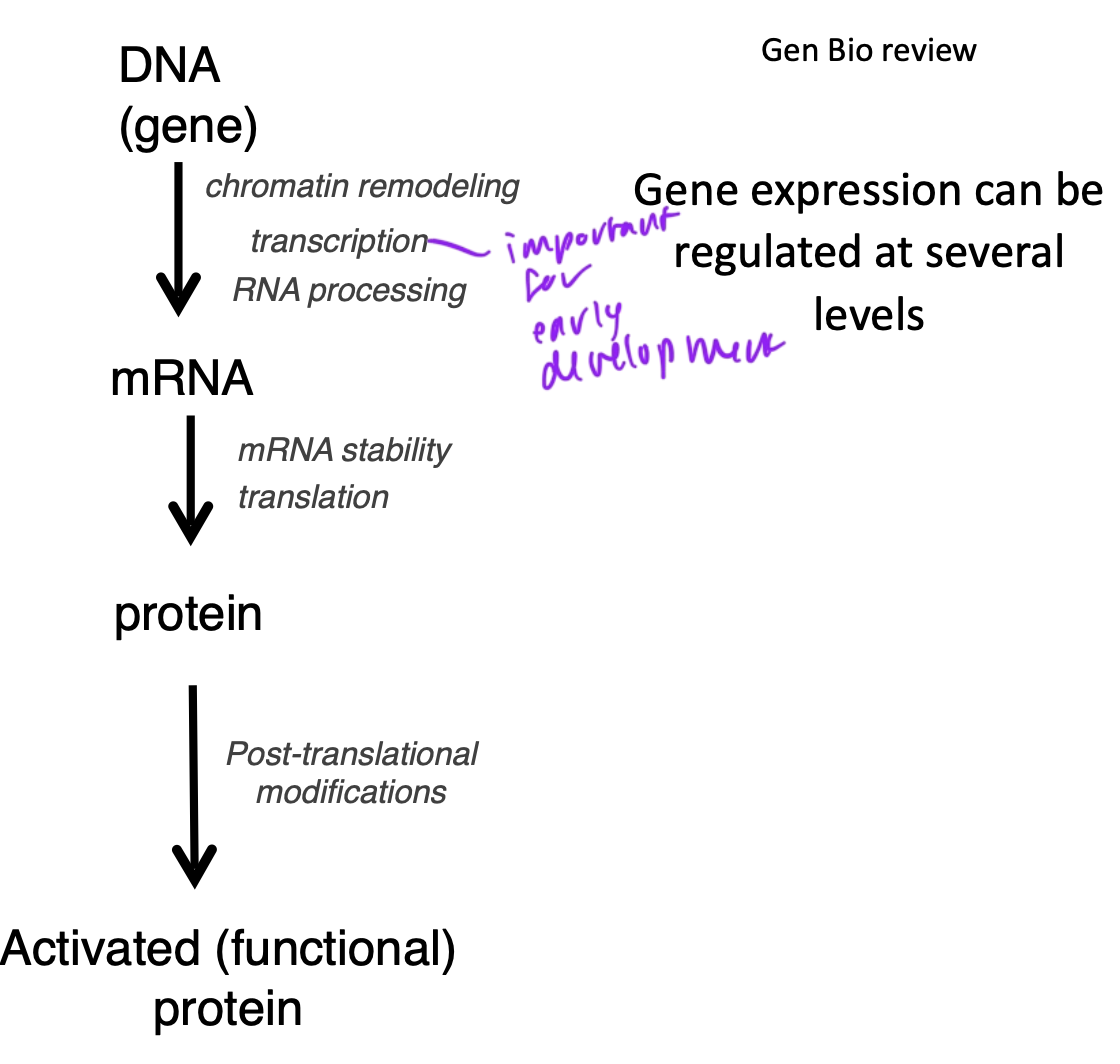
gene expression at the level of _____ is vital for early developmental changes
transcription
What are some physical ways differential gene expression occurs
histone modifications
DNA methylation
Chromatin 3D architecture
all changes chromatin to make certain areas more/less available to be transcribed
diff cells express diff sets of ______
TFs, which in turn bind to different enhancers/silencers in other genes to turn certain genes on or off
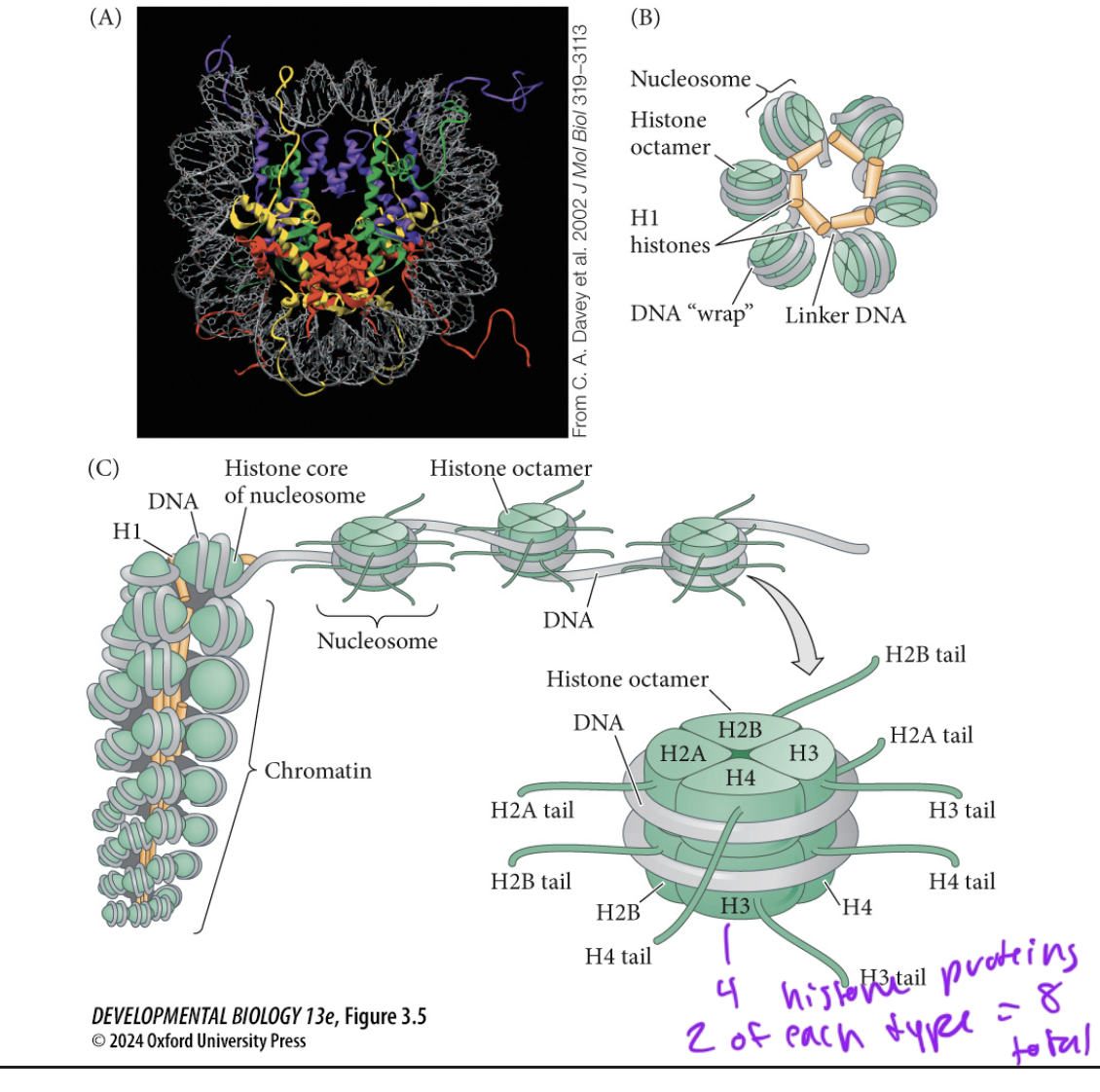
histones
proteins that help organize chromatin
nucleosomes contain 2 of each of the 4 types of histone proteins, to form a 8 protein total complex/octamer
histone modifications
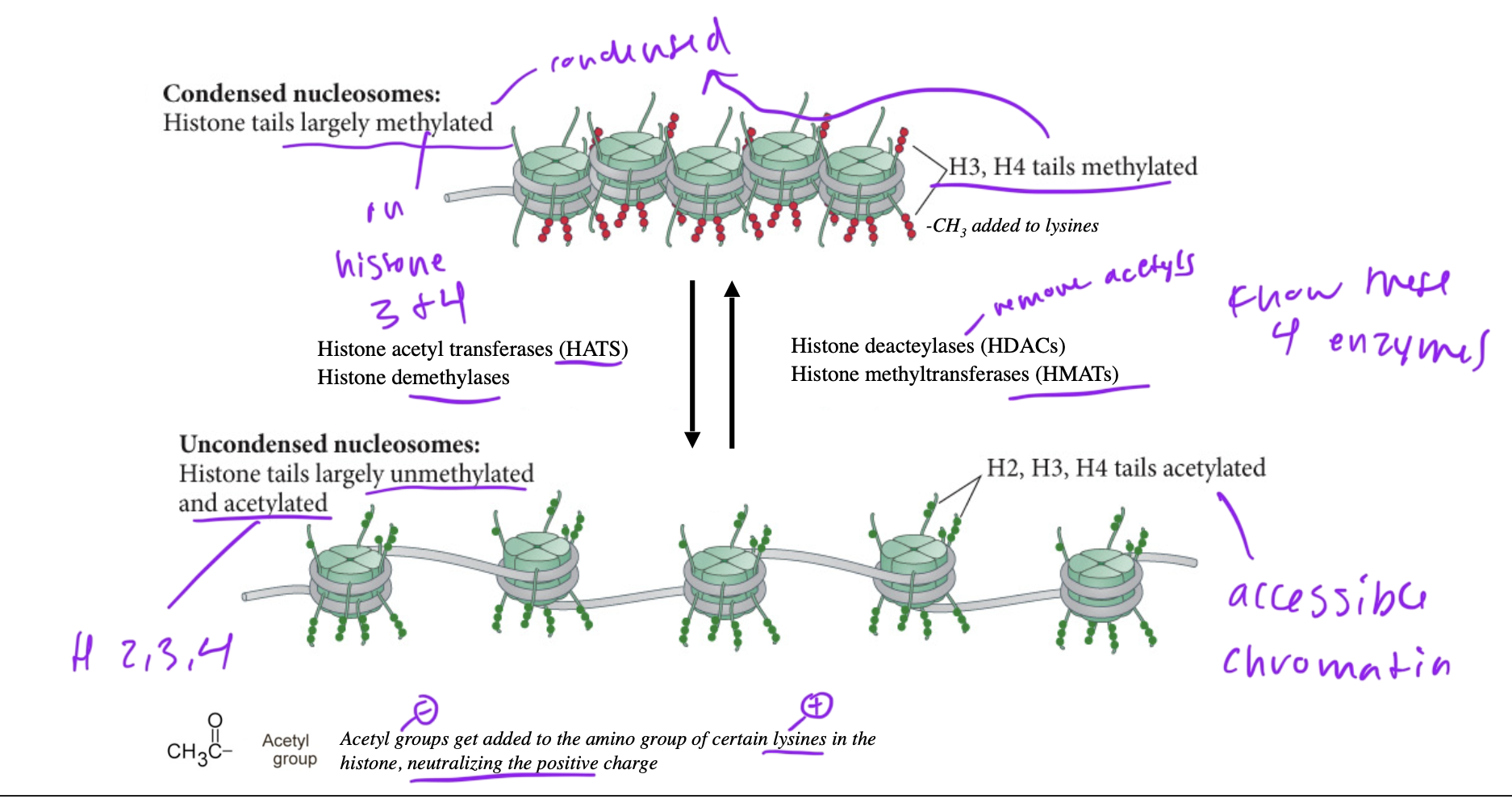
if histone tails are methylated and deacetylated, it promotes condensed chromatin
when the histone tails are mostly unmethylated and acetylated, it promotes opened up and decondensed chromatin
histone tails get methylated on histones ____
3 and 4
promotes condensation
HATS
histone acetyl transferases
adds acetyl groups onto histone 2,3,4
promotes chromatin decondensation

histone demethylases
remove methyl groups from histones, promoting decondensation of chromatin
HDACs
histone deacetylases
remove acetyls from histone, especially at histone tails 2,3,4
promotes chromatin condensation
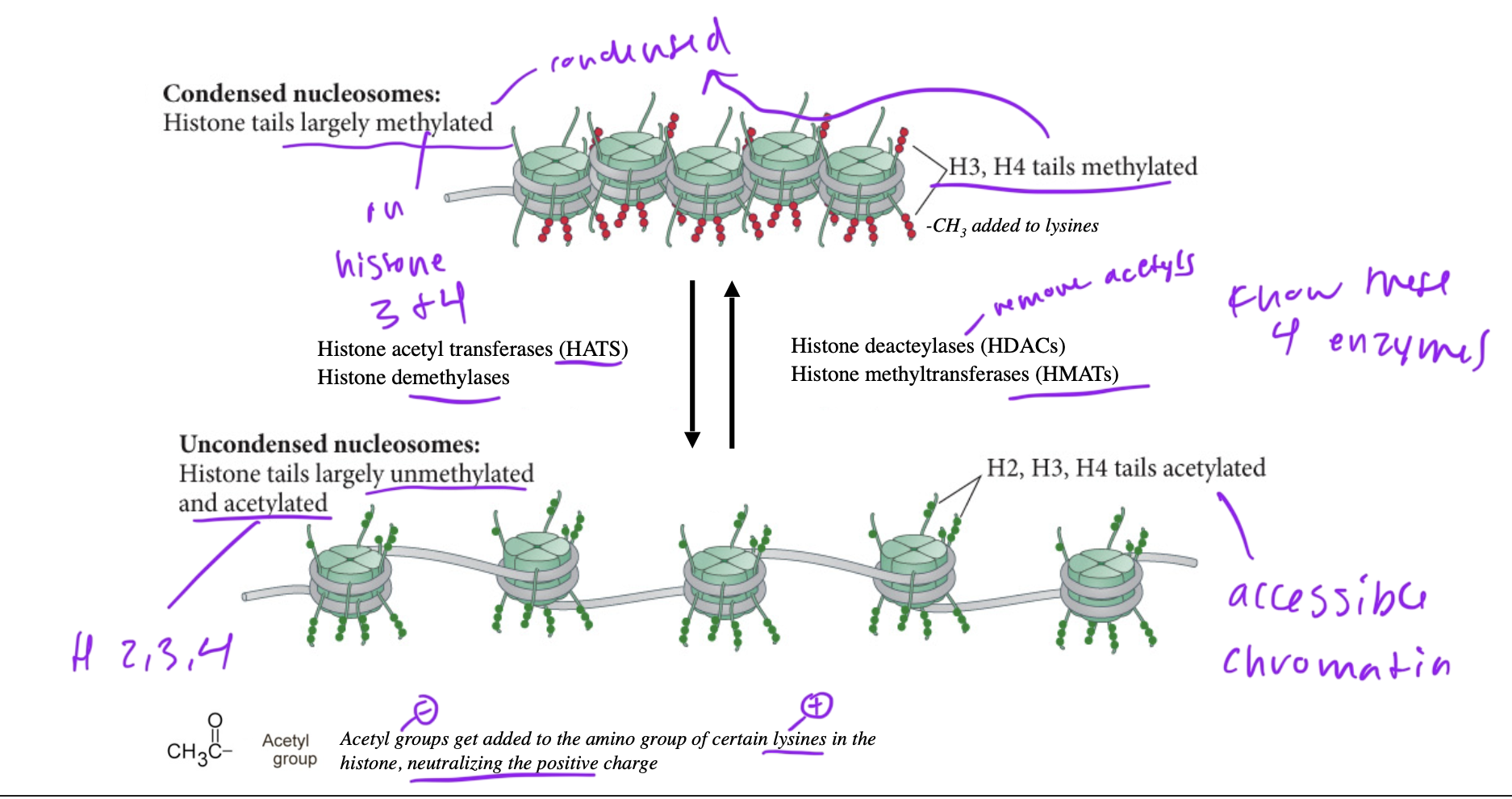
HMATs
histone methyltransferases
adds methyl groups onto H3, 4
promotes chromatin condensation

What promotes chromatin decondensation?
adding acetyls (HATS)
removing methyls (histone demethylases)
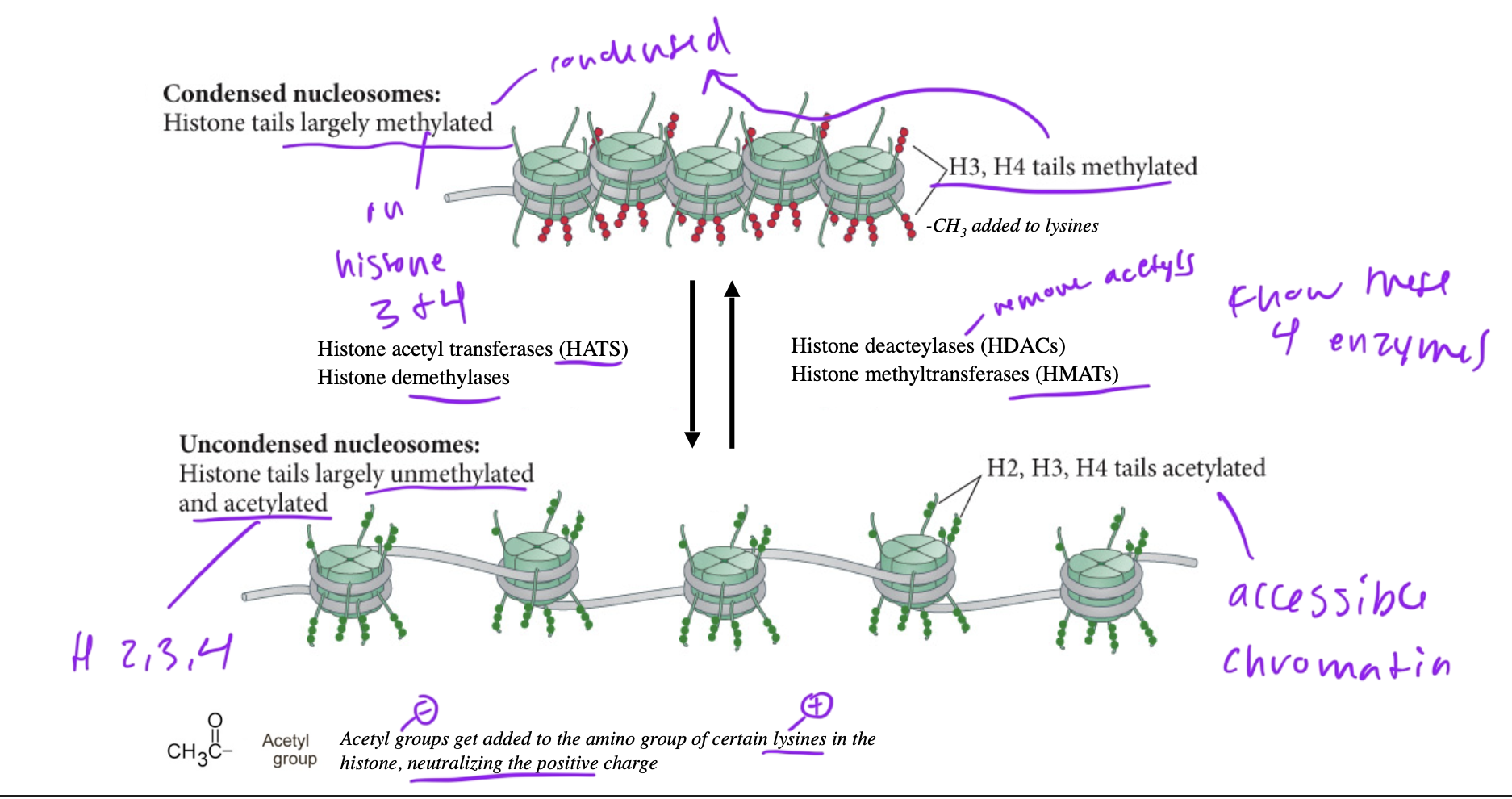
What promotes chromatin condensation?
removing acetyls (HDACs)
adding methyls (HMATS)

Regarding histone methylation/acetylation, acetyl groups (neg) get added to the ____
amino group of certain lysines (which are pos) in the histones
this forms a neutral complex
which histones get methylated/demethylated
3,4
which histones get acetyled/deacetylated?
2,3,4
DNA methylation of regulatory regions in genes typically…
blocks transcription
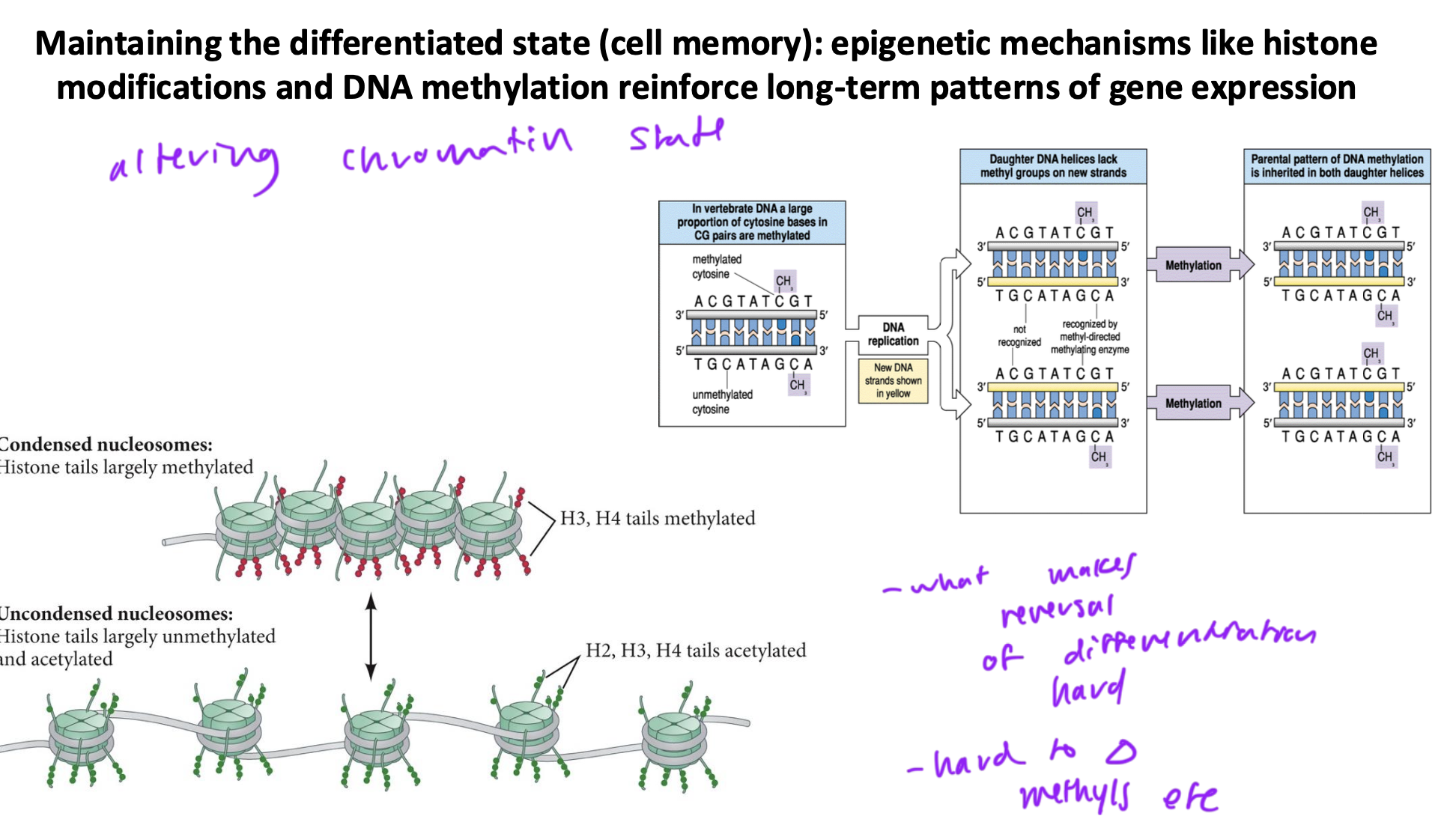
in vertebrates, many cytosine bases in CG pairs of the DNA sequence are methylated, forming 5-methylcytosine
when DNA replication occurs, only the parent strand remains methylated, so it is deemed hemi-methylated
can then be methylated again at the C of a CG, can block transcription of certain genes

How does DNA methylation actually block transcription?
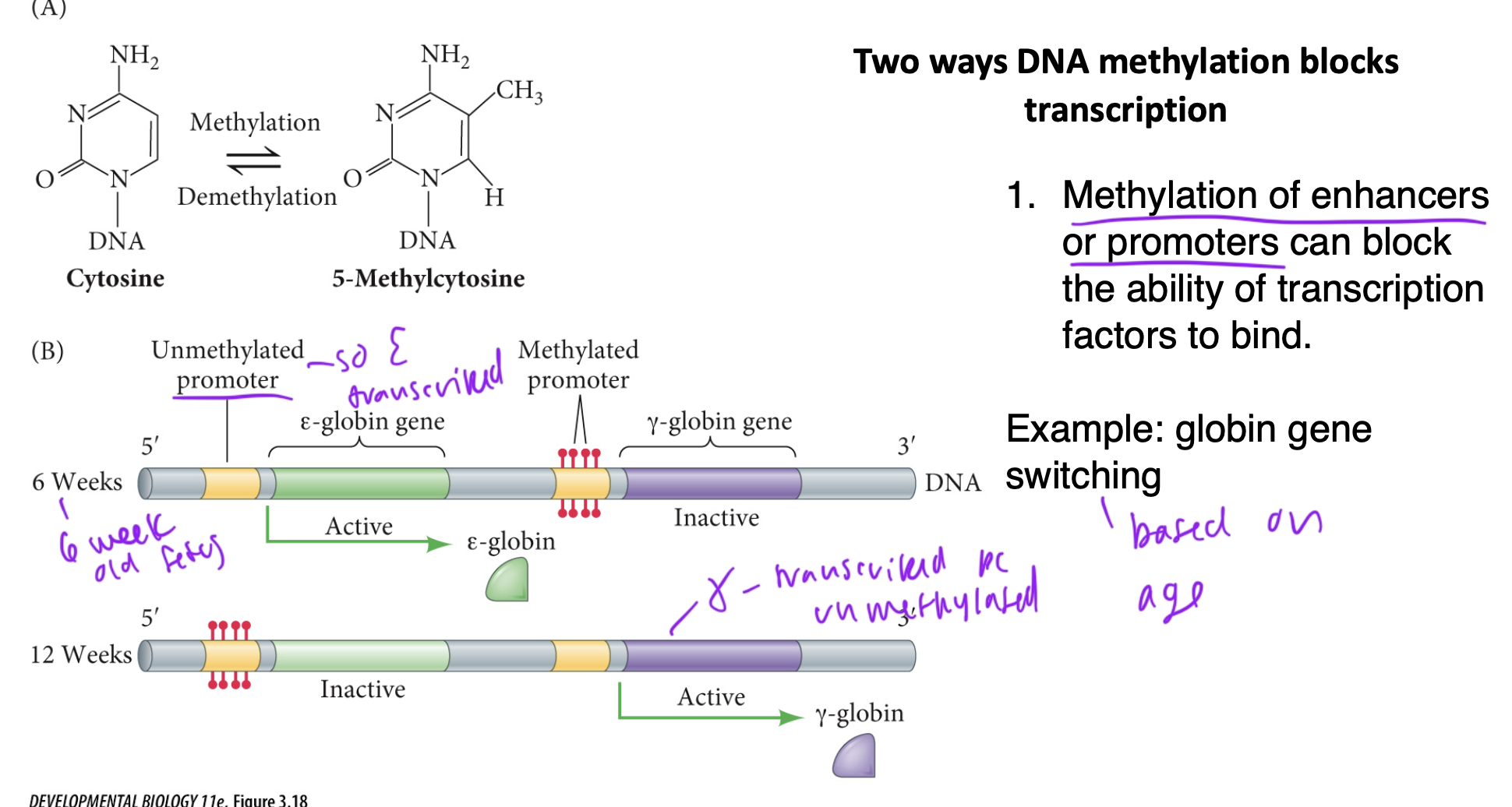
methylation of enhancers or promoters can block TFs from binding to the sequence
methylated DNA can recruit histone modifying enzymes, which promote chromatin condensation and inhibit transcription
What happens when enhancers or promoters get methylated
can block TFs from binding to the sequence
ex: in globin gene switching, so that fetus has diff globins
unmethylated regions get transcribed as usual
What happens when methylated DNA recruit histone modifying enzymes
histone deacetylase or HMAT could be recruited
promotes chromatin condensation and inhibit transcription

coding region of a gene
contains the info to actually make a protein (the exons) as well as introns, which are non-coding regions

what are some regulatory elements in gene expression
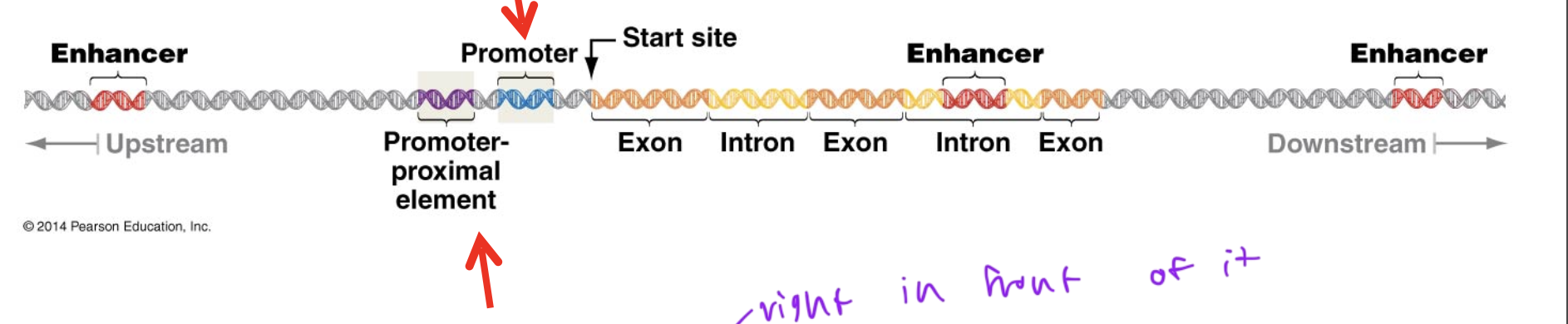
promoter
promoter proximal elements
enhancers
silencers
which two regulatory elements on genes can be found anywhere?
enhancers and silencers
RNA polymerase assembles where?
at the promoters
and the promoter proximal element goes right in front of it (goes just upstream of the promoter)
promoters
conserved sequences near the transcription start site, where RNA poly assembles to help initiate transcription
ex of a promoter: the TATA box
promoters are position dependent
if an enhancer is deleted,
then the gene will could not be transcribed
enhancers bind to
TFs that promote transcription
silencers bind to
TFs that inhibit transcription
position-independent regulatory dequences on genes
enhancers and silencers
TFs
proteins that bind to regulatory regions of DNA and influence RNA Poly’s ability to initiate transcription
basal/general TFs
bind to the promoter itself
so are similar in diff cell types
ex: TBP (TATA-binding protein), TFIID
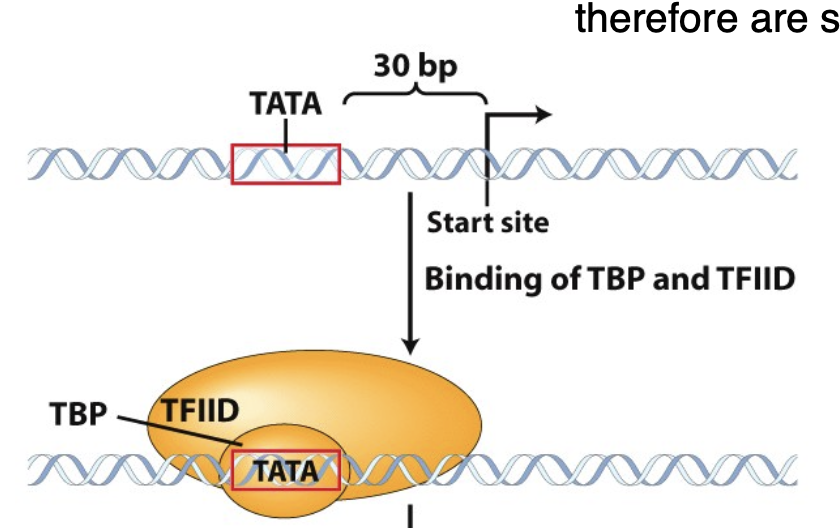
regulatory TFs
bind to promoter-proximal elements, enhancers, or silencers
so vary for each cell type
expressed depending on what genes a cell needs at a given pt in time
a single type of regulatory TFs could regulate…
multiple genes
as long as the genes have the correct type of regulatory elements for the TF to bind to)
related genes can be turned on as a set because
a single type of TF can regulate multiple diff genes
How do activating regulatory TFs work
promote transcription by recruiting histone-modifying enzymes that relax chromatin
so would recruit histone acetylase (HAT) and histone demethylase
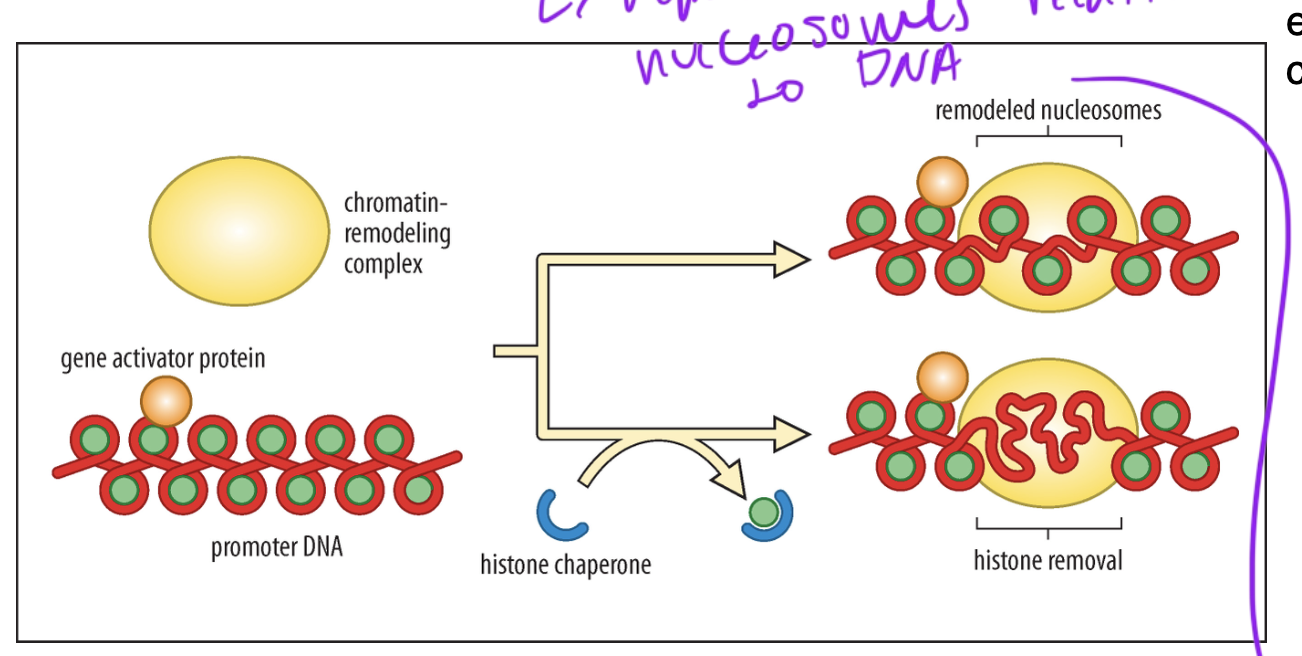
OR could recruit chromatin-remodeling complexes, which displace histones/reposition DNA in nucleosomes to make certain sequences more accessible
OR could promote assembly of RNA Poly onto the promoter
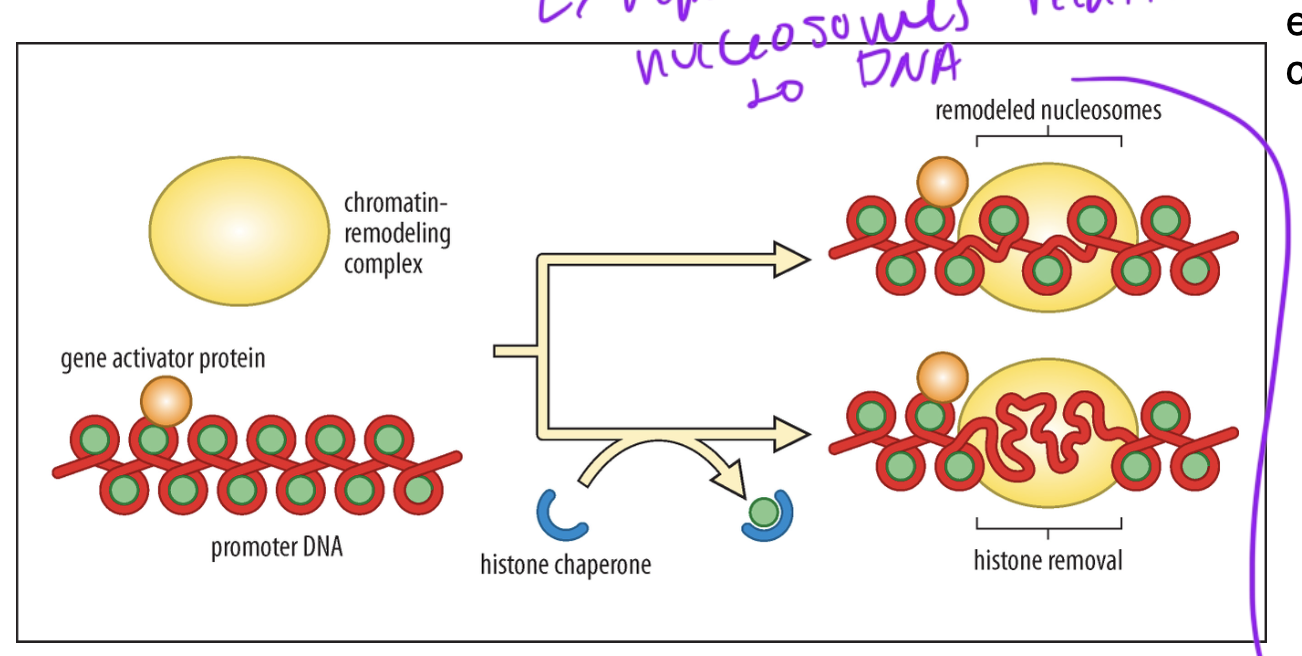
chromatin remodeling complexes
reposition nucleosomes relative to DNA to make certain parts of the genome more accessible
Activating regulatory TFs promoting assembly of RNA Poly onto the promoter
uses a mediator complex of ~ 12 proteins to get RNA Poly onto the promoter to promote transcription of a certain part of the genome
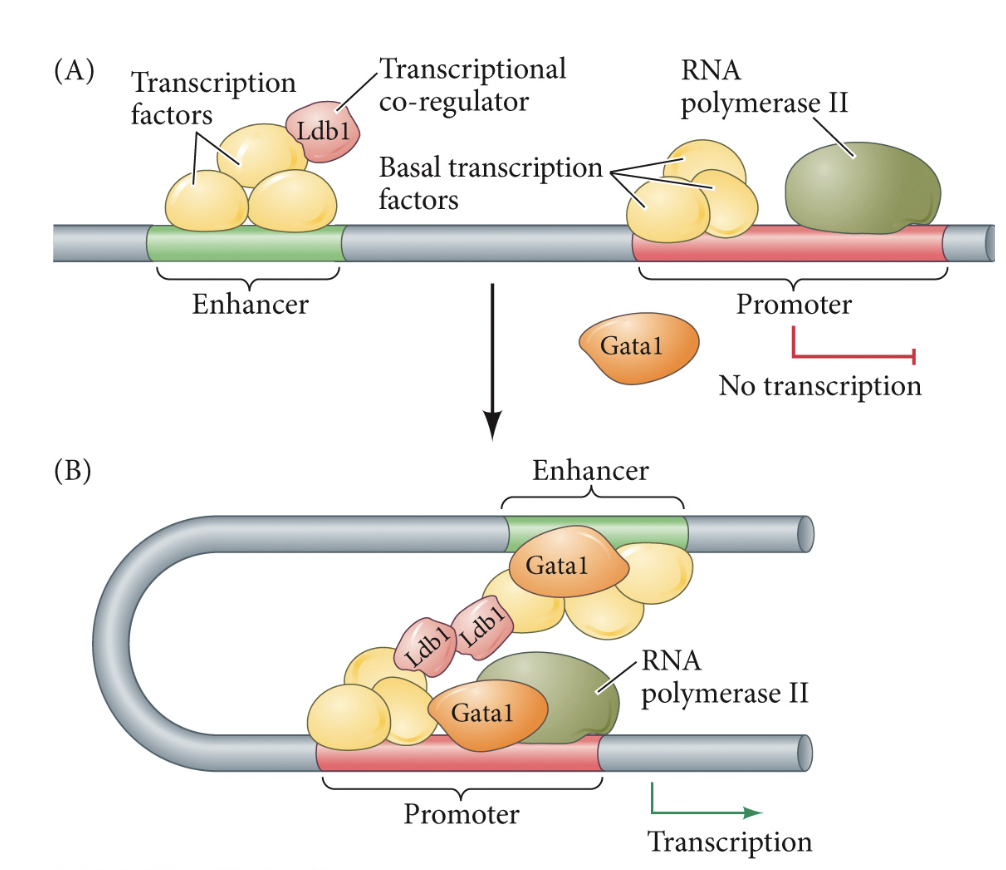
mediator
a complex of ~ 12 proteins
regulatory TFs bound to enhancers bind to mediator (a complex) to help position RNA Poly onto the promoter
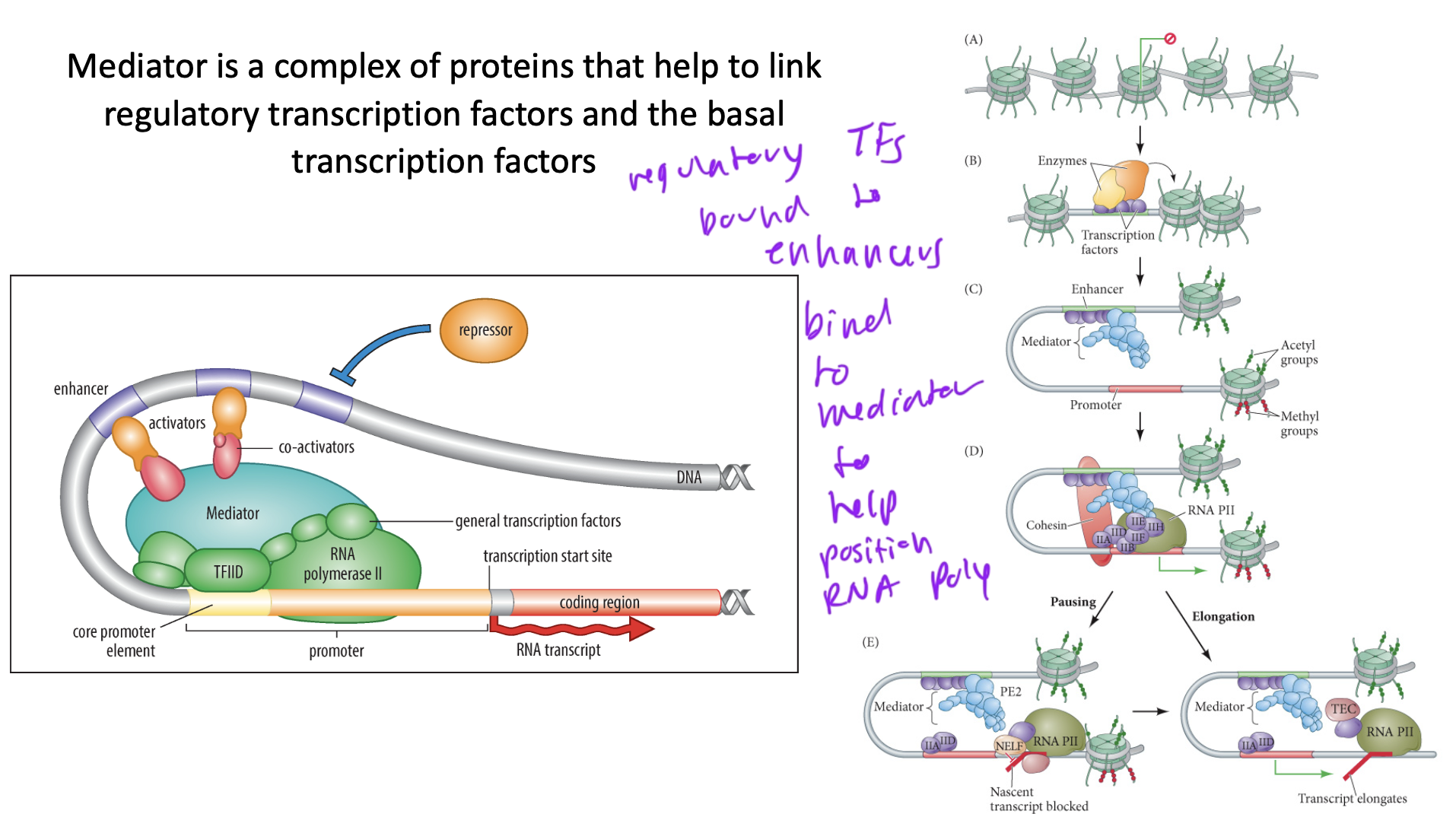
diff combos of regulatory TFs can bind to diff
enhancers or silencers, allowing cells to express diff sets of genes
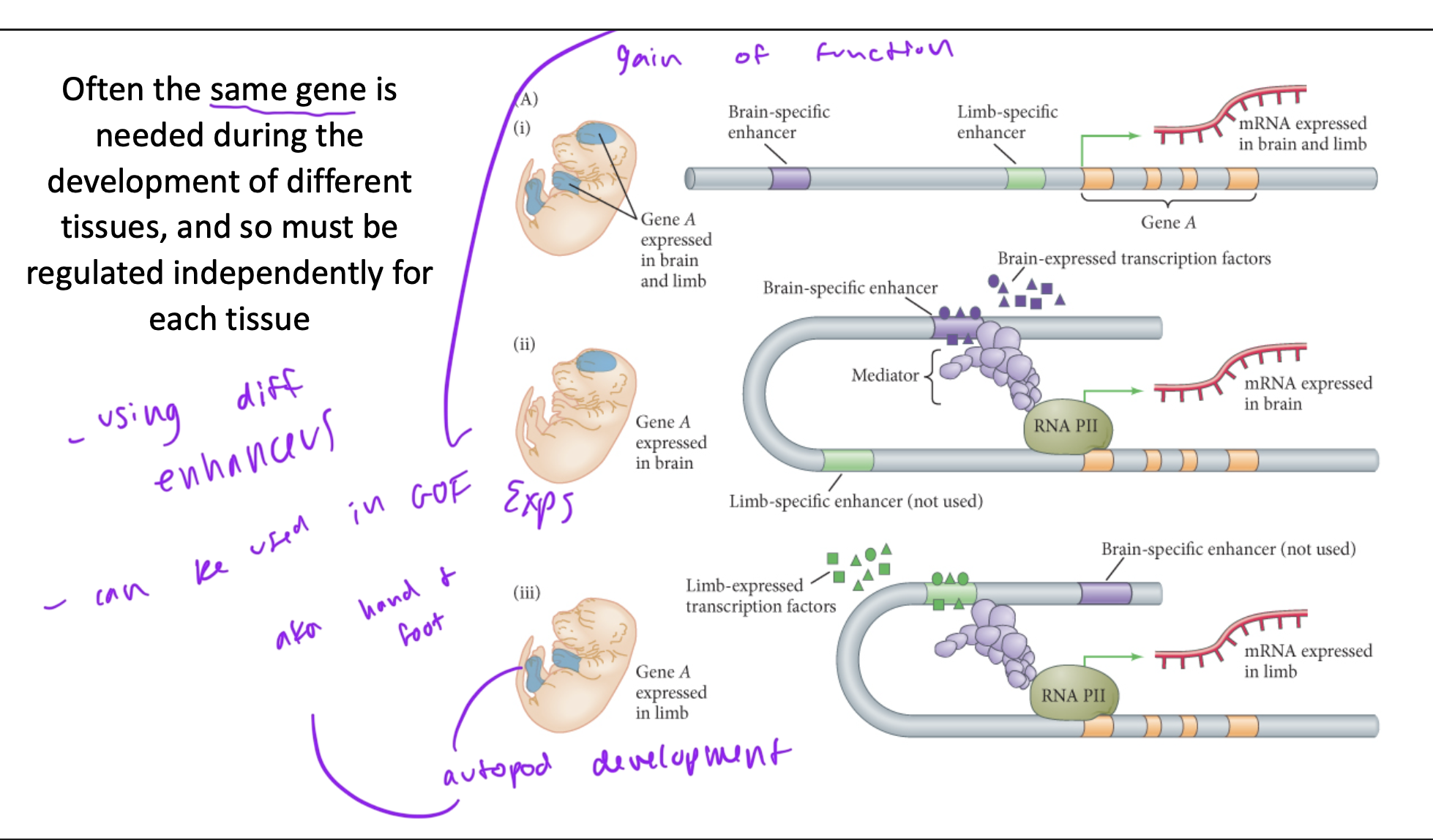
if the same gene is needed at multiple diff times in development,
so diff parts of the gene must be regulated independently for formation of each separate tissue as the embryo develops
ex: using diff enhancers to promote brain vs limb development
this whole idea can also be used in gain of function Exps
3D organization of chromatin
helps stabilize patterns of gene expression once they are established
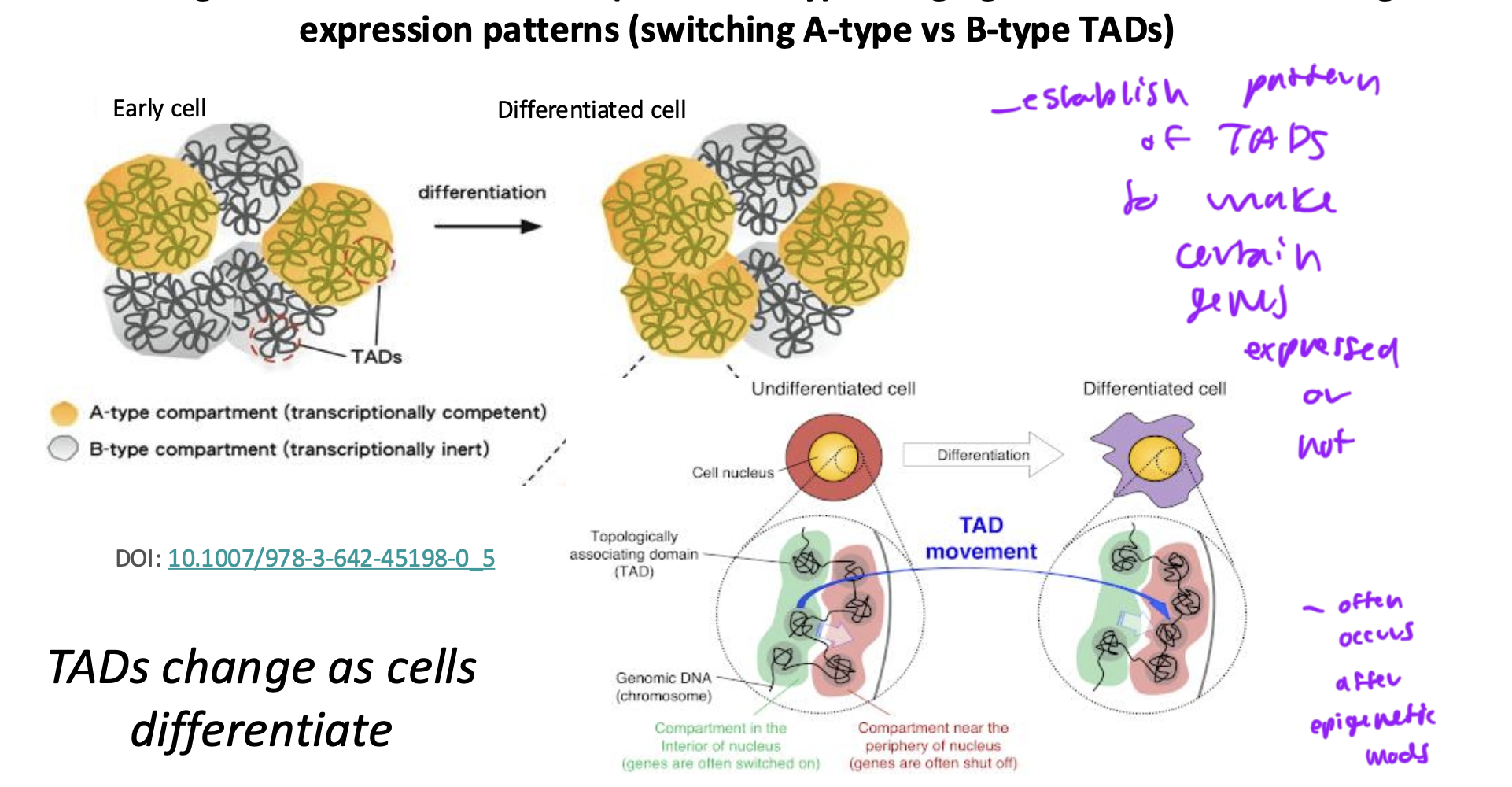
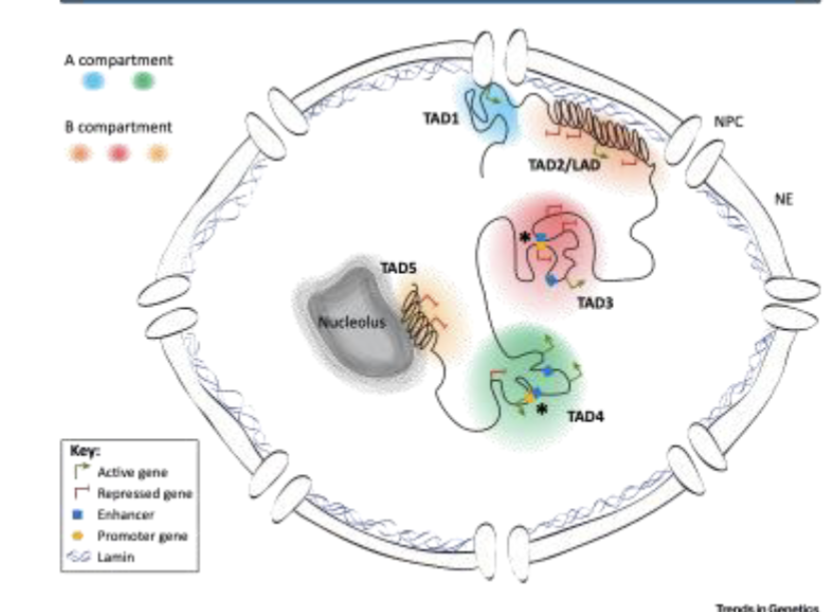
ex: TADs (topologically associating domains) , which change topology of the nucleus
TADs
topologically associating domains
proteins that help change the topology of DNA so that certain regions are more or less accessible
allows for multiple loops of DNA to be regulated simultaneously, so genes pulled into a common TAD are regulated together (usually)
Types of TADs
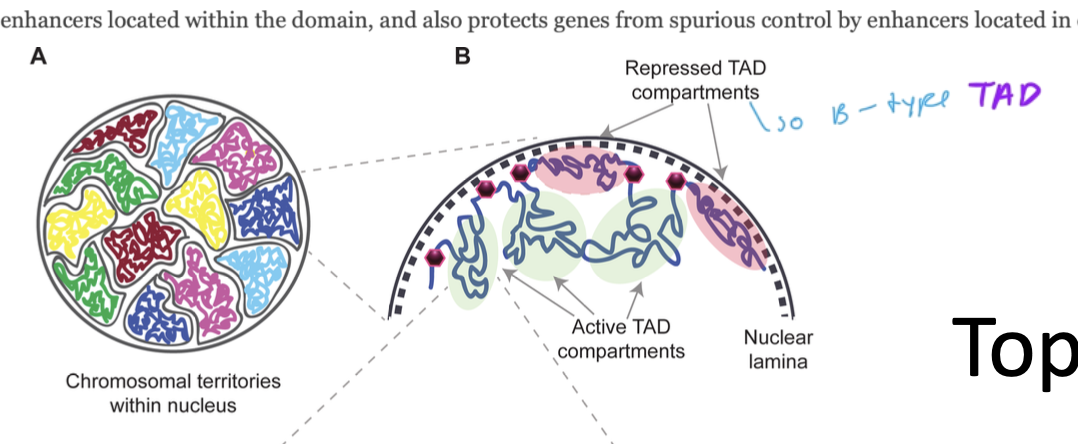
B-type
TADs that are in a region that is being repressed (inhibited from transcription)
if a B-type TAD is stuck on a nuclear lamina, it is called a LAD (lamina associated domain)
A-type
TADs that are in a region that is actively being transcribed, so the chromatin is less condensed
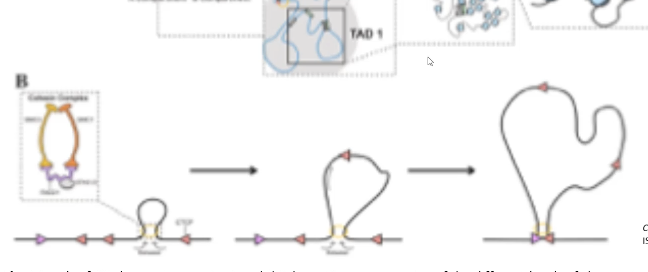
CTCF
protein that binds to sites at the boundaries of a TAD’s area
binds to the DNA itself and stops cohesin from sliding, therefore determining the endpt of a TAD’s area
cohesin
loops the DNA between 2 TAD regions, forming chromatin loops (topologically pulls out the chromatin)
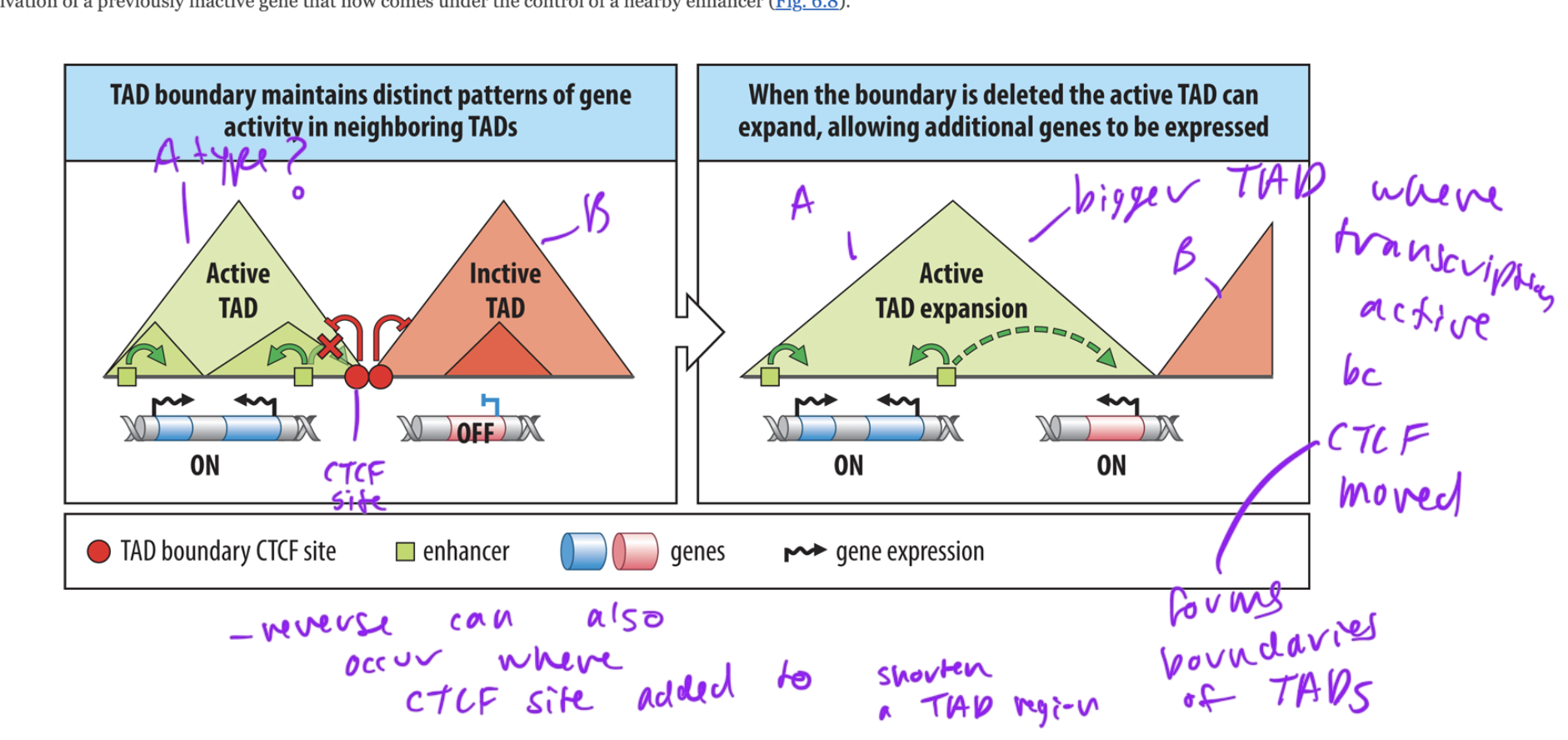
if CTCF sites between an active and inactive TAD site are deleted, then
the active TAD site expands as the CTCF site is no longer restricting it
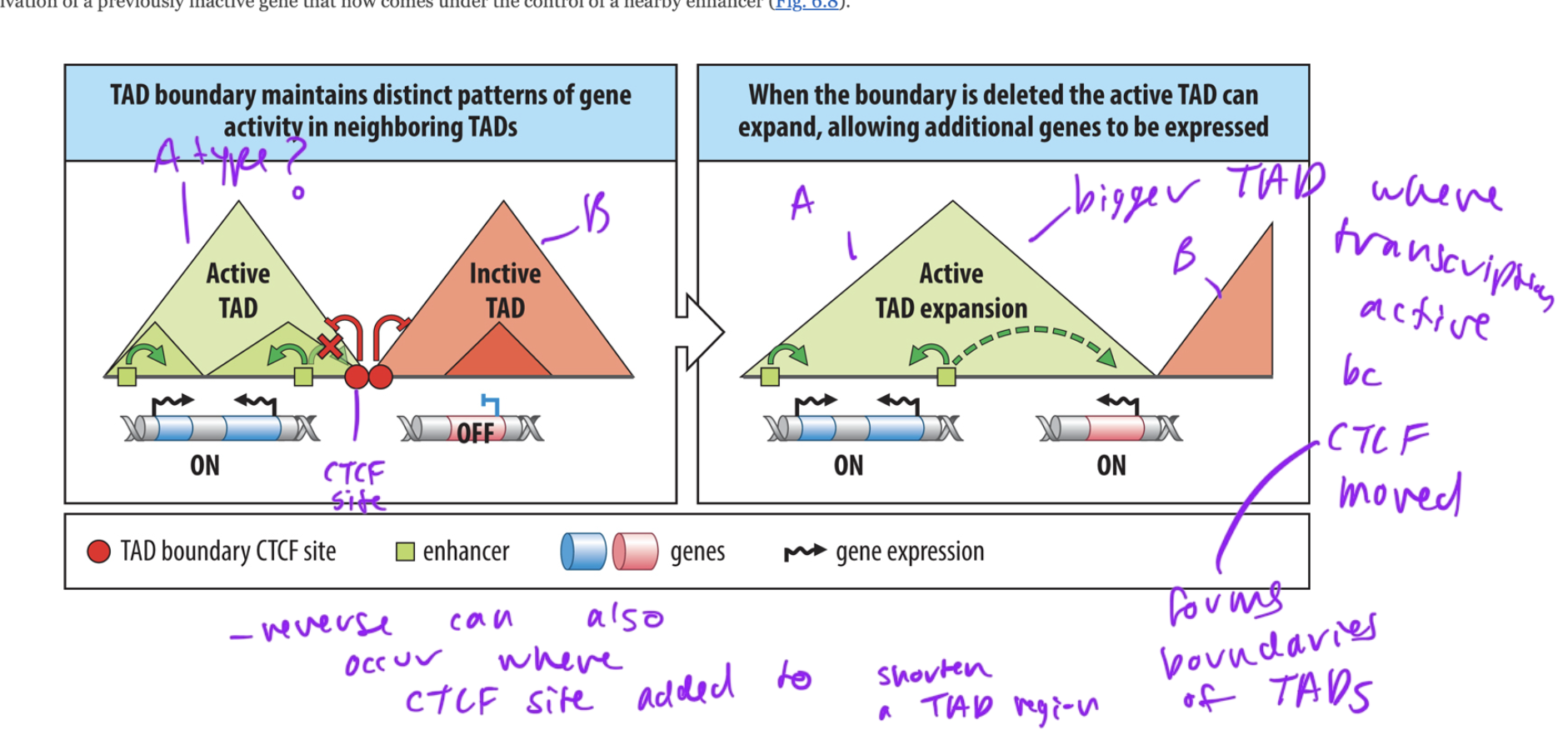
if a CTCF site is added to an active TAD region then
that TAD region will get shortened
differential gene expression
a consequence of different cells, or the same cell at diff pts, having :
unique patterns of chromatin structure,(diff TAD structure)
epigenetic mods
and expressing unique sets of regulatory TFs
differentiation is a ____ process
slow
What is the first step in studying differentiation
fate mapping
you stop at diff pts in development and take image so see where things traveled to, and after what amount of time
allows you to form a slideshow of what gives rise to what
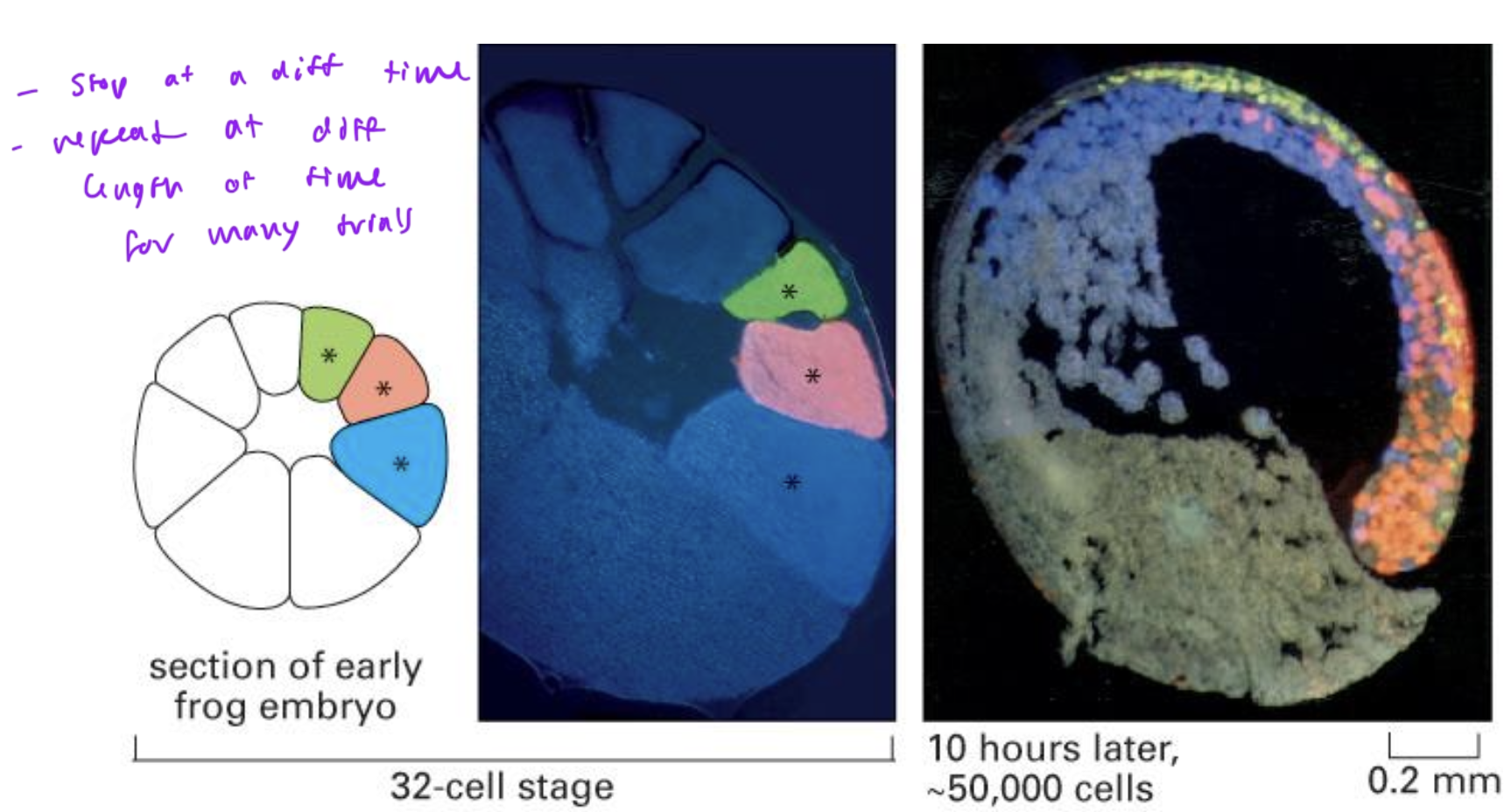
_________ is what showed us that at progressively later stages in development, differentiation is a gradual, and almost always ONE-WAY process
fate mapping
attributes of fate mapping
highly reproducible
is very similar across diff species
differentiation is almost always unidirectional, except..
amphibians/reptiles regrowing tails, limbs for wound healing
totipotent
cells that could become anything
the fertilized egg
some of the earliest blastomeres
pluripotent
cells that can become almost anything
so can give rise to any cell an organism needs, just cannot make a whole new organism
multipotent
cells that can become a few other types of cells
includes many of adult subsets of cells, like adult stem cells
unipotent
cells tah can only become 1 type of cell
reprogramming
the name for when you study differentiation reversal
2 phases to the differentiation process
commitment
cell memory
committment
when cells acquire the pattern of gene expression necessary for a specific differentiated state
occurs during embryogenesis when a new, unique pattern of gene expression has been established
cell memory
when a cell maintains the pattern if gene expression necessary for that differentiated state
via:
pos feedback loops
DNA methylation
changes in chromatin state
commitment occurs before
cell memory
RNA sequencing to study the commitment process
take embryos at a certain stage
break their tissues down into individual cells
inject barcodes reagents into the cells
the cells then release RNA which you isolate using reverse transcriptase
repeat for thousands of cells until you have a bunch of data
then you can see what gene gets expressed when you inject diff barcodes
so you can see how similar gene expression is in diff cells and what comes from what gene
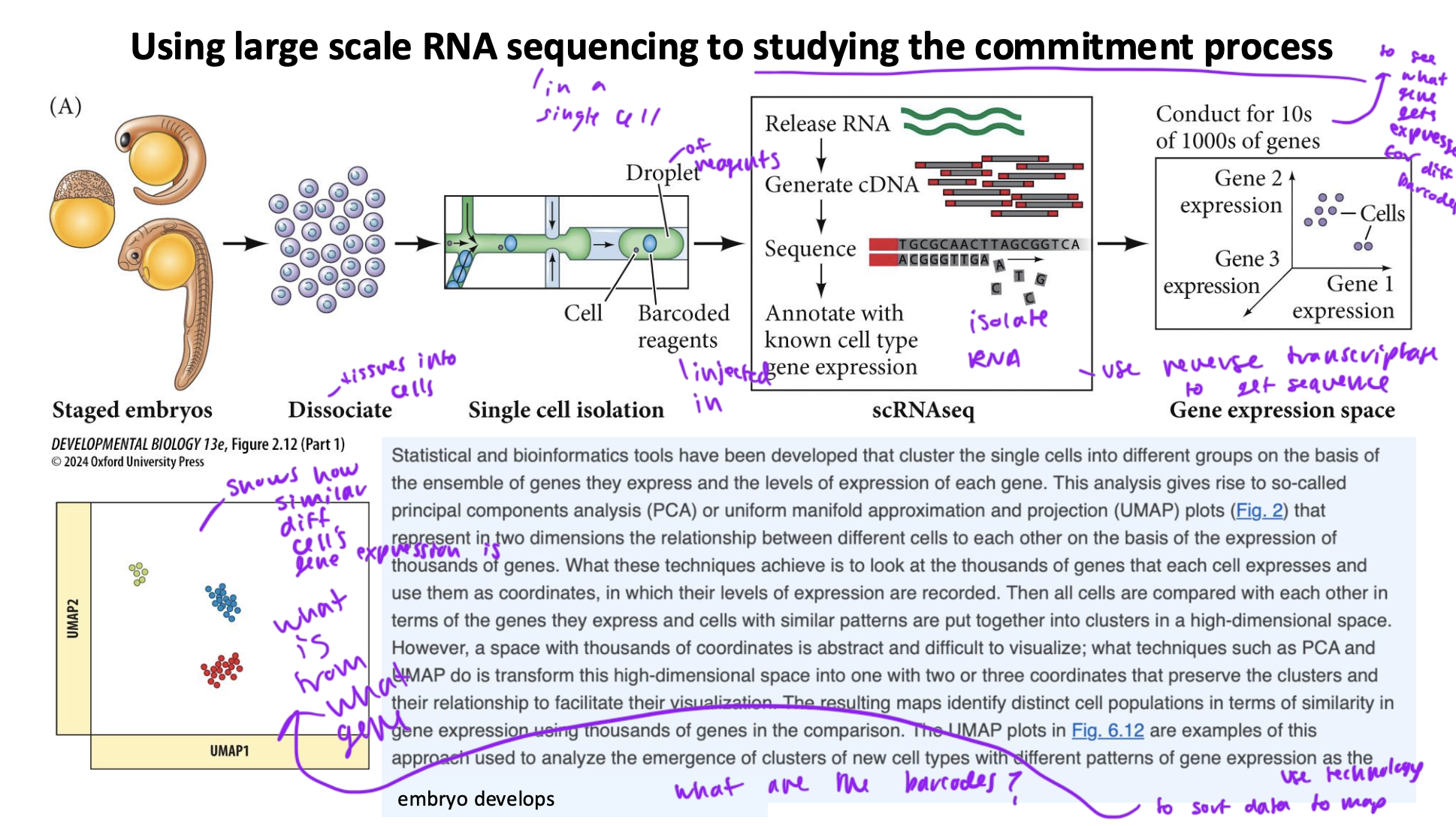
how could you study changes during commitment at the population level?
by doing RNA sequencing for a few individual cells
see how cell-level gene expression changes over time during commitment
shows you for a given endpt, what patterns of expression occurred before it
could do LOF Exp to see what the genes then actually control
commitment heavily depends on
the proper extracellular signals
2 experimentally defined benchmarks during commitment
specification
determination
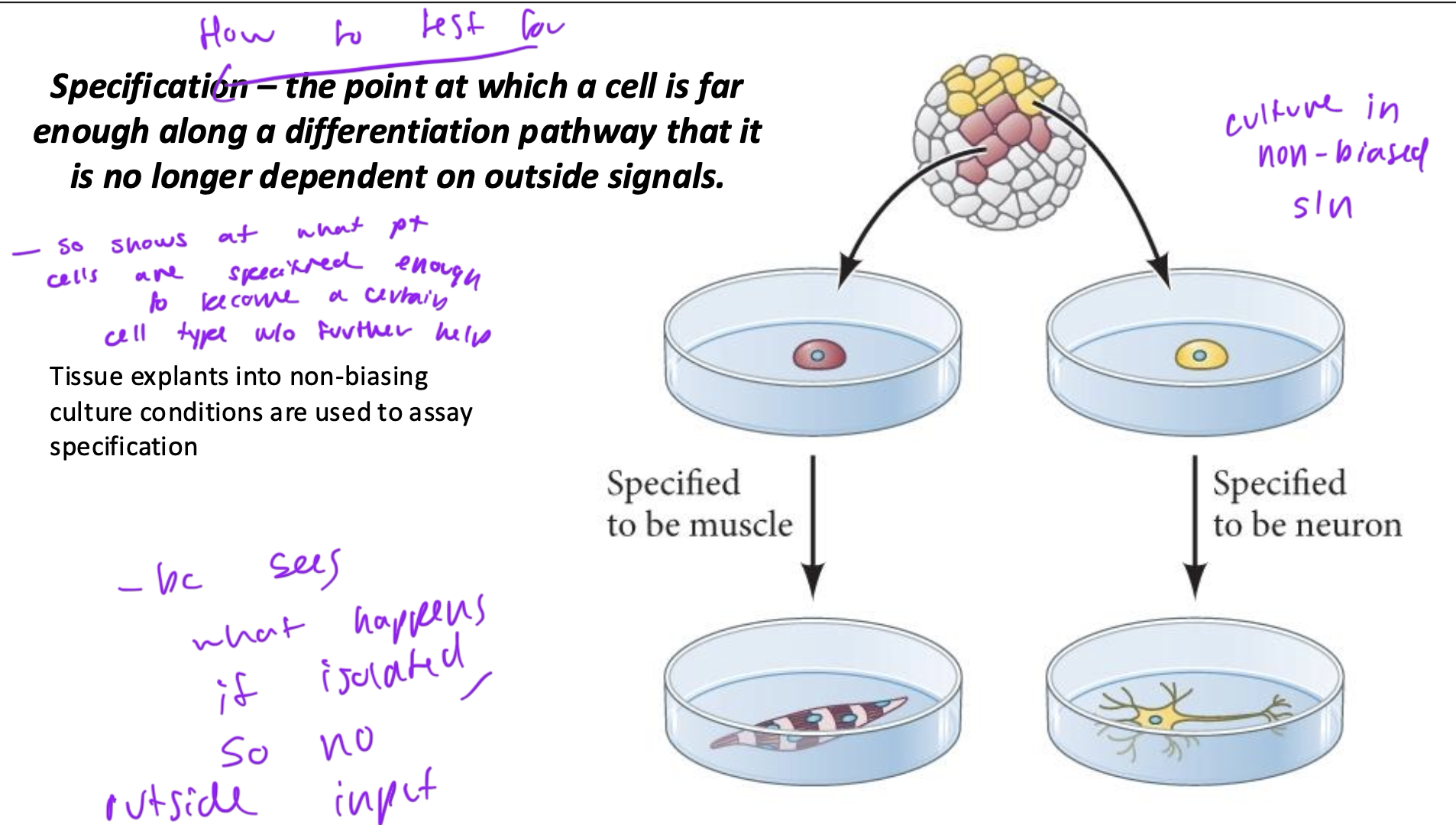
specification
the pt at which a cell is far enough along a differentiation pathway that is no longer dependent on outside signals telling it to continue on that path
determination
the pt at which a cell is far enough along a differntiation pathway that it will ignore any signals telling it to choose a diff path
determination occurs ____ specification
after
How to test for specification
culture a cell in non-biased solution to see what happens to the cell without any outside input
if the cell type continues as before, it was already specified
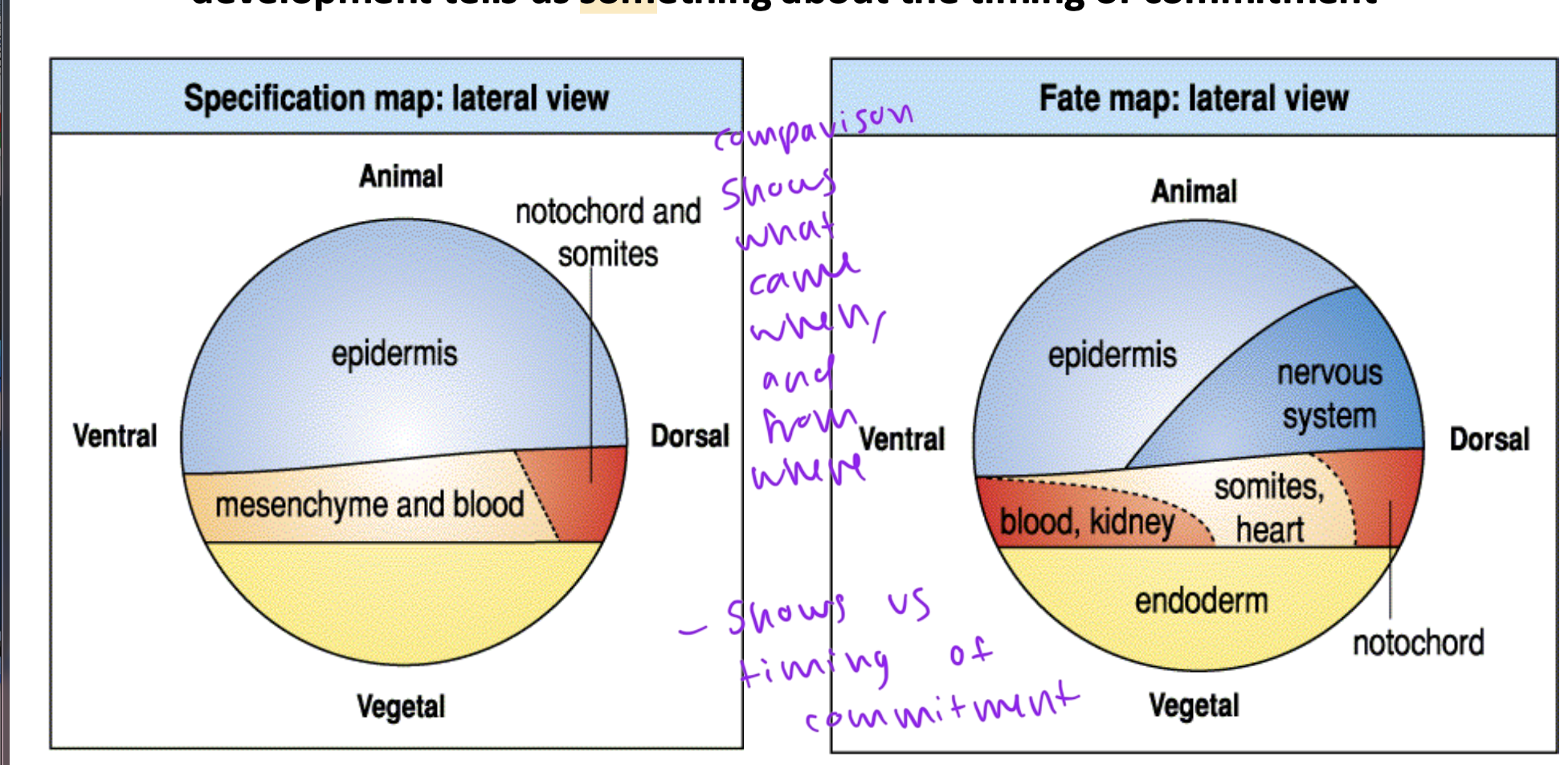
How to analyze timing of commitment
use specification map to see that state of differentiation at a given pt in time
then compare to fate map to see where certain things specified into a certain cell type
by comparing the 2, you can see what came when, and from where
so shows us the timing of commitment
How to study determination
use heterotopic (diff-place) transplantation or co-cultures
heterotopic transplantation is when you take tissue out of one part of an embryo and graft it into another part of the embryo
if the cells begin to match the cell type of its new location, it was not determined
if the cells grow as they were before and do not change, then they were already determined
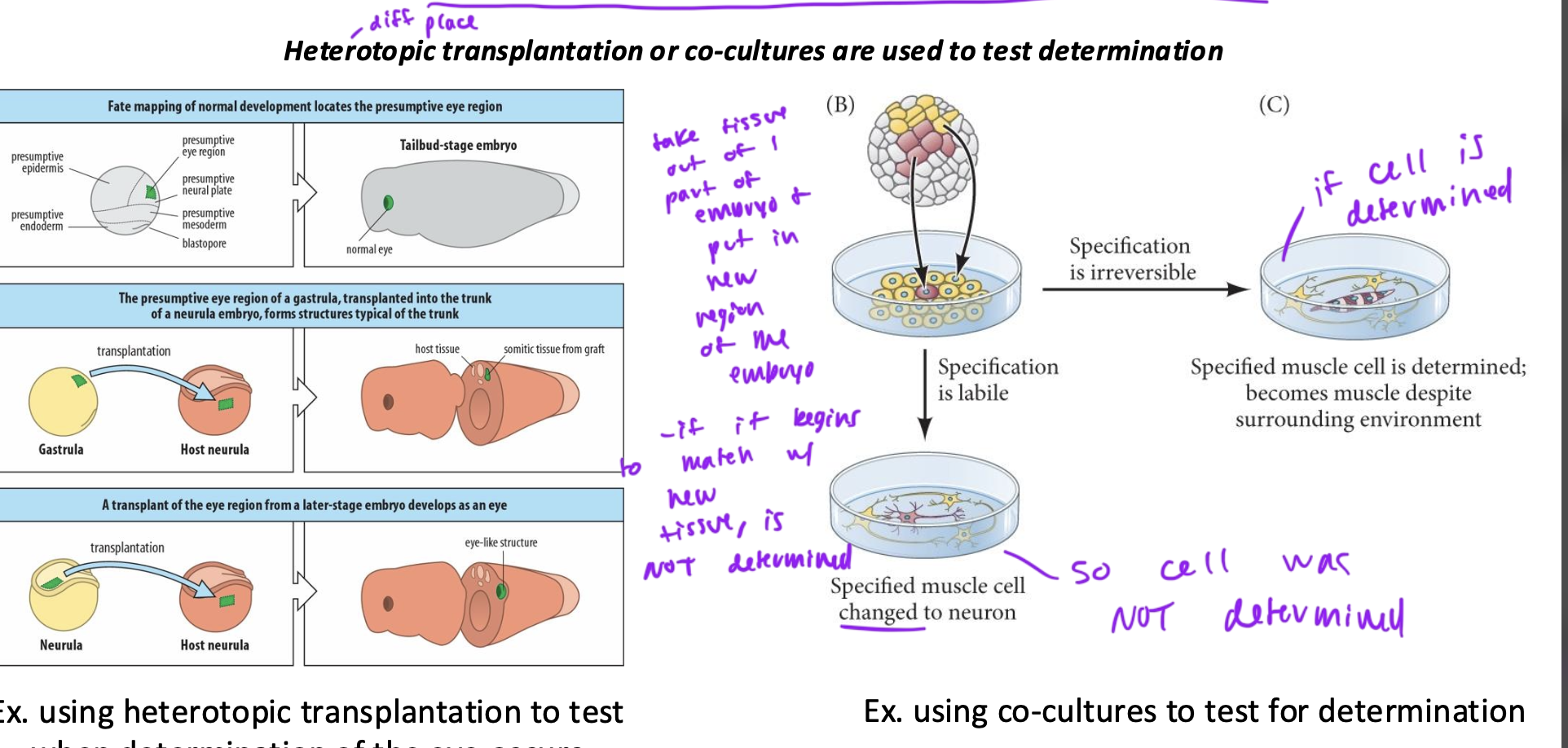
fate vs specification vs determination image

2 modes of specification in early development
autonomous specification
conditional specification
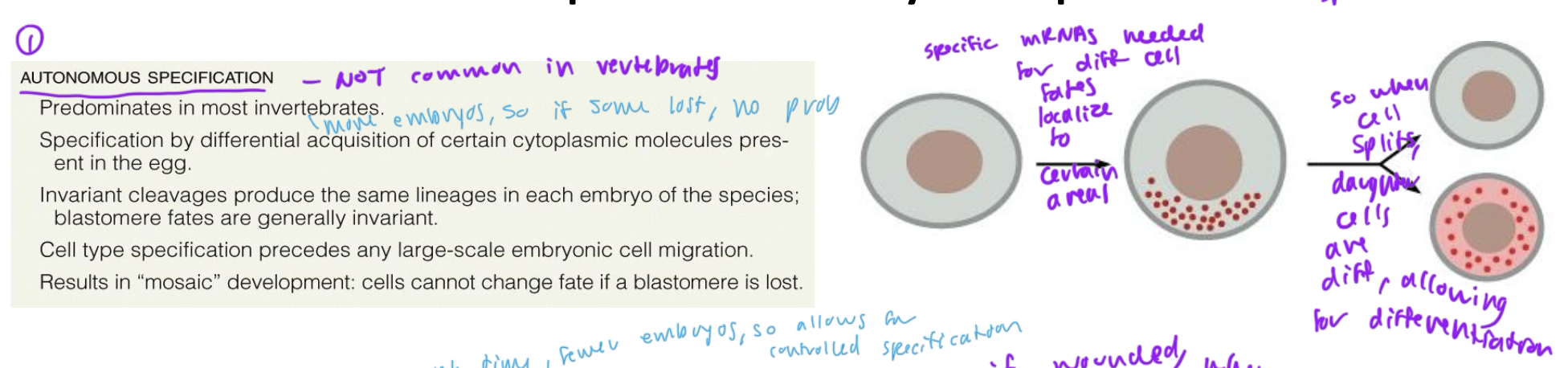
autonomous specification
uncommon in vertebrates, common in invertebrates
invertebrates usually produce many more embryos that have shorter lifespans, and autonomous specification is much more rapid
when specific mRNAs needed for diff cell fates localize to a certain area on a cell
so when that cell divides during mitosis, its two daughter cells are non-identical, leading to differentiation
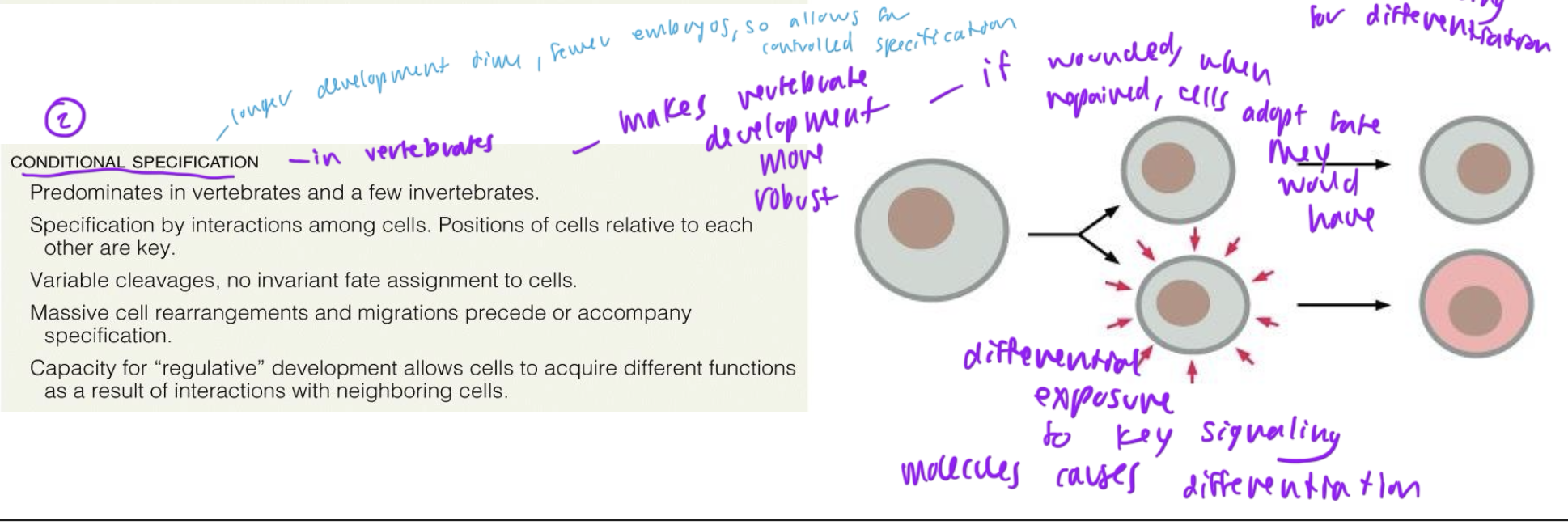
conditional specification
common in vertebrates
takes longer, as does vertebrate development and lifespans
makes vertebrate development more robust
in conditional specification, differentiation is caused by differential exposure to key signaling molecules
this is why wounded vertebrates can repair themselves with cells that adopt to the same fate they would have in the undamaged tissue
conditional specification allows for
compensation/ regulative development
since cells can grow back and specialize into the cell type of the previous tissue (before the wound)

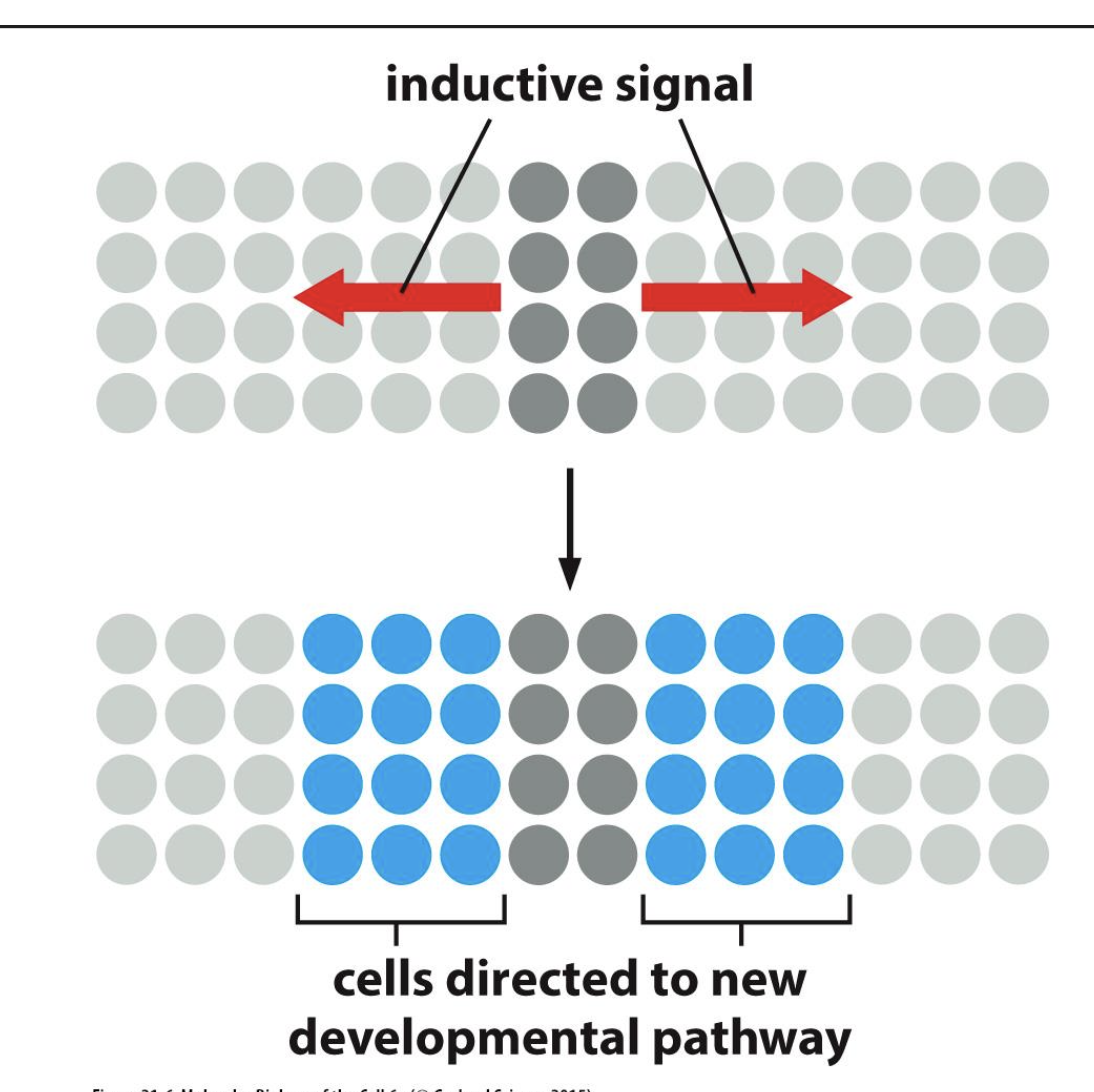
induction
causes conditional specification
when cells causes other nearby cells to undergo a certain developmental pathway
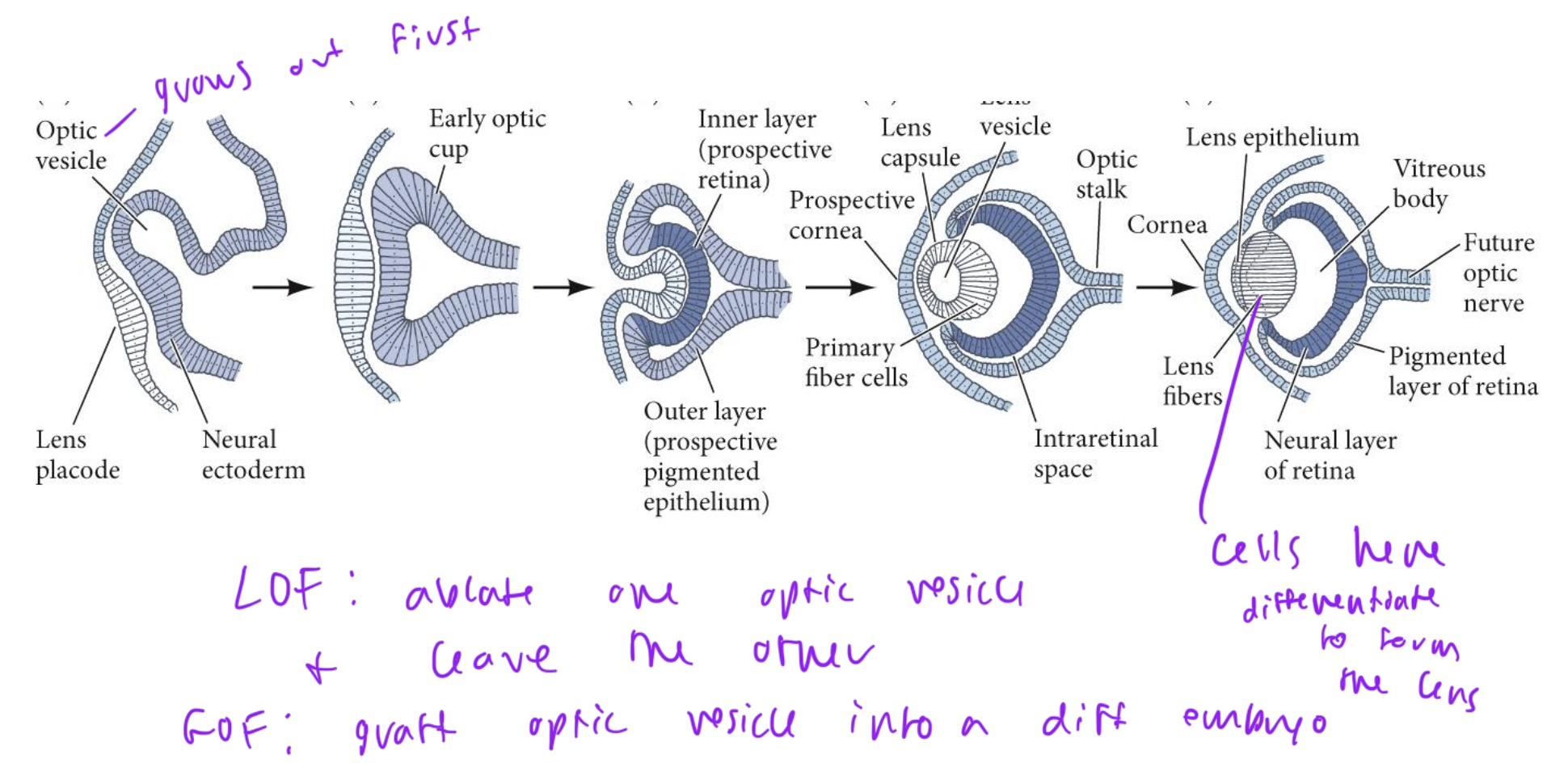
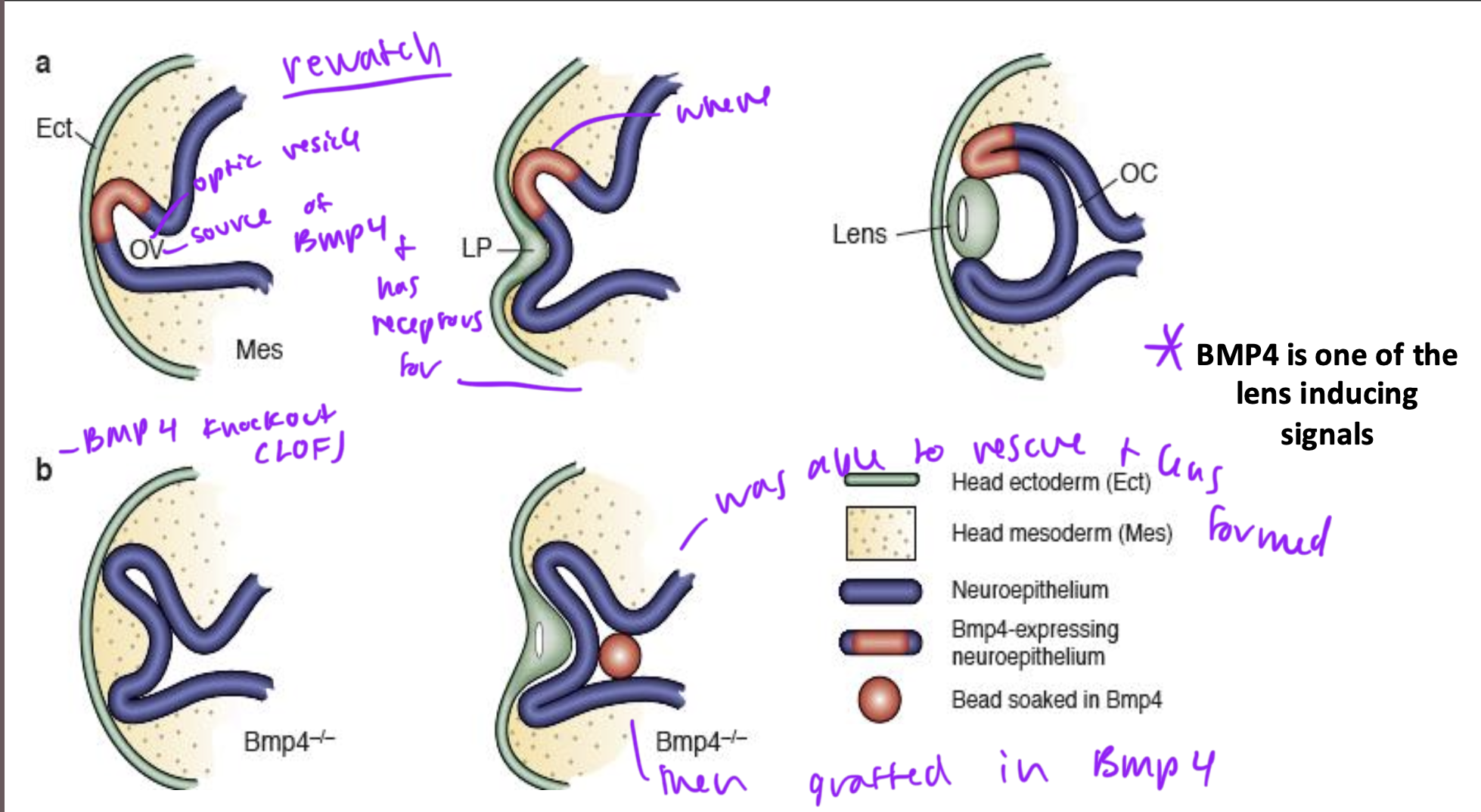
Induction of the lens by the optic vesicle
example of induction
the optic vesicle induces the surface ectoderm to thicken and form the lens placode during vertebrate eye development
the cells must differentiate in order to form the lens
how could you study GOF or LOF with vertebrate lens formation?
LOF: ablate one of the organisms two optic vesicles and leave the other to analyze the difference
GOF: graft an optic vesicle into a diff embryo to see if it develops in a normal manner
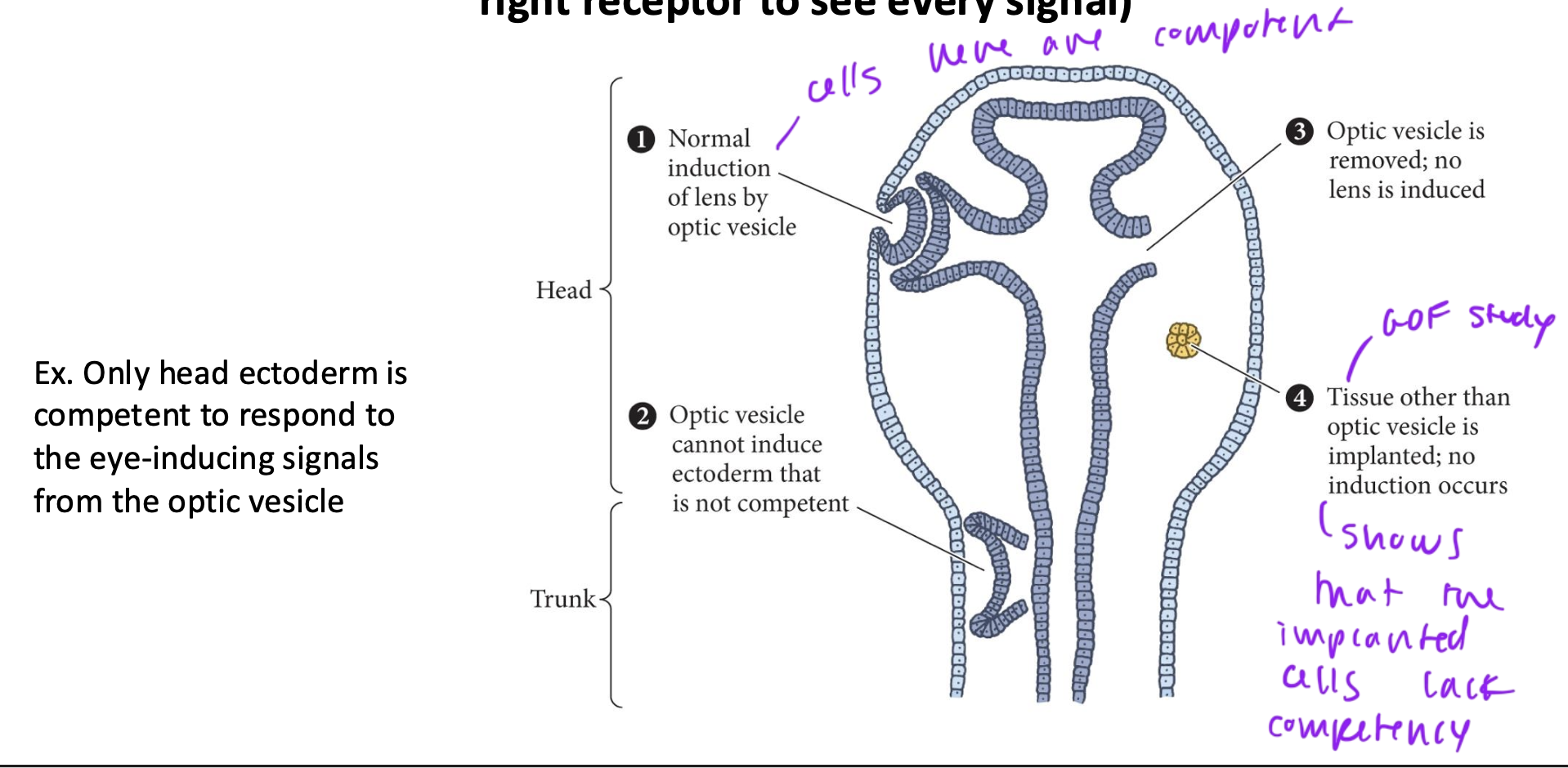
competency
the idea that only certain tissues possess the ability to respond to a particular inducing signal (ie are competent)
because not all tissues express the right receptor to see every signal that exists
competency in optic vesicle formation of vertebrates
see how in GOF study, when optic vesicle is implanted into cervical (neck region), since the cells implanted lack the competency to specialize, no induction occurs, and a lens does not form
but if you implant into the head region, the implanted vesicle would possess competency and a lens would form per usual (diff tissues respond to diff signals is what this shows)
so only ectoderm in the head region can respond competently to the lens inducing signal from the lens vesicle, but areas outside cannot
the unimpaired vesicle forms per usual as it possess competency
BMP4
a lens inducing signal
we know bc BMP4 knockout mice has optic vesicles but no lens (LOF study)
if you collect optic vesicles from BMP knockout mice and graft in beads soaked in BMP4 protein, then the mice would product ens per usual
we see BMP4 is expressed in one of the arms of the optic vesicle
if you grafted bmp4 positive vesicle into the cervical region of a mouse, no lens would form because those tissues lack BMP4 receptors
What if you grafted bmp4 positive vesicle into the cervical region of a mouse
no lens would form because those tissues lack BMP4 receptors
bc head region expresses the Pax-6 protein, which is a TF that regulates many genes, including ones that encode receptors for the BMP family
so a mouse embryo would need
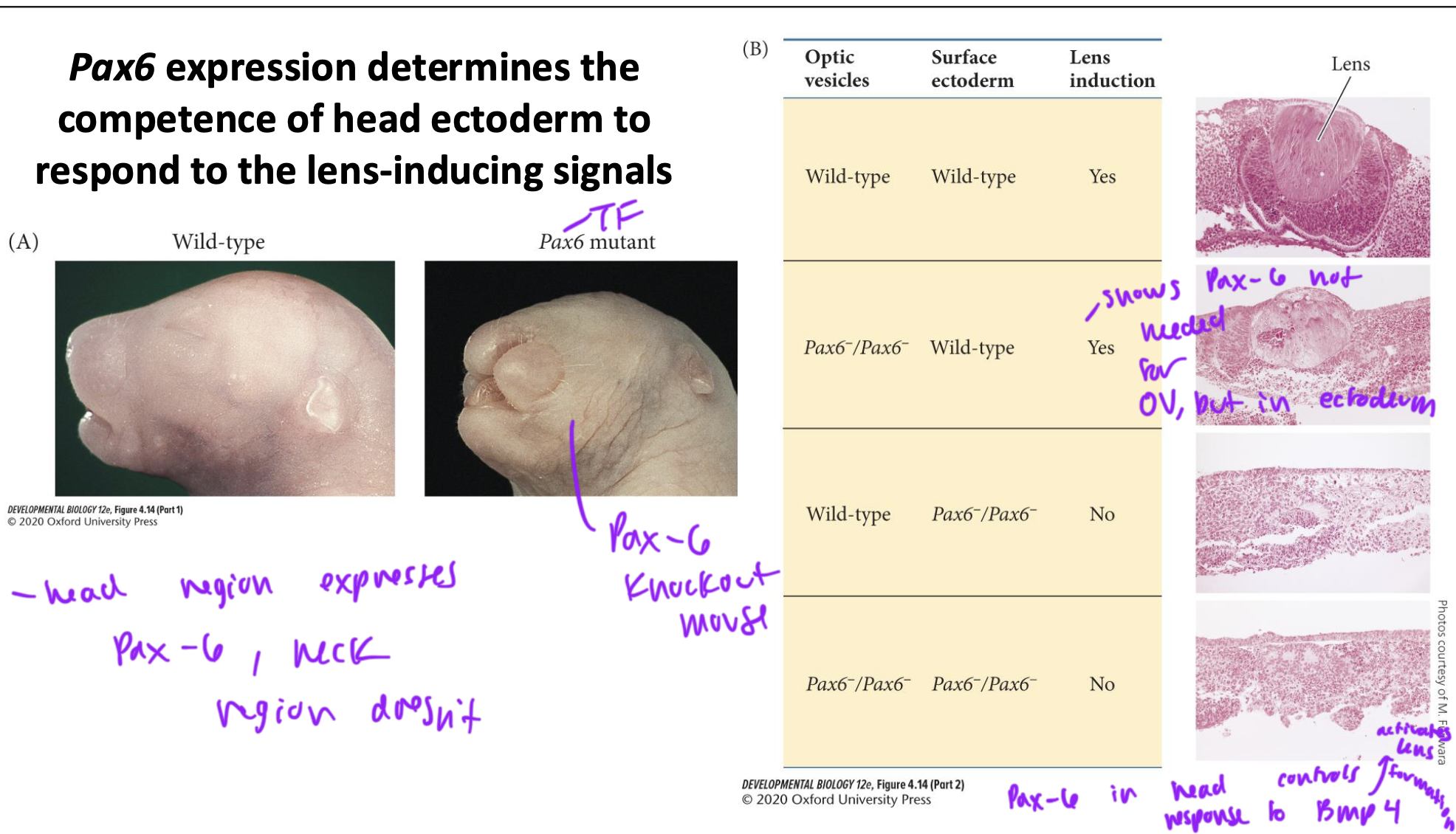
Pax-6 expression determines
the competence of head ectoderm to respond to lens-inducing signals (like BMP4)
we learned through combining knockout and wildtype mice’s vesicles and ectoderm that you need a wildtype ectoderm for lens induction to occur, regardless of Pax-6 knockout of wildtype vesicle being implanted, because it is the ectoderm that expresses the Pax-6
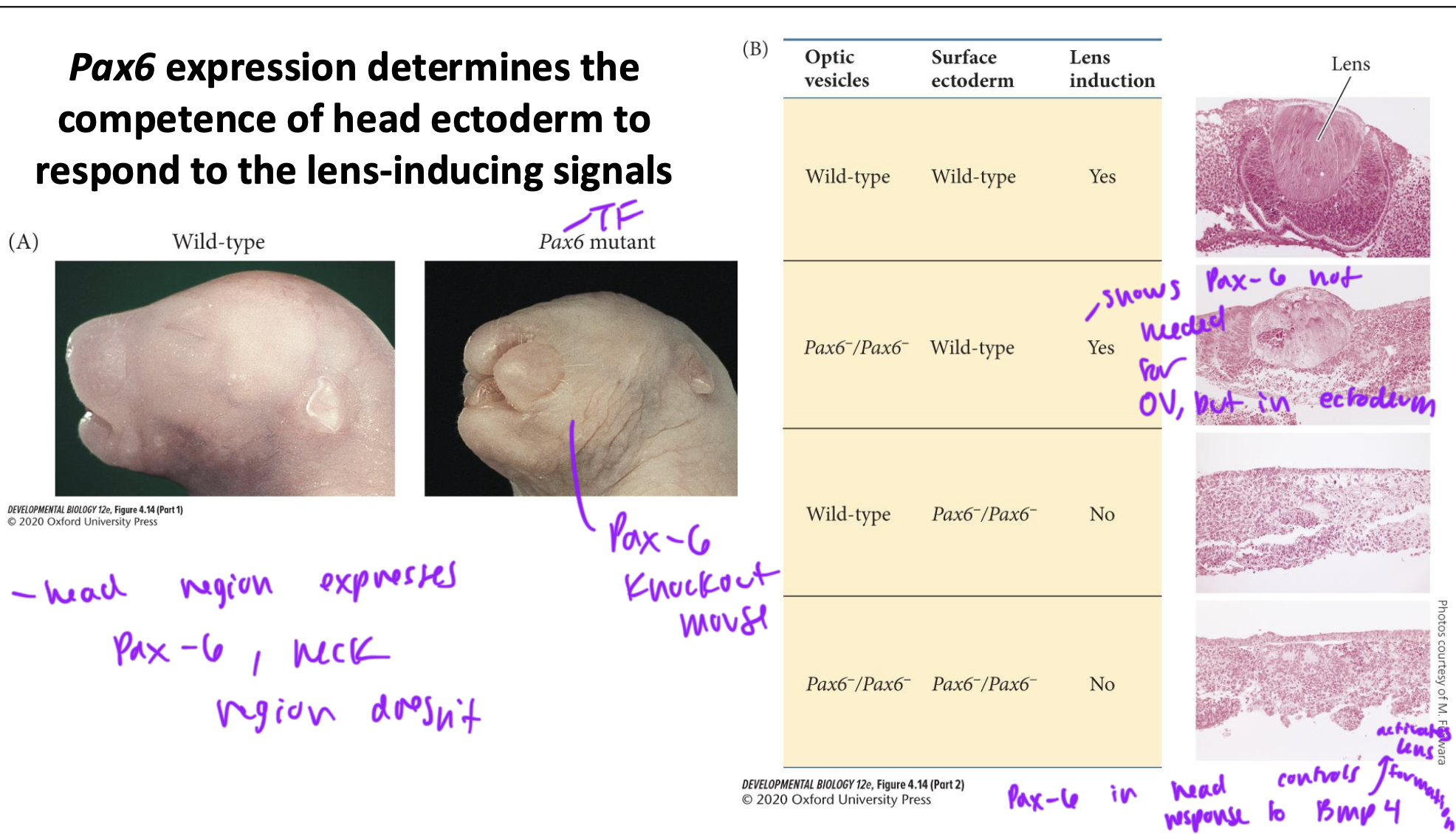
in regards to pax-6 expression in mice lens formation, if you implant wildtype optic vesicles into the surface ectoderm of a wildtype mouse, thenq
lens induction would occur per ususal
in regards to pax-6 expression in mice lens formation, if you implant pax-6 negative optic vesicles into wildtype mice surface ectoderm, then
a lens would grow, but would it would look odd
shows us that Pax-6 is not needed from the optic vesicle itself, but from the surrounding ectoderm
in regards to pax-6 expression in mice lens formation, if you implant wildtype optic vesicle into pax-6 neg ectoderm
no lens forms
in regards to pax-6 expression in mice lens formation, if you implant pax-6 optic vesicle into pax-6 neg ectoderm
no lens forms
How can 1 signal do so much?
the same inductive signal can be processed differently by diff cells depending on:
the other signals a cell receives
the state of the cell receiving the signal

Sequential inductions
one way how complicated arrangements of multiple tissues can form
when cells closest to an induced signal respond to the signal and change, then induce the next cell to do the same, and domino affect goes on and on
so how one cell inducts the next, which inducts the next

Morphogens
one way complicated arrangements of multiple tissues can form
morphogens work by the same signal inducing diff outcomes based on the concentration of morphogen received by a certain cell (so based on how far the cell is from the morphogen secreting cell)
ex: BMP4 is NOT a morphogen to induce lens development in the eye (if over a certain threshold, a lens is formed)
high BMP4 gives certain forms of ectoderm vs neural tissue (will be seen later) so BMP4 can be a morphogen for other things

some signals are morphogens in one context but
not in others
ex: BMP4
how to maintain a cell’s differentiation
cell memory
can be accomplished via:
feedback loops
DNA methylation
changes in chromatin state
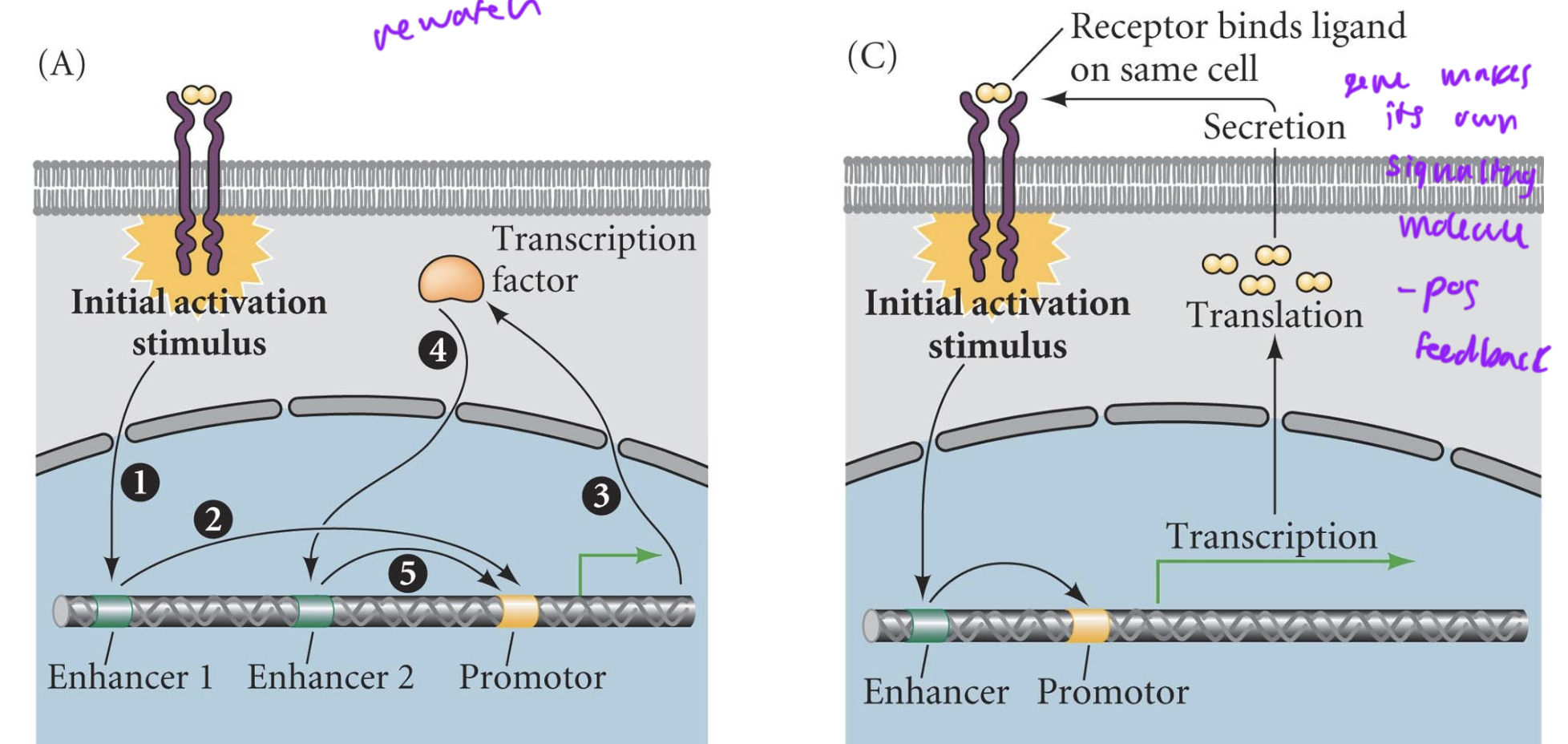
autologous feedback loops to maintain cell memory
work within an individual cell where a signal initiates a signaling pathway that turns on the transcription of a TF necessary for that change in behavior
then that TF regulates expression of its own gene, so you no longer require that initial signal
OR
signal leads to pathway that causes transcription of a protein that is the signal itself, so the cell remembers what it is supposed to do
both are autologous bc they work on themself
paracrine feedback loops to maintain cell memory
between 2 adjacent cells
occurs at the border between 2 tissue types
one cell makes a signal that the next by cell uses to signal it to make a protein, which signals the first cell back
so cells can communicate that they are different and say “I’m right here”

maintaining cell memory via epigenetic mechanisms
altering chromatin state to lock in cell differentiation by methylated regions of DNA you don’t want to use and acetylate regions you do want to use
this is why reversing cell differentiation is so hard, bc its hard to get rid of methylation and acetylation patterns
maintaining cell memory via changing TADs to reinforce gene expression patterns
usually the last thing used to maintain cell memory
helps keep a certain gene expressed or not expressed