ADLERIAN THERAPY - PSYCHOTHERAPY
 Call Kai
 Learn
Learn Practice Test
 Spaced Repetition
 Match
Match Flashcards
 Knowt Play
1/43

There's no tags or description
Looks like no tags are added yet.
Name | Mastery | Learn | Test | Matching | Spaced | Call with Kai | Chat |
|---|
No analytics yet
Send a link to your students to track their progress
44 Terms
self-determined
creative power
VIEW OF THE HUMAN NATURE
People are basically ___ ____ and that they forge their personalities from the meaning they give to their life experiences.
People create their own lives by using their ___ ____.
It is the individual who must ultimately be responsible for making good use of his abilities
People are motivated by their present perceptions and by their present expectations of the future.
Self-determined
used their creative power
determine themselves by meaning by giving to situations
creates their own personality
and Adler view is: essentially optimistic, holistic, and phenomenological orientation.
What us the view of Human Nature according to Alfred Adler? “That People are?”
Social Interest (SI)
Theory or personality
Refers to the individual’s sense of being part of the human community and their attitudes toward others.
An individual’s ability to empathize with others
Social Interest (SI)
provides us with a basically positive outlook on life and an interest in developing the welfare of others
Masculine Protest
to describe the behavior of women who reject traditional feminine roles in favor of more masculine ones.
And one big reason that women (and men, too) reject roles is because they want to gain power and feel more dominant in a situation.
The desire to be a “real man”, a desire to be superior, to strive to be perfect.
Men carefully hide their feminine traits through exaggerated masculine wishes and efforts-
Lifestyles
Behavior is lawfully organized and that each person develops a generalized pattern of responses to most situations
Lifestyle
Habitual pattern of behavior unique to each person
Lifestyle
Considered as the major key of our behavior
Lifestyles
includes our goals, opinions of ourselves and the world, and he habitual behaviors we use for achieving desired outcomes
Goal Oriented and purposeful behavior
counselors we must first understand our client’s goals.
When counselors help clients analyze their goals, they are taking important steps to helping them lead more productive lives
Feelings of Inferiority
It is the presentation of the person to himself and others that he is not strong enough to solve a given problem in a socially useful way
It is more than a sense of inadequacy
Its is inevitable, universal, and normal
Striving for superiority
Used to explain our drive to master external obstacles, to gain power and status, and to arrive at a positive state
Positive striving for perfection
fictional finalism
they exist primarily at the unconscious level of awareness throughout one’s life.
Fictional finalism
deal more effectively with reality, or they may block our attempts to accept reality.
Family constellation
Describes the composition of a family and one’s position within that system
It is not what we are that determines our behavior, but rather, it is what we think we are that has the most impact on us.
The birth order
(SML GFS FF)
Social Interest
Masculine Protest
Lifestyles
Goal oriented and purposeful behavior
Feelings of inferiority
Striving for superiority
Fictional Finalism
Family constellation
Birth Order
What are the theory of personalities by Alfred Adler?
First Born
Birth Order
Best understands the significance of power and the exercise of it
Conservative in outlook, nostalgically look at the past, highly organized, responsible, conscientious
One feels a sense of responsibility and takes care of others.
Second Born
Grows up knowing that he or she has to share parental time and attention
Optimistic, competitive, and ambitious
Strives in directions different from the first born
Middle Child
They are in a difficult and unfair position
They are ambitious and develop a strong social interest
Unfavorable outcomes they are rebellious and envious, they often experience difficulty being a follower
Youngest Child
Tends to be pampered within the family constellation
May excel over all others o establish their place within the family
Competitive orientation and become high achievers
Only child
Not likely to develop a competitive spirit
Develops exaggerated views of their own importance
May develop rich imaginations
Likely to be deficient in social interest
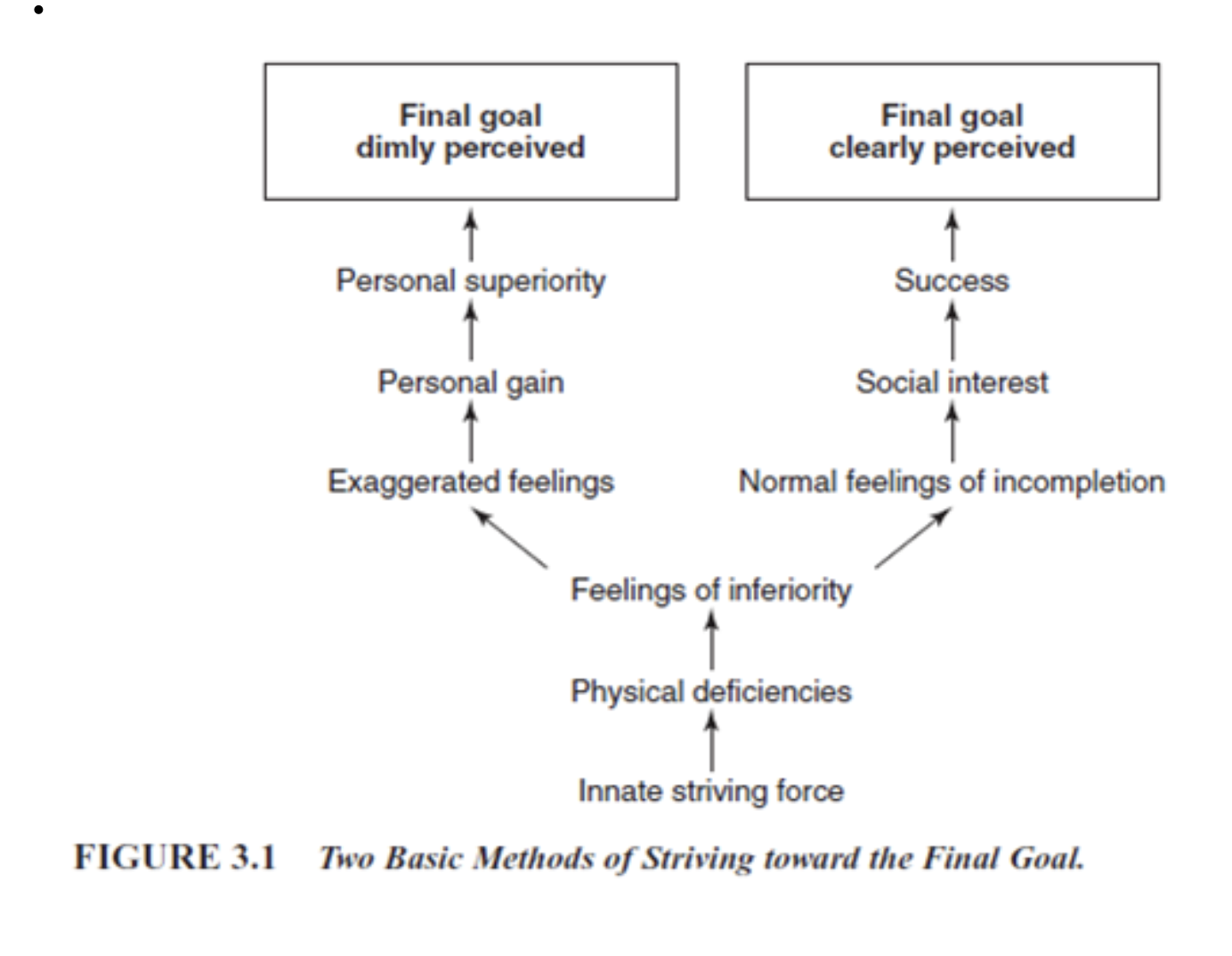
FINAL GOAL IS CLEARLY PERCEIVED
success
social interest
Normal feelings of incompletion
Feelings of Inferiority
Physical deficiencies
Innate striving force
When achieving the final goals what are on the right side?
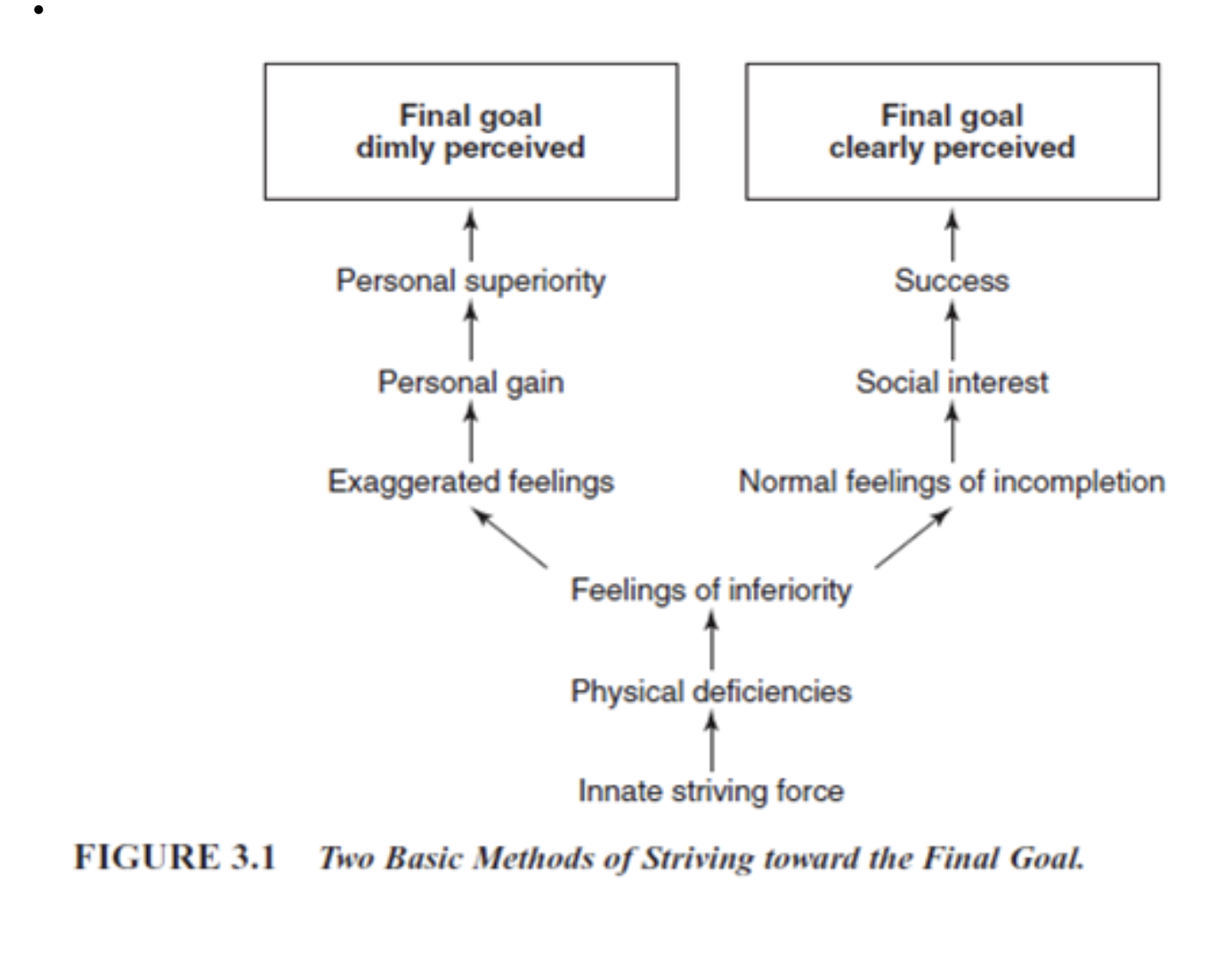
FINAL GOAL IS DIMLY PERCEIVED
personal superiority
personal gain
exaggerated feelings
feelings of inferiority
physical deficiency
Innate striving force
When achieving the final goals what are on the LEFT side?
Birth order position
First childhood memories
Dreams
Three entrances gates to an Individuals “mental life”
Encourage clients to used their own talents to help others to develop social Interest.
Confront clients about their: basic mistakes, misplaced goals, self-defeating behavior
Encourage client to develop new alternatives for reaching their revised goals.
Take a non-pathological view of clients difficulties.
What are the Role of therapist in Adlerian Psychotherapy? (4)
Establishing Therapeutic Relationship (ERT)
Uncovering clients dynamics
2.1 Assessment and Diagnosis
- lifestyle
- early recollection
2.2 Analysis of clients basic mistake (5mistake)
1. Overgeneralization
2. False or Impossible Goals of security
3. Misperception of the life demands
4. Denial of ones worth
5. Faulty Values
2.3 Early recollection as an assessment technique
2.4 Analysis of clients dreams
2.5 Integration and Summary of Adlerian Uncovering and Assessment (UA)Clients Insights and Self Understanding
Reorientation
What are the Phases of Therapy?
Earliest memories
c. Early Recollections as an Assessment Technique
We select memories that coincide with our basic beliefs about ourselves and the rest of the world
______ _____ provide the therapist with an understanding of our mistaken beliefs, social interests, and future actions
Insecurities → Problem → Inferiority
Dream is a way to deal with our ____.
More dreams more ____?.
Dreams is also a way to analyze _____ according to Alfred Adler.
Flying
Falling
Being chased
Being unclothed in public
Common dream symbols:
(moving or striving from below to above)
(moving or striving from above to below)
( an expression of inferiority or weakness in relation to others)
( fear of disclosure or being found out)
30 Minutes → 45 to 50 minutes → Homework Assignment
how many minutes for the children’s therapy session?
for adults?
_____ ____ are usually made near the end of the therapy session
(OAA → CUMPS → BGC → PARA. → SPIT)
Offering encouragement
Asking Question
Acting as if
Catching oneself
Midas Technique
Pleasing Someone
Socratic Questioning
Brainstorming
Creating Images
Goal Setting
Paradoxical Intention
Spitting the in the client soup
What are the therapy technique of Adlerians Psychotherapy
It is a principle and technique of Adlerian Psychotherapy
Helpful for healthy development for children
This is more can work to those people who have belief and faith to themselves.
The therapist should to these following VFP RSA
values
faith
positive self concept
recognition
strength
assests
What can you remember about offering encouragement?
Asking the Questions (Miracle Question in solution focus)
Asking the client to imagine and discuss a possible world where problems are being removed and issues are being addressed
Acting as if
This technique involves asking the client to act ___ ____they were already the person they wish to become or “as if” they had already overcome a specific challenge. This allows clients to experience different behaviors, emotions, and outcomes, facilitating change.
Using the push button
This technique is used to highlight how individuals have control over their reactions and feelings. Clients are encouraged to visualize having two buttons: a negative (e.g., anger) and a positive (e.g., calm). Through practice, they learn to “press” the positive button in situations where they typically might react negatively.
Permits clients to become aware of their self-destructive behaviors or thoughts without feeling guilty about them
Clients are told to “catch themselves” when they are just about ready to revert back to their old ways and to substitute the new behavior.
The goal is to help clients change maladaptive old habits
Midas Technique
Exaggerating the client’s neurotic demands.
Pleasing someone
Technique:
Increase social interest
Demands clients to do something nice
Demands clients to volunteer a service
Socratic Questioning
Leading an individual to insight through a series of questions
Makes the client responsible for his or her own conclusions
Goal setting
Therapists give homework assignments to give clients practice with a behavior.
The client finds threatening situations less and less frightening.
Just like Desensitization
Creating Image
Therapists guide clients through vividly imagined experiences. This can help individuals confront fears, visualize successful outcomes, or experience situations from a new perspective.
Brainstorming
Brainstorms with clients’ alternatives beliefs and convictions.
Example:”I never get what I want”; “Sometimes I get what I want”.
This is just like reframing, you are just like opposing to the clients false belief and providing alternative beliefs.
Spitting the “in the” clients soup
This metaphorical technique makes the client’s self-defeating behaviors unpalatable by highlighting the negative consequences. For instance, if a client procrastinates, the therapist might underscore the anxiety, missed opportunities, or disappointments that arise from this behavior.
Paradoxical Intention:
Three steps: (WER)
What makes you anxious?
Embrace the fear
Rinse and repeat
This technique is used for clients stuck in a behavior pattern.
The therapist might instruct them to intensify or deliberately engage in the undesired behavior.
The intent is for the client to become more aware of the behavior’s absurdity or irrationality, leading them to challenge and change it.
Go ipadayon na nga behavior para ma realize nimo.
3 steps for this ?