MSE 2001
 Call Kai
 Learn
Learn Practice Test
 Spaced Repetition
 Match
Match Flashcards
 Knowt Play
1/95

There's no tags or description
Looks like no tags are added yet.
Name | Mastery | Learn | Test | Matching | Spaced | Call with Kai | Chat |
|---|
No analytics yet
Send a link to your students to track their progress
96 Terms
Material constant / Material Property
a property of a material that doesn’t dep on size or shape
often in adjectives ending in “ivity”
loading and unloading a metal past its yield point but below its Ult tens strength will…
increase the yield strength due to work hardening
adding impurities to metal will make it….
less ductile
Two metal alloys are nearly identical, except Alloy A has 2% impurity content and Alloy B has 8% impurity content. Assuming lattice resistance is nearly zero for both alloys, what do you predict the difference in yield strength (sigma)y to be for these two materials?
Alloy B will have a 2x higher yield strength than Alloy A.
increases # of cyc to failure
flame polishing, shot peening
Adding precipitates to a metal alloy will
incr yield strength but decrease its fracture toughness.
fracture toughness
critical stress
hi density glass = __ Refractice ind
hi
Molar vol is ____ proportional to density
Inversely
fast cooling leads to
hi molar vol
tetragonal shape

orthorhombic shape
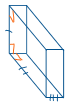
Rhombohedral

Monoclinic

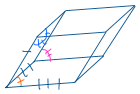
Triclinic
hexagonal

a = b = c, α = β = γ = 90
cubic
a = b ≠ c, α = 120, β = γ = 90
Hexagonal
a = b ≠ c, α = β = γ = 90
Tetragonal
a ≠ b ≠ c, α = β = γ = 90
Orthorhombic
a = b = c, α = β = γ ≠ 90
Rhombohedral
a ≠ b ≠ c, α ≠ 90, β = γ = 90
Monoclinic
a ≠ b ≠ c, α ≠ β ≠ γ ≠ 90
Triclinic
HCP stacking
ABA
HCP # of atoms
6
HCP packing factor
74%
HCP coord #
12
FCC stacking
ABCA
FCC # of atoms
4
FCC packing factor
74%
FCC coord #
12
BCC coord #
8
BCC # atoms
2
BCC packing factor
68%
Band Gap Theory
describes the behavior of how electrons move between groups of atoms depending on the size of the band gap (Eg) (measured in around 10-19 Joules) btw atoms
band gap behavior
e- move from valence band (filled with e-) to conduction band (empty of e-)
speed of energy
J/s (Watt)
when a mat elastic mod is too low, that means its …
not stiff
Modulus of Resilience (Ur)
Amt of elastic energy returned to mat after load is removed
Area under elastic portion of stress strain curve
Coef or restitution

Ductility (εf)
Max strain experienced at point of failure
plastic deformation
Atoms are permanently displaced
Elastic deformation
Atoms are uniformly separated but can return to previous possition
Yield Stress
The stress required to permanently deform mat
(σy)
porous
containing small holes that water and air can enter
ex: pumus
Auxetic mat
Material with a negative poisson’s ratio (elongation in one dir causes elongation in another dir
Ohms law
R = v / i
R = resistance (ohms)
v = voltage
i = current (amps)
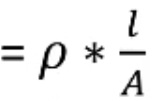
Resistance eq
p (Rho): Resistance
l: length
A: cross-sectional area
Performance parameter
a property of a mat that is det by
mat
shape
size
often in adjectives ending in “ance”
emissivity
Material’s ability to reflect it’s thermal energy in the form of light (think of thermal cams)
Ranges from 0 (completely reflective of light energy, ie. polished metal) to 1 (completely absorbs light energy ie. mat that absorbs heat quickly and is painted black)
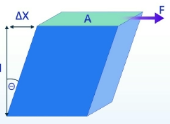
Shear modulus eq
(F/A) / tan(theta)
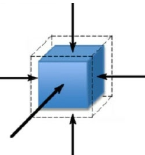
Bulk modulus eq
(F/A) / (delta V / V)
Precious metals
Metals rare on earth
Rare earth metals
Metals with ~57-70 atoms that are sparse when found (but not necessarily rare)
Elastic Modulus (Stiffness)
force needed to stretch, bend, flex mat
Yield Strength (Strength)
Force needed to deform mat
toughness
energy needed to break mat
*stress
aka pressure
σ (sigma)
strain
Δ load / load
ε (epsilon)
Hooke’s law
F= -kΔx (spring Kin En)
*Deformation has a __ relationship to strain in the elastic portion of the stress strain curve
linear
Young’s Modulus
slope of the elastic curve (E)
in Pa
stretches the atoms of mat while
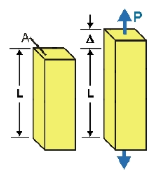
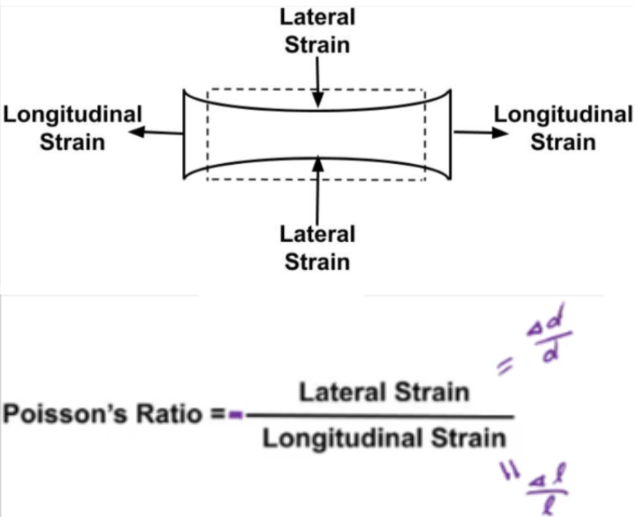
Poisson’s ratio
the neg of rat btw lateral (transverse) strain and longitudinal (axial) strain in longitudinal tensile loading
Usually .3
Acoustic Impedance
(Z)
used to det sound absorption and reflection as it travels btw dif mat
Low Z diff =
most sound is passed through
High Z diff =
most sound is reflected
stress equation
σ = E * ε
Young’s Modulus equation (in Pa)
E = σ / ε
= (F/A) / ( delta L/ L)
Shear modulus
(G)
Bulk Modulus
(K)
Ex: Hydrostatic pressure
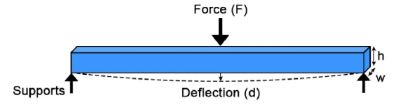
Flexural Modulus
(Ef)
thermal Diffusivity
rate at which a mat will reach a certain temp from const pwr heat source
Thermal Conductivity (Λ)
The rate of heat flow through a mat at steady state
heat flux (Q)
flow of energy from one mat to another
Thermal Diffusivity (Dth)
ratio btw thermal cond and heat cap
material type with the highest diffusivity
polymers
Cathodic protection
use of a sacrificial anode to protect the cathod
reduction (gain e-) occ at the
cathode
oxidation (lose e-) occ at the
anode
part being sacrificed in galvanization is
the anode
metals lower on the Reduction potential table make for better
Anodes to metals above them
Capacitance
the ability of a mat to store electric charge
permittivity (ε)
how easy it is to polarize a mat
Dielectric const (K)
how much charge a dielectric mat can store
Band Gap Theory
Hard magnet
“Permanent” magnet
High coercive field
Can stick to hard or soft magnets
Soft magnet
Loses magnetization very easily
Low coercive field
Diamagnets
Very weak mat response to external mag field
No mag dipoles until there is an external field
ex: wood, glass, water, gold, super conductors, N2
Paramagnets
Weak mag response to external mag field
random dir mag dipoles
ex: O2,