Cell Biology: Chapter 9- Channels and Carriers
 Call Kai
 Learn
Learn Practice Test
 Spaced Repetition
 Match
Match Flashcards
 Knowt Play
1/25

Earn XP
Description and Tags
finally
Name | Mastery | Learn | Test | Matching | Spaced | Call with Kai | Chat |
|---|
No analytics yet
Send a link to your students to track their progress
26 Terms
Integral proteins
Embedded with in the membrane
Portions of the protein associate with fatty acids
Most are transmembranes (competley cross the membrane)
Peripheral Proteins
Outside the membrane
Non covalently attach to other proteins or lipids
Covalently attach to lipids
More details on integral membrane proteins
Most are glycoproteins (carb + protein)
Removed with detergents (hard to remove)
Membrane Spanning Regions
Composed of hydrophobic alpha helixes
Hydropathy
Used to determine which amino acids are part of membrane spanning regions
Hydrophobic amino acids have a value of +1
Hydrophilic amino acids have a value of -1
Peripheral Membrane Proteins
Non covalently attached to integral proteins or lipids
May be removed with high salt
Lipid anchored proteins
Protein covalently linked to lipid
Extracellular: protein covalently links to GPI (attached to membrane)
Acetylcholinesterase
Intracellular: protein covalently links to lipids such as isoprenyl
Ras: site for signal transduction
Rab: vesicular transport
Most transmembrane proteins are able to ___
Diffuse laterally
Dual fluorescence hybridoma
Two cells are fused into a hybridoma
Each cells proteins are labeled with a different color
After some time, the different fluorescently labeled proteins have mixed together to prove that proteins can also diffuse laterally

Diffusion
Natural movement of molecules from high concentration to lower concentration until equilibrium is reached
Simple Diffusion
Transports (mostly hydrophobic)
small polar molecules (H2O, glycerol)
small nonpolar moelcules (CO2)
large nonpolar molecules (steroids)
Energy is diffusion is supplied by the molecules’ own kinetic energy
Affected by size, lipid solubility, and concentration gradient
Smaller molecules diffuse faster than larger molecules
Hydrophobic molecules diffuse faster than hydrophilic ones because they can pass thru fatty acids easily
With concentration gradient
Facilitated diffusion
Uses channels and carriers
Channels are mainly for ions
Carriers are mainly for larger molecules
Will only let speicifc molecules through
Small polar molecules
Large polar molecules (glucose)
Ions (Na+, K+)
Rate of this diffusion is greater than simple diffusion
Facilitated v Simple Diffusion (Graph)
Facilitated diffusion (hyperbolic) happens at a quicker rate than simpel diffusion (linear)
Faciliated diffusion can reach a plateau because the transporters can become saturated (they are all busy transporting something)
Channel protein structure
Moves molecules through open passageway
Alpha helizes interact and form a channel for small molecules
Ex: aquaporin
Kidneys use aquaporins to bring in large amounts of water faster than simple diffusion
Ion Specificity
The amino acisd surrounding the channels play a role in its selectivity and forms a selectivity filter
Ex: In sodium potassium pump: the amino acids around the channel remove water molecules to make sure the ions can be brought in
Voltage gated channel
Regulated by changes in membrane potential
When membranes depolarize, that changes the charge of the membrane and can activate/deactivate channels
Ligand gated channel
Neurotransmitter regulates channel
Covalently modified channel
Epinephrine (neurotransmitter) binds to receptor on a cardiac muscle
Receptor activates protein kinase
Kinase phosphorylates Ca ++ channel (covalent modification)
Phosphorylated channel opens more easily and increases Ca ++
Beta barrel
A different type of membrane spanning region
Found in mitochondria, chloroplasts, gram bacteria membranes
Less selective
Carriers
Bind to molecule and bring it across
Alternate conformations
Ex: GLUT1 is carrier
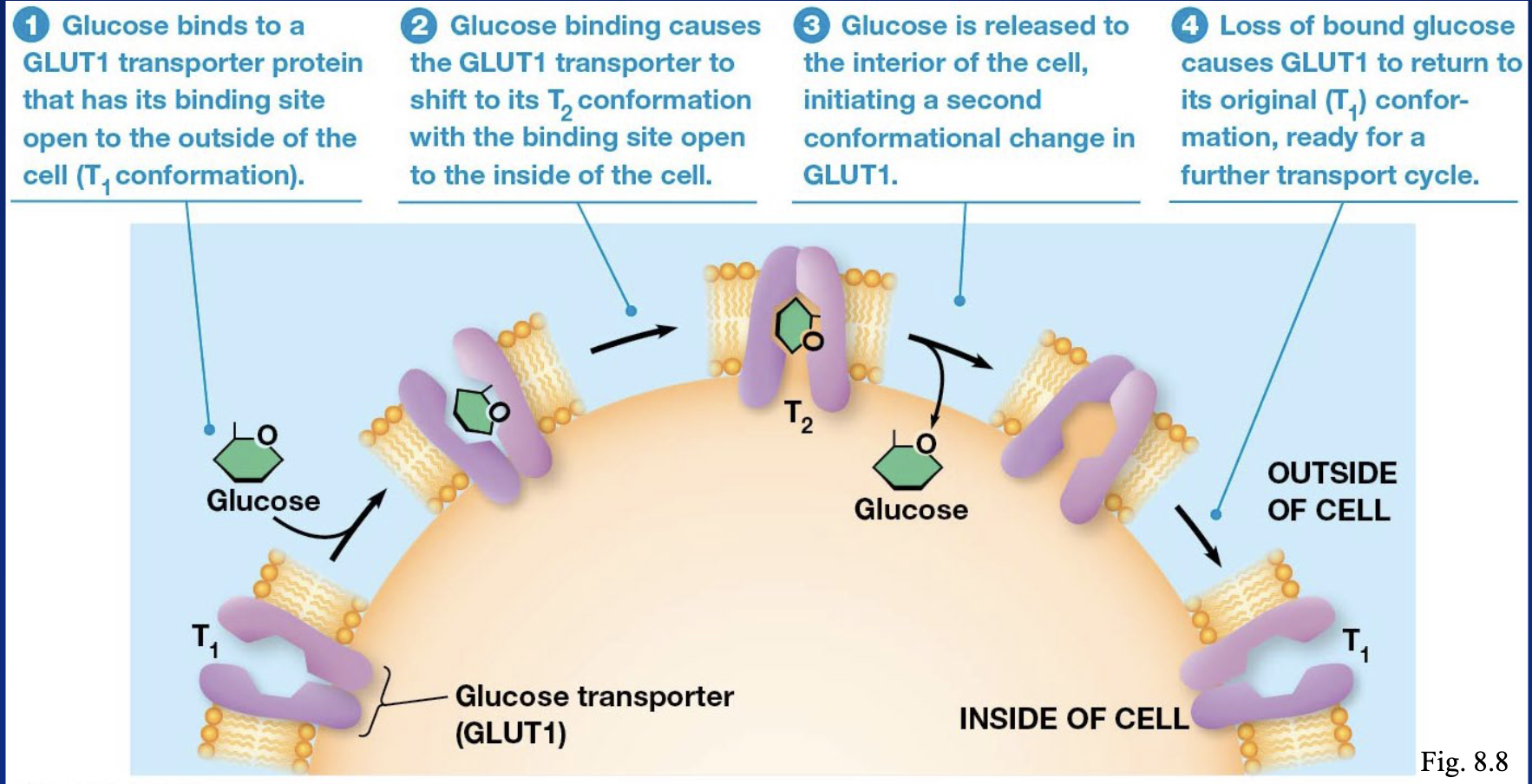
Types of carriers
Uniport: transports only one molecule
Symport: transports molecules in the same direction
Antiport: transports molecules in different directions
Primary Active Transport
Uses ATP to transport molecules against its concentration gradient
ATPases
Moving uphill energetically
4 Types of active transport proteins
P-type: Transports cations; becomes phosphorylated
V-type: transport H+ into vacuoles
F-type: couples H+ transport to ATP synthesis
ABC-type: transports diverse cargo: ions, amino acids, polysaccharides
What is an example of an ATPase
Sodium-Potassium Pump
P-type (also a hydrolase)
Antiport
Pumps 2 K+ into cell, 3 Na+ out of cell
Secondary Active Transport
AKA co-transport
Transports molecule by coupling the movement of one molecule moving with its concentration gradient and the movement of one molecule moving against its concentration gradient
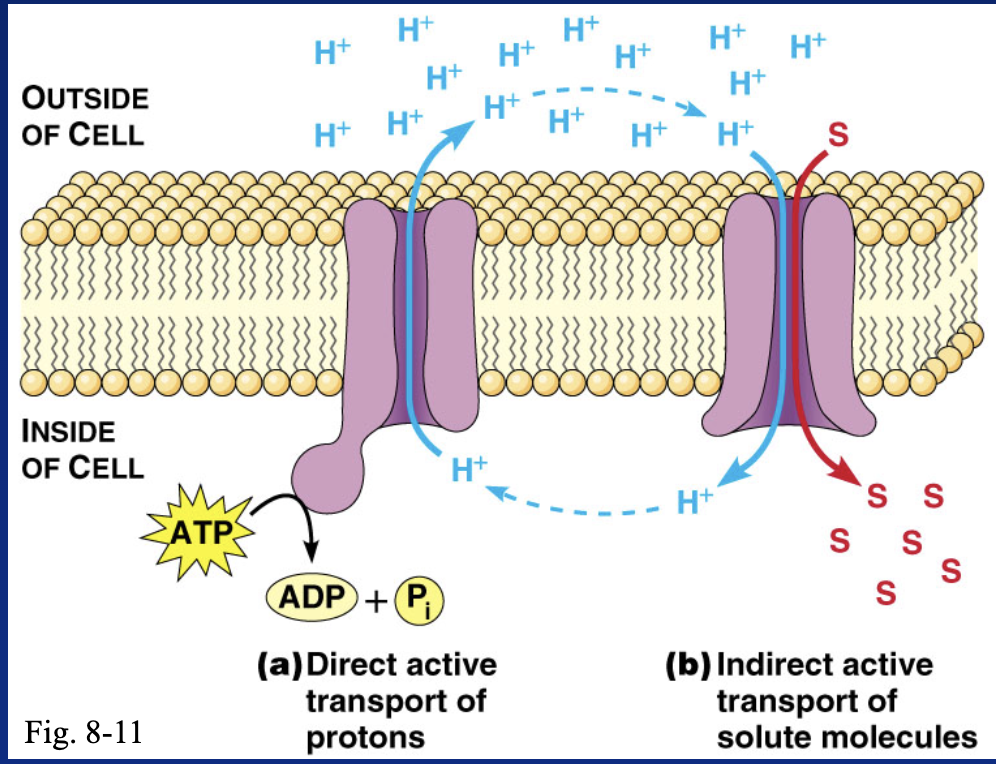
Na+ dependent cotransport
Na+ binds to carrier protein
Na+ moves with its concentration gradient
The energy that produces is used to move glucose against its concentration gradient