Ch 6 Electrolytes and Fluid Balance
 Call Kai
 Learn
Learn Practice Test
 Spaced Repetition
 Match
Match Flashcards
 Knowt Play
1/105

There's no tags or description
Looks like no tags are added yet.
Name | Mastery | Learn | Test | Matching | Spaced | Call with Kai | Chat |
|---|
No analytics yet
Send a link to your students to track their progress
106 Terms
what are the functions of water
-Transports nutrients
-Transports and excretes metabolic waste
-Supports cell shape and structure
-Lubricates friction-generating surfaces
-Sustains normal body temperature
electrolyte balance is significantly integrated with
fluid balance
aprox % of water in males and females
males: 60%
females: 50%
what influences total body water
proportion of lean body mass to body fat, and age
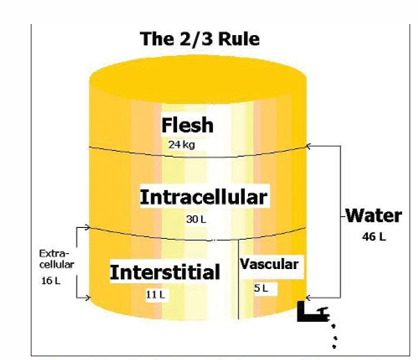
what are the 3 fluid compartments in the body
ICF, ECF, third space
Extracellular fluid (ECF) includes what
interstitial, intravascular, and transcellular
what does third space fluid include
-Peritoneal, pericardial, and thoracic cavities
-Joints and bursae
2/3 rule?
interstitial fluid makes up 2/3 of extracellular volume
PRESSURES
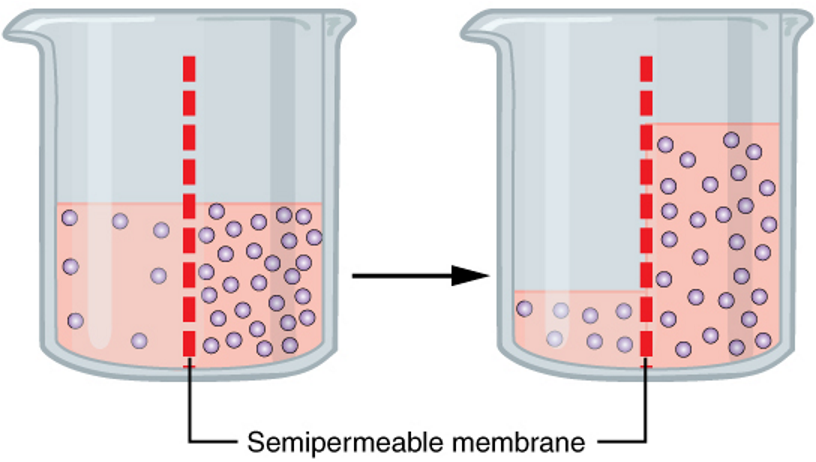
what is osmosis
movement of fluids across a semipermeable membrane from an area of low concentration (of solutes) to an area of high concentration (more solutes)
what is filtration
movement of fluids and solutes
what are the 2 types of pressure
osmotic pressure and hydrostatic pressure
what is osmotic pressure
force that pulls fluid across membrane (pulling force of solutes like salt and proteins that draws water toward higher concentration, aka pulling water towards the solutes)
In our vessels, this tends to be the force that pulls water into the blood vessel (higher concentration of molecules like albumin protein)

what is hydrostatic pressure
pressure exerted by fluid on membrane (physical push exerted by a fluid against a containing wall, aka weight of water/fluid pressing on our blood vessel walls)
In our vessels, this tends to be the blood pressure pushing water out of the blood vessel

osmotic pressure can be expressed as _____ and _______
osmolarity (osmole/L) or osmolality (osmole/kg)
what type of fluids may result in cellular dehydration?
hypertonic
what type of fluids may result in cellular swelling?
hypotonic
what is normal serum osmolality?
285-295 mOsm
what is normal GI tract osmolality?
300 mOsm
INTAKE ESTIMATIONS
what is considered part of fluid intake
Anything fluid at room temperature
metabolic water is what and is it good for intake estimation?
-estimated from using intakes of carbs, protein, and fat as variables
-contributes little in a practical sense
what is part of fluid outake?
sensible and insensible losses
what are sensible losses?
those that are visible and measurable
-Ex: urine and feces
what are insensible losses?
usually not seen or measured
-Through respiration or through skin by evaporation
what is obligatory losses? what is another name for it?
minimum amount needed to remove waste in urine
aka: renal solute load
total urine output is the sum of ___________ and _____________
obligatory urine and facultative urine
what is facultative urine
variable amount of urine adjusted by the body depending on water intake
solute concentration in urine is determined by measuring what?
specific gravity
what two lab findings are best to determine hydration status
1.specific gravity
2.osmolarity
what are the different methods for fluid requirement?
-RDA method
- Holiday-Seger
- ml/kg
- BSA method
RDA method for fluid intake
1ml/kcal
-not best for caloric restriction… would be okay for maintenance and surplus
Holiday-Seger method (peds)
-1-10kg
-11-20kg
-≥ 21kg
1-10 kg: 100-150 mL/kg (OR 4 mL/kg/hr)
11-20kg: 1000 mL + 50 mL/kg for each kg over 10 kg (OR 40 mL/hr + 2 mL/kg for weight >10kg)
≥ 21kg: 1500 mL + 25 mL/kg for each kg over 20kg (OR 60 mL/hr + 1 ml/kg for weight >20kg)
Holiday-Seger method adult
≥ 31kg: 1700 mL + 30 mL/kg for every kg over 30 kg
ml/kg method
adolescents
young adults (16-30)
average adult
55-65
≥65
Adolescents: 40-60mL/kg
Young adults 16-30 years old: 35-40 mL/kg
Average adult: 30-35 mL/kg
Adult, 55-65 years: 30ml/kg
Adult ≥ 65 years: 25 ml/kg
BODY SOLUTES
what are the types of body solutes?
electrolytes and other (glucose, proteins, urea, lactate, and organic acids)
electrolytes include which (8)
sodium, chloride, magnesium, potassium, calcium, phosphate, bicarbonate, sulfate
electrolytes do what in water
dissociate in fluids to form charged particles/ions
other solutes include (5)
Glucose, protein, urea, lactate, and organic acids
Glucose, protein, urea, lactate, and organic acids do what in solutions
remain stable
distribution of electrolytes: relationship between cations and anions
Sum of cations must be equal to sum of anions within a given compartment
what factors influence movement of solutes (4)
Molecular size
Electrical charge of the molecule
Hydrostatic pressure
Method of solute transport
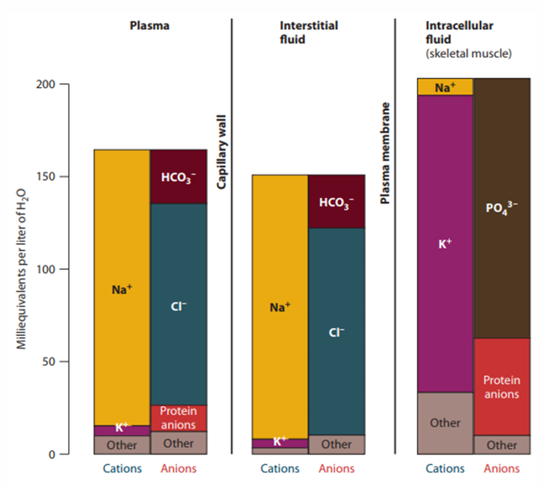
plasma, interstitial fluid, and intracellular fluid compartment components
**extracellular has large sodium and chloride compartment
**intracellular has large potassium and phosphate compartment
ECF and ICF normally are in ________equilibrium
osmotic
ECF volume regulated by
sodium balance
refers to plasma and interstitial (high Na and Cl)
ICF volume regulated by
osmolality and partially by Na/K membrane pump
refers to inside the cell (high K and phosphate)
for osmolality, Equal to blood/body fluids means
isotonic
for osmolality, greater than blood/body fluids means
hypertonic
for osmolality, less than blood/body fluids means
hypotonic
which 3 electrolytes have AIs set?
sodium, potassium, and chloride
Serum levels are _______ to maintain electroneutrality
altered
what are the 4 major electrolytes?
Na, K, Cl, HCO3
functions od the major electrolytes (4)
Maintenance of body fluid osmolarity
Distribution of body fluids among fluid compartments
Regulation of acid-base balance
Promotion of neuromuscular irritability
sources of potassium
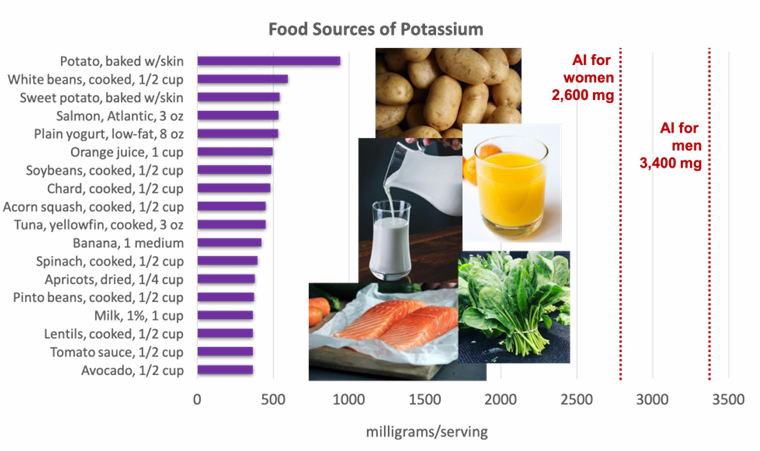
PHYSIOLOGICAL REGULATION OF FLUID AND ELECTROLYTES
by what organ is thirst triggered?
hypothalamus
increase in pressure in capillaries results in what for the kidneys
larger amounts of fluid moving from the capillaries into the renal tubules (excreted as urine)
what are the 2 hormonal influences in the regulation of fluid and electrolytes?
Renin-angiotensin-aldosterone system (RAAS) and arginine vasopressin
what within the blood vessels is stimulated by low hydrostatic pressure?
baroreceptors
low hydrostatic blood pressure is indicative of
decrease in blood volume
what 2 things stimulate the pituitary gland to release arginine vasopressin?
-Increasing osmolality of the ECF
-Detection of a decrease in hydrostatic pressure by baroreceptors in blood vessels
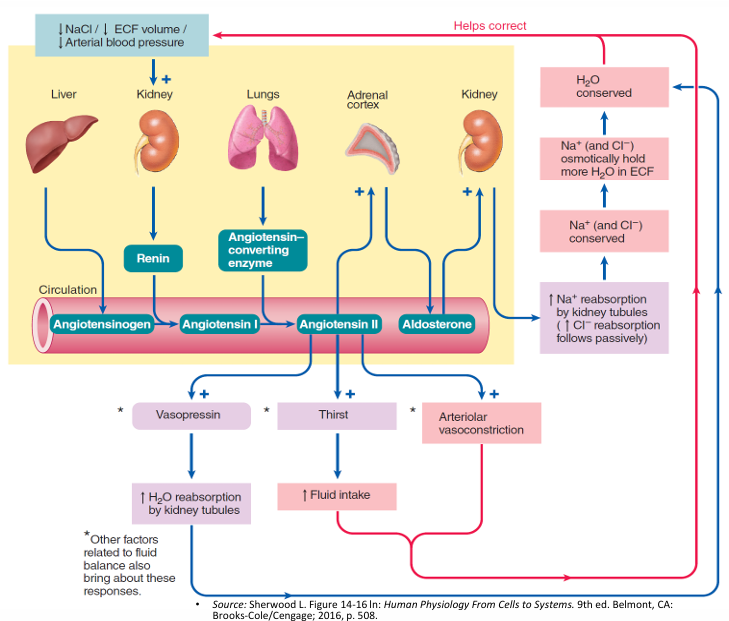
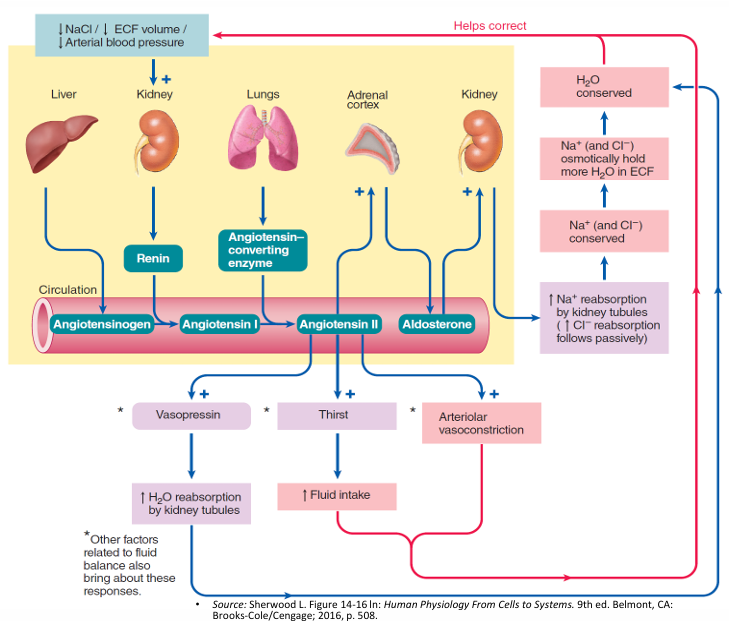
fluid/electrolyte regulation pathway (try to explain from memory)
Decrease Na/Cl OR ECF volume Or arterial BP will result in:
-Liver activation to release angiotensinogen and renin release from kidney --> conversion of angiotensin 1 --> conversion to angiotensin 2 (with lung enzyme) -->
-Angiotensin 2 will trigger:
Vasopressin release --> H2O reabsorption --> water conservation
Thirst --> increased fluid intake --> water increase to correct ECF volume
Vasoconstriction --> helps correct blood pressure
Trigger adrenal cortex to release aldosterone --> trigger kidney to reabsorb more sodium (and chloride passively) --> increase H20 in ECF --> H20 conservation

what are the 4 issues we may see with fluid/electrolyte balance?
1.decrease ECF volume
2.decrease arterial BP
3.decrease NaCl (salt)
4.increase osmolarity
Decrease Na/Cl OR ECF volume Or arterial BP will result in
the release of renin from the kidneys
renin and angiotensinogen (from liver) form
angiotensin I
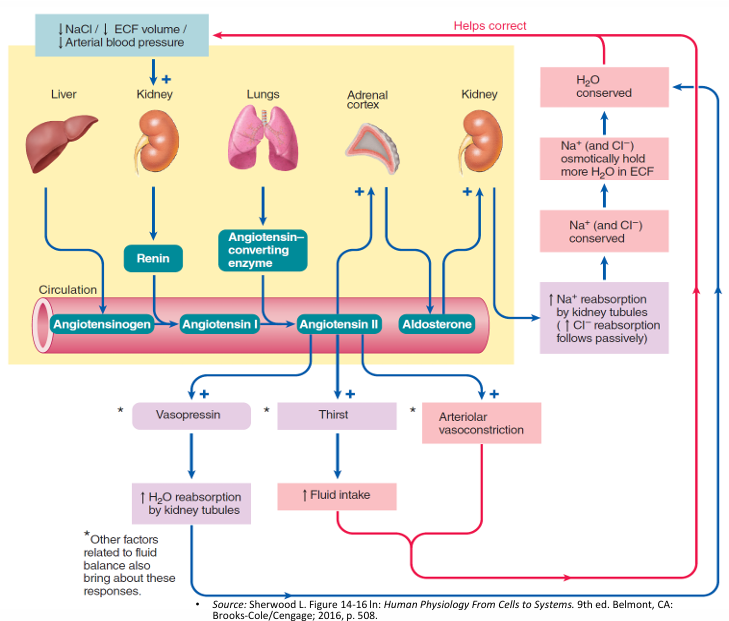
what happens to angiotensin I?
converts to angiotensin II by angiotensin-converting enzyme (lung enzyme)
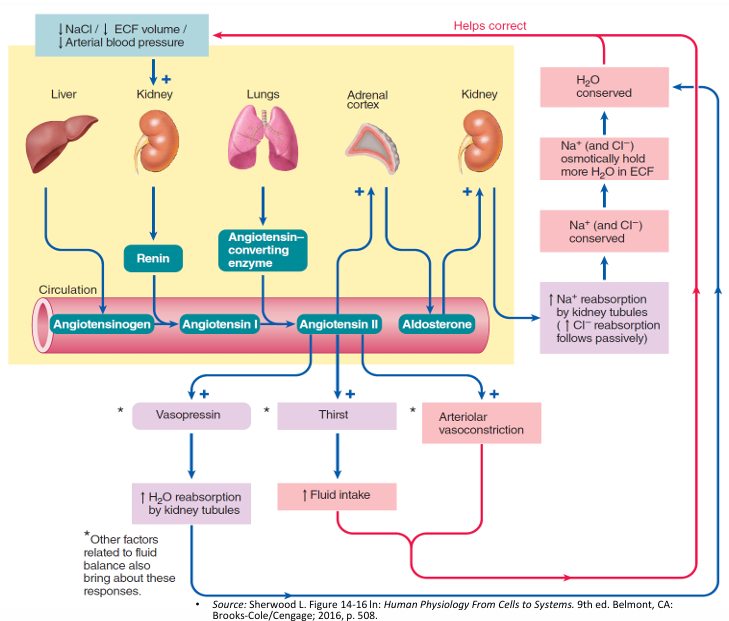
what does angiotensin II do (4 different possible paths)
1.triggers vasopressin release**
2.trigger thirst**
3.trigger vasoconstriction**
4.aldosterone release from adrenal cortex
**other things can also cause these

aldosterone does what for fluid balance?
increase Na reabsorption (Cl passively) which will cause more H20 to be conserved
vasopressin will do what 2 main actions?
1.increase H2O reabsorption
2.arterial vasoconstriction
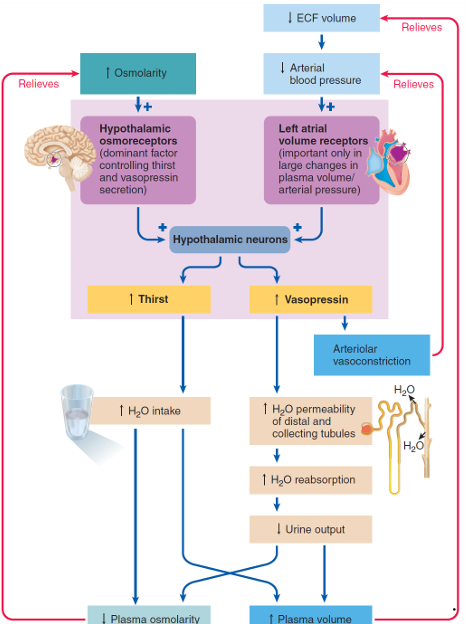
increased water reabsorption will do what? (2)
increase water reabsorption by kidney tubules (so decrease urine output) will decrease plasma osmolarity and increase plasma volume
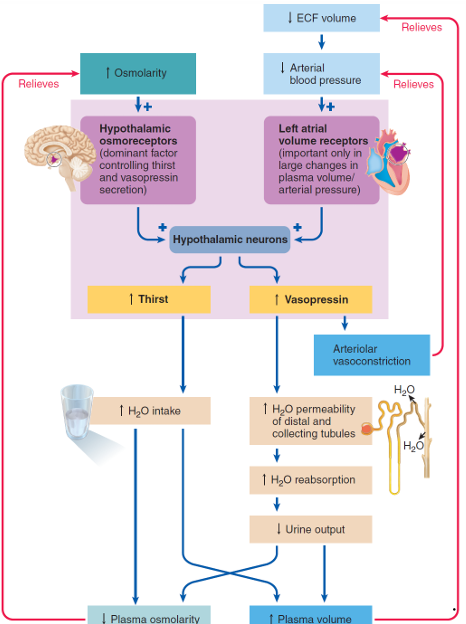
arterial vasoconstriction will do what?
increase arterial BP
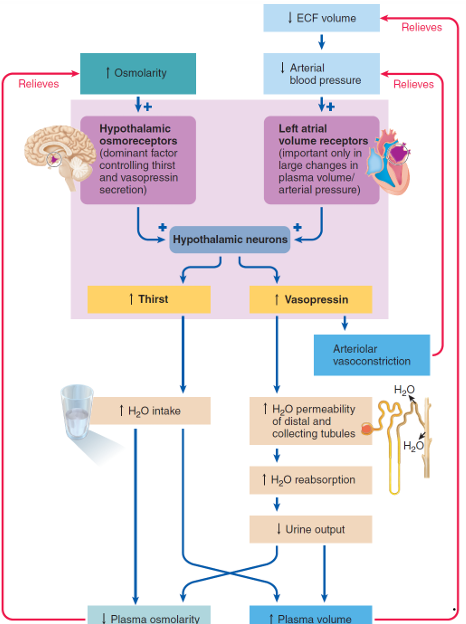
increased osmolarity occurs how?
decrease in water volume makes solute concentration higher
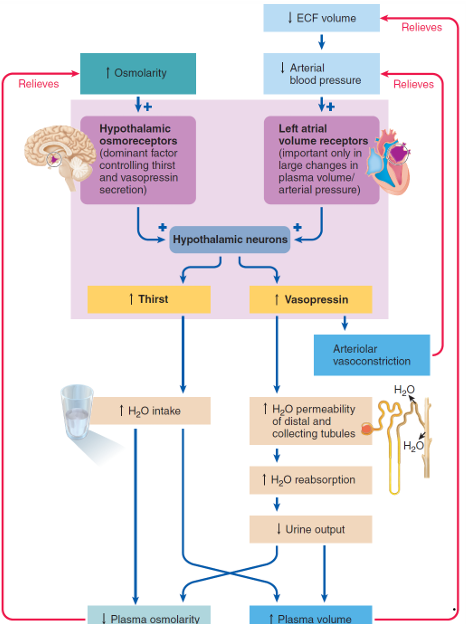
increased thirst will to what?
increase water intake
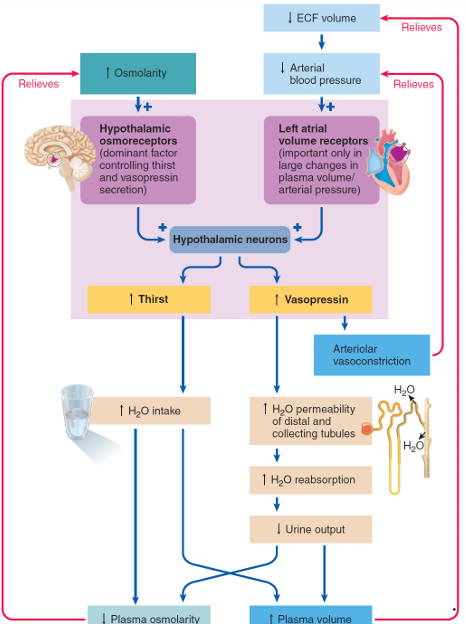
increased water intake will do what 2 things
decrease plasma osmolarity and increase plasma volume (ECF volume)
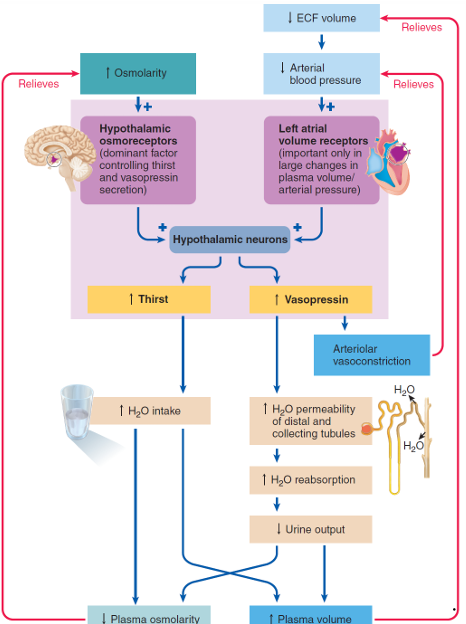
what peptide assist in sodium control
atrial natriuretic peptide (ANP)
how is high potassium regulated (simple)
aldosterone release from adrenal glands
how are calcium and phosphorus regulated?
Dependent on intestinal absorption, exchange between ECF and bone, and renal excretion of these minerals
DISORDERS OF FLUID BALANCE
disorders of fluid balance deal with what 3 things
changes in fluid volume, concentration or osmolarity and composition
changes in fluid, electrolyte, and acid-base balance typically occur
together (rare to happen in isolation)
hypovolemia is always related to what 2 things
renal (urine excretion) or extrarenal loss of fluids
what do we mean by extrarenal loss of fluids?
when fluids are trapped in body spaces
-like with ascites, HF, pulmonary edema and burns
excessive renal losses occurs secondary to
diuresis (increased urine production by kidneys)
hyperglycemia impacts urine output by
increasing it
skin losses contribute to hypovolemia as
fever, sweating
Signs and symptoms of hypovolemia (5)
-Poor skin turgor (skin with decreased turgor remains elevated after being pulled up and released
-Decreased moisture in oral cavity
-Decreased urine output (oliguria)
-Increased urinary specific gravity (1.003-1.035 is normal)
-This reflects fluids conservation by the kidneys
-Disrupted BUN/Cr ratio (>10.1)
hypovolemia physical findings (6)
tachycardia, weak pulse, dizziness, poor skin turgor, dry skin, and mucous membranes
lab findings for hypovolemia
No single lab finding will confirm hypovolemia
(Signs might include elevated urine specific gravity, elevated electrolytes)
treatment for hypovolemia is based on
underlying cause for the fluid deficit
how do we assess weight change for fluid balance?
% weight loss
2% loss/gain:
mild fluid volume deficit or excess (+- 3lbs in a 150lb person)
5% loss/gain
moderate fluid volume deficit or excess (+- 7.5lbs in a 150lb person)
8% loss/gain
severe fluid volume deficit or excess (+- 12lbs in a 150lb person)
what is the most common cause for hypervolemia
decrease in urinary output
why may someone have decreased output (think conditions)
Compromised regulation (CHF, renal failure, cirrhosis, steroid use)
hypervolemia results in what 3 things
elevated BP, jugular venous distension, and edema
what respiratory symptoms are seen with hypervolemia
difficulty breathing (dyspnea) and the presence of rales (fine crackle sound of lungs)
signs and symptoms of hypervolemia
Weight gain over short period of time
Peripheral edema
Distended neck and peripheral veins
Slow emptying peripheral veins
Decreased BUN, hematocrit (hemodilution)
Polyuria if renal function is normal
Increased RR, moist rales, rhonchi
Can include ascites, or pleural effusion depending on underlying cause
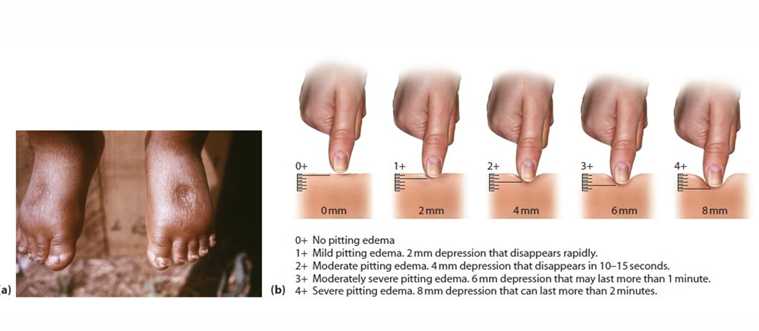
edema categories