ARC 362 Environmental Building Systems I: Psychrometric Chart, Climate, and Thermal Comfort
 Call Kai
 Learn
Learn Practice Test
 Spaced Repetition
 Match
Match Flashcards
 Knowt Play
1/92

There's no tags or description
Looks like no tags are added yet.
Name | Mastery | Learn | Test | Matching | Spaced | Call with Kai | Chat |
|---|
No analytics yet
Send a link to your students to track their progress
93 Terms
What is the Comfort Zone in the Building Bioclimatic Chart?
The area on the chart where temperature and humidity conditions are ideal for human comfort, requiring no corrective measures.

What does the Comfort Ventilation zone represent?
A zone where additional ventilation is needed to maintain comfort, typically in conditions that are slightly above the Comfort Zone.

What is Evaporative Cooling/zone?
A strategy used in the zone where high temperatures and low humidity exist, utilizing water evaporation to cool the air.

What are Internal Heat Gains?
Conditions that are somewhat too cool, where heat from occupants, lighting, appliances, and equipment can help raise the condition toward the Comfort Zone.

What does High Thermal Mass refer to?
A strategy in the chart where materials with high thermal mass are used to absorb and store heat, helping to moderate indoor temperatures.
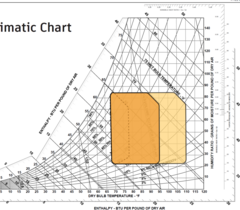
What is High Thermal Mass / Night Flush Cooling?
Thermal mass absorbs/stores heat during the day. At night, cooler outdoor air is ventilated through the building to remove the stored heat and cool the thermal mass for the next day.
What is Humidification?
A zone where the air is too dry, requiring the addition of moisture to reach comfortable humidity levels.

What does Conventional Heating entail?
A strategy used in the zone where the air temperature is too low, requiring active heating methods to achieve comfort.
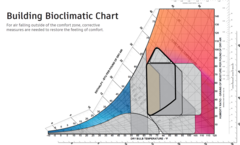
What is Conventional Air Conditioning?
Active cooling AND removal of moisture/dehumidification when necessary to move conditions toward comfort.

What happens to the air when you move upward on the psychrometric chart?
The air gains moisture, indicating an increase in humidity.
What is the relationship between dry-bulb temperature and enthalpy?
Enthalpy is the total heat content of moist air, which includes both sensible heat (related to dry-bulb temperature) and latent heat (related to moisture content).
Why does evaporation require heat energy?
Evaporation absorbs heat from the environment, which is necessary for water molecules to transition from liquid to vapor.
What is the difference between sensible heat and latent heat?
Sensible heat is associated with changes in temperature, while latent heat is associated with changes in moisture content without a temperature change.
How can two air samples have the same dry-bulb temperature but different enthalpy?
They can contain different amounts of moisture; more moisture results in higher enthalpy.
What are the defining characteristics of the Hot/Humid (Tropical) climate type?
Average temperature ≥ 64°F.
What defines the Hot/Arid (Desert) climate type?
High temperature; evaporation > precipitation.
What are the characteristics of the Temperate (Mixed) climate type?
32°F ≤ coldest month ≤ 64°F.
What defines the Continental (Mixed) climate type?
Coldest month < 32°F AND warmest month > 50°F.
What are the characteristics of the Polar (Cold) climate type?
Warmest month < 50°F.
What design strategies are associated with Hot/Humid climates?
Maximize ventilation, avoid heat gain, lightweight materials, large openings/cross ventilation, shaded outdoor spaces, elevated structures, wind orientation, maximize air movement, and minimize thermal mass.
What design strategies are associated with Hot/Arid climates?
Goal: avoid heat gain and retain night coolness. Strategies: thick thermal-mass walls, small shaded windows, courtyards with fountains, night ventilation, use of the diurnal temperature swing, minimizing solar radiation, and evaporative cooling.
What design strategies are associated with Temperate climates?
Goal: balance heating and cooling. Strategies: adjustable shading devices, insulated envelope, south-facing windows for winter sun, cross ventilation for summer, seasonal/adaptive flexibility, and transitional spaces such as porches/verandas.
What is thermal comfort?
Thermal comfort is the state of mind that expresses satisfaction with the thermal environment, influenced by air temperature, relative humidity, air movement, and mean radiant temperature.
What factors affect thermal comfort?
Factors include air temperature, relative humidity, air movement, mean radiant temperature (MRT), clothing, activity level, age, acclimatization, and geographic location.
What is mean radiant temperature (MRT)?
Mean radiant temperature is the average temperature of all surrounding surfaces that affect a person's thermal comfort, influencing how hot or cold they feel.
What is conduction?
Conduction is the heat transfer that occurs between objects or substances in direct contact with each other.
What is convection?
Convection is the heat transfer that occurs through the movement of fluids, including liquids and gases.
What is radiation?
Radiation is the heat transfer that occurs through electromagnetic waves, such as infrared radiation from the sun or a fire.
What is a heat sink?
A device used to transfer heat from a heat source to the surrounding environment. Cooling occurs by removing heat from the source.
What is thermal mass?
Thermal mass refers to materials that absorb and store heat, helping to regulate temperature fluctuations in buildings.
What is time lag in thermal mass?
Time lag is the delay in the movement of heat from outside to inside a building due to the thermal mass, affecting indoor temperature stability.
What is R-value?
R-value is a measure of a material's or component's resistance to heat flow, with higher values indicating better insulation.
What does high R-value mean?
High R-value indicates better thermal resistance, meaning the material is more effective at preventing heat transfer.
What does low R-value mean?
Low R-value indicates poor thermal resistance, meaning the material allows more heat transfer.
What is embodied energy?
Embodied energy is the total energy required to produce a building material, including extraction, manufacturing, and transportation.
What is embodied carbon?
Embodied carbon is the carbon footprint of a material based on greenhouse gas emissions throughout its supply chain, typically expressed in kg CO2e.
What is operational energy?
Operational energy refers to the energy consumed during the use of a building, including heating, cooling, lighting, and appliances.
What is the difference between embodied energy and operational energy?
Embodied energy is the energy used to create a building material, while operational energy is the energy used during the building's lifetime for its operation.
What is transmittance?
Transmittance is the measure of how much light or radiation passes through a material.
What is absorptance?
Absorptance is the measure of how much radiation is absorbed by a material.
What is reflectance?
Reflectance is the measure of how much radiation is reflected off a material's surface.
What is emittance?
A measure of how effectively a surface emits thermal radiation compared with a theoretical black body at the same temperature.
Which climate would prioritize cross ventilation?
Hot/humid climates prioritize cross ventilation to maximize air movement and reduce heat gain.
Why is high thermal mass useful in a hot/arid climate?
High thermal mass is useful in hot/arid climates to absorb heat during the day and release it at night, helping to retain nighttime coolness.
What is the significance of seasonal/adaptive flexibility in temperate climates?
Seasonal/adaptive flexibility allows buildings in temperate climates to adjust to varying heating and cooling needs throughout the year.
What is the importance of limited ventilation in cold climates?
Limited ventilation in cold climates helps to minimize heat loss and maintain indoor warmth.
What do the vertical lines on the psychrometric chart represent?
A) Humidity ratio
B) Dry-bulb temperature / air temperature
C) Relative humidity
D) Enthalpy
B) Dry-bulb temperature / air temperature
What do the horizontal lines on the psychrometric chart represent?
A) Dry-bulb temperature
B) Relative humidity
C) Humidity ratio
D) Dew point temperature
C) Humidity ratio
What do the curved lines extending from lower left to upper right on the psychrometric chart represent?
A) Dry-bulb temperature
B) Relative humidity
C) Enthalpy
D) Specific volume
B) Relative humidity
Moving straight upward on a psychrometric chart indicates which physical change?
A) Temperature increases
B) Temperature decreases
C) Moisture is added (humidification)
D) Moisture is removed (dehumidification)
C) Moisture is added (humidification)
Moving straight downward on a psychrometric chart indicates which change in state?
A) Moisture is removed
B) Moisture is added
C) Air temperature increases
D) Sensible heating
A) Moisture is removed
Moving directly to the right along a horizontal path on the psychrometric chart represents which condition?
A) Air temperature decreases
B) Air temperature increases
C) Humidity ratio increases
D) Moisture is removed
B) Air temperature increases
Moving directly to the left along a horizontal path on the psychrometric chart represents which condition?
A) Temperature increases
B) Moisture increases
C) Temperature decreases
D) Moisture decreases
C) Temperature decreases
A space records 72°F dry-bulb temperature and 45% relative humidity. Is this condition comfortable, and what action is required?
A) No, apply active heating
B) Yes, condition is in the Comfort Zone; no action needed
C) No, increase humidity
D) No, apply night flush cooling
B) Yes, condition is in the Comfort Zone; no action needed
An outdoor condition is recorded at 80°F dry-bulb and 65% relative humidity. Which Bioclimatic Chart zone does this point occupy?
A) Evaporative Cooling
B) Comfort Ventilation
C) Internal Heat Gains
D) High Thermal Mass
B) Comfort Ventilation
If air is at 80°F and 65% RH (Comfort Ventilation zone), what corrective measure brings it toward comfort, and is it passive or active?
A) Increased air movement (passive)
B) Active refrigeration cooling (active)
C) Moisture addition (passive)
D) Night flush (active)
A) Increased air movement (passive)
In an arid region, outdoor conditions are 95°F dry-bulb and 15% relative humidity. Which Bioclimatic Chart zone does this point fall into?
A) Comfort Ventilation
B) Internal Heat Gains
C) Evaporative Cooling
D) Conventional Air Conditioning
C) Evaporative Cooling
To bring 95°F / 15% RH air toward the Comfort Zone using Evaporative Cooling, how must temperature and moisture change?
A) Temperature increases, moisture decreases
B) Temperature decreases, moisture increases
C) Both temperature and moisture decrease
D) Temperature decreases, moisture remains constant
B) Temperature decreases, moisture increases
Which movement on the Building Bioclimatic Chart corresponds to Evaporative Cooling?
A) Up and right
B) Straight down
C) Down and left
D) Up and left (along wet-bulb line)
D) Up and left (along wet-bulb line)
An indoor space in early spring measures 63°F dry-bulb temperature and 50% relative humidity. Which chart zone describes this condition?
A) Internal Heat Gains
A space is at 63°F (Internal Heat Gains zone). What is the primary passive source that can move this condition into the Comfort Zone?
A) Evaporative water sprayers
B) Heat from occupants, lighting, and equipment
C) Opening high vents for cross ventilation
D) Dehumidification equipment
B) Heat from occupants, lighting, and equipment
To shift a point from the Internal Heat Gains zone into the Comfort Zone, which direction must it move on the chart?
A) To the left (decrease temperature)
B) To the right (increase temperature)
C) Straight down (decrease moisture)
D) Straight up (increase moisture)
B) To the right (increase temperature)
Conditions reach 90°F dry-bulb with a high diurnal temperature swing in a dry climate. Which strategy absorbs daytime heat to moderate indoor space?
A) Comfort Ventilation
B) High Thermal Mass
C) Humidification
D) Conventional Air Conditioning
B) High Thermal Mass
How does High Thermal Mass / Night Flush Cooling restore comfort after a hot summer day?
A) Mechanical chillers cool the thermal mass overnight
B) Cool nighttime air flushes the building to purge heat stored in thermal mass during the day
C) Water is sprayed on heavy masonry walls at noon
D) Windows are sealed shut 24 hours a day
B) Cool nighttime air flushes the building to purge heat stored in thermal mass during the day
In winter, indoor air measures 68°F dry-bulb temperature and 10% relative humidity. Which zone on the bioclimatic chart does this occupy?
A) Humidification
B) Conventional Heating
C) Evaporative Cooling
D) High Thermal Mass
A) Humidification
To correct air in the Humidification zone (68°F, 10% RH), what change is required and in which direction must the point move?
A) Temperature decrease; move left
B) Moisture addition; move straight upward
C) Moisture removal; move straight downward
D) Temperature increase; move right
B) Moisture addition; move straight upward
Outdoor air is 35°F dry-bulb temperature. Which zone on the Bioclimatic Chart represents this condition?
A) Internal Heat Gains
B) High Thermal Mass
C) Conventional Heating
D) Comfort Ventilation
C) Conventional Heating
To bring air at 35°F into the Comfort Zone, what active measure is required and how does temperature change?
A) Passive shading; decrease temperature
B) Active heating; increase temperature
C) Comfort ventilation; decrease moisture
D) Evaporative cooling; increase moisture
B) Active heating; increase temperature
Air condition is 95°F dry-bulb and 75% relative humidity. Which zone on the Building Bioclimatic Chart is this?
A) Evaporative Cooling
B) High Thermal Mass / Night Flush
C) Conventional Air Conditioning
D) Internal Heat Gains
C) Conventional Air Conditioning
To move 95°F / 75% RH air to the Comfort Zone via Conventional Air Conditioning, what combination of active adjustments is necessary?
A) Increase temperature and increase moisture
B) Decrease temperature and decrease moisture (dehumidification)
C) Increase temperature and decrease moisture
D) Decrease temperature and increase moisture
B) Decrease temperature and decrease moisture (dehumidification)
Which chart movement vector describes Conventional Air Conditioning operating on hot, humid air?
A) Up and right
B) Down and left
C) Up and left
D) Straight up
B) Down and left
Can a single state point on the Building Bioclimatic Chart be addressed by multiple design strategies?
Yes, strategy zones overlap; multiple passive or active strategies can apply to the same condition.
Which design strategies can be used to address an outdoor condition of 87°F and 25% relative humidity?
Active cooling, passive ventilation/increased air movement, and passive evaporative cooling.
What are the goals and design strategies for Cold climates?
Goal: maximize heat gain and minimize heat loss. Strategies: compact form, south-facing glazing, thermal mass on sunlit surfaces, high insulation/tight envelope, solar heating, deep sun penetration, and limited ventilation.
According to the class 'Embodied Energy by Building Component' graphic, what percentage of embodied energy belongs to each building component?
Structure = 70%, Building Envelope = 20%, Finishes = 10%.
Which building component represents the dominant portion of embodied energy according to the class graphic?
Structure, accounting for 70% of total embodied energy.
According to the structural-system comparison shown in class, how do steel, concrete, and CLT compare in impact?
The steel example is highest, concrete is lower, and CLT is lowest of the three examples shown.
Heat conducts through a solid exterior brick wall from the exterior face to the interior face. What heat transfer mechanism is occurring?
Conduction
Cool air moves across a warm interior floor assembly and picks up heat as it flows. What heat transfer mechanism is active?
Convection
Solar energy passes through glass glazing and directly heats interior surface materials. Which heat transfer mechanism is involved?
Radiation
What is Density?
Amount of mass packed into a given volume.
What is Specific Heat?
Amount of heat energy required to raise one gram of a substance by one degree Celsius.
What is Metabolic Rate?
Rate of heat produced by the body depending on physical activity.
What is Clothing Insulation?
Degree to which clothing prevents heat loss from the body.
How do you identify the Dew Point on an unlabeled psychrometric chart?
Locate the temperature point by following a horizontal line straight left to the saturation curve.
How do you identify Wet-Bulb Temperature lines on an unlabeled psychrometric chart?
Locate the diagonal lines sloping downward to the right from the saturation curve.
How do you identify Enthalpy lines on an unlabeled psychrometric chart?
Locate the steep diagonal lines running nearly parallel to wet-bulb lines, linked to the outer scale.
How do you identify the Saturation curve / 100% relative humidity boundary on an unlabeled psychrometric chart?
Locate the curved boundary line forming the far upper-left border of the chart.
Phoenix and Miami are both at 90°F, but Miami has much higher relative humidity. Which has greater enthalpy and why?
Miami. Their sensible heat from temperature is similar, but Miami contains more water vapor and therefore more latent heat, giving it greater total enthalpy.
What does the Vertical Shade Line represent on the Building Bioclimatic Chart?
The temperature boundary above which solar radiation causes overheating and shading is required.

Why is the Vertical Shade Line drawn at its specific dry-bulb temperature boundary?
It marks the exact outdoor temperature where solar radiation transitions from beneficial heating to unwanted heat gain.
What do conditions to the left versus the right of the Vertical Shade Line imply for building design?
Left: solar radiation is desirable for heating. Right: solar heat gain causes overheating; shading is necessary.
What is the difference between the Vertical Shade Line and the Comfort Zone?
The Comfort Zone defines ideal baseline comfort; the Vertical Shade Line marks the temperature threshold requiring solar shading.