chemistry - topic 4: predicting reactants and products
 Call Kai
 Learn
Learn Practice Test
 Spaced Repetition
 Match
Match Flashcards
 Knowt Play
1/43

Earn XP
Description and Tags
Name | Mastery | Learn | Test | Matching | Spaced | Call with Kai |
|---|
No analytics yet
Send a link to your students to track their progress
44 Terms
Why do some elements have similar characteristics?
They have the same number of outer shell electrons.
What are the elements in Group 1 known as?
Alkali Metals
What are the properties of alkali metals? (4 points)
Soft (can be cut with a knife)
Low MP and BP
Low density
Very reactive
Do alkali metals get more or less reactive as you go down the group? Why?
More reactive (less energy needed to overcome the attractive forces between outer electron and nucleus)
Alkali metals react vigorously with // and // .
Water and oxygen.
(Alkali) metal + water = ?
(Alkali) metal hydroxide + hydrogen gas
(Alkali) metal + acid = ?
Metal salt + hydrogen gas
What are the elements in Group 7 known as?
Halogens
Halogens exist as // molecules.
Diatomic
What do chlorine, iodine, and bromine look like at room temperature?
Chlorine: Poisonous and reactive green gas
Iodine: Crystalline purple-black solid
Bromine: Dense and poisonous red-brown liquid
Do halogens get more or less reactive as you go down the group? Why?
Less reactive (harder to attract an electron when it’s further away from the nucleus).
Halogen + alkali metal = ?
Salt (metal halides)
What happens in a halogen displacement reaction?
A more reactive halogen displaces a less reactive halogen.
What are the elements in Group 0 known as?
Noble gases
Noble gases exist as // atoms.
Monatomic
Why are noble gases inert?
Full stable outer-shell of electrons.
Properties of noble gases: (2 points)
Low MP and BP
Low density
Properties of transition metals: (8 points)
Shiny
Hard/strong
Good conductors of heat/electricity
High MP
High BP
High density
Colourful
Relatively unreactive
Transition metals are often used as //
Catalysts
How does the reactivity change in the periodic table? (image)
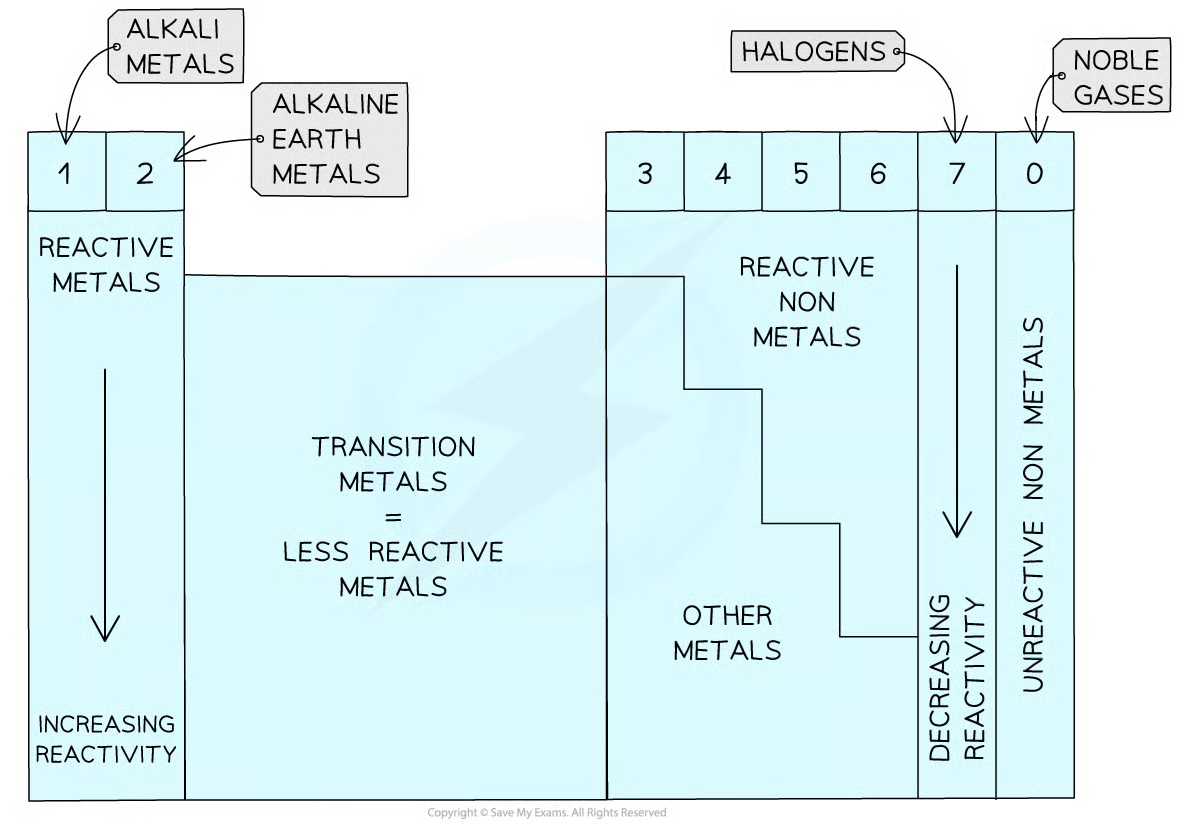
A metal that loses electrons easier will be // reactive.
More
What is the metal reactivity series?
An order based on a metal’s reactivity.
How can we remember the reactivity series?
Group 1 downwards, group 2 downwards, CARBON, group 3 upwards, transition metals
Why do we include carbon in the reactivity series?
To see if the metal oxide can be reduced by carbon.
Elements more reactive can undergo electrolysis
How can you prevent injury during a test for gas?
Conduct tests in a fume cupboard
Stay away from other people
Gas masks (to cover mouth)
How do we test for carbon dioxide gas?
Bubble the gas through limewater - limewater will turn cloudy.
How do we test for hydrogen gas?
Lighted splint - gas will make a squeaky pop noise.
How do we test for oxygen gas?
Glowing splint - splint will relight near oxygen.
How do we test for chlorine gas?
Blue litmus paper - litmus paper will bleach white over chlorine gas.
What is an anion?
A negative ion.
Why do we acidify samples with dilute nitric acid?
To remove interfering ions that may be present and give a false result.
Anions - How do we test for carbonate ions?
First add barium chloride solution to form a white precipitate, then add hydrochloric acid. Mixture will fizz and form CO2.
Anions - How do we test for halide ions?
Dilute nitric acid (HCl can’t be used because there may be chloride ions), followed by silver nitrate solution.
Chloride → white precipitate of silver chloride
Bromide → cream precipitate of silver bromide
Iodide → yellow precipitate of silver iodide
Anions - How do we test for sulphate ions?
Hydrochloric acid, then barium chloride - white precipitate forms.
What solution is used when testing for cations?
Sodium hydroxide.
What is a cation?
A positive ion.
Define precipitate.
Insoluble solids formed as a product of a reaction.
What is the colour of the calcium, copper, iron II, iron III, and zinc precipitate?
Calcium - White
Copper - Blue
Iron II - Green
Iron III - Brown
Zinc - Dissolves
How do we conduct a flame test?
Clean a nichrome wire loop with hydrochloric acid until no colour is produced in a blue flame.
Dip into the sample of the metal compound and place in the clear part of the Bunsen burner flame.
Record what colour the flame goes.
What colour is the flame with lithium, sodium, potassium, calcium and copper?
Lithium - Red
Sodium - Yellow
Potassium - Lilac
Calcium - Orange/red
Copper - Blue/green
What should we use to identify compounds with more than one ion?
Instrumental Analysis.
What are the advantages of instrumental methods of analysis? (3 points)
Sensitive, fast, and accurate.
How can you determine the relative atomic mass of an element?
Mass Spectrometry
What is the molecular ion peak?
The peak furthest to the right, which has the highest mass. The mass of the ion matches this value.