MEDCHEM.01
 View linked note
 Call Kai
 Learn
Learn Practice Test
 Spaced Repetition
 Match
Match Flashcards
 Knowt Play
1/24

There's no tags or description
Looks like no tags are added yet.
Name | Mastery | Learn | Test | Matching | Spaced | Call with Kai |
|---|
No analytics yet
Send a link to your students to track their progress
25 Terms
Stereochemistry
The branch of chemistry concerned with the 3-dimensional artangement of atoms in molecules.
Isomers
compounds that have the same molecular formula but different arrangements of atoms or structures.
Stereoisomers
Isomers that have their atoms connected in the same order but have different 3-dimesional arrangements in space. It includes both enantiomers and diastereomers.
Enantiomers
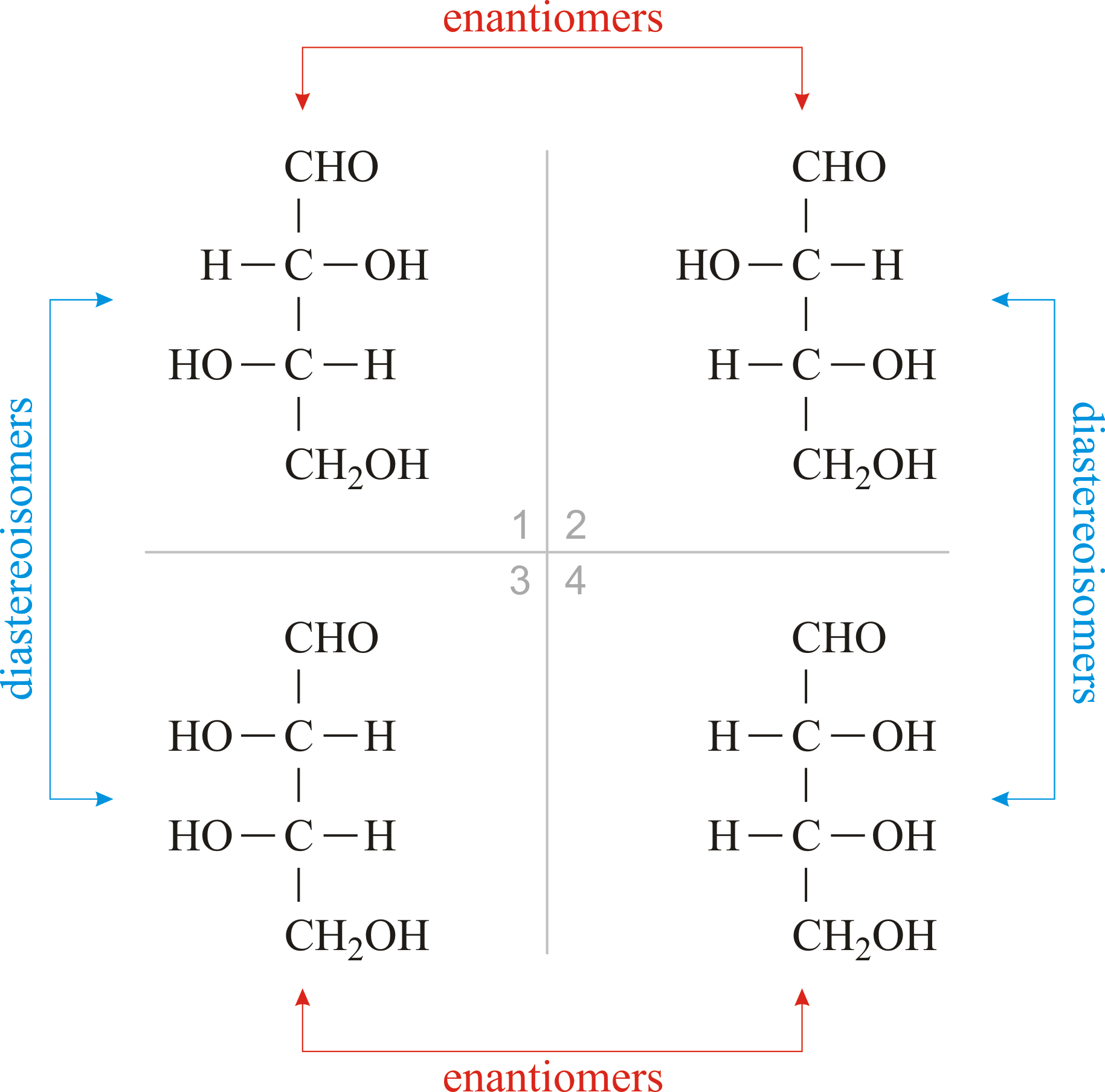
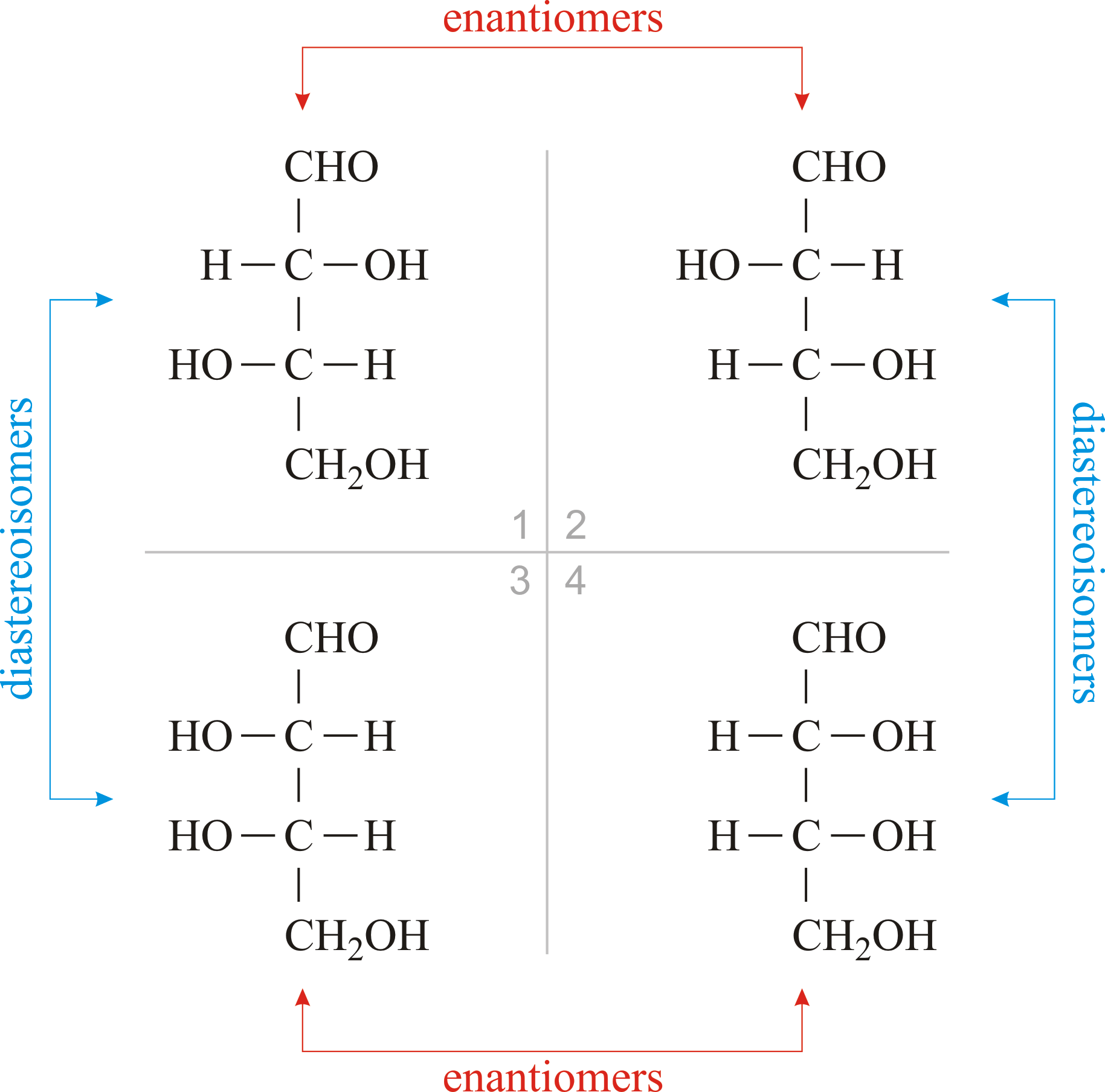
Stereoisomers that are non-superimposable mirror images of each other. They have identical physical properties (ex. boiling point, density..). They have opposite configuration at all chiral centers.
Diastereomers
Stereoisomers that are not mirror images of each other and have different configurations at one or more chiral centers.
Optical Isomers
Another term for enantiomers, which exhibit optical activity and rotate plane-polarized light in opposite directions.
Conformational isomers
Stereoisomers that differ in the rotation around single bonds, leading to different spatial arrangements.
Configurational Isomers
Stereoisomers that cannot be interconverted by rotation around single bonds and require breaking and forming of bonds to change configuration.
Chirality
Chiral molecules are chemically identical to each other but possess unique three-dimensional shapes, making them mirror-images that are not superimposable on each other.Although chemically identical, chiral molecules may possess very different biologicalproperties
Chirality
A property of a molecule that makes it non-superimposable on its mirror image, resulting in two distinct forms known as enantiomers.
Achiral Molecules
Molecules that are superimposable on their mirror images, having no chiral centers.
Chiral Molecule Rules
Needs a stereogenic centre
A carbon atom with four different groups attached to it
Cannot have a plane of symmetry
Stereogenic centre
A carbon atom with four different groups attached to it
Enantiomers
A pair of molecules that are related as non-superimposable mirror images are called enantiomers.
Enantiomers physical properties
Enantiomers have identical physical properties such as melting point and boiling point, but differ in optical activity. They rotate plane-polarized light in opposite directions.
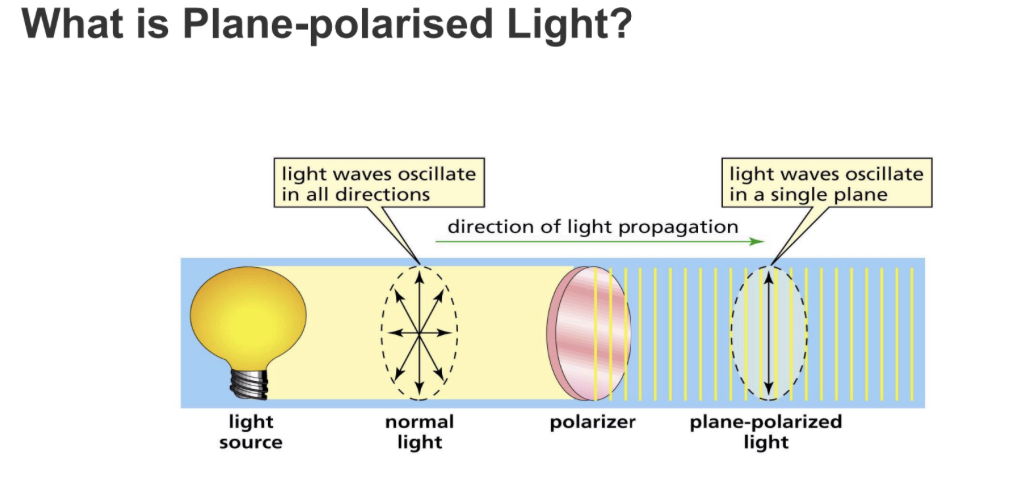
What is Plane-polarised Light?
Light that oscillates in a single plane, often used in optical experiments to study chiral substances.
How you can differentiate between a pair of enantiomers using a polarimeter
A polarimeter measures the angle of rotation of plane-polarized light caused by enantiomers, allowing for differentiation based on their opposite rotation directions.
Levorotatory
describes an enantiomer that rotates plane-polarized light to the left (counterclockwise).
Dextrorotatory
describes an enantiomer that rotates plane-polarized light to the right (clockwise).
How to calculate the specific rotation of a molecule
Specific rotation is calculated using the formula [α] = α / (c × l), where α is the observed rotation, c is the concentration in g/mL, and l is the path length in decimeters.
Racemic Mixture
a mixture containing equal amounts of both enantiomers, resulting in no net rotation of plane-polarized light, therefore optically inactive.
Optically active molecules
Can rotate the plane of polarised light.
Chirality in Drug Design
Chirality plays a critical role in drug design as chiral drugs may have different therapeutic effects; one enantiomer may be effective while the other could be harmful.
Chiral Amino Acids
Chiral amino acids are fundamental building blocks of proteins, creating a homochiral environment crucial for proper protein folding and functionality.
Enzyme Specificity
Enzymes are chiral and often exhibit specificity for one enantiomer over another, affecting binding affinity and reaction rates.