Lesson 6 - Respiratory systems in bony fish
 Call Kai
 Learn
Learn Practice Test
 Spaced Repetition
 Match
Match Flashcards
 Knowt Play
1/6

There's no tags or description
Looks like no tags are added yet.
Name | Mastery | Learn | Test | Matching | Spaced | Call with Kai | Chat |
|---|
No analytics yet
Send a link to your students to track their progress
7 Terms
Gill anatomy
-Series of gill arch’s on each side of head, contained in gill cavity and covered by protective operculum
-Each gill arch attached to two stacks of filaments
-Lamellae on surface of filament and rows of the, which consists of flattened cells which cover vast network of capillaries. So, rich blood supply steep conc. gradient for efficient gas exchange. Lamellae also have secondary lamellae which increase surface area.
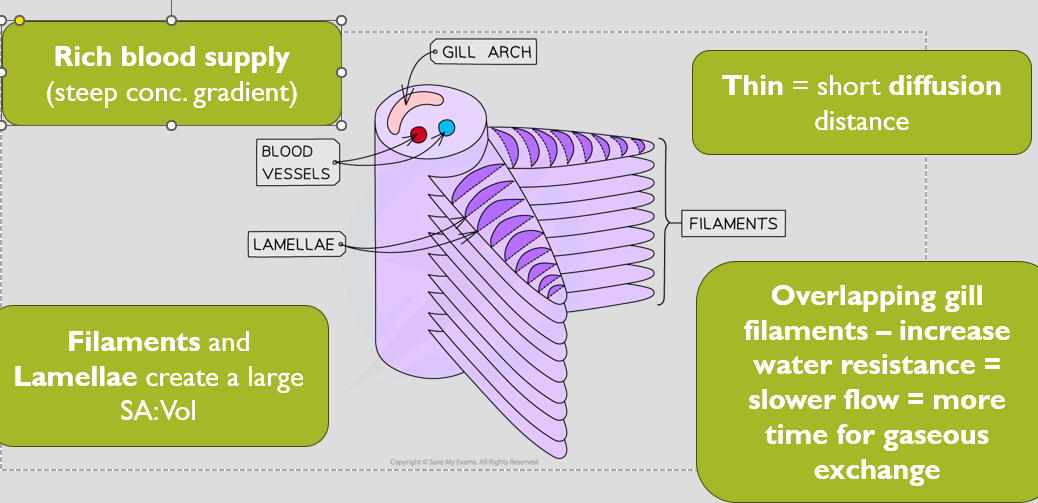
Gill filaments (Primary lamellae)
These are long thin, feathery structures attached to gill arches, and each gill arch carries two rows of filaments. Contain blood vessels which transport blood to and from secondary lamellae. As they are thin and flat, it reduces diffusion distance and their feathery arrangement allows water to flow over a large area
Secondary lamellae
These are tiny, thin, plate-like projections that cover the surface of each gill filament. They are packed densely along the the filament to create a very large total surface area. Contain a network of capillaries running very close to the surface, reducing distance. Main site of gas exchange
What is counter current
Blood flows in opposite direction to water flow, so water has higher oxygen content than the blood it meet, which allows continuous diffusion of oxygen into blood, achieves up to 80-90% oxygen extraction. Without it oxygen in water and in blood would equalise and gas exchange would be less efficient.
What does fish ventilation ensure
Ventilation mechanism constantly pushes water over gills and ensure they are constantly supplied with water rich in oxygen
How does ventilation in fish occur
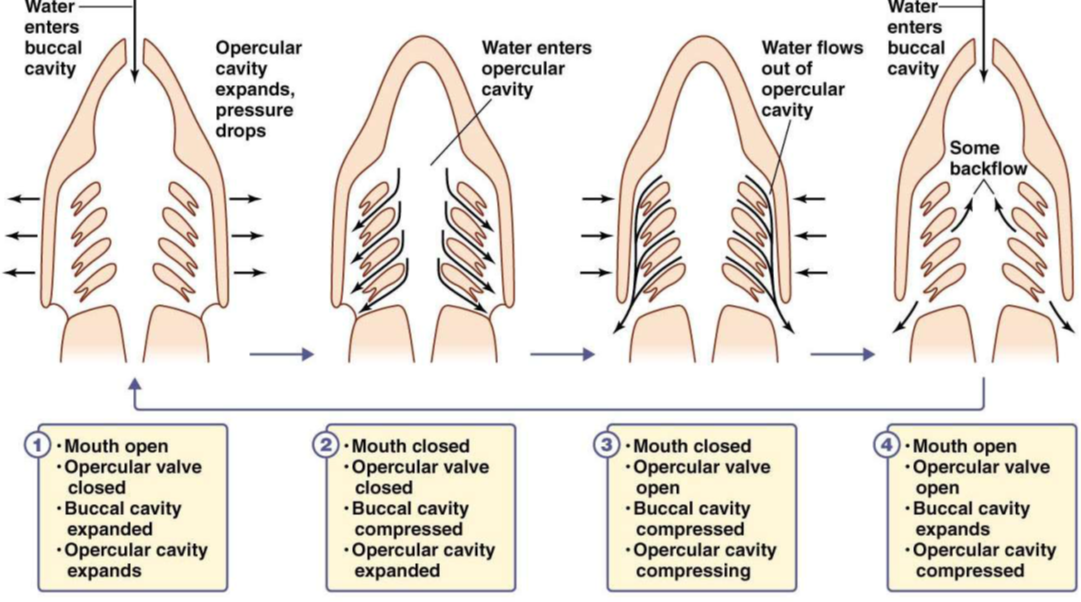
Fish mouth opens, so buccal cavity is lowered so volume in buccal cavity increases, pressure inside decreases and water enters down a pressure gradient
Fish mouth closed, buccal cavity floor rises so volume decreases and pressure increases, this means water is forced over gills into opercular cavity
Opercular cavity contracts (volume decreases). Pressure increases in opercular cavity. Water is forced out through the operculum
Why do bony fish need water to flow over their gills for gaseous exchange to occur
To maintain and create a steep conc. gradient
To maximise rate of diffusion
Blood flows in opposite direction to water flow so water is constantly supplying fish blood with oxygen