Lecture 9 Transcriptional Regulation of Gene Expression
 Call Kai
 Learn
Learn Practice Test
 Spaced Repetition
 Match
Match Flashcards
 Knowt Play
1/74

There's no tags or description
Looks like no tags are added yet.
Name | Mastery | Learn | Test | Matching | Spaced | Call with Kai | Chat |
|---|
No analytics yet
Send a link to your students to track their progress
75 Terms
-to-% of our genome codes for proteins
1 to 2
in multicellular organisms, gene expression is under extremely
elaborate control
even bacterium express genes __
selectively to make enzymes needed to digest food only when available
through embryonic development, a fertilized egg cell gives rise to many
cell types that differ in structure and function
differences between a mammalian neuron and a hepatocyte for example are so
extreme that it is difficult to imagine that the two cells contain the same DNA
however, nearly all the cells of a multicellular organism contain the same
genome
cell differentiation is instead achieved by
changes in gene expression
controlling gene expression in cells slide

__ is responsible for the diversity in cell type
differential gene expression
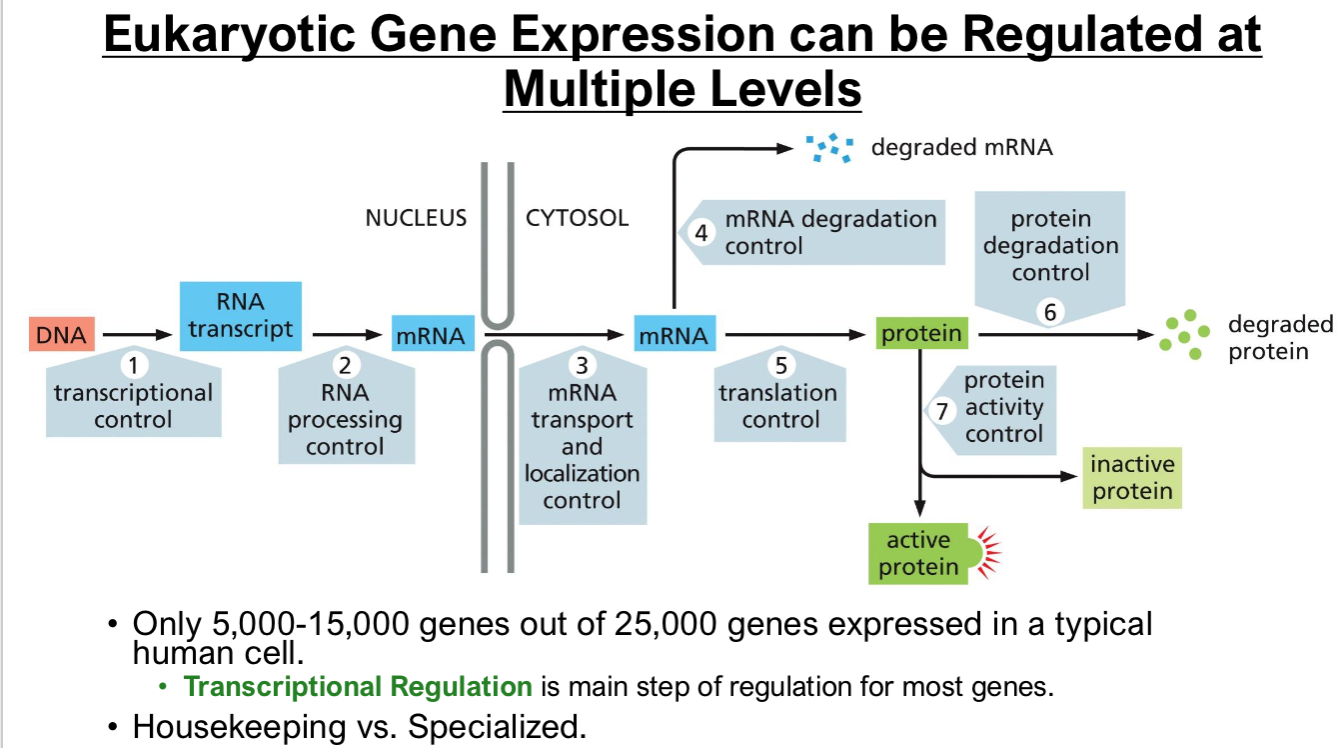
eukaryotic gene expression can be regulated at
multiple levels
only _ genes out of the 25,000 genes expressed in a typical human cell
5,000-15,000
_ is main step of regulation for most genes
transcriptional regulation
some genes expressed in both liver and neural cells while others are
only expressed in one
the regulation of gene expression for multiple levels gives most control over
genome at any given time
regulation of gene expression from multiple levels slide
transcription is controlled by
proteins binding to regulatory DNA sequences
a transcription factor does what
binds to promoter regions and activates or represses
in addition to promoter, nearly all genes, whether bacterial or eukaryotic, have regulatory
DNA sequences that are used to switch the gene on or off
regulatory DNA sequences are recognized by
proteins called transcription regulators to control transcription
where does a transcription regulator bind on DNA
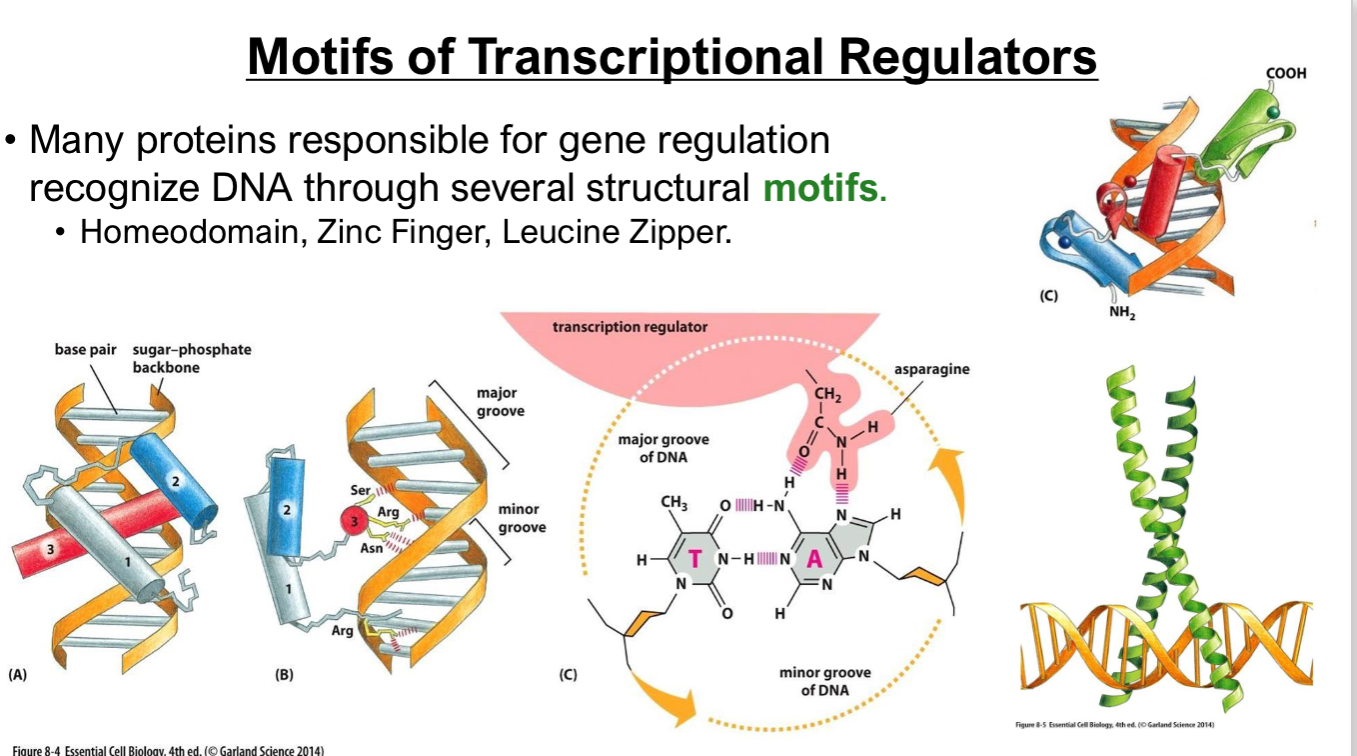
to the major groove of a DNA helix
typical protein-DNA interface consists of
10-20 contacts, each involving a different amino acid each contributing to strength of protein-DNA interaction
transcriptional regulators interact with DNA in a
specific place and way
these features will vary depending on
nucleotide sequence, thus different proteins will recognize different nucleotide sequences
proteins forms —,—,— with edges of bases
hydrogen bonds, ionic bonds, and hydrophobic interactions
around how many contacts typically formed at protein-DNA interface combine for interaction both highly specific and strong
20
_ interactions are among tightest and most specific molecular interactions
protein-DNA
transcription regulator binding spot slide

many proteins responsible for gene regulation recognize DNA through
several structural motifs
structural motifs typically scene in proteins responsible for gene regulation
homeodomain, zinc finger, leucine zipper
motifs of transcriptional regulators slide
a cluster of _ can be transcribed from a single promoter
bacterial genes
transcription switches allow cells to respond to
changes in environment
clusters of genes transcribed as a single mRNA molecule are common as bacteria called
an operon
expression of tryptophan operon is controlled by
a regulatory DNA sequence called the operator situated within the promoter
in prokaryotic transcriptional events that express an operon expresses all the parts that are needed for
a function
operator =
piece of DNA sequence a transcriptional regulator can bind
bacterial genes being transcribed from a single promoter slide

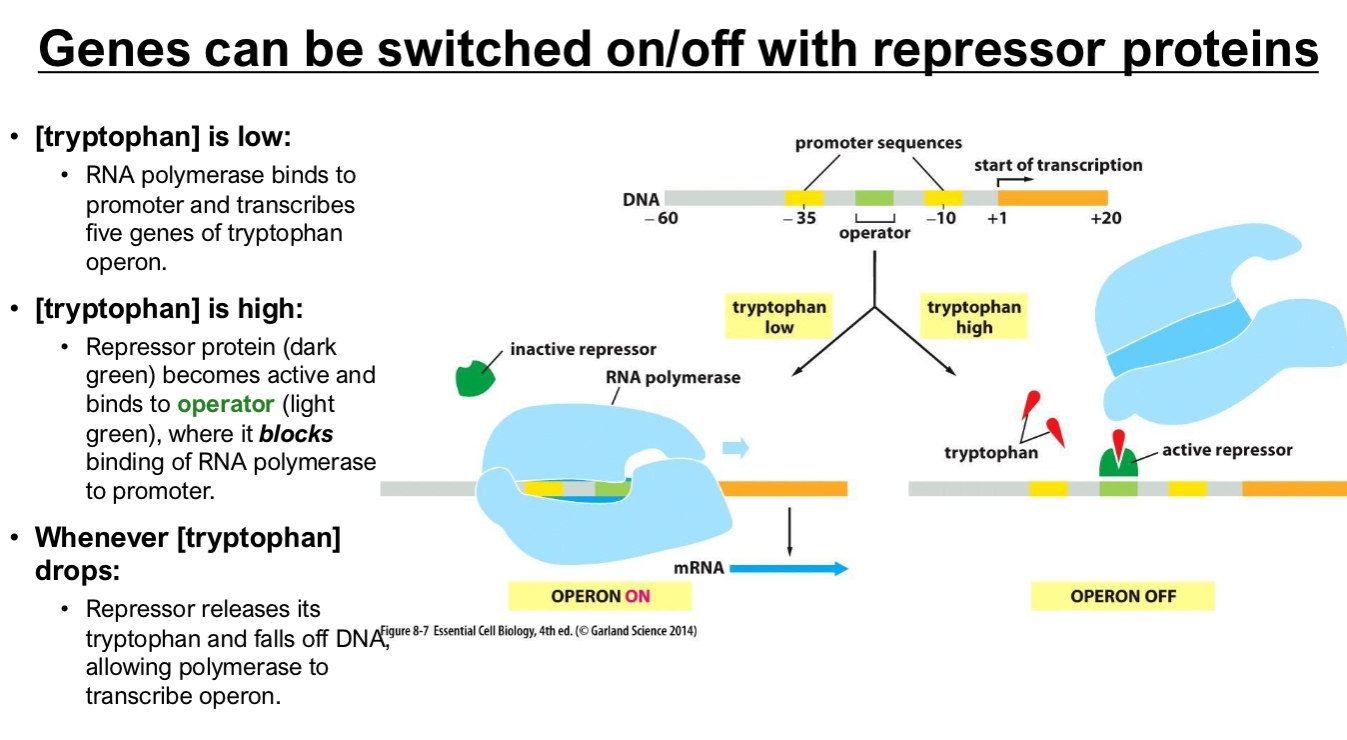
genes can be _ with repressor proteins
switched on and off
when tryptophan is low
RNA polymerase binds to promoter and transcribes five genes of tryptophan operon
when tryptophan is high
repressor protein becomes active and binds to operator where it blocks the binding of RNA pol to promoter
whenever tryptophan drops
repressor releases its tryptophan and falls off DNA, allowing polymerase to transcribe operon
operons put together
multiple genes for a particular process
microbes _ own tryptophan when it gets low
produce
when tryptophan levels are high tryptophan does what
binds to represor protein to activate, repressor protein then becomes activated and binds to operator and blocks RNA pol from binding
tryptophan slide
gene expression can also be controlled by
activator proteins
what does an activator protein do
binds to regulatory sequence on DNA and interacts with RAN pol to help initiate transcription efficiently
without activator promoter _
fails to initiate transcription efficiently
bacterial catabolite activator protein must do what before it can bind to DNA
bind cyclic AMP (cAMP)
lac operon is controlled by _ signals:
2 signals: glucose nd lactose
+glucose +lactose
nothing binds, operon is off
+glucose -lactose
repressor is bound, operon off
-glucose, -lactose
cyclic amp and CAP bound, repressor bound, operon off
-glucose, +lactose
CAP bound w/ cyclic AMP, RNA pol can bind, operon on
Glucose and lactose concentrations control
initiation of transcription of Lac operon through effects on Lac repressor protein and CAP.
Lactose is absent,
Lac repressor binds Lac operator and shuts off expression of operon.
Glucose is absent,
cyclic AMP (red triangle) is produced by cell and CAP binds to DNA. LacZ, first gene of operon, encodes enzyme β-galactosidase: breaks down lactose to galactose and glucose
Addition of lactose increases
intracellular concentration of related compound, allolactose. Allolactose binds to the Lac repressor, causing it to undergo a conformational change that releases its grip on operator DNA (not shown).
lac operon slide

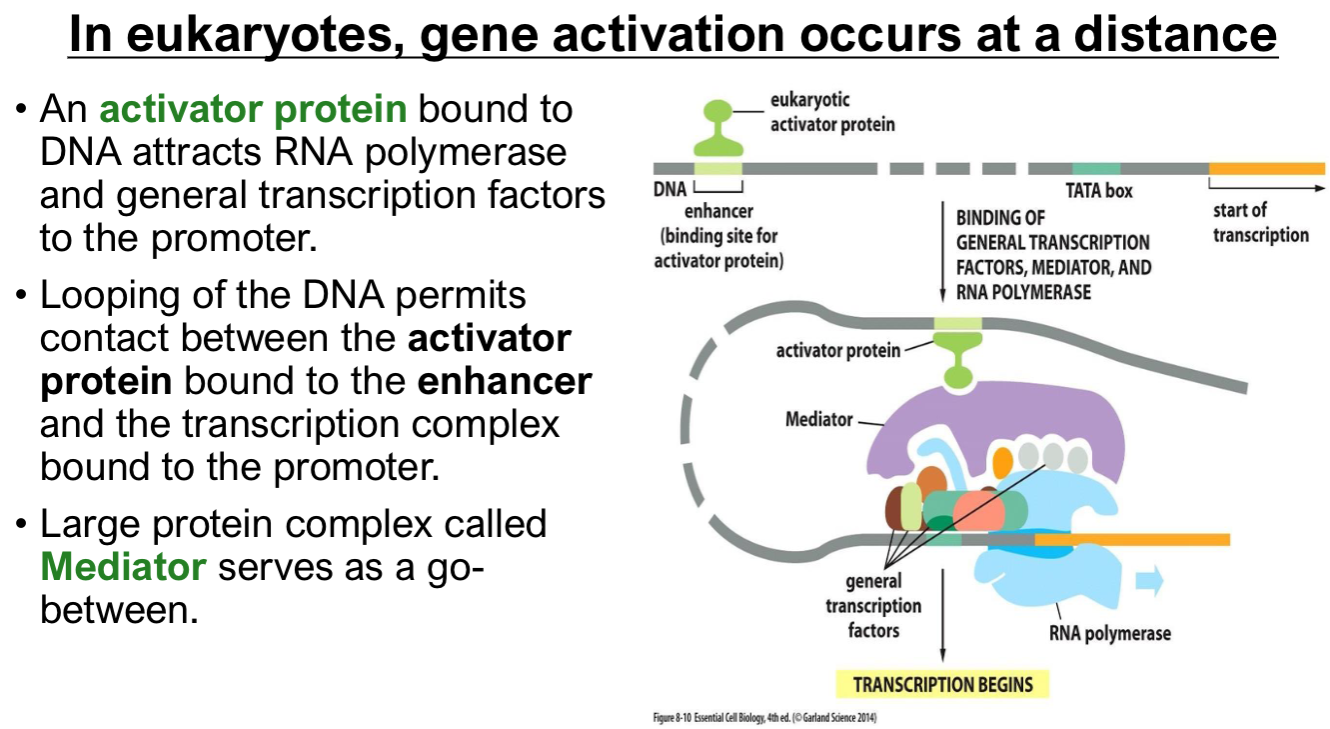
in eukaryotes gene activation occurs how
at a distance
an activator protein bound to DNA does what
attracts RNA polymerase and general transcription factors to the promoter
looping of the DNA permits what
contact between the activator protein bound to the enhancer and the transcription complex bound to the promoter
what serves as the go between
large protein complex called mediator
eukaryotic gene activation slide
eukaryotic gene activator proteins can direct _ alterations in chromatin structure
local
activator proteins can recruit —- and —- to promoter region of DNA
histone-modifying enzymes, chromatin-remodeling complexes
histone-modifying enzymes and chromatin-remodeling complexes makes DNA packaged in —- more —
make DNA packaged in chromatin more accessible to other proteins
the covalent histone modifications can serve as
binding sites for proteins that stimulate transcription initiation
eukaryotic gene activator slide 1

many transcription activators attract histone acetylases which do what
attach an acetyl group on tail of histone proteins
histone acetylases alter
chromatin struccture allowing greater accesibility to DNA
many repressors attract
histone deacetylases enzymes that remove acetyl groups from histone tails, thereby reversing the positive effects that acetylation has on transcription initiation
histone acetylases slide
