Bonding and Structure
 Call Kai
 Learn
Learn Practice Test
 Spaced Repetition
 Match
Match Flashcards
 Knowt Play
1/16

There's no tags or description
Looks like no tags are added yet.
Name | Mastery | Learn | Test | Matching | Spaced | Call with Kai | Chat |
|---|
No analytics yet
Send a link to your students to track their progress
17 Terms
What is an ionic bond?
An electrostatic attraction between oppositely charged ions.
What two factors affect the strength of ionic bonding?
ionic radius
ionic charge
What is an ionic radius?
The distance from the centre of the ion’s nucleus to its outermost electron.
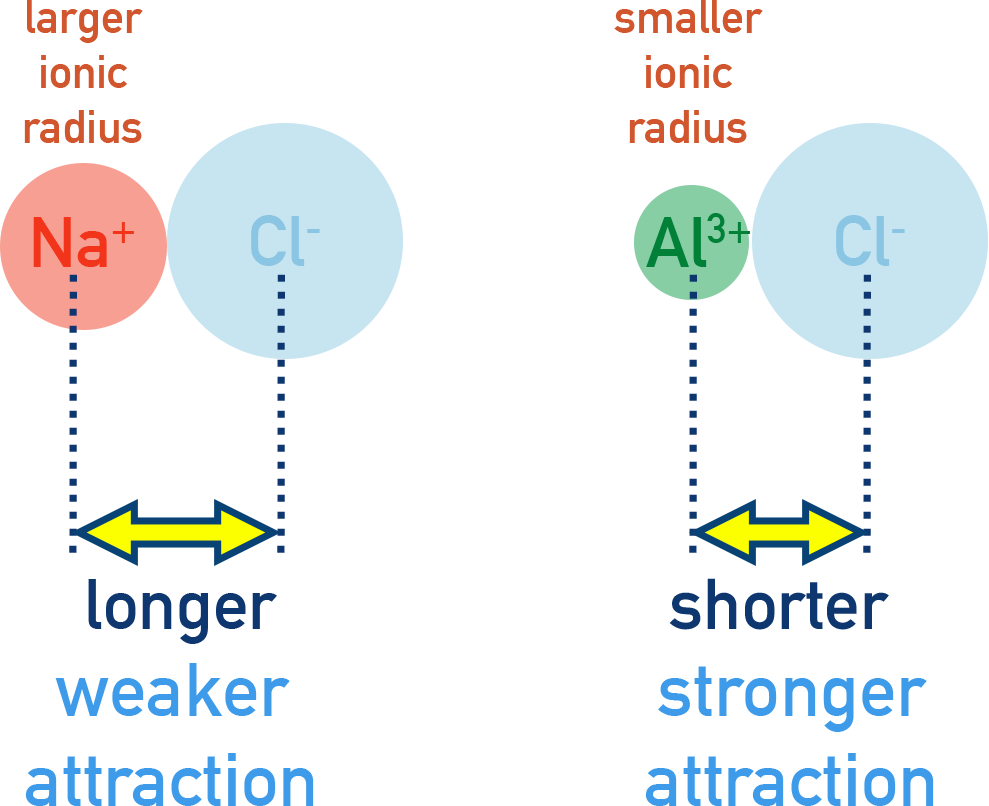
How does ionic radius affect the strength of ionic bonding?
The smaller the ionic radius, the stronger the ionic bond formed.
This is because the electrostatic forces of attraction have to act over a shorter distance, making them stronger.
How does ionic charge affect the strength of ionic bonding?
The greater the ionic charge, the stronger the ionic bond formed.
This is because the ion will have a greater attraction to other ions, resulting in stronger electrostatic forces of attraction between them.
How are ions formed?
They are formed when an atom loses/gains electrons.
One atom loses electrons and forms a cation.
It transfers these electrons to another atom, which gains electrons as a result, forming an anion.
How can the electronic configuration of cations and anions be drawn using dot-and-cross diagrams?

What are the trends in ionic radii down a group?
The ionic radii increase because each succeeding element has more electron shells.
This increases the distance between the nucleus and outer electron.
What are isoelectronic ions?
Ions with the same electronic configuration.
EX: Na+ and Mg2+ → both have 10 electrons
What is the trend in ionic radii for isoelectronic ions?
The greater the number of protons in the ion’s nucleus, the smaller the ionic radius.
This is because the positive charge of the nucleus is greater, so the ion’s electrons are more strongly attracted to it.
As a result, the electrons are pulled closer to the nucleus.
What are the properties of ionic compounds?
high melting points
poor conductors of electricity when solid, but good conductors of electricity when aqueous/molten
often soluble in water
brittle
Why do ionic compounds have high melting points?
Their oppositely charged ions are held together by strong electrostatic forces of attraction (ionic bonds) which require a lot of energy to break.
Why are aqueous/molten ionic compounds good conductors of electricity, but solid ionic compounds aren’t?
In aqueous/molten ionic compounds, their ions are free to move but in solid ionic compound they aren’t.
Why are ionic compounds often soluble?
Why are ionic compounds brittle?
When a force is applied to an ionic solid, its layers of ions may slide over each other.
As a result, ions of the same charge are forced side by side, causing them to repel each other.
This causes the solid to break apart.
What is ion migration?
The movement of ions due to an externally-applied electrostatic field.
How does ion migration provide evidence for the existence of ions?
During electrolysis of a molten/aqueous ionic compound, its ions move to the oppositely charged electrode due to their electrostatic attraction to oppositely charged species.
Positive ions move to the cathode, where they gain electrons and form atoms.
Negative ions move to the anode, where they lose electrons and form atoms.