M2-5-Orbit and ear
 Call Kai
 Learn
Learn Practice Test
 Spaced Repetition
 Match
Match Flashcards
 Knowt Play
1/42

There's no tags or description
Looks like no tags are added yet.
Name | Mastery | Learn | Test | Matching | Spaced | Call with Kai | Chat |
|---|
No analytics yet
Send a link to your students to track their progress
43 Terms
Cornea + sclera makes up the
Fibrous layer of the eyeball
The Iris contains
smooth muscles that alter size of pupil
palpebral fissure
opening of eyelids
Ciliary glands
infection in this area results in a sty
Anteroposterior axis
coronal plane movement
Conjunctiva
Transparent mucous membrane
Superior and inferior conjunctival fornix is at the site of
reflection between bulbar and palpebral conjunctiva
Bulbar and palpebral conjunctiva are continous, and form a ____ when eye is closed
conjuctiva sac
Lacrimal fluid is secreted by:
Lacrimal gland
Where does lacrimal fluid flow into
Into the superior conjunctival fornix, and is swept towards the lacrimal puncta by blinking
Where does lacrimal fluid drain into
Inferior meatus of the nasal cavity via the nasolacrimal duct
Levator palpebrae superioris
Inserts into subcutaneous tissue of upper lid and superior tarsal plate. Innervated by CN III
Superior tarsal muscle
Inferonasal slip of levator palpebrae superioris is made up of smooth muscle. Innervated by sympathetic IML of T1
Striated extraocular muscles other than ___ ____ originate fromthe apex of the orbit
Inferior oblique
All of the rectus muscles originate from the:
common tendinous ring
Incycloduction
tiling of eyeball towards the midline
Excycloduction
tilting of eyeball laterally
What eye muscles are innervated by CN III
Levator palpebrae superioris, superior rectus, inferior rectus, medial rectus, inferior oblique
What eye muscle is innervated by CN IV
Superior oblique
What eye muscle is innervated by CN VI
Lateral rectus
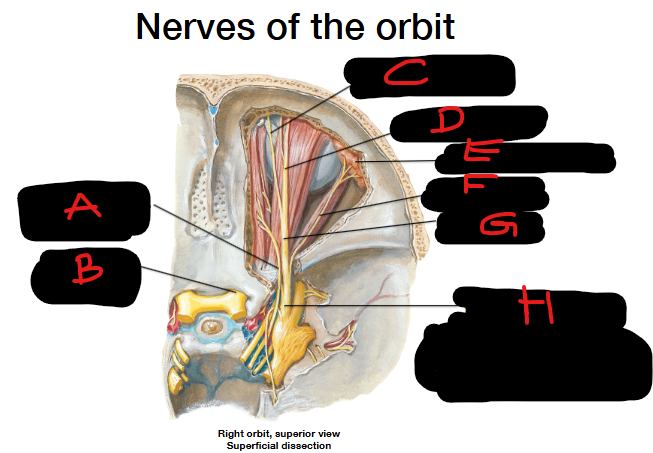
Define A
Trochlear n.
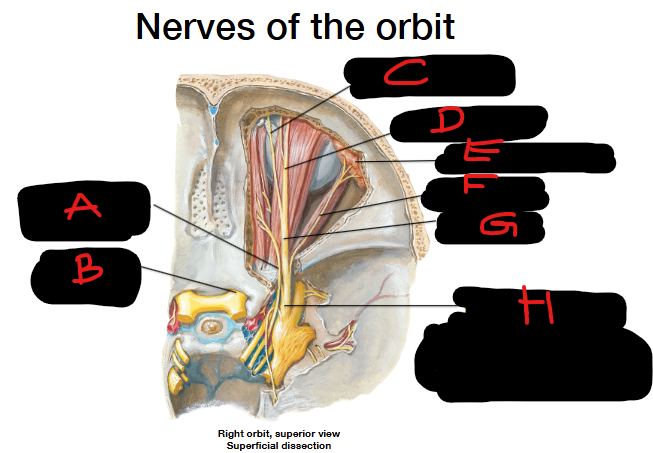
Define B
Optic n
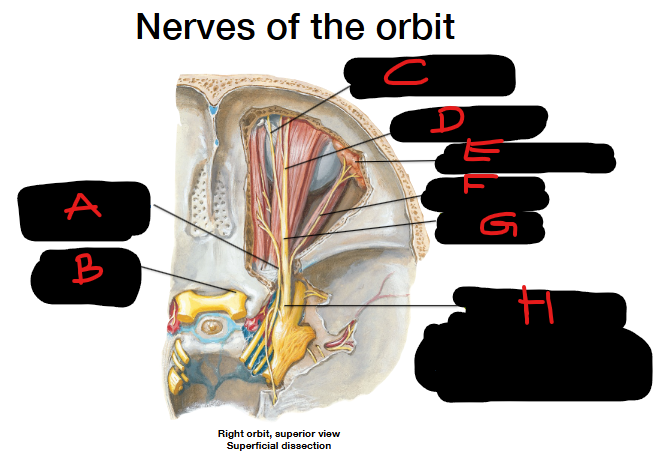
Define C
Supratrochlear n
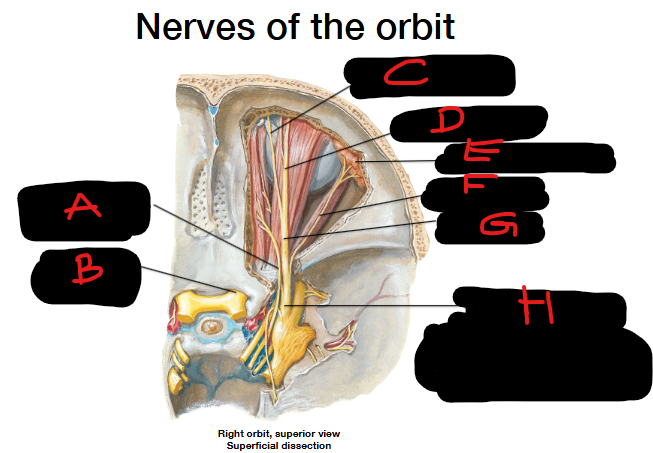
Define D
Supraorbital n
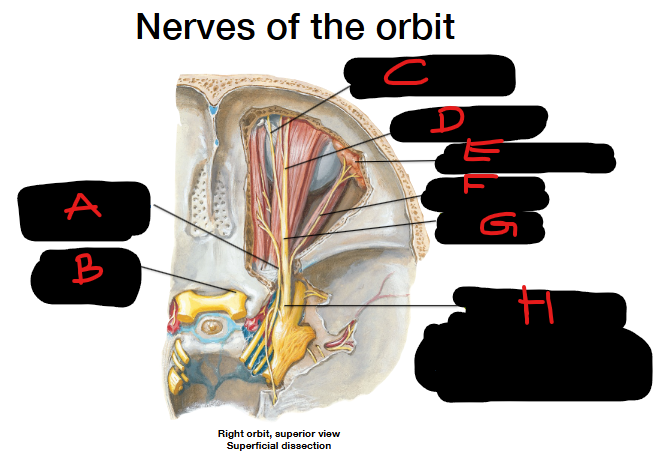
Define E
Lacrimal gland
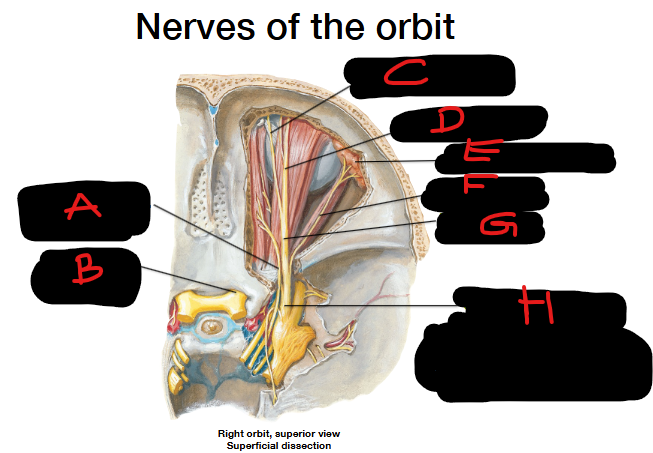
Define F
Lacrimal n
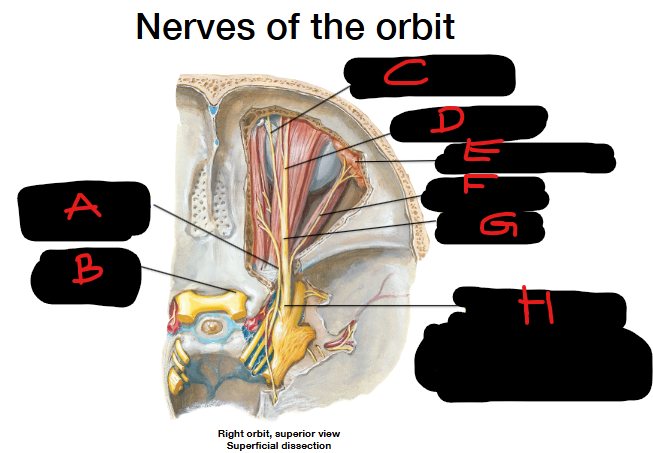
Define G
Frontal n
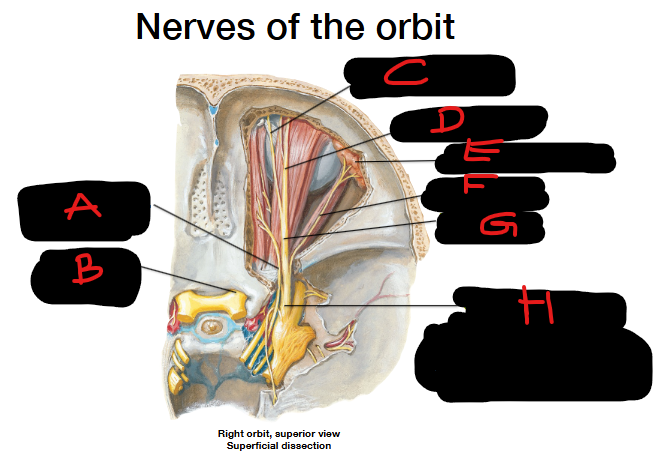
Define H
Ophthalmic n
Innervation of the lacrimal gland
Preganglionic parasympathetic fibers CN VII, synapse on postgangl;ionic parasympathetic cell bodies in pterygopalatine ganglion suspended from maxillary n, hitchhike on branches of V2 and V1 via lacrimal n
Sphincter pupillae action
decreases pupil diameter, andthus limits light reaching the retina
Sphincter pupillae innervation
parasympathetic (preganglionic originate in CN III, synapse in ciliary ganglion, postganglionics in short ciliary n)
Dilator pupillae action
Increase pupil diameter, and this increases light reaching the retina
Dilator pupillae innervation
Sympathetic (preganglionic arise in T1 IML & synapse in superior cervival ganglion; postganglinoics hitchhike on long ciliary n)
Ciliary muscle action
reduces tension on zonular fibers that suspend the lens in the eye, allowing lens to rebound to a more rebounded shape
Ciliary muscle innervation
parasympathetic (preganglionic carried in CN II and synapse in ciliary ganglion; postganglioic carried by short ciliary nerves)
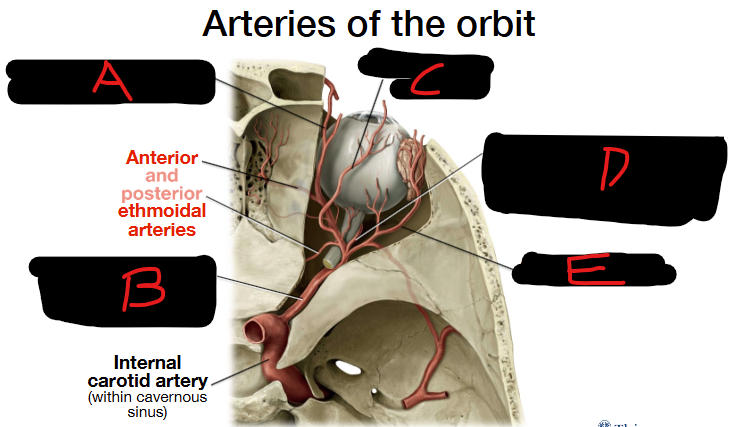
Define A
Supratrochlear artery
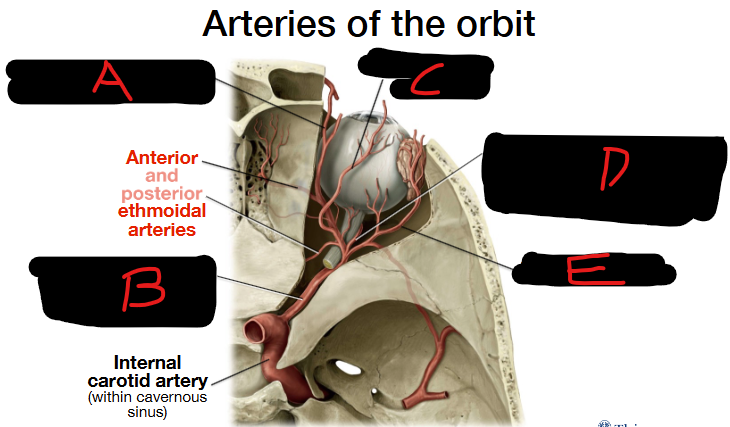
Define B
Ophthalmic artery
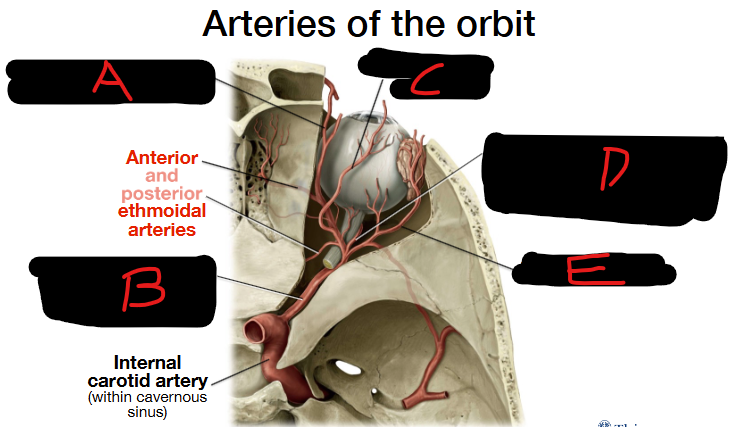
Define C
Supraorbital artery
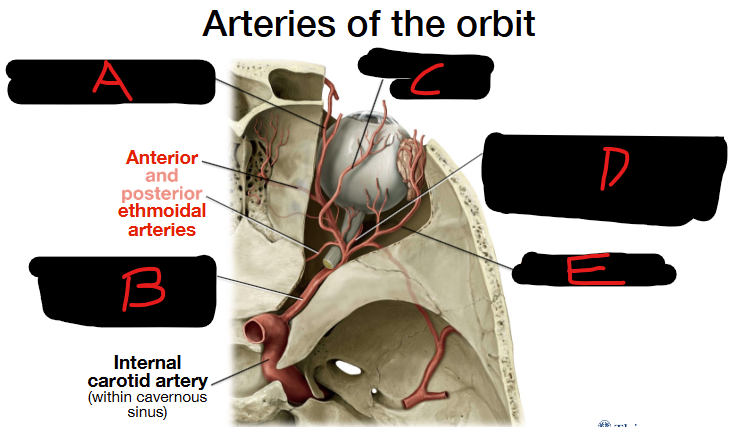
Define E
Lacrimal artery
Senses of hearing
sound waves vibrate tympanic membrane, vibration transfers through middle ear ossicles resulting in vibration at oval window by stapes, then pressure waves are created within cochlea
Semicircular duct detects
angular acceleration in different plane
Utricle and saccule detect
linear acceleration and orientation of head in space
Greater petrosal nerve Carries
preganglionic parasympathetics for lacrimal gland (and other visceral structures)