BCH4024 Douma Exam 4 - Lecture 2
 Call Kai
 Learn
Learn Practice Test
 Spaced Repetition
 Match
Match Flashcards
 Knowt Play
1/47

There's no tags or description
Looks like no tags are added yet.
Name | Mastery | Learn | Test | Matching | Spaced | Call with Kai | Chat |
|---|
No analytics yet
Send a link to your students to track their progress
48 Terms
What is the typical structure of B-DNA?
Right-handed helix with sugar-phosphate backbone on the outside and bases stacked inside, perpendicular to the backbone.
What interactions contribute to the stability of B-DNA?
Hydrophobic interactions and base stacking (Van der Waals forces) between nitrogenous bases.
What is the major groove and minor groove in DNA?
Areas where bases are more or less exposed to the environment; important for protein-DNA interactions.
What is A-DNA?
Dehydrated DNA structure, more compact with bases splayed out; resembles double-stranded RNA or RNA-DNA hybrids.
How does A-DNA differ structurally from B-DNA?
A-DNA bases are not forced to the interior because there is no water present; they splay out and the helix becomes more compact.
What is Z-DNA?
A left-handed helix structure found in regions of high G-C content, comprising less than 1% of cellular DNA.
How does RNA differ structurally from DNA?
RNA is single-stranded, contains ribose sugar, and uses uracil instead of thymine.
How does RNA form secondary structures?
Complementary regions base pair to form structures like hairpins and stem-loops.
What tertiary structures can RNA form?
Complex three-dimensional shapes formed by interactions between secondary structures; important for catalytic RNA molecules (ribozymes).
What is a gene?
A DNA sequence that encodes a functional product (protein or functional RNA) and includes regulatory elements.
What is a genome?
All of the genetic material (DNA) in a cell.
How many chromosomes do humans have?
46 chromosomes (22 pairs of autosomes and 2 sex chromosomes).
Where are centromeres and telomeres located?
Centromeres are at the center (no genes), telomeres are at the ends (no genes, protective structures).
How is DNA compacted in eukaryotic cells?
DNA wraps around proteins to form chromatin, preventing tangling and fitting into the nucleus.
What is semi-conservative DNA replication?
Each daughter genome consists of one old (parental) strand and one newly synthesized (daughter) strand.
What were the three models of DNA replication proposed?
Conservative, semi-conservative, and dispersive models.
What did the conservative model predict?
One genome with both old strands and one genome with both new strands after replication.
What did the dispersive model predict?
Each strand is a patchwork of old and new DNA after replication.
How was DNA replication mechanism determined?
Through the Meselson-Stahl experiment using nitrogen isotopes (N-15 and N-14) and cesium chloride gradients.
What was observed after one round of DNA replication in the Meselson-Stahl experiment?
One intermediate band, indicating hybrid DNA (not fully old or new).
What was observed after two rounds of DNA replication?
A mix of intermediate (hybrid) DNA and fully light (N-14) DNA, confirming semi-conservative replication.
What is the role of DNA Polymerase?
Catalyzes the addition of nucleotides during DNA synthesis.
What structure does DNA Polymerase resemble?
A right hand with the catalytic site in the "palm."
What residues coordinate the catalytic magnesium ions in DNA Polymerase?
Two aspartic acid residues.
What is the role of magnesium ions in DNA Polymerase?
Stabilize the nucleophile (3' hydroxyl) and electrophile (triphosphate) during nucleotide addition.
In what direction does DNA synthesis occur?
5' to 3' direction.
How does each phosphodiester bond form to make the sugar-phosphate backbone in DNA?
The -OH group on the deoxyribose sugar (3' end) acts as a nucleophile attacks the incoming dNTP.
What is released during DNA synthesis?
Pyrophosphate (beta and gamma phosphates).
What is a primer in DNA replication?
A short DNA or RNA strand with a free 3' hydroxyl group that DNA Polymerase can extend.
Can DNA Polymerase initiate DNA synthesis de novo?
No, it can only extend from a pre-existing 3' hydroxyl.
What is pre-synthetic error control?
DNA Polymerase checks if incoming nucleotides fit properly in the active site before catalysis.
What is a nuclease?
An enzyme that degrades polynucleotides (DNA or RNA) by breaking phosphodiester bonds.
What is an exonuclease?
A nuclease that breaks a phosphodiester bond at one end of a polynucleotide chain (can be 5' -> 3' or 3' -> 5').
What is a 5' to 3' exonuclease?
An exonuclease that removes nucleotides starting from the 5' end.
What is a 3' to 5' exonuclease?
An exonuclease that removes nucleotides starting from the 3' end.
What is an endonuclease?
A nuclease that breaks a phosphodiester bond within a polypeptide chain (can be sequence-independent or specific).
What are the two types of breaks that endonucleases can perform?
Single-stand break (nick) or double-strand break.
What is an Excinuclease?
A nuclease that breaks two phosphodiester bonds within a somg;e polynucleotide chain.
What is a restriction endonuclease?
A type of endonuclease that only breaks phosphodiester bonds at a specific DNA sequence (restriction sites).
What are the structural characteristics of sequences that a restriction endonuclease would recognize and act on?
Short, palindromic sequences of 4-6 nitrogenous bases long.
What are palindromic sequences?
Sequences that are exactly the same on both strands of DNA when read from 5' -> 3'.
What is a sticky end?
A single-stranded overhang left after staggered cutting by a restriction enzyme.
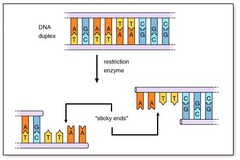
Why is the formation of sticky ends important (i.e., why a staggered cut instead of a straight one?)
The staggered cut allows strands broken in this fashion to easily anneal to other DNA molecules on their own through hydrogen bonding. It is commonly used in the lab to create new combinations of DNA that didn't previously exist in nature.
What is the only enzyme that can take two, preexisting DNA chains, and link them together by forming a phosphodiester bond between them?
DNA Ligase
What does DNA Ligase use to form the phosphodiester bond?
It uses an AMP molecule from ATP to activate the 5' phosphate group. Interestingly, in bacteria, it pulls the AMP molecule from NAD+.
Why is AMP used to form the phosphodiester bond?
It serves as an excellent leaving group that will be attacked by the 3' -OH group to form the phosphodiester bond.
What is recombinant DNA?
DNA created by combining DNA from two different sources.
What organism is used to produce human insulin via recombinant DNA technology?
Engineered E. coli cells.