Cellular Respiration Flash Cards
0.0(0)
Studied by 2 people Call Kai
 Learn
Learn Practice Test
 Spaced Repetition
 Match
Match Flashcards
 Knowt Play
Card Sorting
1/76

Last updated 2:35 PM on 2/24/23
Name | Mastery | Learn | Test | Matching | Spaced | Call with Kai |
|---|
No analytics yet
Send a link to your students to track their progress
77 Terms
1
New cards
Anabolic Reaction
a chemical reaction that uses energy to build substances used for cell activities (growth, maintenance, and repair)
2
New cards
Examples of anabolic reactions:
1. Photosynthesis
2. Muscle/bone growth
3. Condensation reactions
3
New cards
Catabolic Reaction
chemical reactions that break down substances and release energy
4
New cards
Examples of catabolic reactions:
1. Cellular Respiration
2. Digestion
3. Hydrolysis
5
New cards
Cellular Respiration
the process of breaking down organic molecules to make ATP
6
New cards
Enzyme
proteins that speed up chemical reactions
7
New cards
Redox Reaction
reactions which electrons are transferred between molecules
e- always travel H+
e- always travel H+
8
New cards
Electron Acceptor
molecules that carry electrons
9
New cards
Matrix
space inside the inner membrane in the mitochondria
10
New cards
Cristae
folds of the inner membrane
11
New cards
Glycolysis
glucose is broken down into pyruvic acid
12
New cards
Transition Phase
breaks down pyruvic acid
13
New cards
Aerobic
with oxygen
14
New cards
Krebs Cycle
breaks down acetyl CoA to produce Co2, H+, and ATP
15
New cards
Electron Transport Train
a group of molecules found in a membrane that transfers electrons
16
New cards
Fermentation
glycolysis + anaerobic respiration
17
New cards
Purpose of Fermentation
to regenerate NAD+ so that glycolysis can still occur
18
New cards
Anaerobic
without oxygen
19
New cards
2 Examples of Catabolic Reactions:
1. Cellular Respiration
2. Digestion
20
New cards
Function of ATP:
energy storing molecules, provides energy for all living things
21
New cards
What does ATP stand for?
adenosine triphosphate
22
New cards
5 Building Blocks of ATP:
1 adenine
1 ribose
3 phosphates
1 ribose
3 phosphates
23
New cards
Draw symbol for ATP- label where energy is stored
A - P - P \~ P
high energy bond in \~
high energy bond in \~
24
New cards
What process makes ATP and in what organelle?
in the mitochondria during cellular respiration
25
New cards
What does ADP stand for?
adenosine diphosphate
26
New cards
Write the equation for making ATP.
A - P - P + P + E → → A - P - P \~ P
27
New cards
What 3 things are needed to make ATP?
1. ADP
2. Phosphate
3. Energy
28
New cards
What three things are produced when ATP is broken down?
1. ADP
2. Phosphate
3. Energy
29
New cards
3 types of molecules that can be broken down to make ATP:
Which one is used the most?
Which one is used the least?
Which one is used the most?
Which one is used the least?
1. Carbs
2. Lipids
3. Proteins
Carbs are used the most
Proteins used the least
30
New cards
Write the equation for cellular respiration.
What two things are needed?
What three things are made?
What two things are needed?
What three things are made?
C6 H12 O6 + 6 O2 → 6 CO2 + 6 H2O + ATP
Needed- Sugar, oxygen
Made-CO2, water, energy
Needed- Sugar, oxygen
Made-CO2, water, energy
31
New cards
List the three stages of cellular respiration in order:
1. glycolysis
2. transition phase
3. aerobic respiration
32
New cards
Draw and label the structure of the mitochondria
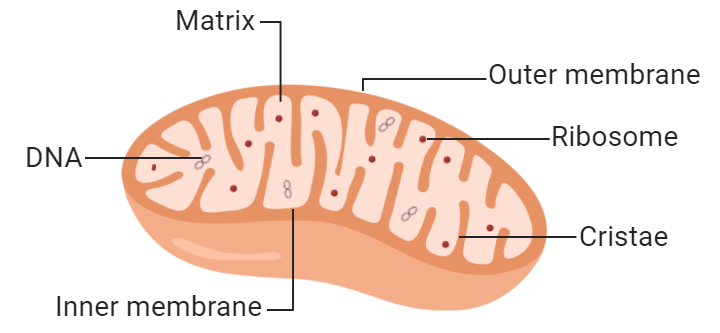
33
New cards
Where does glycolysis happen?
the cytoplasm
34
New cards
Does glycolysis need oxygen to happen?
no
35
New cards
Does glycolysis use oxygen?
No
36
New cards
What molecule starts glycolysis?
glucose
37
New cards
What molecules ends during glycolysis?
pyruvic acid
38
New cards
Write out the 4 steps of glycolysis
1. Two phosphates attach to glucose
2. 6-C is split in two 3-C molecules (G3P)
3. Each G3P gets a phosphate
4. All phosphates are removed, forming pyruvic acid
39
New cards
End result of glycolysis
2 pyruvate
2 ATP
2 NADH
2 ATP
2 NADH
40
New cards
Where does the transition phase happen?
the matrix
41
New cards
Does the transition phase need oxygen?
yes
42
New cards
Does the transition phase use oxygen?
yes
43
New cards
What molecule starts the transition phase?
pyruvic acid
44
New cards
What molecules ends during the transition phase?
acetyl CoA
45
New cards
What is the end result of the transition phase?
process happens 2x:
\
2 Co2
2 NADH
2 acetyl CoA
\
2 Co2
2 NADH
2 acetyl CoA
46
New cards
What two steps make up aerobic respiration?
1. Krebs Cycle
2. Electron Transport Chain
47
New cards
Where does the Krebs cycle happen?
matrix
48
New cards
Does the Krebs cycle need oxygen?
yes
49
New cards
Does the Krebs cycle use oxygen?
no
50
New cards
What molecule starts the Krebs cycle?
acetyl CoA + oxaloacetic acid
51
New cards
What molecule ends during the Krebs cycle?
oxaloacetic acid
52
New cards
Write out the 5 steps of the Krebs cycle
1. Acetyl CoA joins with oxaloacetic Acid to form citric acid
2. Citric acid is broken down to form a 5 carbon molecule
3. 5-C molecule is broken down to form a 4-C molecule
4. 4-C is changed into a new 4-C
5. The new 4-C is changed into oxaloacetic acid
53
New cards
What is the end result of the Krebs cycle?
4 Co2
2FADH2
2 ATP
6NADH
2FADH2
2 ATP
6NADH
54
New cards
Where does the ETC happen?
cristae
55
New cards
Does the ETC need oxygen to happen?
yes
56
New cards
Does the ETC use oxygen
yes
57
New cards
Write the 6 steps of the ETC:
1. NADH drops off its electron to the ETC
2. FADH2 drops off its electrons to the ETC
3. The electrons are passed through the ETC
4. At the same time, hydrogens are brought outside the cristae
5. \*\* Hydrogen comes back in to the matrix through the enzyme ATP synthase, making ATP
6. Oxygen picks up electrons from the ETC and joins with Hydrogen to make water
58
New cards
What is the end result of the ETC?
34 ATP
6 water
6 water
59
New cards
Name the enzyme that is used to make ATP during the ETC:
ATP synthase
60
New cards
Explain why oxygen is important
* final electron acceptor
* without it, the ETC would become backed up with electrons + will not be able to move through the ETC molecules
* H+ ions cannot be released from NADH and FADH2- H+ cannot diffuse back into matrix
* No energy produced → cell death
* without it, the ETC would become backed up with electrons + will not be able to move through the ETC molecules
* H+ ions cannot be released from NADH and FADH2- H+ cannot diffuse back into matrix
* No energy produced → cell death
61
New cards
Give two examples of electron acceptors
NAD+, FAD
62
New cards
How much ATP is made in glycolysis?
2
63
New cards
How much ATP is made in the transition phase?
0
64
New cards
How much ATP is made in the Krebs cycle?
2
65
New cards
How much ATP is made in the ETC?
34
66
New cards
How much ATP is made in aerobic respiration?
36
67
New cards
How much ATP is made in cellular respiration?
36
68
New cards
Why isn’t aerobic respiration 100% efficient in making energy?
it cannot happen without oxygen
69
New cards
What process happens if oxygen is not present after glycolysis?
fermentation will occur
70
New cards
What two processes make up fermentation?
glycolysis + anaerobic respiration
71
New cards
List the two main types of fermentation:
1. Lactic acid fermentation
2. Alcoholic fermentation
72
New cards
Steps of lactic acid fermentation
1. Pyruvate and NADH from glycolysis enter the fermentation process.
2. Two NADH molecules provide energy to convert pyruvate into lactic acid.
3. As the NADH is used, it is converted back into NAD+.
4. Two molecules of NAD+ are recycled back to glycolysis.
73
New cards
Steps of alcoholic fermentation
1. Pyruvate and NADH from glycolysis enter alcoholic fermentation.
2. Two NADH molecules provide energy to break down pyruvate into an alcohol and carbon dioxide.
3. As the NADH molecules are used, they are converted back into molecules of NAD+.
4. The molecules of NAD+ are recycled back to glycolysis.
5. The recycling of NAD+ allows glycolysis to continue.
74
New cards
What is the end result of lactic acid fermentation?
Lactic acid
NAD+
NAD+
75
New cards
What is the end result of alcoholic fermentation?
Ethanol
Co2
NAD+
Co2
NAD+
76
New cards
Give 2 every day examples of alcoholic fermentation
Alcoholic- process that makes bread, beer, and wine
77
New cards
Give 2 every day examples of lactic acid fermentation
Lactic Acid- dairy products, muscle cells during exercise