S1 - Intro to Preliminary Diagnosis of Oral Lesions
 Call Kai
 Learn
Learn Practice Test
 Spaced Repetition
 Match
Match Flashcards
 Knowt Play
1/126

There's no tags or description
Looks like no tags are added yet.
Name | Mastery | Learn | Test | Matching | Spaced | Call with Kai | Chat |
|---|
No analytics yet
Send a link to your students to track their progress
127 Terms
Bulla
A circumscribed, elevated lesion that is more than 5 mm in diameter. Usually contains serous fluid and looks like a blister.

Lobule
Segment or lobe that is part of a whole. These lobes sometimes appear fused together.

Macule
An area that is usually distinguished by a color different from that of the surrounding tissue. It is flat and does not protrude above the surface of the normal tissue.

A freckle is an example of which lesion?
Macule

Papule
A small, circumscribed lesion usually less than 1 cm in diameter. It is elevated or protrudes above the surface of normal surrounding tissues.
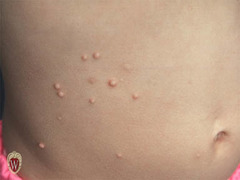
Pustules
Variously sized circumscribed elevations containing pus.

Vesicle
A small, elevated lesion less than 1 cm in diameter that contains serous fluid.

Pedunculated
Attached by a stem-like or stalk-like base similar to a mushroom.

Sessile
Describes the base of a lesion that is flat or broad instead of stem-like.

Nodule
A palpable solid lesion up to 1 cm in diameter found in soft tissue and can occur above, level with, or beneath the skin surface.
Palpation
The evaluation of a lesion by feeling it with the fingers to determine the texture of the area. Descriptive terms are soft, firm, semifirm, and fluid-filled

The most frequent descriptions of the colors of a lesion are ...
Red, pink, salmon, white, blue-black, gray, brown, and black.
Erythema
An abnormal redness of the mucosa or gingiva.
Erythroplakia
A clinical term used to describe an oral lesion that appears as a smooth red patch or granular, red and velvety patch. Less common than leukoplakia.
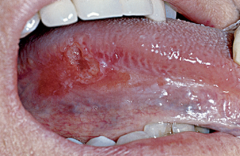
Pallor
Paleness of the skin or mucosal tissues.

Leukioplakia
A clinical term for a white, plaque-like lesion on the oral mucosa that cannot be rubbed off or diagnosed as a specific disease.
Corrugated
Wrinkled
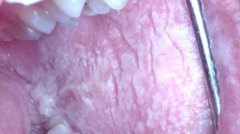
Fissure
A cleft or groove, normal or otherwise, showing oriminent depth.
Papillary
Resembling small, nipple-shaped projections or elevations found in clusters.
Coalescence
A radiographic term to describe lesions in the bone that explains the process in which parts of a whole join together or fuse to make one.
Diffuse
A radiographic term to describe lesions in the bone that explains describes a lesion with borders that are not well defined, making it impossible to detect the exact parameters of the lesion.
Multilocular
A radiographic term to describe lesions in the bone that describes a lesion that extends beyond the confines of one distinct area. Is defined as many lobes that are somewhat fused together (soap bubbles).
Radiolucent
Describes the black or dark areas on a radiograph. Less dense tissue, such as pulp, is seen as a radiolucent structure.

Radiolucent and Radiopaque
A mixture of light and dark areas with no lesion and denotes a stage in lesion development.

Radiopaque
Describes the light or white area on a radiograph that results from the inability of radiant energy to pass through the structure.
The denser the structure, the __ is appears on the radiograph.
Whiter
Root Resorption
Radiographically, the apex of the tooth appears shortened or blunted and irregularly shaped. This occurs as a response to stimuli, which can include a cyst, tumor, or trauma.
External Root Resorption
Arises from tissue outside the tooth, such as the periodontal ligament.
Internal Root Resorption
Triggered by pulpal tissue reaction from within the tooth and the oral area can be seen as a diffuse radiolucency beyond the confines of the normal pulp area.
Scalloping Around the Root
A radiolucent lesion that appears to extend up the periodontal ligament and between roots.
Unilocular
Having one compartment or unit that is well defined or outlined as in a simple radicular cyst.
Well Circumscribed
Used to describe a lesion with borders that are specifically defined and in which one can clearly see the exact margins and extent.
Anomaly
Something that deviates from what is standard.
Dysphagia
Difficulty swallowing
Dysphonia
Difficulty speaking
Dyspnea
Difficulty breathing
What are the two standards of measurement used to describe the size of a lesion?
mm and cm
Why would you use mm over cm?
So you can use the perio probe to document the size of a lesion.
The Diagnostic Process
Clinical > Radiographic > Historical > Laboratory > Microscopic > Surgical > Therapeutic > Differential
How does the lesion present in a clinical diagnosis?
Color, shape, location, and history of lesion.
Which diagnosis does the radiograph provide sufficient info to establish the diagnosis
Radiographic Diagnosis
What are you looking for during a radiographic diagnosis?
Abnormalities, dental caries, pathology, anatomical landmarks, and unusual findings.
What is included in a historical diagnosis?
Personal history, family history, past and present medical and dental histories, history of drug ingestion, history of presenting disease or lesion.
Laboratory Diagnosis includes looking for
Blood chemistires, urinalysis, cultures.
What is often the main component of the definitive diagnosis?
Microscopic Diagnosis
In a microscopic diagnosis, adequate ___ sample is necessary.
Tissue
In a microscopic diagnosis, what can be used to detect changes in tissues?
Additional screening technologies
In a microscopic diagnosis, what test can be used to obtain information from the oral mucous epithelium?
Brush test
Brush Test
A circular brush is used to obtain cells from the full thickness of epithelium, and the results may help determine whether a scapel biopsy is needed to establish a diagnosis.
A ___lesion cannot be diagnosed on the basis of clinical appearance alone.
White
Diagnosis is made using the information gained during surgical procedure is called ?
Surgical Diagnosis
Nutritional deficiencies are common conditions to be diagnosed by ___ means.
Therapeutic
Necrotizing ulcerative gingivitis (NUG) responds to what?
Hydrogen peroxide
Differential Diagnosis
That point in the diagnostic process when the practitioner decides which test or procedure is required to rule out the conditions originally suspected and to establish the definitive or final diagnosis.
Hygienists Role in Differential Diagnosis
Be observant, collect data, patients' medical and dental health histories, history of lesion, clinical description, evaluation, biopsy, and microscopy reports.
Fordyce Granules
Clusters of ectopic sebaceous glands that appear as yellow lobules in clusters and are commonly observed on the vermilion border of lips and buccal mucosa with no treatment available.

Torus Palatinus
An exophytic growth of normal compact bone that is found in the midline of the hard palate. It is an inherited, gradual formation and may take on various shapes and sizes, may be lobulated, and is covered by normal soft tissue.
What is the treatment for torus palatinus?
None, unless it interferes with speech, swallowing, or a prosthetic appliance.
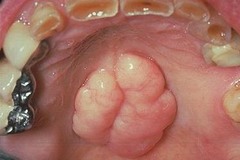
Mandibular Tori
Outgrowths of dense bone found in the lingual aspect of the mandible in the area of the premolars above the mylohyoid ridge. Usually bilateral, often lobulated or nodular, and can appear fused together.

What is the treatment for mandibular tori?
No treatment unless they interfere with fabrication and placement of prosthodontic appliance.
Melanin Pigmentation
The pigment that gives color to skin, hair, mucosa, and gingiva. Most commonly observed in dark-skinned individuals.
Retrocuspid Papilla
A sessile nodule on the gingival margin of the lingual aspect of the mandibular cuspids and resolveswith age.
Lingual Varicosities
Red-to-purple enlarged vessels or clusters, usually observed on the ventral and lateral surfaces of the tongue, often in individuals oler than 60.

Linea Alba
A "white line" extends anteroposteriorly on the buccal mucosa along the occlusal plane, may be lateral, and may be more prominent in patients who have a clenching or bruxing habit.
Leukodema
A generalized opalescence on the buccal mucosa, most commonly observed in black adults. If the mucosa is stretched, the opalescence becomes less prominent.

Lingual Thyroid
Undescended, trapped remnants of thyroid tissue that is a mass in the midline of the dorsal surface of the tongue posterior to the circumvallate papillae in the area of the foramen cecum.

What kind of appearance does a lingual thyroid have?
Clinical appearance.
Is the lingual thyroid more prominent in women or men?
Women
Treatment of the Lingual Thyroid
Evaluation of the patient to determine whether the thyroid gland is present in its normal location.
Median Rhomboid Gossitis
Flat or slightly raised oval or rectangular erythematous area in the center of the tongue. May be associated with a chronic infection with Candida albicans. No treatment, but antifungal treatment may be used.
Erythema Migrans (Geographic Tongue)
Erythematous patches surrounded by a white or yellow border, diffuse areas devoid of filiform papillae, and a distinct presence of fungiform papillae. Genetic factors may play a role in the presence and may be exacerbated by stress. May cause burning discomfort and no treatment is usually indicated.

Ectopic Geographic Tongue
Term used to describe "geographic tongue" found on mucosal surfaces other than the tongue.

Fissured Tongue
The dorsal surface of the tongue appears to have deep fissures or grooves. The cause is unknown, and no treatment is necessary. Direct the patient to brush the tongue gently with a toothbrush to remove debris.

White Hairy Tongue
Elongated filiform papillae are white and result from either an increase in keratin production or a decrease in normal desquamation. Direct the patient to brush the tongue.

Black Hairy Tongue
Papillae are brown-to-black because of chromogenic bacteria.

Contributing factor of a black hairy tongue:
Tobacco, foods, hydrogen peroxide, alcohol, and chemical rinses.
After arriving at a differential diagnosis, info from which one if the following categories will best establish a final or definitive diagnosis?
Microscopic
The descriptive term that would best be used for a freckle is what?
Macule
Which one of the following terms describes the base of a lesion that is stalk-like?
Pedunculated
Clinical diagnosis can be used to determine the final or definitive diagnosis of all of the following except:
Unerrupted supernumerary teeth
Radiographic diagnosis would contribute to the definitive diagnosis of all of the following except:
A retained deciduous tooth
To determine the presence of blood dyscrasias, which one of the following would provide the most definitive information?
Laboratory blood tests
When an antifungal ointment or cream is used to treat suspected angular cheilitis, which one of the following diagnostic categories is being used?
Theraputic
Yellow clusters of ectopic sebaceous glands commonly observed on the buccal mucosa and evaluated through clinical diagnosis are most likely:
Fordyce Granules
A slow-growing, bony hard exophytic growth on the midline of the hard palate is developmental and hereditary in origin. The diagnosis is determined through clinical evaluation. You suspect:
Torus Palatinus
The "white line" observed clinically on the buccal mucosa that extends from anterior to posterior along the occlusal plane is:
Linea Alba
Which one of the following occurs as an erythematous area, is devoid of filiform papillae, is oval to rectangular in shape, does not change its characteristics, and is located on the midline of the dorsal surface of the tongue?
Median Rhomboid Glossitis
Which one of the following diagnostic categories would the dental hygienist most easily apply to the preliminary evaluation of oral lesions?
Clinical
These examples of exostoses are found on the lingual aspect of the mandible in the area of the premolars. They are benign, bony hard, and require no treatment. Radiographically they appear as radiopaque areas and are often bilateral. You suspect:
Mandibular Tori
Which of the following terms is most often used when describing mandibular tori?
Lobulated
Which of the following conditions is a benign anomaly, has a diffuse gray-to-white opaque appearance on the buccal mucosa, and is most commonly seen in adult black individuals?
Leukoedema
A patient has the clinical signs of necrotizing ulcerative gingivitis. The hygienist has the patient begin hydrogen peroxide rinses without culturing the bacterial flora. This action applies to which one of the following diagnostic categories?
Theraputic
A small circumscribed lesion usually less than 1 cm in diameter that is elevated and protrudes above the surface of normal surrounding tissue is called a:
Papule
The base of a sessile lesion is:
Broad and flat
The identification of which one of the following is not determined by clinical diagnosis?
Compound Odontoma
Another term for erythema migrans is:
Heographic Tongue
The cause of supernumerary teeth is most likely:
Genetic
Historical diagnosis can include the patient's:
All of the above
Which condition is most often seen on the buccal mucosa?
Fordyce Granules
Which of the following is not considered a variant of normal?
Hairy leukoplakia