Renaissance and Baroque - 1/4 MODERN ART QUIZ
 Call Kai
 Learn
Learn Practice Test
 Spaced Repetition
 Match
Match Flashcards
 Knowt Play
1/23

Earn XP
Description and Tags
Vocabulary flashcards covering key artworks, artists, dates, and stylistic categorizations from Heinrich Wölfflin based on the ARTH-UA 6-001 lecture notes.
Name | Mastery | Learn | Test | Matching | Spaced | Call with Kai | Chat |
|---|
No analytics yet
Send a link to your students to track their progress
24 Terms

Domenico Ghirlandaio (Italy). Last Supper. C. 1480
Doesn’t feel alive = primitive
You could pluck out one of the subjects and they could be on their own, existing outside of the painting

The Last Supper (Leonardo da Vinci), 1495-98
A ca. 1495–98 Italian painting categorized by Heinrich Wölfflin as 'Classic'.
Overlapping figures who are hard to pluck out
The sum is greater than the parts
Idealization of the painting- taking your subjects into movement
All of the figures are interacting with one another

Madonna of the Goldfinch, Raphael, 1505
Categorized by Wölfflin as 'Classic'.
Subjects are interacting
One mass
Alive
Idealized- taking your subjects into movement

Filippino Lippi (Italy). Virgin and Child with Angels. 1490s
Compare to Madonna of the Goldfinch
Primitive
Can pluck out the subjects, not interacting, looks like a painted and staged background.

Pietro Perugino (Italy), Francesco delle Opere, 1494.
Heinrich Wölfflin as 'Primitive'.
Painted backdrop
Not super alive

Domenico Ghirlandaio, Portrait of a Lady (Ghirlandaio), 1483-85.
Primitive
Not lifelike

Leonardo da Vinci (Italy). Mona Lisa. c. 1503-05
Classic
Smoky, hazy, blended, alive

Piero di Cosimo (Italy), Venus and Mars with Cupid, 1505
Primitive
Figures seem very separate
Background looks like a painted backdrop
Separate characters

Titian (Italy). Venus of Urbino. 1538
Classic
Subjects are doing an action in the background- looking through a trunk together
Alive
Principles of Art History (1915)
A work by Heinrich Wölfflin presenting formal dualities such as 'Linear vs. Painterly', 'Multiplicity vs. Unity', and 'Clarity vs. Confusion, Closed vs. Open, Plane vs. Recession'.

Lorenzo di Credi, Venus, 1490
Italian painting categorized under Wölfflin's 'Linear' style category.
Crisp edges
Background is lacking, plain, subject is the main focus

Rembrandt van Rijn (Holland). Bathsheba. 1654
Painterly - BAROQUE
Baroque, hazy; lines are not crisp; lifelike; background is deep and complex

El Greco (Spain), Brother Hortensio Felix, 1609
Categorized by Heinrich Wölfflin under the 'Painterly' style.
Hazy lines
Background deep and complex
More realistic-looking

Pope Julius II, Raphael, 1511
Linear
Hyper realistic
crisp edges

Frans Hals (Holland). The Jolly Toper. 1628-30
Painterly
Baroque, hazy, lines are not crisp
Background is deep and complex
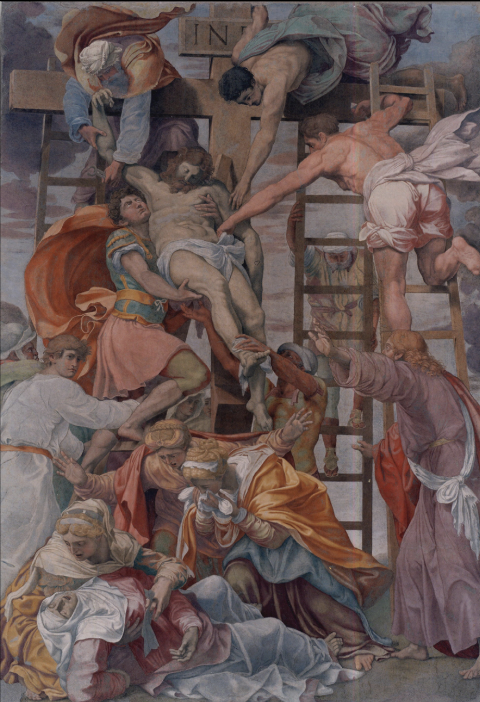
Daniele da Volterra (Italy). Descent from the Cross. c. 1545
Multiplicity vs. Unity
This is Multiplicity
Upper group vs lower group
Lots of figures, crisp, separate characters doing their own thing

Peter Paul Rubens (Flanders). Descent from the Cross. 1610-11
Unity (baroque)
'High drama, dramatic lighting, figures morphing together and interacting

The Birth of Venus, 1484-86, Sandro Botticelli (Italy)
Used by Wölfflin to illustrate Clarity, Closed form, and Plane compositional style.

Peter Paul Rubens, The Lion Hunt, 1621
Baroque formal traits including Confusion, Open form, and Recession.
Figures that are not contained, expands beyond the canvas
Dramatic
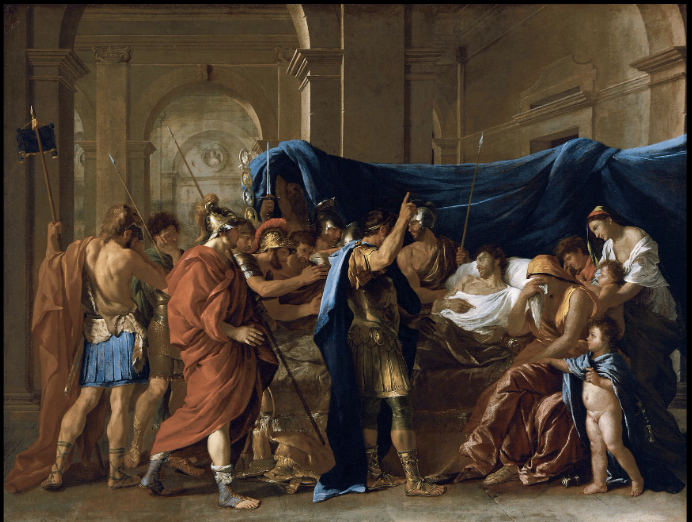
Nicolas Poussin, Death of Germanicus (France) 1626-28
Classical alternative within Baroque art- NARRATIVE-HEAVY!
Crisp, clean, morality story, contained scene

Caravaggio (Italy). Entombment. c. 1603
Baroque drama
Intense lighting
Classical, narrative heavy, morality focused
*Other Baroque’s: varieties of realism.
This is Baroque drama realism, vs Celebrating the Birth, which is slice of life realism.

Jan Steen (Holland). Celebrating the Birth. 1664
Psychological and social interests realism
Slice of life (Cuckold symbol)

Nicolas Poussin, Burial of Phocion, 1648
Exemplifying the Classical Landscape genre in Baroque art
Narrative Heavy
Figures in the back, but the main focus is the dead body in the foreground

Jacob van Ruisdael, 1670, View of Haarlem from the Dunes at Overveen
Representing 'Romantic' Landscape art in the Baroque period.
Focusing more so on the beauty of the landscape
Figures are very small