EPHF COMPLETE
 Call Kai
 Learn
Learn Practice Test
 Spaced Repetition
 Match
Match Flashcards
 Knowt Play
1/221

There's no tags or description
Looks like no tags are added yet.
Name | Mastery | Learn | Test | Matching | Spaced | Call with Kai | Chat |
|---|
No analytics yet
Send a link to your students to track their progress
222 Terms
Automation definition
use of machines to do human work, control of manufacture, application and extension
4 types of automation
info acquisation, integration, selection, execution
problems with automation
reliability, calibration, sa, confusion, allocation
limits of function allocation
difficult of allocation between automation and human
principles of human-centred automation
mental models, attention, response selection, perception, interaction, organisational
mental models (principle)
define and communicate the purpose of automatio, role of person, simplification
attention (principle)
system to signal its inability to satisfy a given role
response selection (principle)
should avoid accidental activation and deactivation
interaction (principle)
keep humans integrated within workflow loop, flexible automation
perception (principle)
automation should be transparent
organisational (principle)
user should be effectively trained to operate the complex automated system
anthropometry
study of human body dimensions
anthropometry engineering
using human body measurements for design
applications of anthropometric guidelines
workspaces, consumer products
factors of human variability
sex, ethnic groups, nationalities
anthropometric percentile
percentage of population with body dimension of certain size or smaller
factors affecting human variability
age, sex, generational, body postion, occupational, clothing
anthropometric data distribution
represnted as normal distribution
normal percentile number
50th
structural anthropometric data
static measurements of body dimensions
functional anthropometric data
body adopting various working postures
anthropometric design principles
determine user population, body dimensions, percentage of population to accomodate, percentile value, use data sensibly, conduct usability test
mechanics
study of forces and motions produced by their actions
biomechanics
applying mechanis to structure and function of human body
occupational biomechanics
mechanical behaviour of the musculoskeletal system and tissues undergoing physical work
biomechanics types
statics, dynamics
musculoskeletal system
bones, connective tisues, muscles
biomechanical models
mathematical models that treat the mechanical properties of the human body
application of biomechanical models
predict stress levels of specific musculoskeletal components quantitively, identify and avoid hazards
low back problems
most costly and prevalent work related musculoskeletal disorder, accounts for 1/3 claims
cumalative trauma disorders (CTD)
disorders of the soft tissues in upper extremitites such as in fingers, hand, wrist, arms, elbow and shoulderctd
ctd severity
occurs due to repetitive tasks, accounts for more than 50% of all occupational illnesses
2 types of human beahaviour models
probabilistic, deterministic
KLM-GOMS Model
developed to predict completion time for human computer interaction tasks
model validity
does the model behave like a human in some useful way
model fitting
parameters to match human data
task network models
complex tasks, acting in parallel, probabilistic
control theoretic models
linking human to a system with changing state
cross-over model
relates the order of a system to its behaviour
control instability
control errors over time grow larger, leading to loss of control
cognitive architecture models
uses human cognition to predict human behaviour
machine-learned model
uses imitation learning methods to train a large neural network to reproduce human behaviour
Rasmussen’s Skills-Rules-Knowledge Model
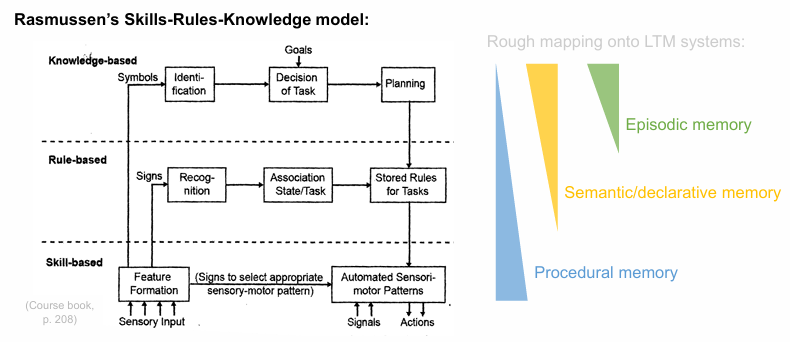
knowledge-based decisions
user analyses environment without prior experience
knowledge-based decisions theories
multiattribute utility, expected value
rule-based decisions
familiarity of situations enforces rule followed response
skill-based decisions
triggered by sensory cues, carried out without concious effort
optimal decision making
making the best decision based on criteria
suboptimal decision making
choices that doesn’t result in the best outcome
normative decision making
how decisions should be made
descriptive decision making
how decisions are actually made
bias
ways in which decision making becomes suboptimal
principles of improving decision making
choice architecture, displays, automation, proceduralisation, training
choice architecture
limit number of options
displays
provides fast and unbiased cues
automation
suggest suitable actions
proceeduralisation
methods of forming decisions
training
how to use procedures and tools
situational awareness (SA)
provides perception for decision making
Endsley’s 3 level model
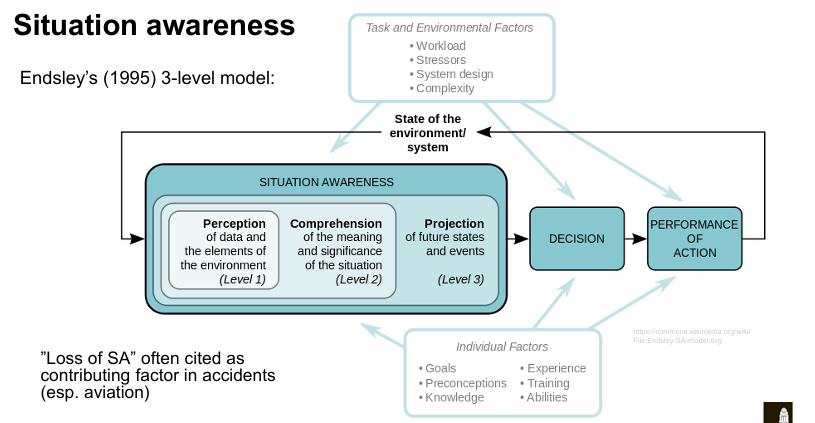
levels of SA
perception, comprehension, projection
perception
observation of environment and its elements
comprehension
meaning and significance of situation
projection
future states and events
SA global assessment technique (SAGAT)
interrupt taks and question probe sa
Situation Present Assessment Method (SPAM)
ask questions during task and measure response time
SA Rating Technique (SART)
subjective rating of situation
perception design priniciples (for improving sa)
make situation changes noticable
comprehension design principles (for improving sa)
organise situation info around goals
projection design principles (for improving sa)
train for sa
selective attention mechanics
brain’s ability to focus on specific tasks whilst being able to tune out external/internal distractions
4 factors of selective attention mechanism
salience, expectancy, value, effort
salience
bottom-up, stimulus driven process that refers to elements that naturally capture your attention
effort
energy required to process stimulus
expectancy/value
top-down, knowledge driven, value effects frequency of response to stimuli
implications of selective attention and perception for design
maximise bottom-up, automaticity, top-down, discriminating features
working memory (WM)
short-term memory, temporary store of info keeps available during use
limits of working memory
capacity, time confusability, similarity
WM implications on design
minimise working memory load, provide visual echoes, placeholders for sequential tasks, exploit chunking, confusability, zeros, negatives
long term memory
storing memory and retriving it later
types of long term memory
semantic, episodic, procedural
4 factors of long term memory mechanism
strength, associations, working memory interaction, forgetting
effect of repetition
forms habits, encourages memory and automatcity
LTM implications for design
encourage regular use, acitve reproduction, standardise, memory aids, design helpful habits, remembered info, correct mental models
visual echoes
visual display of info that minimises the burden on WM
placeholders
feedback provided after each task which require multiple steps
exploiting chunking
reduce info size, create meaningful sequences, letter preference over numbers, seperation
instruction congruence
reduction of WM load through alignment of order of words and actions
redundancy gain
processing info faster and more accurately, by better presentation
semantic
memory for general knowledge
episodic
memory for specific events
procedural
acquisition of recalling tasks through gradual repition and practice
ltm strength
frequency and recency of tasks
ltm associations
linking items to other items
ltm and wm interaction
retrieval of information depends on strength of association
forgetting trends
exponential decay of item strength and association strength
Baddeley’s model of WM

central executive
directs attention, coordinates info to subsystems
visuospatial sketchpad
maintains visual and spatial info
phonological loop
processes audiotory and verbal information