Proteins
 Call Kai
 Learn
Learn Practice Test
 Spaced Repetition
 Match
Match Flashcards
 Knowt Play
1/73

There's no tags or description
Looks like no tags are added yet.
Name | Mastery | Learn | Test | Matching | Spaced | Call with Kai | Chat |
|---|
No analytics yet
Send a link to your students to track their progress
74 Terms
What is a condensation reaction?
Release of water during bond formation
What is a peptide bond?
- Joins two amino acids
- rigid and planar
What configuration do peptide bonds assume?
trans configuration
Why is the trans form favored in peptide bonds?
Less steric collisions occurs in the trans form than the cis form
Where does free rotation occur?
Around the alpha carbon and the carbonyl carbon (psi) and nitrogen atom (phi).

What allows proteins to fold in different ways?
Rotation around bonds.
What are the levels of structure in a protein?
Primary, Secondary, Tertiary, and Quaternary
The structure of a protein is determined by the...
Amino acid sequence
What is the primary structure of a protein?
The linear sequence of amino acids of a polypeptide chain
What determines the charge of a protein at a given pH?
The pKa of the dissociation of protons by the carboxyl, amino, and the side chain groups.
What is the isoelectric point?
The pH at which the net charge of the molecule is zero.
If the pH is lower than the pKa, then the protein is ________ protonated.
more
If the pH is higher than the pKa, then the protein is _____ protonated.
less
What is the pKa value of the amino group at the N termini?
~9
What is the pKa value of the carboxyl group at the C termini?
~2
What is the secondary structure of proteins?
Form recurring localized structures within regions of the polypeptide chain
What are two common regular secondary structures?
Alpha helix and Beta sheet
What are three irregular secondary structures?
Loops, turns, and coils
Alpha helices are ______ handed structures
right
How is the peptide backbone of alpha helices formed?
H-bonds between each carbonyl oxygen atom and amide hydrogen atom 4 residues apart (occurs within the same strand)
Where are alpha helices found?
Globular, membrane spanning, and DNA binding proteins
Which amino acid is absent from the helical region?
Proline
Why is proline absent from the helical region?
Proline doesn't have an amide nitrogen for H-bonding and the appropriate bond angles to fit within the helix.
Beta sheets are composed of __________.
Strands/chains
How are the strands/chains held together in Beta sheets?
Hydrogen bonding
When does optimal hydrogen bonding in Beta sheets occur?
When strands are pleated (bent)
What directions can Beta sheet strands run?
Opposite (anti parallel) or same (parallel) direction.
What is the anti-parallel arrangement?
- Composed of the same strand that folds back on it's self
- Atoms involved in H-bonding are directly opposite to each other
What is the parallel arrangement?
- Atoms involved in H-bonding are skewed.
- One amino acid is H-bonded to two amino acids in the opposite strand.
What is a Beta turn?
-Irregular secondary structure
- Consist of 4 successive residues that connect B-strands in anti-parallel arrangement
What is the second and third residue in B-turns
Second residue is proline
Third residue is glycine.
How many residues are loops?
6 - 16 residues long
Where are loops and turns found?
On the surfaces of proteins which are involved in interaction with other molecules
What are Motifs?
- Secondary structures that form a pattern
What are two examples of a structural motif?
- Helix turn helix motif found in DNA binding proteins.
- Ba Ba B structural motif found within a domain of the enzyme lactose dehydrogenase.
What is the tertiary structure of a protein?
- Folding of the secondary structures
- Specifies the location of each atom in a protein
- Structural elements fold into 3D
Are the tertiary structures rigid or dynamic and flexible?
Dynamic and flexible
What types of bonding hold tertiary structures together?
Ionic interactions, H-bonds, disulfide bonds, and hydrophobic interactions.
Ionic interactions
Occurs between amino acids whose side chains are charged
Disulfide bridges
- Formed between two cysteine residues within and between polypeptide chains.
- Oxidation of the sulfhydryl groups of the free cysteine residues results in the formation of covalent disulfide bridges.
What is the Insulin structure?
Chain A and B are connected by two disulfide bridge (intermolecular), and a single disulfide bridge exists in chain A (intramolecular).
H-bonding
- Occurs between amino acids with polar and charged side groups.
- H-bonding also occurs between unpaired polar NH and CO groups of the main chain to exist in hydrophobic environments (a-helices, B-sheets).
Hydrophobic interactions
- Strong tendency for hydrophobic amino acid residues to cluster together resulting in the expulsion of water.
- An increase in entropy gives rise to an energetically stable overall structure
Van der Waals interaction
The compact structure of a protein is further stabilized by these forces between the tightly packed hydrocarbon side chains.
In cystolic globular proteins, the polar amino acids are found make up the ________ of the protein, while the non-polar or hydrophobic make up the ______ of the protein. (Myoglobin)
Surface
Core
In transmembrane proteins. the non-polar amino acids make up the ________ of the protein, while the polar residues make up the _______ of the protein. (Bacterial porins; B-barrels)
Surface
Core
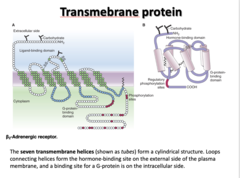
What is an example of a transmembrane protein?
B2-Adrenergic receptor
What is the B2-Adrenergic receptor?
- Seven transmembrane helices form a cylindrical structure.
- Loops connecting helices form the hormone-binding site of the external side of the PM, and a binding site for a G-protein on the intracellular side.
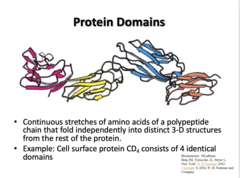
What are protein domains?
Continuous stretches of amino acids of a polypeptide that fold independently into distinct 3D structures from the rest of the proteins
What is an example of a protein domain?
Cell surface protein CD4 consists of 4 identical domains
What is the Quaternary structure of proteins?
- Combination of 2 or more polypeptide chains (subunits)
- Many proteins function as dimers, tetramers, and oligomers
- The subunits are arranged in a geometrical and spatial manner
- A subunit is known as a protomer
What is it called when the quaternary structure contains identical subunits?
Homo
What is it called when the quaternary structure contains different subunits?
Hetero
E. coli Formate transporter has 5 similar subunits and would be classified as...
homopentameric protein
A G protein with 3 different subunits would be classified as...
Heterotrimeric protein
Hemoglobin consists of 4 polypeptide chains: a1, a2, B1, B2, and would be classified as...
Heterotetrameric
What is a native protein?
- The final 3D structure of a protein.
- Most proteins will fold by themselves into the native structure.
What happens if proteins misfold?
They would aggregate, be degraded by proteolytic enzymes, or be refolded by chaperones (heat shock proteins).
What happens when a polypeptide chain begins folding?
- It will continue refolding and find several metastable intermediates (high energy) until it finds the confirmation with lowest native energy.
- These are kinetic barriers. Slows the process down.
What factors cause protein denaturation?
pH, temperature, and the nature of the solvent
How does temperature denature proteins?
When the temperature is increased, the rotational and vibrational energies in bonds increases.
How does pH denature proteins?
Changes in pH will disrupt ionic and H bonds
How do solvents denature proteins?
Can disrupt hydrophobic interactions
What is protein denaturation?
Disruption of 3D structure resulting in loss of function
What are prions?
- Proteins that act as templates for other prion proteins to misfold and resist degradation
- Cause neurodegenerative diseases.
How are prion diseases acquired?
By infections (mad cow disease) or through sporadic or heritable mutations (Creutzfeldt Jakob Disease (CJD)
What are the two confirmations of prions?
PRPc and PRPsc
Which prion confirmation does not contain the disease?
PRPc
Which prion confirmation does contain the disease?
PRPsc
PrPc is predominantly consist of _________, while PrPsc is enriched with _________
a-helices
b-sheets
How are prions resistant to degradation?
PRPsc aggregation into a multimeric complex which is resistant to proteolytic degradation
Does PRPc normally convert to PRPsc?
No, PRPc does not convert to PRPsc because of high activation energy.
Certain structural domains are binding sites for specific molecules, called a _________, or for other proteins
ligand
The 3D native structure of a protein has the _______ energy
lowest