fiscal policy
 Call Kai
 Learn
Learn Practice Test
 Spaced Repetition
 Match
Match Flashcards
 Knowt Play
1/29

There's no tags or description
Looks like no tags are added yet.
Name | Mastery | Learn | Test | Matching | Spaced | Call with Kai | Chat |
|---|
No analytics yet
Send a link to your students to track their progress
30 Terms
fiscal policy
is the use of government spending and taxation to influence the level of economic activity and achieve specific economic and social objectives.
Keynesian economics believes that fiscal policy can be a powerful tool to stabilise the business cycle.
Recent examples of Keynesian fiscal policy being employed effectively are the global financial crisis in 2009 and the Covid pandemic in 2020.
How fiscal policy can affect the aggregate supply curve
Spending on infrastructure adds to capital stock (right shift)
The impact of income tax rates on the willingness of people to work (left or right shift)
sustainable economic growth
allows current living standards to rise without compromising future living standards
balancing economic growth with the environmental and social consideration such as health care and social equity to improve long term prosperity
can be considered the most important objective because it is the means by which national income and average living standards rise over time.
important determinant; output will always grow by simply increasing the quantity of resource (labor force and capital stock)
measured best in real GDP per capita - because if population grows faster than output, then each slice will get smaller
shift outward of the PPF or shift outward on economy’s long run aggregate supply curve (LRAS)
target rate of potential GDP between 2.5 and 3 percent, driven by the growth in the labor force and productivity
Full employment
everyone who is willing and able to work can find a job.
nonaccelerating inflation rate of unemployment - maximum level of employment that is consistent with low and stable inflation - around 4.5%
unemployment is at the natural rate (4%) , where cyclical unemployment = 0, and there’s only structural and frictional unemployment.
full employment conditions experienced between 2022 and 2024 when the unemployment rate fluctuated between 3.5 and 4.2%.
important because of economic and social costs associated with high unemployment
opportunity cost - government funds could’ve been spent on education, healthcare etc
direct monetary cost - government welfare payments increase and government tax revenue will fall.
cause lower consumption spending→ lower profits, lower business confidence → less investment spending → reduce future economic growth
long term unemployment causes personal and social costs (mental and physical health) on the person
Price stability
appropriate target for consumer inflation is 2-3 percent on average, over the course of the business cycle
low and stable rate of inflation over time
important to avoid the damaging costs of high inflation
erodes purchasing power of households by increasing the cost of living → reduced living standards
causes interest rates to rise → negatively affects business investment decisions and household spending on discretionary g & s
erodes confidence in money as a store of value → households engage in speculative economic activity (e.g. purchasing property) which reduces the potential output of the economy if it diverts resources away from productive investment.
lower international competitiveness, increases income inequality, PAYG taxpayers suffer bracket creep
important to maintain the value of money
Reduced income inequality
measured by the Gini coefficient - ranges from 0 to 1 (perfect equality)
derived from the Lorenz curve - plots the cumulative percentage of total income received against the cumulative number of household, starting with the poorest household.
Gini coefficient for Australia in 2020 was 0.32 - compares favorably against USA (0.39) and UK (0.37)
fiscal policy reduces income inequality:
through income tax
is the main source of gov’t revenue
is a progressive tax - higher income tax groups pay a greater proportion of tax than lower income groups
through government spending
transfer payments (pensions and benefits) provide cash support for certain groups
indirect payments/ subsidies (education, social housing, healthcare) allow essential services to be provided at less than their full cost so all Australians have access.
budget purposes
Establishing how revenue will be raised and allocating funds to areas of need.
This funding allocation doesn't change much year-on-year because they are often on-going costs like funding the education system, etc.
It is partly driven by political decisions, campaign promises and manifestos
Redistributing income from the wealthy to the less wealthy
The wealthy pay higher rates of tax
Those on lower incomes receive more government support
Influencing the level of macroeconomic activity
To stabilise fluctuations in the business cycle
planned vs actual budget
always differs
government must make assumptions about Real GDP, employment, inflation, unemployment, exchange rate, commodity prices, trading partners’ economic performance, world oil prices etc when planning the budget, which can become inaccurate
influence of the business cycle- e.g. gst, excise and income tax changes due to unemployment or consumption spending changing
economic shocks can happen e.g. bushfires, floods, health crisis like COVID
e.g. unexpected downturn → less tax revenue, more welfare payments = greater deficit/ lower surplus than planned
e.g. unexpected upswing→ more tax revenue, less welfare payments = lower deficit/ greater surplus than planned
e.g. The 2017-18 budget forecast planned a $29.4 billion deficit; actual outcome was 10.1 Bil deficit. Employment boom, global economic synchronisation and surging tax receipts due to strong global commodity prices
balanced budget
outlay equals revenue (G=T)
neutral effect on the level of economic activity- injection of government spending=withdrawal of revenue
surplus
outlays are less than revenue (G<T) - government is saving
has a contractionary effect on the economy because it represents a net withdrawal of government spending
can be used to fund:
pay off government debts built up from previous budget deficits
secondary effect in boosting spending from bond holders receiving their money back
held over to fund future expenditure
may be unfair- benefit goes to future generations who are free- riding from taxpaying predecessors
returned to taxpayers through tax cuts (to buy political favor with citizens)
deficit
outlays are greater than revenue (G>T)
government is dissaving and must borrow to finance the deficit
has an expansionary effect on the economy and increases the level of economic activity, so gov’t can aim for a budget deficit when the economy is contracting
record budget deficit recorded in COVID 2020-2021 because of increased government spending
methods of financing deficit
selling government assets
selling government bonds
borrowing from the central bank
borrowing from overseas
selling government assets
rare
government property e.g. public land and buildings
government business enterprises; e.g. Commonwealth Bank, Qantas, Telstra and Medibank Private
problem - limited to what government owns, can’t be sold a second time, negative impact on low-income groups who may have relied on subsidised government services
borrowing from overseas
this will lead to an increase in the money supply within Australia
but the exchange rate will also increase due to the inflow of money
an appreciated exchange rates makes our exports less competitive and makes imports more competitive against our domestic goods → worsen the trade balance
selling government bonds
bonds/ commonwealth government securities- a financial instrument which raises funds for its issuer in return for a rate of interest payable to the buyer
popular with institutional and private investors, can be bought by domestic and private investors
In 2024, of the $900 billion worth of CGS on issue, 48 per cent were owned by overseas residents, while 52 per cent were issued to Australian residents.
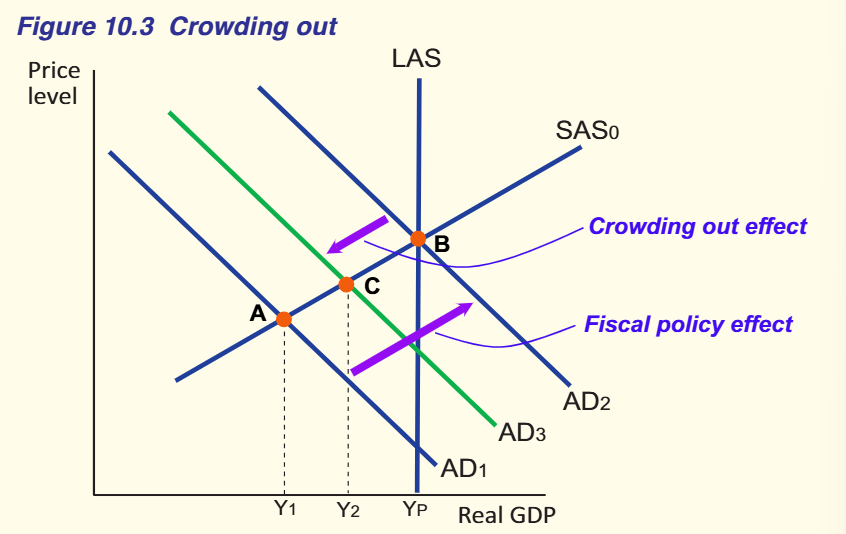
negative impact: crowding out
Crowding out
occurs when excessive government bond issuance and borrowing lead to higher interest rates, reducing private sector investment and slowing economic growth. This limits capital availability for businesses and households, potentially hindering long-term economic expansion
crowding out doesn’t always occur - e.g. if economy is in recession, private spending is already low and unlikely to fall in response to government stimulus
borrowing from domestic investors is good because no increase in money supply (no inflation), interest payments on the bonds will be paid back its own citizens
crowding out isn’t an issue if bonds are sold to foreign residents, BUT interest payments on the issued bonds will be sent overseas as a net leakage, and the government’s share of foreign debt will increase
borrowing from the reserve bank
referred to as ‘printing money’.
direct injection of new funds into the economy which increases the money supply and therefore is highly inflationary (growth in money supply exceeds growth in real output)
This method would only be appropriate if the economy was in a deep depression. The Reserve Bank has publicly stated that it will not facilitate this method because of its effects on inflation.
impacts of voernment debt
must be paid off by taxpayers at some point
interest is an ongoing cost to taxpayers
removes political restraint on wasteful spending
crowding out
reduces economic activity (not really)
Debt must be paid off by taxpayers at some point in the future
This requires either higher levels of taxation, reducing wealth and income, or lower levels of government spending.
By increasing debt today, the government is effectively borrowing from the wealth of future generations to pay for current expenditure.
Interest payments impose an ongoing cost on taxpayers until the total debt is paid off
Interest payments pose a significant opportunity cost which prevents increased spending or lower taxes elsewhere
and interest rates will rise long before Australia is able to pay off this debt meaning that interest payments will grow substantially
Funding government spending through issuing government debt removes the political restraint on wasteful government spending.
When spending is funded by current taxation, increasing spending means raising taxes on the electorate.
Deficit spending removes this restraint and obscures the opportunity cost of government spending.
Crowding out
Increasing the supply of government bonds lowers the price of bonds and increases the yield.
Holding all else constant, higher interest rates on government bonds will put upward pressure on business loan interest rates, thus reducing business investment.
Reduce economic activity, causing bad consequences
There is some evidence that increasing levels of debt as a share of GDP can cause a drag on growth.
Some argue that Australia’s debt burden is not a cause for concern because it is relatively lower than many other developed countries.
However, this is a misleading claim as it does not take into account the direction of government debt, which has been increasing steadily since the 2008-09 fiscal year.
Strengths of fiscal policy
short outside lag - direct impact of budget announcements on economy
direct - immediate implementation
effective and complementary to automatic stabilisers to influence level of macroeconomic activity
Weaknesses of fiscal policy
time lag/ inside lag- recognition lag of policies produced on out of date data and decision lag of deliberative parliamentary processes
inflexibility- social, demographic and political constraints make it difficult to create large changes to pattern and allocation of spending when developing a budget
political constraints - election promises, re- election
unintended impact on private sector decisions- crowding out makes borrowing riskier for businesses, discouraging stimulating the economy
Automatic economic stabilisers
changes that occur automatically to government transfer payments and tax revenue due to changes in the business cycle.
determines cyclical balance
impact of income taxes and transfer payments
economic shock absorber- reduce level of aggregate spending in a boom, increase it in a trough
impact the budget outcome
When the economy enters the trough phase of the cycle (slower growth), tax revenue falls and welfare payments rise, so the budget balance moves towards deficit (or an increasing deficit).
When the economy is stronger, tax revenue rises and welfare payments fall, so the budget balance becomes increasingly positive.
Discretionary fiscal policy
deliberate changes to expenditure decisions and taxation
expansionary
contractionary
neutral
determines structural balance
Expansionary
aim to close a negative output gap by increasing aggregate demand
used in a period of low economic activity to stimulate spending, usually associated with a budget deficit
The final effect is larger than the initial stimulus because of the multiplier - a small change in government spending (i.e. a small vertical movement in AE) produces a larger increase in the level of aggregate income.
ways to stimulate household and business spending include:
reducing income tax to increase household purchasing power;
cutting corporate tax to stimulate business spending on inputs, employment and investment;
and/or increasing government spending on infrastructure, such as transport and communications projects, or in main departments such as healthcare, education
causes the price level to rise- may increase inflation rate depending on the size of the negative output gap
initially at equilibrium at point a where real GDP (Yp) is lower than potential GDP (Yp). Unemployment higher than natural rate, inflationary pressure is low.
Contractionary policy
used in a period of stronger economic activity to reduce levels of spending in the economy, usually associated with a budget surplus.
ways to achieve this contractionary outcome might include:
increasing personal income tax rates and company taxes;
reducing or postponing spending on major projects;
and/or increasing excise taxes such as those applied on sales of cars, tobacco and alcohol.
As there are many components of government revenue and expenditure, reducing spending means that a decision has to be made as to what component of expenditure will be reduced.
It could be current or capital expenditure, and might be taken from defence, education, health or infrastructure.
The actual way in which revenue is increased or expenditure is cut is usually influenced by politics (as much as by economic judgements).
political unpopularity of taxes
cuts to government expenditure is difficult because high proportion of department spending is on wages and salaries
initially at equilibrium where point A where real GDP (y1) is greater than potential GDP (Yp)
unemployment lower than natural rate, inflationary presure is high
has a multiplier effect
Balanced
If the government thought economic conditions were close to the natural rate of employment with inflation in the 2-3 per cent range, it might adopt a neutral budget stance.
In this case, there would be little difference between revenue and spending, and the budget outcome would move towards balance.
Budget balance
The budget balance = structural balance + cyclical balance
The stance of fiscal policy is determined by the structural balance, not the overall balance - a structural deficit means that fiscal policy is expansionary, whereas a structural surplus implies that fiscal policy is contractionary. Ideally the structural balance should equal zero when the economy is at potential GDP (full employment).