Musical terminology
 Studied by 0 people
 Call Kai
 Learn
Learn Practice Test
 Spaced Repetition
 Match
Match Flashcards
 Knowt Play
1/23

There's no tags or description
Looks like no tags are added yet.
Name | Mastery | Learn | Test | Matching | Spaced | Call with Kai |
|---|
No analytics yet
Send a link to your students to track their progress
24 Terms
Four ways sound can be altered
Time, Pitch, Timbre, Dynamics
Time - levels of rhythmic activity 1
Free meter: no discernible consistent beat, you cant tap your foot to it
Time - levels of rhythmic activity 2
Pulsatile: a consistent beat, but no recurring pattern of accented beats
Time - levels of rhythmic activity 3
Metered: a consistent beat, and a recurring pattern of accented beats
Metered Divisive meters
made up of groups that can be evenly and symmetrically divided [ex. duple - 2/4, 4/4, 6/8, triple - 3/4, 9/8] — the majority of western pop music is duple meter.
Metered Additive meters
made up of asymmetric groups of 2 and 3 beats [ex. 9 (2+2+2+3 or 2+3+2+2)] — additive meters are common in eastern european, arab, persian, and indian musics.
Time - syncopation
Once the meter is established it doesnt need to be explicitly played. syncopation is the accenting of unexpected beats to make the rhythmic component of a piece more interesting. in modern western popular music duple meter is almost ubiquitous, so syncopation is used extensively to avoid monotony.
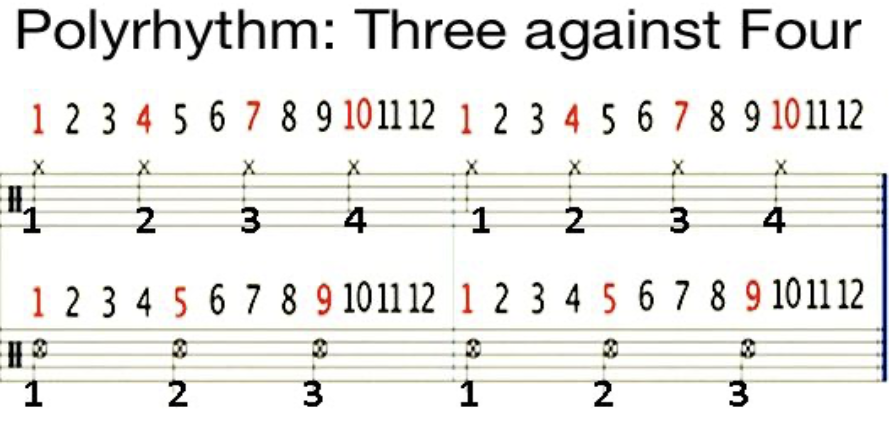
Time - polyrhythm
more than one rhythm existing in the same piece of music. the example below has a divisive triple meter (above) and a divisive duple (below)
Time - tempo
the pace of music, expressed in bpm. tempo is independednt of meter. meter is simply a recurring pattern of accented and unaccented beats, and is neither fast nor slow; tempo determines the speed of music
Pitch
highness or lowness of a note. high notes vibrate at a higher freq than low notes. The note an octave above any other note vibrates at double the frequency, which our ears can easily recognize, and explains why we think of scales in octaves.
Pitch - interval
the distance between two pitches. in most western music, the intervals between the notes in a scale are usually whole steps, but sometimes half steps.
Pitch - scale
the group of pitches that make up one octave. scales in some cultures only contain a few notes. a piano can play up to 12 notes in one octave, but the most common western scales, the major and minor scales, contain 7 pitches. Heptatonic scales: 7 notes scales [do re mi fa so la ti -do-] pentatonic scales: 5 note scales, common in folk music [do re mi so la -do-]. the placement of the large and small intervals changes our perception of the scale. this is why people raised with western music perceive minor scales as sad and major as happy.
Pitch - melody
a succession of notes, varying in pitch, which have an organized and recognizable shape
Pitch - phrase
melodies are usually made up of a number og phrases
Pitch - melodic contour
the shape of a melody or phrase. phrases typically ascend, descend, or form an arch
Pitch - temperament
has to do with the precise tuning of the pitches in a scale, the exact frequency at which each pitch vibrates. the greeks discovered that a mathematical relationship exists between pitches. if you divide a string on an instrument in two it produces the same note but an octave higher. dividing it in three gives you the fifth degree of the scale and dividing it in five gives you the third degree of the scale. in this way you can eventually determine all of the notes of the scale.
Pitch - Greeks
they thought that they had discovered some secret connection between mathematics and music. and the very construction of the physical universe. but the pitches derived by physics are not the ones we use in the real world. every culture seems to have its own temperament which means the exact frequencies of the notes in any actual scale are a bit off of those dictated by physics.
Pitch - chords
western music is built on a system known as “tonal harmony“ over time certain groups of pitches were considered to sound good together, and these groups of pitches are called chords c+e+g make the “c major” chord. likewise certain chords seem to sound good when played in certain orders, and a system of “chord progressions“ or chord patterns was developed. the movement from one chord to another is a big part of the formal structure of western music.
Timbre
 Note
Note  Flashcards (276)