Biodiversity Unit 1 (FAU- Frazier) quiz
 Call Kai
 Learn
Learn Practice Test
 Spaced Repetition
 Match
Match Flashcards
 Knowt Play
1/56

There's no tags or description
Looks like no tags are added yet.
Name | Mastery | Learn | Test | Matching | Spaced | Call with Kai | Chat |
|---|
No analytics yet
Send a link to your students to track their progress
57 Terms
Mutualism
Both species benefit
Commensalism
One benefit; the other has no effect
EX: cockroaches
Parasitism/pathogens
one is benefiting and the other is harmed
EX: Tics
Photoautrophs = to what photosynethic blue/green algae?
cyanobacteriaD
Decomposers
Break down organic molecules
recycling nutrients
Difference between a plant and animal cell
Plant cell: cell wall (made of cellulose) and chloroplast
Characteristics of Protista
Eukaryotic cells (have membrane-bound organelles)
inicellular
colonial
multicellular organisms (simple structure)
Polyphyletic origin - organisms have distinct origins and ancestors
How do fungus-like protists feed
-heterotrophic (cannot make their own food)
dissolves food outside their bodies then absorbes it
How do animal-like protists feed
-heterotrophic
feed by consuming other organisms and digest inside the body
Hetero-
different, gets food from different organism
Auto-
Self; gets food from itself
Mixo-
gets food in both wyas its mixed
How is everything grouped?
By their ecological role
producer (autotrophic) (plant-like)
consumer (heterotrophic)(animal-like)
both (mixotrophic)
Phylum Chrysophyta (Plant-like)
Golden-brown algae
Autotrophic
Mostly unicellular or colonial
Cell wall: cellulose or pectin
Chlorophyll A & C
Includes diatoms
Diatoms (Plant-like)
Unicellular
Cell wall: silica or pectin
Chlorophyll A & C
Part of Chrysophyta
Phylum Phaeophyta (Plant-like)
Brown algae
The algae we eat
Autotrophic
Mostly multicellular
Chlorophyll A & C
Structure:
Holdfast
Stipe
Frond
Vessel cells
Phylum Rhodophyta (Plant-like)
Red algae
Multicellular
Chlorophyll A & D
Deep-water pigments
Lack flagella
Cell wall: cellulose
Can deposit calcium carbonate
Coralline/calcareous algae
Extracts: carrageenan + agar
Phylum Chlorophyta (Plant-like)
Green algae
Most abundant
Unicellular, colonial, or multicellular
Chlorophyll A & B
Cell wall: cellulose + pectin
Ancestor of land plants
Phylum Euglenophyta
Mixotrophic
Unicellular
No cell wall
Chlorophyll A & B
2 flagella
Stigma = eyespot
Euglena is an example (Genus)
What is the stigma in Euglenophyta?
Eyespot
Helps Euglena detect light
Allows it to swim toward light
Phylum Dinoflagellata (Mixotrophic)
Unicellular
Chlorophyll A & C
Cellulose cell wall
Red tides
Toxins can kill fish
Zooxanthellae
Bioluminescence
Pfiesteria can feed on fish
Warm water can cause zooxanthellae to leave coral → coral bleaching
What are zooxanthellae?
Algae living with coral
When water gets too warm, they can leave coral
Their loss causes coral bleaching
Kingdom Diplomonadida (Animal-like)
Mostly parasites of guts
Unicellular
Multiple flagella
No plastids
No mitochondria
Example: Giardia lamblia (intestinal parasites)
Causes intestinal disease/diarrhea
Kingdom Parabasalida (Animal-like)
Mostly parasites/commensals of guts
Unicellular
Multiple flagella
No mitochondria
Has a flagellum running underneath plasma membrane
Examples:
Trichomonas vaginalis
Trichonympha — termite gut
Phylum Choanoflagellida
Unicellular or colonial
One flagellum
Flagellum surrounded by a collar
Gave rise to/origin of animals
Phylum Kinetoplastida
Unicellular
Has flagella
Symbiotic or pathogenic
Kinetoplast = extra nuclear DNA
Associated with a single large mitochondrion
Examples:
Trypanosoma → African sleeping sickness
Leishmania —→ eats cartilage
Phylum Apicomplexa
All species are parasites
Adults are non-motile
Includes Plasmodium
Causes malaria
Know the Plasmodium life cycle
Plasmodium life cycle order
Sporozoite → Cryptozoite → Merozoite → Gametocyte
Sporozoite → mosquito
Cryptozoite → liver
Merozoite → red blood cells
Gametocyte → mosquito
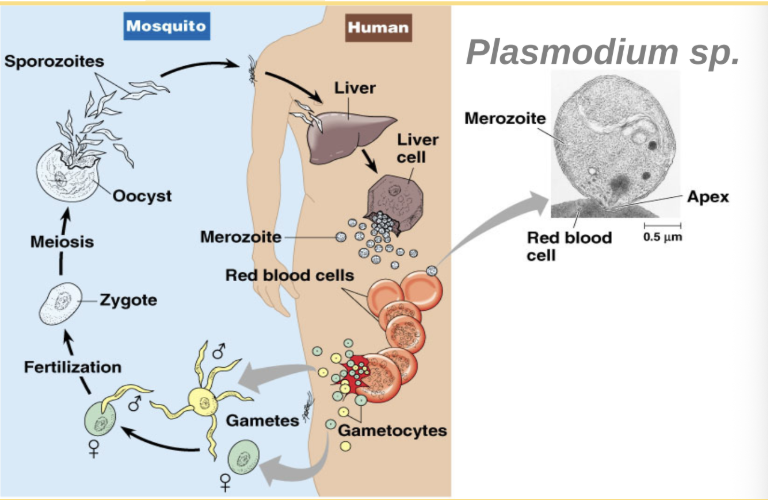
Plasmodium — Sporozoite
Stage in the mosquito
Found in mosquito salivary glands
Injected into human when mosquito bites
Plasmodium — Cryptozoite
Stage in the liver
Plasmodium — Merozoite
Infects red blood cells
Released from liver
Enters bloodstream
Infects red blood cells
Plasmodium — Gametocyte
Sexual reproduction stage
Taken up by the mosquito
Continues the cycle
Characteristics of malaria
Caused by Plasmodium
Parasite
Can cause high fever and shaking/chills
Phylum Ciliophora
Unicellular
Mostly free-living in freshwater
Surface mostly covered by cilia
Specialized organelles:
Contractile vacuole
Complex cytoskeleton
Micronucleus + macronucleus
Conjugation
Binary fission
Example: Paramecium
Ciliophora — Conjugation vs. Binary Fission
Conjugation:
Exchange of genetic material
Involves micronuclei
Binary fission:
One organism splits into two
Contractile vacuole
Removes excess water from the cell
Helps maintain water balance
Without proper water regulation, a freshwater organism can take in too much water
Phylum Rhizopoda
Amoeba
Unicellular
No shell
Uses pseudopods
Pseudopods used for:
Locomotion
Food acquisition
Phylum Actinopoda
Amoeba-like
Unicellular
Heterotrophic
Silica shell
Thin, ray-like pseudopods = actinopods
Pseudopods extend through holes in shell
Phylum Foraminifera
Amoeba-like
Unicellular
Heterotrophic
Calcium shell
Shell is chambered and porous
Has chambers inside shell
Compare Rhizopoda, Actinopoda, and Foraminifera
Rhizopoda
→ No shell
→ Pseudopods
Actinopoda
→ Silica shell
→ Ray-like pseudopods
Foraminifera
→ Calcium shell
→ Chambered, porous shell
Phylum Oomycota
Water and slime molds
Marine, freshwater, terrestrial
Needs water
Heterotrophic
Zoospores = flagellated spores
Parasites and decomposers
Example: potato blight
Phylum Myxogastria
Plasmodial slime mold
Terrestrial
Plasmodium = one large cell
One mass of cytoplasm
Many nuclei
Amoeboid movement
No cell wall
Reproduction: sporangium → spores
Phylum Dictyostelida
Cellular slime molds
Pseudoplasmodium = aggregate of cells
Forms sporangium
Sporangium produces spores
Cell wall: cellulose
Myxogastria vs. Dictyostelida
Myxogastria
ONE giant cell
Many nuclei
Plasmodium
No cell wall
Dictyostelida
MANY individual cells
Cells aggregate
Pseudoplasmodium
Cellulose cell wall
Algae pigments
Chrysophyta
Phaeophyta
Rhodophyta
Chlorophyta
Euglenophyta
Dinoflagellata
Chrysophyta → A + C
Phaeophyta → A + C
Rhodophyta → A + D
Chlorophyta → A + B
Euglenophyta → A + B
Dinoflagellata → A + C
Shell types
Rhizopoda
Actinopoda
Foraminifera
Rhizopoda → No shell
Actinopoda → Silica shell
Foraminifera → Calcium shell
Organisms with NO mitochondria
Diplomonadida
Parabasalida
Slime molds
Oomycota →
Myxogastria →
Dictyostelida →
Oomycota → water/slime molds
Myxogastria → one giant cell, many nuclei
Dictyostelida → many cells aggregate
Asexual vs Sexual reproduction
Asexual reproduction = cloning yourself
Copies DNA into two strands
Cuts itself into two
Sexual reproduction = Mixing of DNA

Hierarchy of Order? (There's 6 of them)
Molecule, Organelle, Cells, Tissues, Organ, Community
“Dear King Phillip Came Over For Good Spagetti”
Domain
Kingdom
Phylum
Class
Order
Family
Genus
Species
Eukaryotic Animal Cell only has what 3 things in its cell structure?
- DNA in Nucleus
- Cytoplasm
- Plasma Membrane
Taxonomy is the study of?
Species identification
What is the Binomial nomenclature and Linnaeus of Genus and Species?
Genus - Homo
Species - Sapiens
Evolution clock:
1 billion years =
1,000 million years
What are the 5 kingdoms
Plantae
Fungi
Animalia
Protista - single-celled organelles
Monera