Chapter 18 Modulation of Movement by the Basal Ganglia
 Studied by 0 people
 Call with Kai
 Learn
Learn Practice Test
 Spaced Repetition
 Match
Match Flashcards
 Knowt Play
1/28

There's no tags or description
Looks like no tags are added yet.
Name | Mastery | Learn | Test | Matching | Spaced | Call with Kai |
|---|
No study sessions yet.
29 Terms
1. Which nuclei comprise the striatum?
a. Globus pallidus and caudate
b. Putamen and pallidum
c. Caudate and substantia nigra pars compacta
d. Putamen and caudate
e. Pallidum and substantia nigra pars compacta
d. Putamen and caudate
2. Where are medium spiny neurons located?
a. Striatum
b. Pallidum
c. Globus pallidus
d. Substantia nigra pars compacta
e. Subthalamic nucleus
a. Striatum
3. Output from the basal ganglia projects from which structures?
a. Globus pallidus and caudate
b. Putamen and pallidum
c. Globus pallidus and substantia nigra pars reticulata
d. Putamen and caudate
e. Pallidum and substantia nigra pars compacta
c. Globus pallidus and substantia nigra pars reticulata
4. Which regions of the cerebral cortex project directly to the striatum?
a. Association areas of the frontal and parietal lobes
b. Temporal lobe
c. Insular cortex
d. Cingulate cortex
e. Nearly all regions of the cerebral cortex
e. Nearly all regions of the cerebral cortex
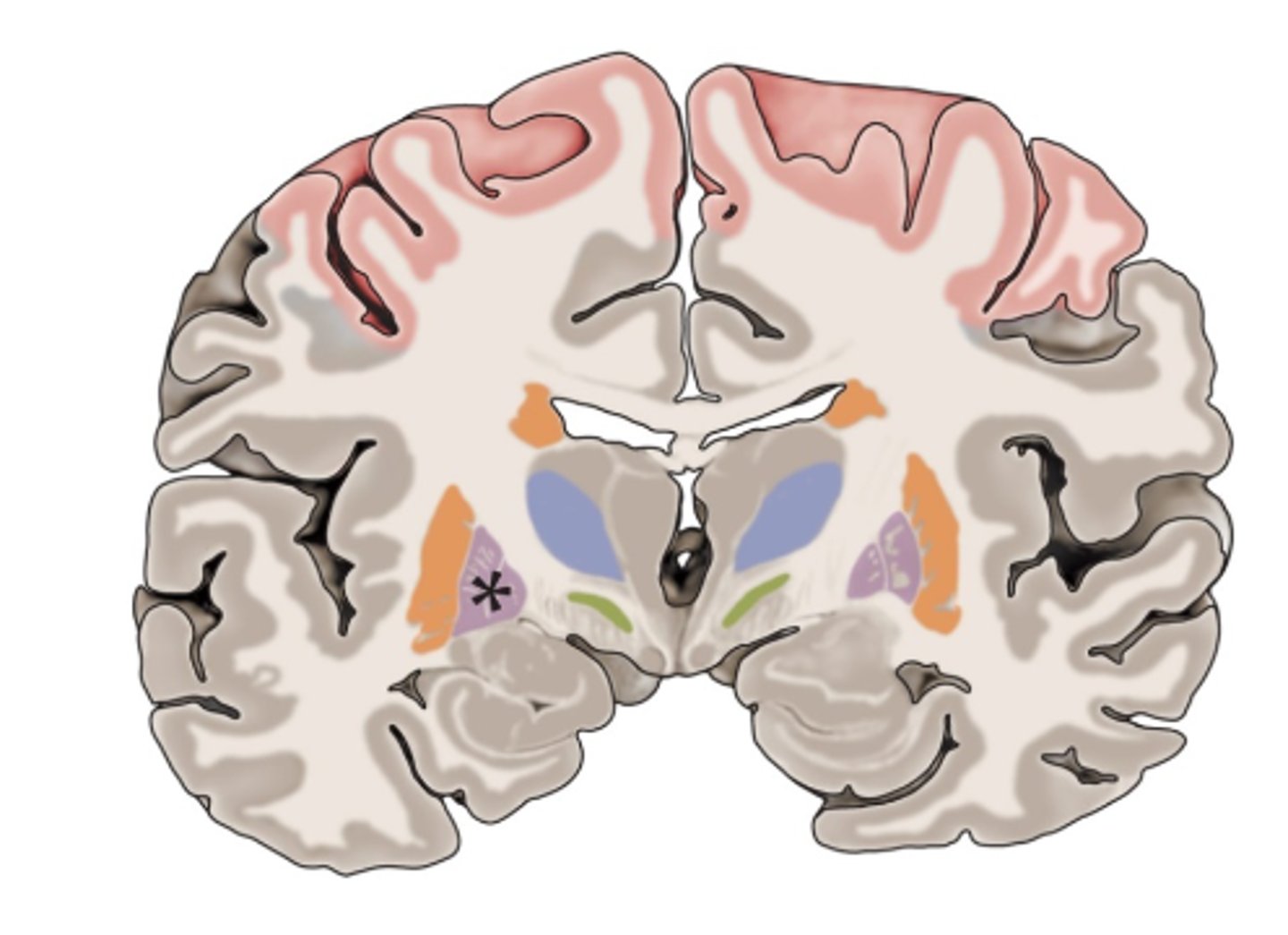
Which region of the basal ganglia is indicated by the asterisk?
a. Striatum
b. Pallidum
c. Globus pallidus
d. Substantia nigra pars compacta
e. Subthalamic nucleus
c. Globus pallidus
6. What evidence suggests that medium spiny neurons are associated with a decision to move?
a. Cortical areas concerned with the hand converge in a different striatum area than cortical areas
concerned with the leg.
b. Neurons in the putamen and caudate discharge seconds before the initiation of movement.
c. The more extensively interconnected the area of cortex, the greater the overlap in their
projections to the striatum.
d. Staining of the striatum reveals patches surrounded by matrix.
e. Input and output into the different components of the striatum is unique.
b. Neurons in the putamen and caudate discharge seconds before the initiation of movement.
7. Which neurons do not directly synapse on the striatum?
a. Cortical neurons
b. Local circuit neurons
c. α motor neurons
d. Thalamic neurons
e. Dopaminergic neurons from the brainstem
c. α motor neurons
8. Dopaminergic neurons that synapse on medium spiny neurons originate from which brain
region?
a. Substantia nigra pars reticulata
b. Pallidum
c. Globus pallidus
d. Substantia nigra pars compacta
e. Subthalamic nucleus
d. Substantia nigra pars compacta
9. The transmitter for the medium spiny neurons of the striatum is
a. glutamate.
b. GABA.
c. dopamine.
d. serotonin,
e. norepinephrine.
b. GABA.
10. There is a high degree of convergence from the medium spiny neurons to the neurons of the
_______ and _______.
a. caudate; putamen
b. globus pallidus; substantia nigra pars compacta
c. caudate; substantia nigra pars reticulata
d. globus pallidus; substantia nigra pars reticulata
e. putamen; substantia nigra pars compacta
Answer: d
d. globus pallidus; substantia nigra pars reticulata
11. Efferent neurons from the globus pallidus that influence the activity of the motor areas of the
cortex arise from the _______ segment and relay in the _______ before reaching the cortex.
a. internal; VA/VL thalamic nuclei
b. external; VA/VL thalamic nuclei
c. internal; substantia nigra pars compacta
d. external; substantia nigra pars compacta
e. internal; substantia nigra pars reticulata
a. internal; VA/VL thalamic nuclei
12. Excitation of the motor cortex is associated with excitation in which other brain region?
a. Striatum
b. Pallidum
c. Globus pallidus
d. Substantia nigra pars reticulata
e. VA/VL complex of thalamus
a. Striatum
13. A researcher injects a GABA antagonist into the globus pallidus and then stimulates the
striatum. What are the expected changes in the downstream response?
a. Increased activation of the globus pallidus and increased excitation of the motor cortex
b. Decreased activation of the globus pallidus and increased excitation of the motor cortex
c. Increased activation of the globus pallidus and decreased excitation of the VA/VL complex of
the thalamus
d. Increased activation of the globus pallidus and increased excitation of the VA/VL complex of
the thalamus
e. Decreased activation of the globus pallidus and decreased excitation of the motor cortex
e. Decreased activation of the globus pallidus and decreased excitation of the motor cortex
14. Substania nigra pars reticulata axons project to _______; the globus pallidus axons do not
project to this region.
a. substantia nigra pars compacta.
b. superior colliculus.
c. thalamus.
d. caudate.
e. cerebral cortex.
b. superior colliculus.
15. The external segment of the globus pallidus projects to the internal segment and the _______
in the _______ pathway.
a. subthalamic nucleus; direct
b. caudate; direct
c. subthalamic nucleus; indirect
d. caudate; indirect
e. VA/VL complex of the thalamus; indirect
c. subthalamic nucleus; indirect
16. Subthalamic nucleus neurons that project to the internal segment of the globus pallidus
release which transmitter?
a. Glutamate
b. GABA
c. Dopamine
d. Serotonin
e. Norepinephrine
a. Glutamate
17. Increased activity from the _______ to the subthalamic nucleus increases the _______ input
to the VA/VL complex of the thalamus.
a. cerebral cortex; excitatory
b. internal segment; inhibitory
c. external segment; excitatory
d. cerebral cortex; inhibitory
e. internal segment; excitatory
d. cerebral cortex; inhibitory
18. D1 and D2 receptors are _______, with D1 receptors _______ cAMP and D2 receptors
_______ cAMP.
a. metabotropic; decreasing; increasing
b. metabotropic; increasing; decreasing
c. metabotropic; increasing; maintaining
d. ionotropic; decreasing; increasing
e. ionotropic; increasing; decreasing
b. metabotropic; increasing; decreasing
19. Which evidence suggests that dopaminergic input to the striatum may contribute to reward-
related modulation of behavior?
a. Shortly before the onset of a saccade, medium spiny neurons drastically reduce the firing of
reticulata neurons.
b. Reward-based behavior is eliminated by caudate injections of D2 receptor antagonists.
c. Optogenetic methods that selectively activate the direct pathway show that monkeys prefer
sucrose water over plain water.
d. Dopaminergic synapses on medium spiny neurons are on the shaft of spines that receive input
from the cerebral cortex.
e. In monkeys, latencies of saccades toward a target are shorter when associated with a larger
reward.
e. In monkeys, latencies of saccades toward a target are shorter when associated with a larger
reward.
20. A scientist creates a D1 receptor knockout mouse. How would this effect the functioning of
the basal ganglia?
a. Cerebral cortex input to spiny neurons would not be enhanced.
b. There would be decreased input from the substantia nigra pars compacta onto the striatum.
c. The indirect pathway would be eliminated.
d. cAMP would only be increased due to substantia nigra pars compacta input.
e. Reward-based behavior would be reduced.
a. Cerebral cortex input to spiny neurons would not be enhanced.
21. While visiting a distant uncle, you notice that his face seems "mask-like" and that he keeps
calling you and your sister by your mother's name. He shuffles when he walks, and his shoulders
are stooped. Based on these symptoms, which condition would you suspect that your uncle had?
a. Huntington's disease
b. Parkinson's disease
c. Alzheimer's disease
d. Multiple sclerosis
e. Muscular dystrophy
b. Parkinson's disease
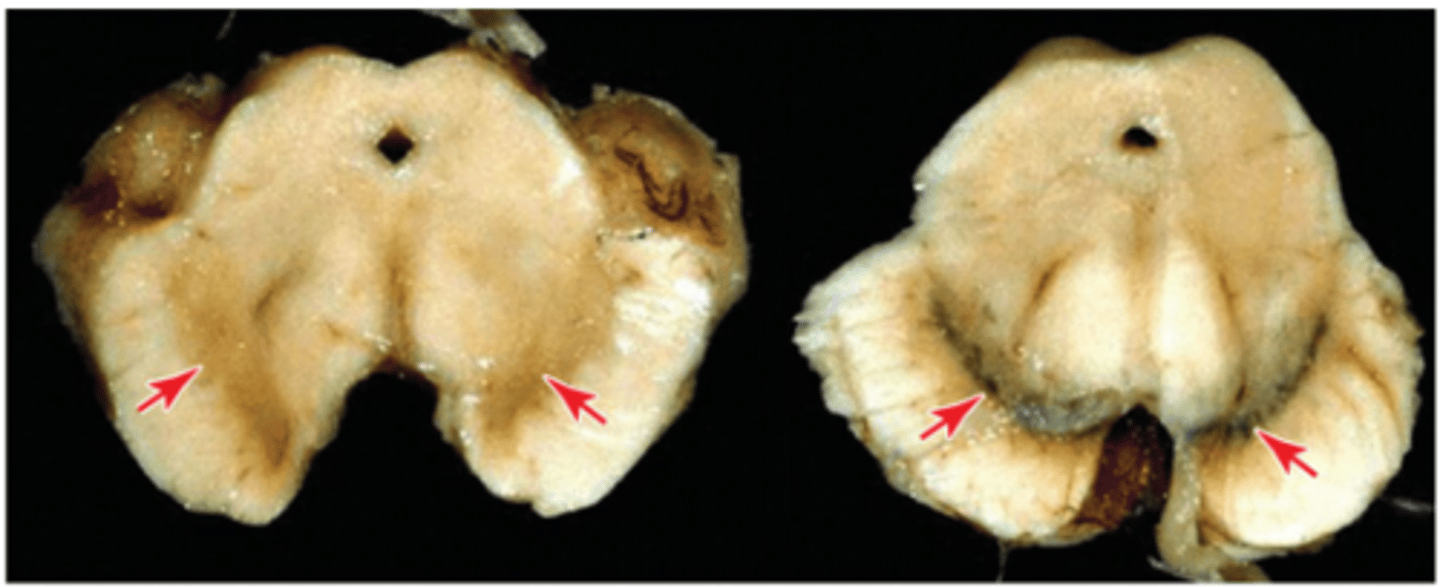
The midbrain on the left shows evidence of which disease/disorder?
a. Down syndrome
b. Huntington's disease
c. Parkinson's disease
d. Alzheimer's disease
e. Traumatic brain injury
c. Parkinson's disease
23. In Parkinson's disease, dopaminergic input from the _______ decreases.
a. striatum
b. subthalamic nucleus
c. internal globus pallidus
d. substantia nigra pars compacta
e. VA/VL complex of the thalamus
d. substantia nigra pars compacta
24. People suffering from Parkinson's disease have increased _______ of the VA/VL complex of
the thalamus, leading to decreased excitation of the _______.
a. inhibition; frontal cortex
b. inhibition; subthalamic nucleus
c. inhibition; internal globus pallidus
d. excitation; frontal cortex
e. excitation; subthalamic nucleus
a. inhibition; frontal cortex
25. Which region is one of the most common targets for deep brain stimulation?
a. Frontal cortex
b. Subthalamic nucleus
c. Caudate
d. Substantia nigra pars compacta
e. VA/VL complex of the thalamus
b. Subthalamic nucleus
26. Your 48-year-old cousin's mood seems to be increasingly irritable and impulsive the last few
years. You also notice that his left arm seems to move a lot more than his right. It seems that
your cousin tries to cover up this extra movement by incorporating it into seemingly intentional
movements. When you discuss this with your mother, she recalls that her aunt had similar
behaviors. Which condition would you expect that your cousin has?
a. Huntington's disease
b. Parkinson's disease
c. Alzheimer's disease
d. Hemiballismus
e. Muscular dystrophy
a. Huntington's disease
27. Huntington's disease is characterized by degeneration of neurons that project to the _______.
a. striatum
b. subthalamic nucleus
c. external globus pallidus
d. substantia nigra pars compacta
e. VA/VL complex of thalamus
c. external globus pallidus
28. People suffering from Huntington's disease have _______ inhibition of the VA/VL complex
of the thalamus, leading to increased excitation of the _______.
a. decreased; frontal cortex
b. decreased; subthalamic nucleus
c. decreased; internal globus pallidus
d. increased; frontal cortex
e. increased; subthalamic nucleus
a. decreased; frontal cortex
29. Damage to the subthalamic nucleus results in which condition?
a. Huntington's disease
b. Parkinson's disease
c. Alzheimer's disease
d. Hemiballismus
e. Muscular dystrophy
d. Hemiballismus