PCCR I: The Clinical Encounter, Interviewing Process, Health History, and Physical Exam
 Call Kai
 Learn
Learn Practice Test
 Spaced Repetition
 Match
Match Flashcards
 Knowt Play
1/30

There's no tags or description
Looks like no tags are added yet.
Name | Mastery | Learn | Test | Matching | Spaced | Call with Kai | Chat |
|---|
No analytics yet
Send a link to your students to track their progress
31 Terms
5 Major Steps of PT Encounter
1: Initiation - initial rapport w/ pt and family members
2: Information Gathering: exploring both pt perspective of illness and biomedical perspective of disease (bkgd and context)
3: Physical Examination:appropriate components of physical exam
4: Explanation & Planning: appropriate amount and type of information, next steps/plan of action, shared decision making
5: Closing the Session: answer questions, reiterate plan, and assure commitment to health. Self reflect
Initiate Encounter
Set Stage/Adjust Env (appearance, setting private and comfortable)
Greet Pt and establish rapport (include family)
explain role and involvement
Id title, preferred name, gender pronouns
Newborns and Infants:
Greet parents, encourage keeping baby happy/comfortable, ask how parents are (recognition!!)
Young/School-aged children: intro to child then family/caregiver. Beg w/ play → ask age appropriate Q
Adolescent: they are main focus (ensure caregivers feel heard). Spend time w/ pt alone (awk confidentiality and trust)
Older Adults: space for maneuvers, lower bkgd noise, warm temp, time to answer/talk
Physical & Sensory Disabilities: “people-first” language. Directly to pt, not caregivers; avoid need to provide assistant (how can I help)
Wheelchairs: path of access, keep in wheelchair, respect space
Blind/low vision: announce yourself and others, notify when leaving, explain next actions
Deaf/Hard of Hearing: sign language interp? (Never use family); mouth is not covered and look at pt when speaking; minimize bkgd noise
LGBTQIA+: higher anxiety and fear → higher distrust = no trust, not hx; have barriers to healthcare
Information Gathering
Esta. Agenda:
CC/Presenting Problems?
Open ended Q.
Invite story → esta what is most important to pt
active listening! Once done ask specific q to garner additional info
Pt perspective? FIFE (feelings, ideas, effect onf Function, expectatios)
ID and respond to emotional cues: NURSE (name/understand/legitimize/respect/support/explore)
Explore biomedical perspective (important bkgd info and context)
Health Hx; PMH; FH; SH; RoS
Physical Examination
Head→Toe!! Maintaining comfort (Avoid embarassing)
Physical findings? Presence/absence of disease/illness?
Explanation & Planning
Provide useful info and verify understanding
elab CC and how it relates to disease/illness (no medical jargon)
“Teach-back” method/ “show-me” method
Negotiate Plan via Shared Decision Making
intro choices and describe process → explore pt pref → move toward decision of pt choosing
Closing Encounter
Inform closing time. Any Q?
new concern/topic assures them of interest and make plans for FU
Summarize plan and plan for further evaluation/tx/FU
Self reflect
mindfulness? “Purposefully and nonjudgementally attentive to [one’s] own experience, thoughts, and feelings”
Reflect on behavior w/ own biases, values, assumptions
Skilled Interviewing - Guided Questioning
Open → Focused Q
elicits graded response
Series of Q at a time. Mult choices?
Clarify pt meaning
Encourage clarification
Use echoing/reptition
Skilled Interviewing - Active/attentive listening & Empathetic Response
Attention to verbal and nonverbal language
Empathy “capacity to ID w/ pt and feel pt’s pain as own, then respond in supportive manner”
don’t assume!! Ask elaboration
Skilled Interviewing - summarization & transitions & Partnering
Review what pt said and allow them to correct/fill-in any additional details
Skilled Interviewing - validation, empowering, reassurance
Allows pt to feel as though response if legitimate and understandable
Empower to ask Q, express concerns, to q/probe recommendations (makes them likely to follow plan)
Skilled Interviewing - Appropriate verbal/non-verbal communication
Simple, recog words (no medial jargon)
Non-stigmatizing language
Posture/gesture/facial expressions (nodding)
Eye contact
Tone of voice/use of silence
Mirror!!
Stig vs Non-stig language
Ex-con → person who was/is incarcerated
Parolee/probationer → person on parole/probation
Drug abuser/junkie/addict- → person who uses/injects drugs
Schizo/depressive → person w/ …
AIDS/HIV pt → person living w/…
Prostitute/hooker → sex workers/ person involved w…
Rape victim → sexual assault survivor
Handicapped/Disabled → people w/ diabilities
Normal/healthy/whole/typical → people w/o diabilities
Dwarf/midget → person of short stature/ little person
Confined to wheelchair/wheelchair bound → person who uses…
Symptoms vs Signs
Subjective (pt tells you) vs Objective (physical exam findings and diag)
Comprehensive Medical History
For new pt: fund/personalized knowledge abt pt; strengthens clincial-pt relationship; id/ r/o physical cause related to pt concerns; baseline for future assessments; platform for health promotion (edu and counseling); dev proficiency in essential skills of physical exam
Initial Info & ID Details
CC
HX of Present Illness (HPI)
PMH
FH
Personal and SH
RoS
Comprehensive Medical History - Initial Information and Identifying Details
Date and Time of Eval
Pt ID: Name (initials), Age, Gender
Source of Info: Pt/Parent/Spouse/caregiver/EMS
unreliable/unable - docu reason (pt vague…spouse is reliable historian)
Comprehensive Medical History - Chief Complaint
Primary Sx/ concern causing pt to seek care
Document: [Chief Complaint] x duration (I have crushing chest pain x 3hrs)
Mult? Primary sx as CC and addition as HPI (under positive asso sx)
Comprehensive Medical History - History of Present Illness
Clear, Concise, chronological description of pt’s complaint
OP5QRS2T
Onset: when began?
if vague ask clarifying to better quantify (Guided Q)
When__ start? What does time mean to you? Yrs or mths
Precipitating: What cause Sx?
what doing when __ began; anything unusal? →risk factors? Relevant PMH/SH
Palliative: factors that make sx better
anything make sx better? → anything for pain? → better w/ __
Provocative: factors that make sx worse
Progression: how sx changed since onset
focused has __ changed since began? →ep longer/freq/severe?
Prior episodes: focused - exp b4? → if y what was cause?
Quality: Description of sx
can you describe? → dizziness to you..? → aching/burning/sharp…
Radiation: sx anywhere else? (PREDOM for pain)
pain move/travel? →CP to neck/jaw/arm; ABD →back (straight or wrap around?)
Site: location
where? →point w/ finger? →same both or worse?
Severity: Bad
PAIN scale 1-10 can clarify w/ palliative/provocative factors)
NONPAIN: mild, moderate, severe (how affecting ability…)
Timing: often/long sx affect pt
time of day w/ worse sx; how often exp; how long ep; pain wax/wane or intermittent/constant
Comprehensive Medical History - HPI (associated sx)
Other symptoms present (aside from CC)
OPQRST each positive sx (any RoS pt says yes to)
List all negative (any ROS pt says no to)
Comprehensive Medical History - Past Medical History
Adult Illnesses (dates and yrs since diagnosis)
medical (High BP, Heart attack, Hep, asthma, COPD, seizures cancer)
surgery (type and date/yr, surgeon’s name) directed to r/o appendicitis…
Hospitalizations (date, hospital, diag, tx, studies done, outcomes)
Trauma/serous injury (age @t time of injury, tx, causes, complications, outcome
OBGYN (obstetric hx, menstrual hx, methods of contraception, sexual function)
Psychiatric (hx of depression, anxiety, suicidal ideation/attempts, homicidal ideation. Y to any ask abt prior psych hospitalization (date, duration, tx)
Childhood illness
acute illness: MMR, Chicken pox, Whoopting cough (pertussis, Rheumatic fecer, scarlet fever, polio (ALL MANIFEST LTR IN LIFE)
Consistent strep (tonsillectomy)
Chronic illness: asthma, DTM (either PMH or childhood (if resolved then))
Health Maintenance: immunizations (name, yrs admin), vaccines; screening tests (colonoscopy, mammogram, PAP smear…)
Mediations (name, dose, route, frequency, indication (esp w/ PRN) why/what diag)
Allergies: allegen and reaction (date/yr). Foods, medicatios, env and insect
Comprehensive Medical History - Family History
Outlines ages and health OR age and cause of death of family members (2 generations above and below)
Age or age of death of each relative
Health and any known medical probs (why die?)
Docu alive and well (A&W) w/ no MH
Ask abt chronic disease (DOCU if neg/pos)
HTN, coronary artery disease, elev cholesterol lvls, stroke, DTM, thyroid/renal disease, arthritis, TB, asthma/lung disease, headache, seizure disorder, mental illness, suicide, substance abuse
Cancer hx (breast, ovarian colon, prostate)
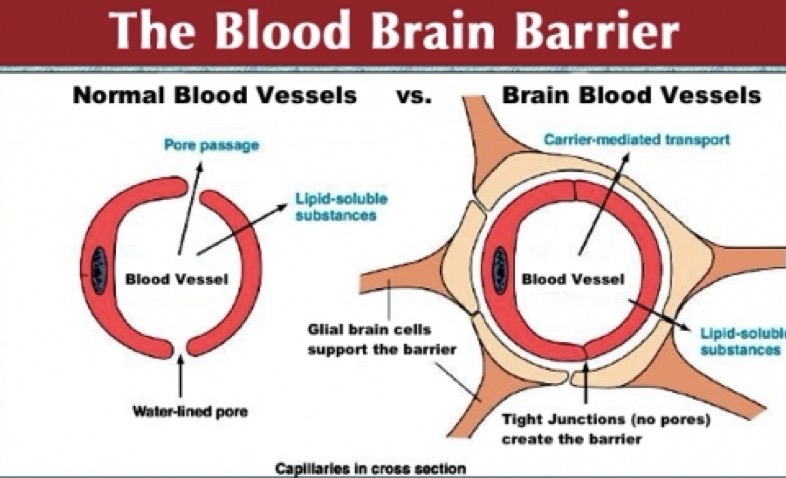
Comprehensive Medical History - Personal and Social History
Pt’s personality and interests, coping mech, strengths, and concerns
non-judgmental!!
Sensitive topics (explain why you need to know)
Influence from societal, cultural, and family constraints
Opening q and specific q to garner info
Ackow own discomfort
Tobacco use/ illicit, recreational drug use/ alc use (specific!!)
Occupation & highest level of education
Marital Status
Lifestyle Habits (diets, exercise, supplements, caffeine intake)
Safety measures (seatbelt, bike helmet. Sunscreen, smoke detectors, firearms in home)
mainly comprehensive; firearms w/ psych
Sexual orientation/ gender ID
Birthplace
Person environmental map (sig relationships? Healthy? Home environment, life exp, leisure act, sexuality, spirituality, social support syst)
Baseline level of function (ADLs/iADLs aka basic vs instrumental)
consider w/discharge
Comprehensive Medical History - SH (Tobacco/Illicit/Alc)
Tobacco use
Using: what kind? How many? How long (pack yrs = PPD x yrs smoking)
If not using: Have you ever? How long? When quit?
Recreational/Illicit Drug Use
National Institute on Drug Abuse recc: “how many times in the past year have you used an illegal drug or used a prescription medication for nonclinical reasons?”
what used? Last used? How much? How often?
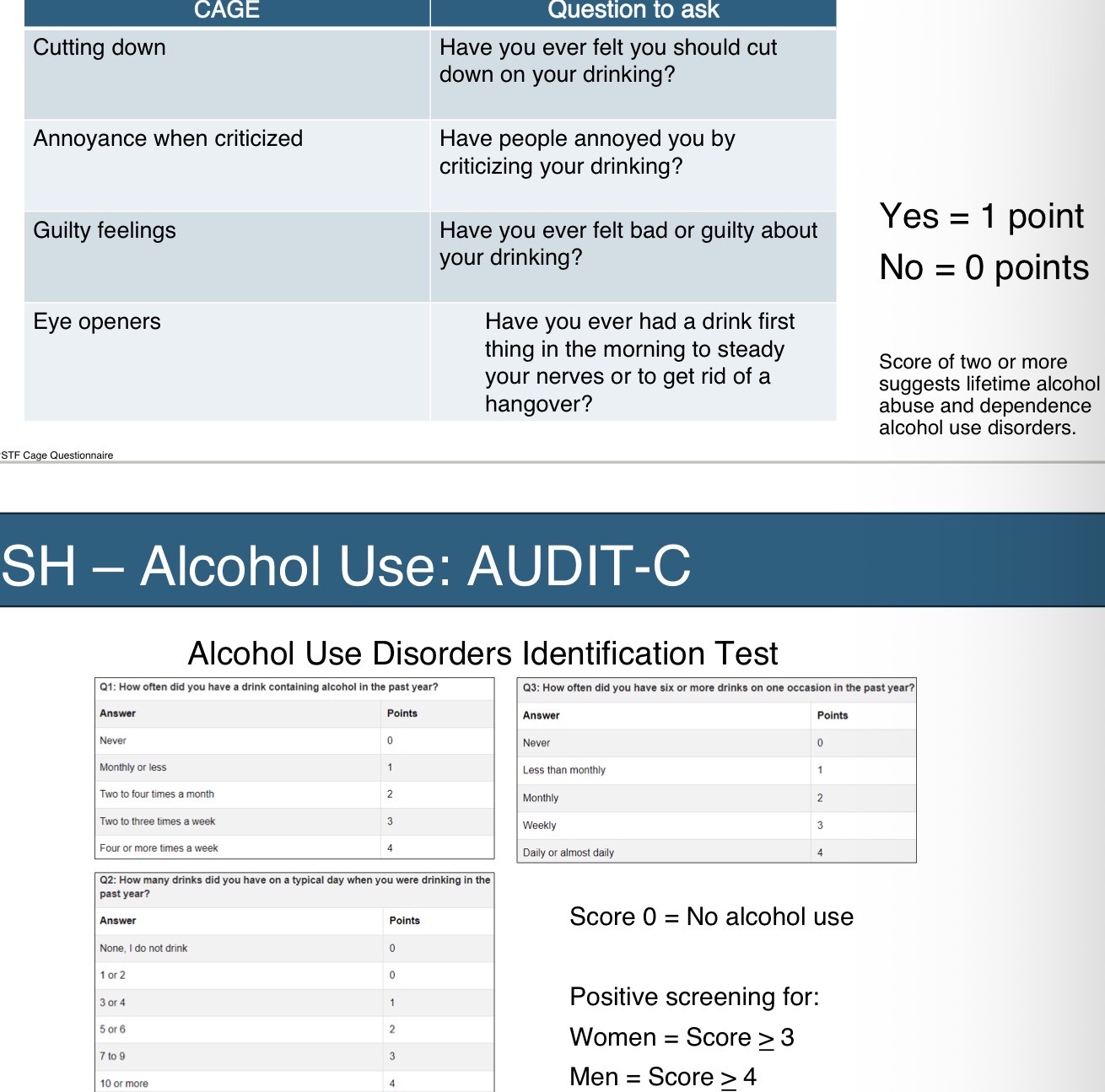
Alcohol Use
how often? How many drinks (men 4/day or 14/wk; women 3/day or 7/wk)? When last drink?
Misuse → blackouts, withdrawal seizures, accident/injuries secondary to drinking, diff at work/relationships due to alcohol abuse
CAGE questionnaire; AUDIT-C
Comprehensive Medical History - SH (Sexual Orientation & Gender ID-SOGI)
Do NOT assume - asking allows relevant and compassionate care
appropriate/DIRECT questioning, specific language (gender neutral; ask pt how they refer to genetalia), consider generalized approach (specific concerns/q to start regarding sex health/practice?)
Then go to 5p+
Consider asking as pt of ROS/HPI (genitourinary syst)
5 Ps+
Partners: last time w/ intimate contact? Sexual intercourse? Genders? Partners in last 6mth/5yrs/lifetime? New partners in last 6mth?
Practices: have sex? What kinds (oral,vaginal,anal)? Using/sharing sex toys? Pts of body used for sex?
Protection from STIs: what done to protect? When use condoms (if N then why?) Any concerns abt HIV/AIDS?
Past HX of STIs: ever had one? Y kind, when, tx, meds? Ever tested? Y when, what, results?
Pregnancy Prevention: plans desire for children?
Opp sex partners: concen abt preg/getting partner preg? Doing anything to prevent? Want info on birth control? Any Q or concerns abt preg prevention?
Other: assessment of trauma/violence/sex satis/ sex heal concerns/probs and support for SOGI
Comprehensive Medical History - SH (Spiritual History)
Asking - express compassion and increase feeling of being understood
FICA Screening tool
Faith/belief: what is it?
Importance and Influence: does it influence healthcare decision making?
Community: any community? Is this a support? (Y how?)
Address: how address issues in healthcare?
Comprehensive Medical History - SH (Familial and Social Relationships)
Both short and long term effects (mental/health behavior/physcial)
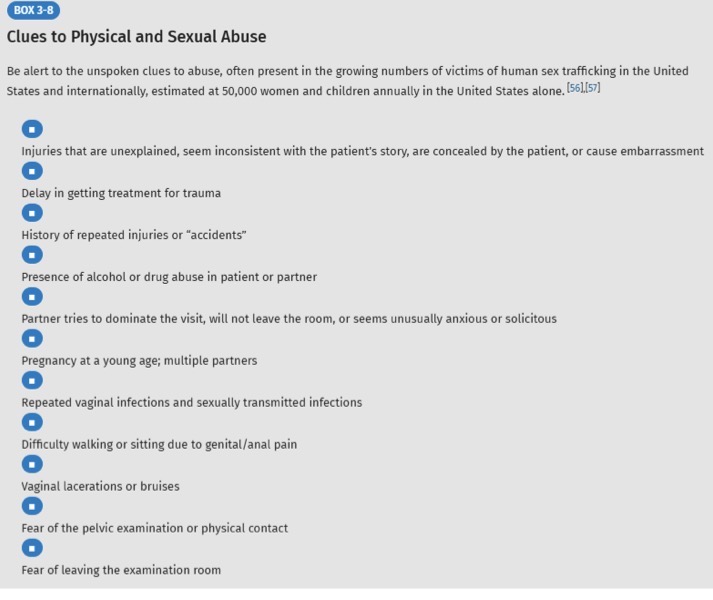
Abuse? DO NOT ask in presence of others, ask them to leave
resistance? Don’t force situ
Begin q with normalizing statement (b/c abuse is common in many of my pt’s lives, I’ve begun to ask about it regularly)
Relationship where hit/threatened?
Anyone treated badly? Made them do things you don’t want to?
Anyone you’re afraid of?
Comprehensive Medical History - Review of Systems
Inquiry method to uncover any prob/sx you or pt may have overlooked (particularly in areas unrelated HPI)
can uncover sx supporting different diagnosis
Y/N head-toe format
Always ask at end of interview, when clinal reasoning GONE
Helpful to ask general Q
ANY ADDITION MAJOR SX RELATED TO CC, MOVE TO HPI W/ OTHER POSITIVE ASSO SX
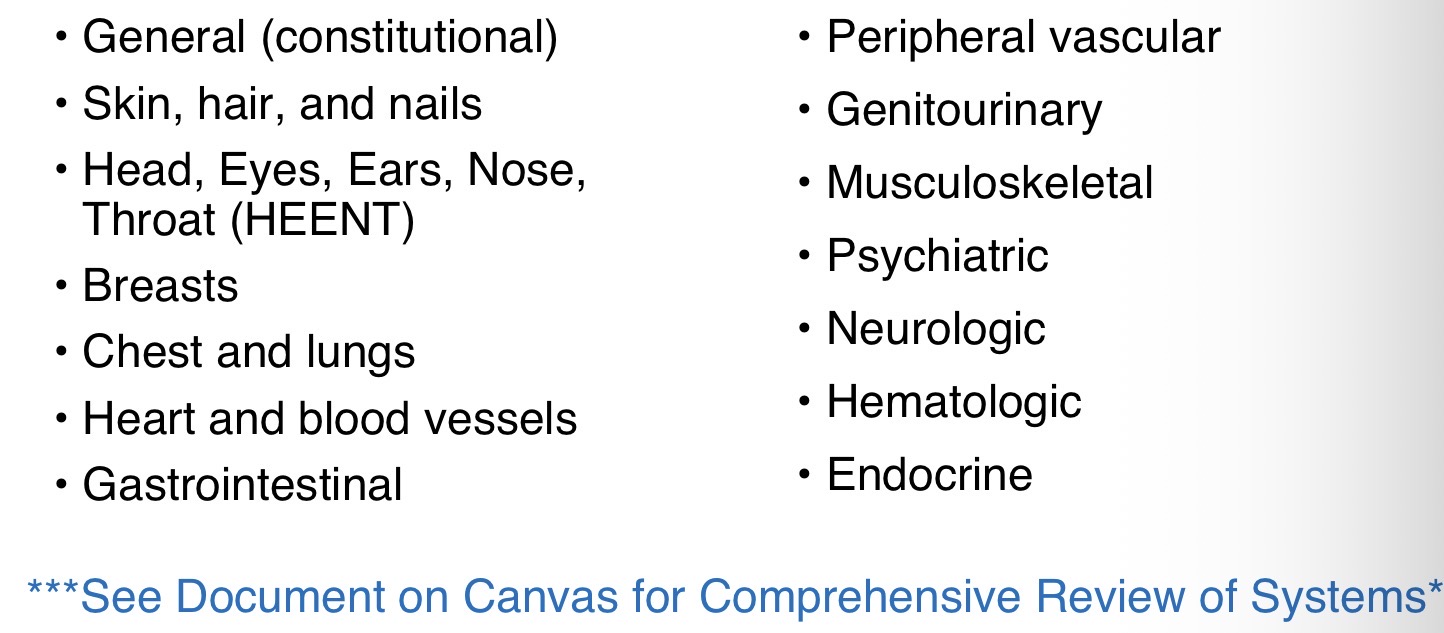
The Physical Examination - Preparation
Hand hygiene (soap&water/ hand sanitizer)
Observe sign for contact precautions and don appropriate PPE
Contact: contracted thru touching (MRSA, C.Difficile)
Gloves, gown
Droplet: spread thru contact w/ secretions from mouth, nose, lung (esp w/ coughing and sneezing) typ ~3ft, COVID ~6ft
Gloves, gown, mask
Airborne: spread thru air over long distances (TB, Chickenpox)
Place in neg pressure room
Gloves, gown, respirator mask
Reverse Isolation: protect pt from staff/visitors (immunocompromised typ chemo)
Gloves, gown, mask
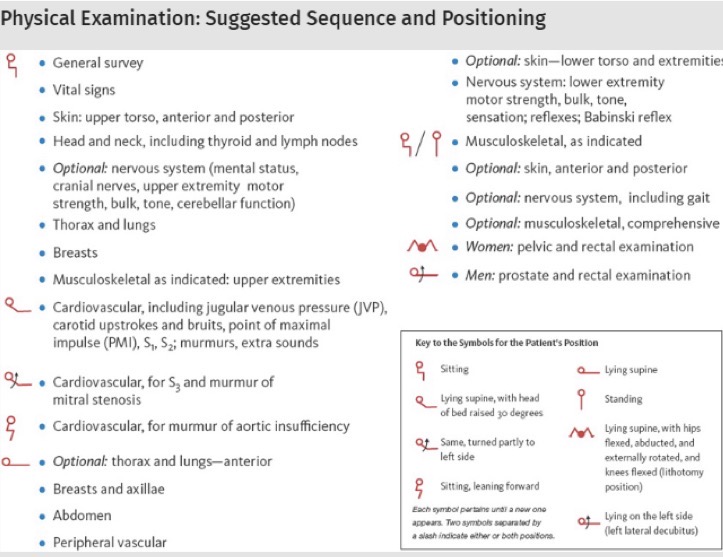
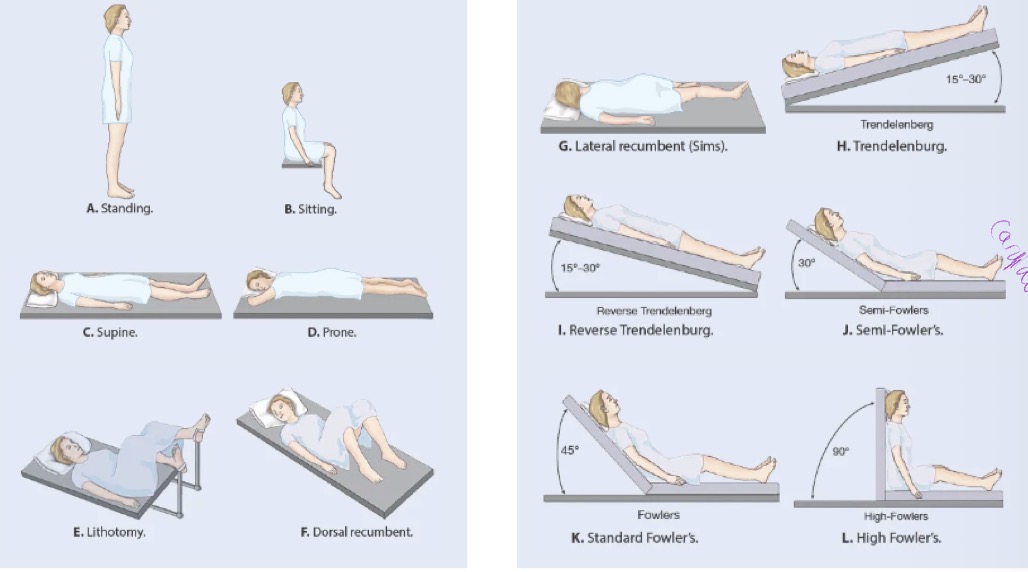
The Physical Examination - Positioning
Standing/Sitting
Supine/Prone
Lithotomy/Dorsal Recumbent/Lateral Recumbent
Trendelenburg/Reverse Trendelenburg
Semi-Fowler’s/Standard Fowler’s/High Fowler’s
The Physical Examination - Head to Toe
Vitals → General Survey → Skin (can be incorp into inspection of each body syst) →HEENT-N → lungs/thorax → cardiovascular → breasts/axilla → abdomen → peripheral vascular/lymphatics → neurologic → musculoskeletal → genital/rectal
The Physical Examination - Cardinal Techniques (IPPA)
Exception: abd (IAPP)
Inspection: observation of details of pt appearance, behavior, mvmt
Palpation: Tactile pressure form the palmar fingers/finger pads to assess areas of body
Percussion: striking finger against digit from other hand lying flat against surface of chest/abd to evoke sound wave
Auscultation: using stethoscope to detect chara of heat, lungs, bowels, vasculature