BITCH Lec 1
 Call Kai
 Learn
Learn Practice Test
 Spaced Repetition
 Match
Match Flashcards
 Knowt Play
1/32

There's no tags or description
Looks like no tags are added yet.
Name | Mastery | Learn | Test | Matching | Spaced | Call with Kai | Chat |
|---|
No analytics yet
Send a link to your students to track their progress
33 Terms
First law of thermodynamics
Energy is conserved (it cannot be created or destroyed)
Second law of thermodynamics
Entropy is ALWAYS increasing
Third law of thermodynamics
The entropy of a system approaches zero as the temperature approaches zero
Enthalpy(H)
total heat energy in a system
Entropy(S)
Disorder!
When does entropy increase?
-Going from ice to liquid
-Going from liquid to gas
-From less to more particles
Positive entropy/ more disorder is more favorable, T/F?
T
Endothermic
ΔH>0, enthalpically unfavorable!
Exothermic
ΔH<0, enthalpically favorable
What requires more energy, breaking or forming a bond?
breaking a bond
Biomolecules assume shape and structure in response to . T/F
True
What bonding do multiple water molecules form when interacting?
Hydrogen bonds
Hydrogen bonds
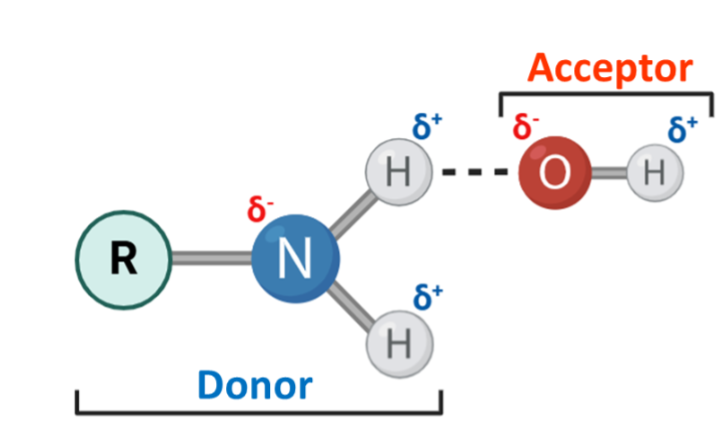
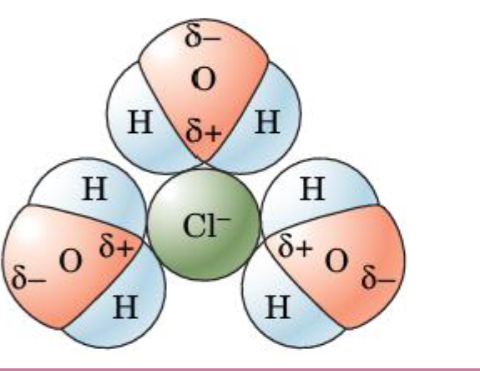
Water has a partial charge due to its dipole. You can observe that it bonds based on the charge of the mlcl its bonding to

How does water interact with non-polar solutes?
Water forms a ring around the non-polar
solute, using hydrogen bonding, without
interacting with the solute.
Aggregation
Water forms a ring around the non-polar
solute, using hydrogen bonding, without
interacting with the solute.
The water ring formed around a hydrophobic or nonpolar solute is called?
Sphere of hydration
pH=
-log[H+]
pOH=
-log[OH]
pH+pOH=
14
At pH=7 what is true of the H+ and the OH-?
they are equal! (OH-=H+)
Bronsted-Lowry acid and base theory
Acid is the proton donor
Base is the proton acceptor
What does pKa describe?
the strength of an acid
Henderson-Hasselbach Equation
pH=pKa+log([A−]/[HA])
Titration curve
plot of pH vs. the amount of strong base acid
Inflection point
The point on a titration curve where enough base has been added to neutralize 50% of the acid
Equivalence point
point where enough base has been added to exactly neutralize the acid
a-carboxyl-group pKa
2
a-Amino group pKa
9
pH<pKa
acidic/protonated state is preferred
pH>pKa
basic/de-protonated state is preferred
All amino acids are weakly polyprotic acids that undergo multiple ionization events T/F?
True
Zwitterion
A molecule containing both positive and negative functional groups with an overall net electrical charge of zero