4.2 Respiration
 Call Kai
 Learn
Learn Practice Test
 Spaced Repetition
 Match
Match Flashcards
 Knowt Play
1/27

There's no tags or description
Looks like no tags are added yet.
Name | Mastery | Learn | Test | Matching | Spaced | Call with Kai | Chat |
|---|
No analytics yet
Send a link to your students to track their progress
28 Terms
Is cellular respiration an exothermic or endothermic reaction?
Exothermic
What is aerobic respiration?
Uses oxygen to release energy from glucose
What is anaerobic respiration?
Releases energy from glucose without using oxygen
How can respiration take place in cells to transfer energy?
Aerobically
Anaerobically
What do organisms need energy for? (3)
Chemical reactions — build larger molecules
Movement
Keeping warm
What is the word equation for aerobic respiration?
glucose + oxygen → carbon dioxide + water
What is the balanced symbol equation for aerobic respiration?
C6H12O6 + 6O2 → 6CO2 + 6H2O
What is the equation for anaerobic respiration in muscles?
glucose → lactic acid
Why is less energy transferred in anaerobic respiration than in aerobic respiration?
Incomplete oxidation of glucose
What is the equation for anaerobic respiration in plant and yeast cells?
glucose → ethanol + carbon dioxide
What does fermentation have economic importance in the manufacture of?
Bread
Alcoholic drinks
What is fermentation?
Anaerobic respiration in yeast cells
What does the number if mitochondria in a cell tell you?
How active the cell is
How are mitochondria adapted for aerobic respiration?
Folded inner membrane → large SA
for enzymes
During exercise the human body reacts to the increased demand for energy.
What increases during exercise and why?
Heart rate
Breathing rate
Breath volume
provide muscles with more oxygenated blood
During exercise, what happens if insufficient oxygen is supplied to the muscles?
Anaerobic respiration
During anaerobic respiration in muscles, what does the incomplete oxidation of glucose cause?
A build up of lactic acid → oxygen debt
What happens during long periods of vigorous activity?
Muscles become fatigued → inefficient contraction
What does the body do to reduce the build up of lactic acid from anaerobic respiration?
Blood flowing through muscles transports lactic acid to the liver — converted back into glucose
What is oxygen debt?
Amount of extra oxygen needed after exercise → reacts with lactic acid and removes from cells
What is the equation for oxygen debt repayment?
lactic acid + oxygen → carbon dioxide + water
Fully explain the increase in heart rate during exercise. (5)
Heart rate increases — pumps greater volume of oxygenated blood → muscles
Delivers faster and greater supply of oxygen + glucose
Increased rate of aerobic respiration
Releases more energy — used for muscle contraction
Faster blood flow:
removes carbon dioxide from muscles more quickly
removes lactic acid more rapidly — prevents oxygen debt + muscle fatigue
Fully explain the increase in breathing rate during exercise.
Breathing rate + breath volume increase — brings more air and oxygen to lungs
Allows more oxygen to enter blood → delivered to muscles
Muscles use extra oxygen to increase rate of aerobic respiration
Increased respiration releases extra energy — muscle contraction
Faster breathing rate — removes carbon dioxide from blood more quickly
carbon dioxide must be removed — waste product continuously produced by increased rate of respiration
During exercise, why is the glycogen stored in the muscles converted back to glucose?
Muscles need lots of extra energy to contract
Glycogen converted back to glucose — extra energy
Increases rate of respiration
What is metabolism?
Sum of all reactions in a cell or the body
How is the energy transferred by respiration in cells is used by the organism?
Continual enzyme controlled processes of metabolism — synthesise new molecules
What does metabolism include? (5)
Conversion of glucose → starch, glycogen, and cellulose
Formation of lipid molecules from molecule of glycerol and three molecules of fatty acids
Use of glucose and nitrate ions to form amino acids — used to synthesise proteins
Respiration
Breakdown of excess proteins — forms urea for excretion
![<ul><li><p><strong>Figure 8</strong> shows an axolotl.</p></li></ul><p>Explain why an axolotl may die in water with a low concentration of oxygen. [4 marks]</p>](https://assets.knowt.com/user-attachments/fe5fef97-eff1-4fe1-9d9e-118e5cc0396b.png)
Figure 8 shows an axolotl.
Explain why an axolotl may die in water with a low concentration of oxygen. [4 marks]
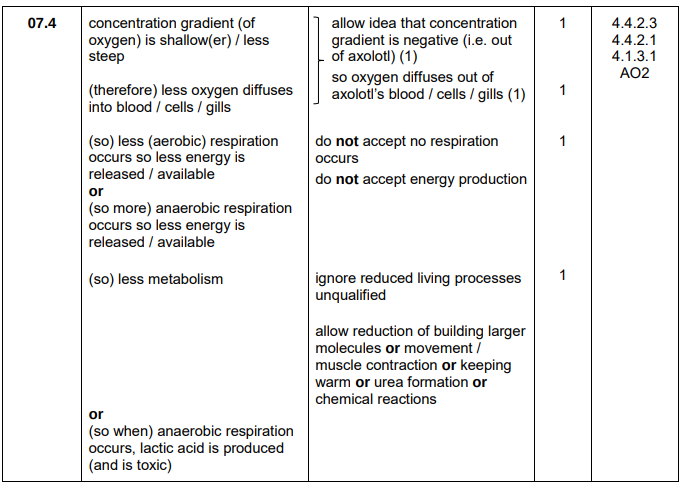
Concentration gradient of oxygen is shallower
Less oxygen diffuses into blood
Less aerobic respiration occurs → less energy released so less metabolism