Measurement of Hearing Quiz 3 - Hearing Threshold and the Audiogram
 Call Kai
 Learn
Learn Practice Test
 Spaced Repetition
 Match
Match Flashcards
 Knowt Play
1/63

There's no tags or description
Looks like no tags are added yet.
Name | Mastery | Learn | Test | Matching | Spaced | Call with Kai | Chat |
|---|
No analytics yet
Send a link to your students to track their progress
64 Terms
Assessing the auditory system
-Behavioral pure tone thresholds
a primary component of the audiologic test battery
important for many purposes
-For diagnostic (site of lesion) purposes we measure and compare two thresholds obtained via the
air conduction pathway and bone conduction pathway
-Dysfunction at any point along these pathways results in HL
Air conduction pathway
-Air conduction (AC)
outer ear —> middle ear —> inner ear and beyond
-Elevated AC thresholds mean dysfunction somewhere along the pathway
but you dont know where!
-Bone conduction testing can help
Bone conduction pathway
-bypasses outer and middle ear
directly stimulates both cochlea simultaneously
-comparing AC and BC thresholds helps isolate site of dysfunction
Air conduction audiometry
-signal source is audiometer
-output transducer options
supra-aural headphones
e.g. TDH-39, 49, 50
insert earphones
e.g. ER-3A, ER-5A
circumaural headphones
e.g. Sennheiser HDA-200
Loudspeaker (sound field thresholds)
Bone conduction audiometry
-signal source is audiometer
-output transducer is a bone oscillator
e.g. radio ear B-71
-mastoid placement is typical
forehead placement may be used with kids, post-mastoidectomy patients, automated audiometers
correct calibration values are required
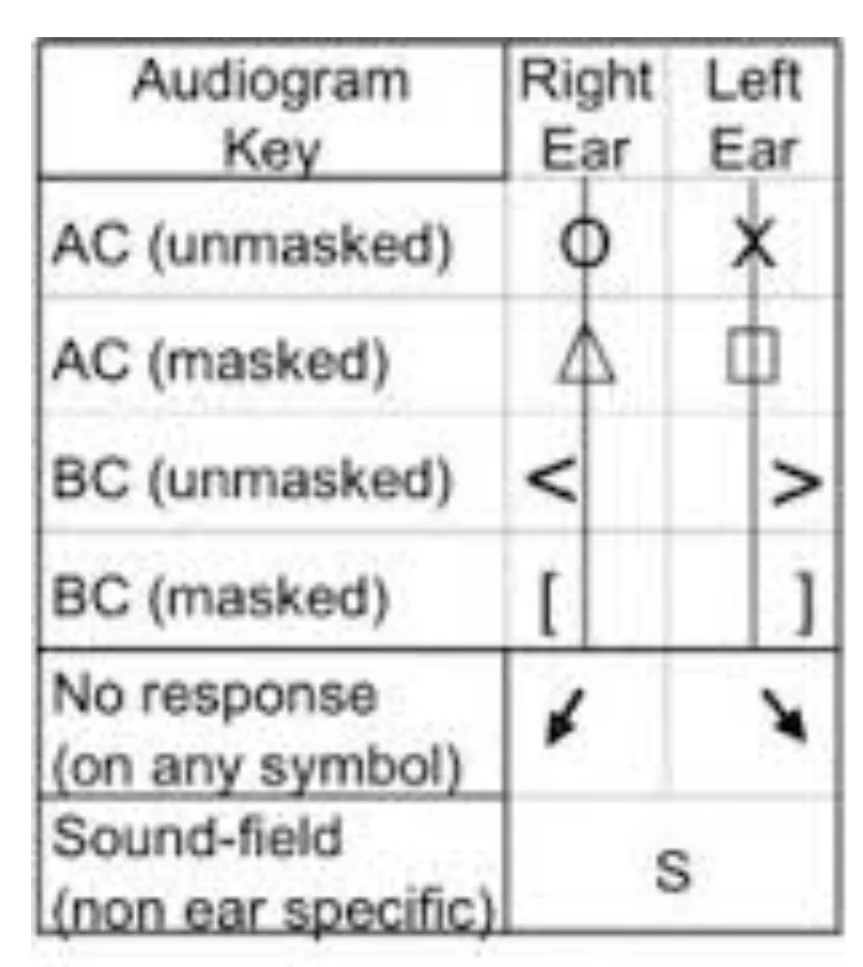
AC pure tone right ear symbol
red circle
AC pure tone left ear symbol
blue X
AC pure tone masked right ear
Red triangle
AC pure tone masked left ear
blue square
audiogram symbols: Pure tone bone
-place bone conduction (BC) symbols to the right (for the left ear) or left (for the right ear) of the frequency axis
unmasked BC mastoid symbol shows side of transducer placement (not the ear responding)
Or use the ear “unspecified” symbol “^” (placed on the frequency axis)
or place the oscillator on the forehead and use the forehead symbols
Bone conduction-mastoid unmasked left ear
>
Bone conduction-mastoid unmasked right ear
<
Bone conduction-mastoid masked left ear
]
Bone conduction-mastoid unmasked right ear
[
bone conduction - forehead unmasked
Carrot pointing down
bone conduction - forehead masked
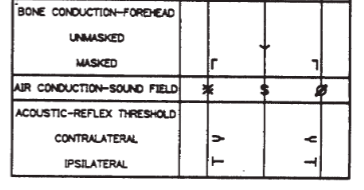
audiogram symbols: no response
-Symbols for “no response” at highest output level
add a downward directional arrow to the existing symbol
to the left (right ear) or right (left ear) of the symbol
Do not connect with lines
* symbol
often used to suggest a “vibrotactile” response to BC
Symbols for unaided soundfield threshold
S
-reflects the threshold in the better ear
-If no response- do not connect with lines to actual responses
-Aided: often use “A” bust must be defined on the audiogram
classifying HL
-terms reflect the expected (on average) magnitude of speech understanding problems that someone with that pure tone average (PTA) would have
normal limits
-10 to 15
slight HL
16-25
Mild HL
26-40
Moderate HL
41-55
Moderately-severe HL
56-70
Severe HL
71 to 90
profound HL
91+
Types of audiometers
-Described based on their capabilities
Pure tone generation (type 1, 2, 3, or 4)
Type 1-full diagnostic; Type 4- hearing conservation
Extended high frequency testing (Type HF)
8000-16000
Speech (type A, B, or C)
Input for recorded materials
Microphone for MLV
Earphone and/or loudspeaker output
-E.g. Type 1HFA
Frequency response
-The need for a flat frequency response depends on your purpose
Pure tone threshold measures versus complex stimuli (e.g. speech)
Maximum output
-Need varies with purpose
Screening audiometer versus diagnostic audiometer
-Max output also varies with frequency
-Increasing levels above the maximum creates distortion
Supra-aural
-TDH series (39,49, 50)
-MX 41 AR cushion
-Headband should be tight enough to hold paper between cushions
-Calibrated in a 6cc coupler
Supra-aural Pros
-reliable/durable
-inexpensive
-familiar
supra-aural cons
-poor frequency response
high frequency roll off (same as insert phones)
-Low frequency “leakage”
-Compared to inserts earphones
Less interaural attenuation ~40dB
Increased “occlusion” effect
-Can cause collapsing canal
Circumaural
cushions fit around (not on) the pinna
Circumaural pros
-Some have flat frequency response
-may be used with extended HF audiometry
-very comfortable
-better noise isolation than supra-aural
Circumaural cons
-modified calibration methods used
won’t fit on a 6cc coupler
-big on small heads
-Less interaural attenuation
insert earphones (ER 3A/5A/3C)
-Mimics frequency response of TDH 39 headphones
-calibrated in a 2cc coupler
insert earphone pros
-more hygienic
disposable foam earplugs
-More comfortable for adults and kids
-inter-aural attenuation ~50-70 dB
-Greater attenuation of ambient noise
-Protect against collapsing canals
-Less variability in threshold due to transducer placement
-Less artifact during electrophys testing (ER 3A/3C)
-Ease in relating behavioral audiometric data to hearing aid measures (both calibrated in a 2cc coupler)
insert headphones cons
-mimics frequency response of TDH 39 earphones
NOT FLAT frequency response!
-Costs! ~$400.00 pair
~$1.00 pair for disposable tips
-Cerumen can block receiver output
-connector is easily lost!
Bone conduction transducers
-Radio Ear B70A, 71, 72, and B81 (new) are common
Headband tension affects force (levels)
-Calibrated using an “artificial mastoid”
-Compared AC responses frequency responses are peaky and don’t have much low frequency
-Lower output and dynamic range compared to AC transducers
~30-50 dB more output via AC
-Newer “B81” model gives more LF output with less distortion than B71
Audiologists describe threshold results in terms of:
-Degree of loss
normal, mild, … profound
-Configuration of loss - how thresholds vary with frequency
flat, sloping…
-Type of loss (or site of lesion- outer, middle, or inner ear, neural or higher)
conductive, sensorineural or mixed
-Symmetry of loss - hearing loss is (or not) similar between ears
unilateral loss is asymmetric
bilateral loss can be symmetric or asymmetric
Configuration of loss
-no consensus on how to define configuration
-flat loss
-sloping loss
-rising/reverse slope loss
-trough loss
-peak(ed) loss
Flat loss
-thresholds (in general) ± 20 dB
Sloping loss
-general trend of poorer thresholds as frequency increases
LF<HF by >20 dB
May add qualifiers e.g. mild, moderate, or severe based on thresholds
steeply sloping loss
a large change over a narrow frequency range
ski slope loss
precipitous loss
rising/reverse slope loss
-same as sloping but reverse direction
HF<LF by >20 dB
trough loss
-worst thresholds in mid-frequencies
cookie bite loss
Peak(ed) loss
-best thresholds in mid frequencies
reverse cookie bite loss
inverted V audiogram
Conductive loss
-bone conduction thresholds are normal and are better than air conduction thresholds
-conductive losses have an air-bone gap (ABG)
ABG (in dB) =AC threshold-BC threshold
-Conductive loss means the site of lesion is in the outer or middle ear
an ABG>10 dB is significant even if AC thresholds are normal
Sensory/neural (sensory or neural)
-also sensorineural & SNHL
-with SNHL AC and BC thresholds are similar (ABG<10 dB)
-generally BC<AC (meaning BC is better than AC) thresholds but BC thresholds can be worse
-Sensory (cochlea) or Neural (VIII nerve) or higher
Mixed loss
-Bone conduction thresholds are not normal
-ABG is >10
-Site of lesion is outer/middle ear and cochlea (or higher)
-Any HL that has both a conductive and SN component in the same ear
Why do we care about asymmetry?
-consistency
-Diagnostic utility
Asymmetric defintion
-Between ear difference of
>10 dB at 3 or more frequencies
>15 dB at 2 or more frequencies
>20 dB at 1 or more frequencies
-These criterion were based on best match to “expert” judges
optimizing consistency not diagnostic utility
-Pretty conservative criteria resulting in high prevalence of asymmetry (i.e. >50% cases)
Diagnostic utility of asymmetry
-Asymmetric SNHL can be a red flag for vestibular schwannoma (VS)
but no standardized criterion/definition of asymmetry for detecting such tumors
-Asymmetry alone is not an accurate diagnostic indicator of retrocochlear pathology
-But in conjunction with other test results, the presence of asymmetry can (and should) influence your clinical decision.
How much asymmetry is “too much?”
-Answer varies across clinicians and sites
-Starting out remember Mangham theory: Average difference >20 at 1,2,4 and 8 kHz was one of the most accurate predictors
But used alone, sensitivity is not great, and false positives will be high! This will be the case with any asymmetry criteria
-Remember, asymmetry alone is not an accurate diagnostic indicator of retrocochlear pathology
-PTA protocols cannot be used for proper screening or diagnosis of vestibular schwannoma despite their good sensitivity, and MRI remains the gold standard for this purpose
Measuring thresholds
-Multiple methods can be used to measure thresholds (e.g. hearing or visual thresholds)
-Current methods are based on early work by Gustav Fechner
He developed the “method of limits”
basis for current clinical method
Method of limits (MOL)
-A series of ascending and descending runs. Each run consists of a series of “yes-no” trials
After each trial, the subject says “yes” or “no”
-The threshold is the average of “crossover points”
-A valid and reliable method, but it’s time-consuming, and it’s susceptible to subject bias and criterion effects
Subject bias: anticipation bias, habituation bias
Subject criterion: strict, lax
Current threshold search procedure (ASHA)
-Current method is a “modified method of limits”
First pass- Hughson and Westlake
modification of MOL but only “ascending” runs contribute to threshold
Current version- Carhart and Jerger “modify Hughson and Westlake” procedure
Keep only ascending responses contribute to threshold criteria
suggest 5 dB step size
Use 1-2 second stimulus duration with quiet intervals in between
Terminate ascending run at first response
decrease level and start next ascending run
Threshold defintion
“the lowest hearing level at which responses occur in 1) at least one-half of a series of 2) ascending trials, with a 3) minimum of two responses out of the three required at a single level.” ANSI
-Repeat at 2, 3, 4, 6, and 8 kHz
recheck 1000 Hz. if thresholds differ by >5 dB use best threshold and recheck threshold at another frequency
Finish, in order, 500, 250, and then 125 Hz (if needed)
Minimal response level (MRL)
-Infants and young children are not “little adults”
-MRL: lowest level of stimulus that produces the desired response
actual thresholds may improve over time
stimulus characteristics
-1-2 seconds duration (all types)
Vary the time intervals between presentations
no shorter than 1-2 seconds
-Pulsed tones (~200-250 ms on/off duration) may reduce false positives and be “preferred”
-Warble tones (or narrow band noises) are required for sound field testing but can affect thresholds, especially for steeply sloping losses
Response characteristics
-Multiple options are available based on what the patient can do
Press a button
Raise a finger, arm
verbal response
any consistent response that is time locked to your stimulus presentation is acceptable
-Your interpretation of a patient response can affect your threshold
patient response and your interpretation must be consistent
slow responders, “off” responders are o.k.
look for a faster response at higher levels
watch for false positives or false negatives
reinstruct as needed
Dealing with false positives
-False positive: Person says “yes I hear it” when no tone was presented
Increase signal level to remind them of the tone
Make sure your timing of presentations is varied
Reinstruct or vary instruction
e.g. respond “ONLY” if you are sure you hear the tone
Try pulsed or warbled (FM) tones
Dealing with false negatives
-Person doesn’t respond “yes” even though the signal is above threshold
Could have a conservative criterion
reinstruct
e.g. make sure you respond even if it is very faint
Could be giving you a response that you are not seeing
watch the person not just the response light
Look