Life10e Ch02 Lecture-Small Molecules and the Chemistry of Life
 Call Kai
 Learn
Learn Practice Test
 Spaced Repetition
 Match
Match Flashcards
 Knowt Play
1/33

There's no tags or description
Looks like no tags are added yet.
Name | Mastery | Learn | Test | Matching | Spaced | Call with Kai | Chat |
|---|
No analytics yet
Send a link to your students to track their progress
34 Terms
Electron
negligible mass; negative charge
Protons
have mass; positive charge
Neutrons
have mass; no charge
Element
pure substance containing only one
kind of atom.
atomic number
Number of protons
The number of protons
identifies an element.
Atoms have
volume and mass.
Mass of atoms consist of
one proton or one neutron
1 atomic mass unit (amu)
1 dalton, or 1.7 × 10⁻²⁴ grams
Mass of electron
ne electron = 9 × 10–28 (negligible and usually ignored)
protons and electrons determine what
how an element behaves
in chemical reactions.
periodic table
how Elements are arranged
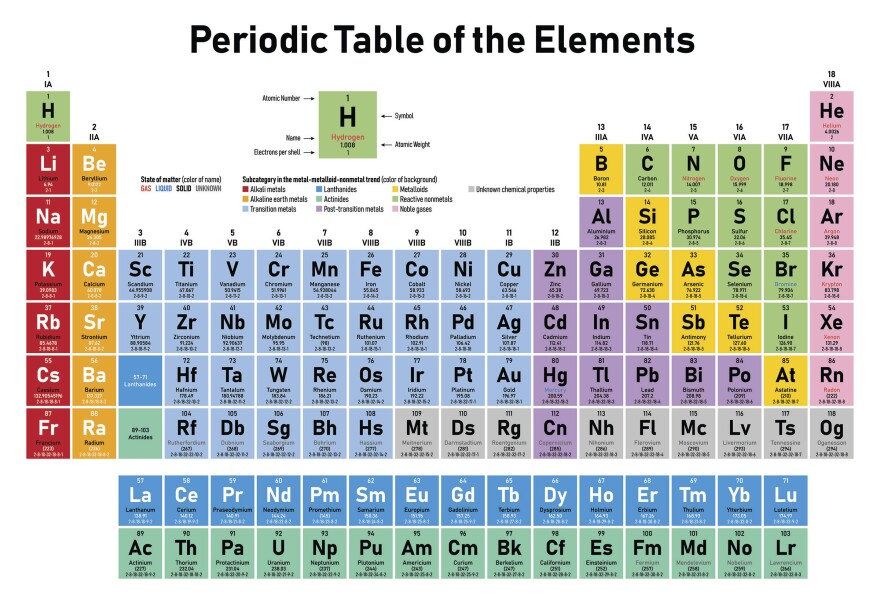
About 20–25% of the 92 elements
are essential to life (essential
elements)
Bulk elements: Carbon, hydrogen,
oxygen, and nitrogen make up
96%
Atomic Number
number of protons

Chemical symbol
He

Atomic weight
proton + neutrons

Mass number
number of protons +
number of neutrons/daltons
Isotopes
forms of an element with
different numbers of neutrons, and
thus different mass numbers
Example:
12C has 6 neutrons
13C has 7 neutrons
14C has 8 neutrons
Atomic weight
(relative atomic mass):
average of mass numbers of isotopes
in their normally occurring proportions.
Radioisotopes
give off energy in the form of alpha,
beta, and gamma radiation from the nucleus.
radioactive decay
transforms the atom,
sometimes resulting in a change in the number of
protons.
Molecule
stable association of atoms
Radioisotopes
useful in research and in
medicine, but radiation can damage cells
and tissues.
Radiation is sometimes
used to treat cancer
atoms will interact
The number of electrons determines how
Chemical reactions
Changes in the distribution of electrons between atoms.
Orbital
region where an electron is
found at least 90% of the time.
shapes
and orientations
can be
occupied by two electrons.
electron shells
First shell: one s orbital (holds 2
electrons). Second shell: 1 s and 3 p orbitals
(holds 8 electrons). Additional shells: 4 orbitals (each holds
8 electrons).
valence
shell
outermost electron shell, determines how the atom
behaves.
stable
outermost shell is full;’ wont interact with other atoms.
unpaired
electrons
are reactive atoms, in their outermost shell
Reactive atoms
an share electrons, or
lose or gain electrons, resulting in
atoms being bonded together to form
molecules.
Octet rule
Tendency of atoms to form
stable molecules resulting in 8
electrons in their outermost shell