Found 1.2 (2222)
 Call Kai
 Learn
Learn Practice Test
 Spaced Repetition
 Match
Match Flashcards
 Knowt Play
1/31

There's no tags or description
Looks like no tags are added yet.
Name | Mastery | Learn | Test | Matching | Spaced | Call with Kai | Chat |
|---|
No analytics yet
Send a link to your students to track their progress
32 Terms
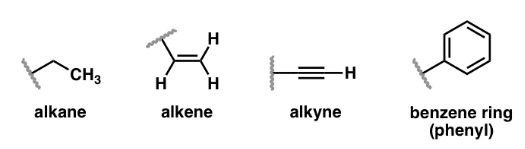
Types of Hydrocarbons
Alkane
Alkene
Alkyne
Aromatic
Alkane
Carbon—Carbon single bonds
Alkene
Carbon—Carbon double bond
Alkyne
Carbon—Carbon triple bond
Aromatic compounds
Functional group → Benzene Ring
Can have single/double bond
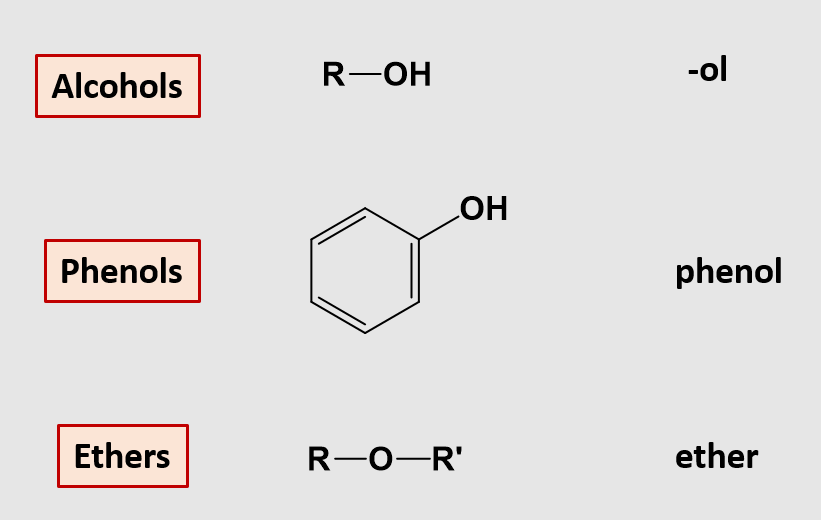
Functional Groups Based on Water
Alcohol
Phenol - ex
Ethers - ex
Alcohols
R-O-H = hydroxyl group
Hydrogen atom directly bonded to oxygen
Aromatic alcohol → phenols
Propofol = 2,6-diisopropylphenol
12 carbon atoms = low water solubility → suspended
Ethers
R-O-R’
Functional group = oxygen bridge b/w 2 alkyl groups
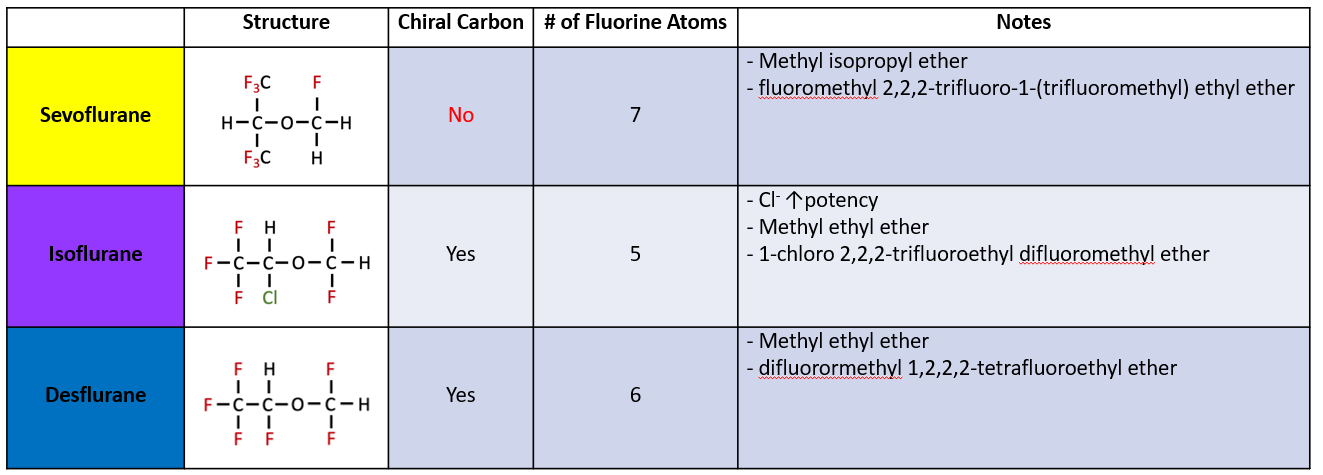
Halogenated ethers used in anesthesia replaced by halogens
Halogenated Ethers VISUAL
Amines - ex
Imidazole - ex
Functional groups derived from ammonia (NH3)
More water soluble than other groups w/ hydrogen bonds
DNA synthesis/transcription
Many medications
Ketamine, dopamine, epinephrine, serotonin
Imidazole
5-membered ring making up many drugs (midazolam)

Carbonyl Functional Groups
Aldehydes
Ketones - ex
Carbon double bonded to oxygen
C needs two more bonds for octet (usually functional groups)
Aldehydes
CG + alkyl group & H+
Ketones
CG + 2 alkyl groups
Most common → acetone (sweet odor)
Progesterone, oxycodone, methadone, etc.

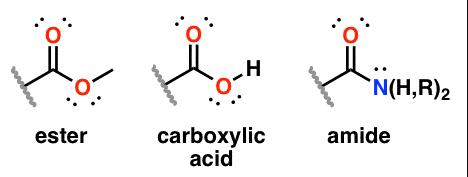
Other Carbonyl Functional Groups
Carboxylic Acid
Esters
Amides
Carboxylic Acid
Hydroxyl group bonded to CG
Esters
Alkoxy group bonded to CG
Condensation product b/w carboxylic acid & alcohol
Amides
Nitrogen atom bonded to carbonyl group
Condensation product b/w carboxylic acid & alcohol
Carbohydrates
Functions: Rapid energy/ATP, energy storage, cell structure and recognition
Formula → (CH2O)n
Ex. Polyalcohol aldehydes or ketones
Saccharides - 4
ex
Monosaccharides
Simple sugars
Glucose is most common
Disaccharides
Mono + mono (bound by glycosidic bonds)
Sucrose, Lactose, Fructose
Polysaccharides
Chain of many monos
Starches, cellulose, and glycogen
Oligosaccharides
Chain of 2-10 monos
Glycoproteins - 3 ex
Sugar + protein via glycosylation
Functions
Protective structure
Cell wall structure, GI mucus
Erythrocyte surface recognition—ABO blood group
Connective tissue—collagen
Inactive Form
Coagulation (prothrombin, thrombin, & fibrionogen) - enzymes
Gluconeogenesis
reactants 3
where
stim
Creating new glucose from non-carbs (glucose new)
Lactic acid (normal, exercise)
Amino acids (muscle, amine)
Glycerol - last to be used (starvation)
Occurs primarily in the liver
Stim by Cortisol = protein breakdown & deamination into glucose
Glycogenesis vs Glycogenolysis
where
stim
Glycogenesis (glycogen generate)
↑ serum glucose + insulin = glycogenesis
Stored in liver & muscle
Glycogenolysis (glyco break)
Liver stim by glucagon = Increases serum glucose
Muscle stores stim by Epi release only within muscle cells
Lipids
fxn
type? ex
Hydrophobic = organic soluble
Composed of nonpolar hydrocarbon functional groups + few polar functional groups
Fxn: Energy storage, cell membranes, signaling
Saponifiable: Contain hydrolyzable ester bonds
Triglycerides, phospholipids, waxes
Nonsaponifiable: Lack hydrolyzable ester bonds
Steroids, prostaglandins, vitamins A, D, E, K

Triglycerides - 2(2)
make up
Have 3 fatty acid residues esterified to glycerin backbone
Fatty acids
Long-chained carboxylic acids w/ an even number of carbon
Saturated fatty acids → only have carbon-carbon single bonds
Unsaturated fatty acids → contain at least one carbon-carbon double bond
Monounsaturated → one carbon-carbon double bond
Polyunsaturated → 2+ carbon-carbon double bonds

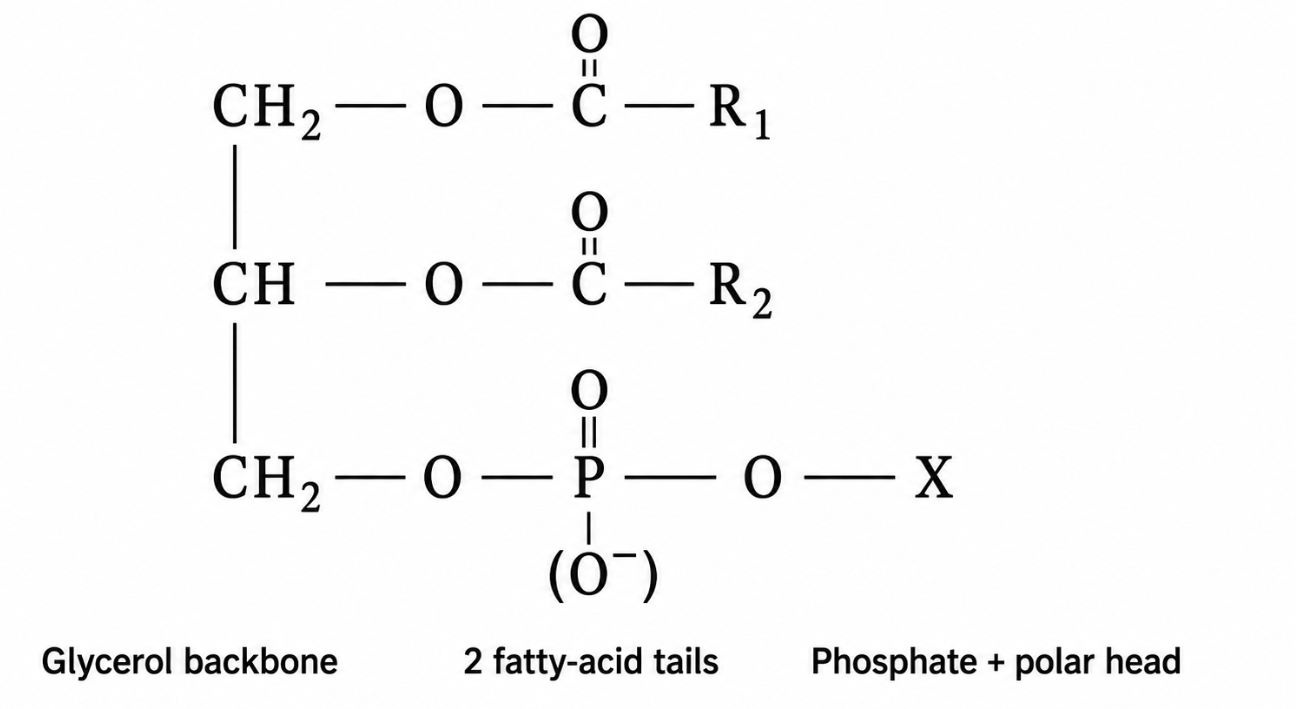
Phospholipids - 2
make up
Like triglycerides except 1 fatty acid replaced by phosphate ester group
Common in cellular membranes b/c of their surfactant properties
Head = Polar (Hydrophilic) phosphate group
Tail = Lipid, Non-polar, Hydrophobic
Steroids
make up
prime ex - 2 types
Characterized by three 6-membered rings fused to a 5-membered ring
Cholesterol
Essential in cell membranes
Transported as lipoprotein, proteins are denser than lipids
High-density lipoprotein → greater protein-to-lipid ratio
Low-density lipoprotein → lower protein-to-lipid ratio
Estrogen & Testosterone

Prostaglandins - 3
ex
Powerful, but short-lived, lipid hormones
Synthesized from arachidonic acid on demand through COX
NSAIDs inhibit COX
Affects inflammatory response, gastric protection and renal flow
Metabolism - 3 key players
Acetyl coenzyme A (A.CoA)
Shuttles carbon from glucose & FA metabolism into the Krebs Cycle
Nicotinamide adenine dinucleotide (NAD+)
Oxidation-reduction (redox) reaction = NADH → feeds into electron transport chain to bulk produce ATP
Coenzyme Q (QH)
Reduced form = QH2
Precursor of FADH
Glycolysis - 3
aerobic - 2
anaerobic - 2
where for all of them
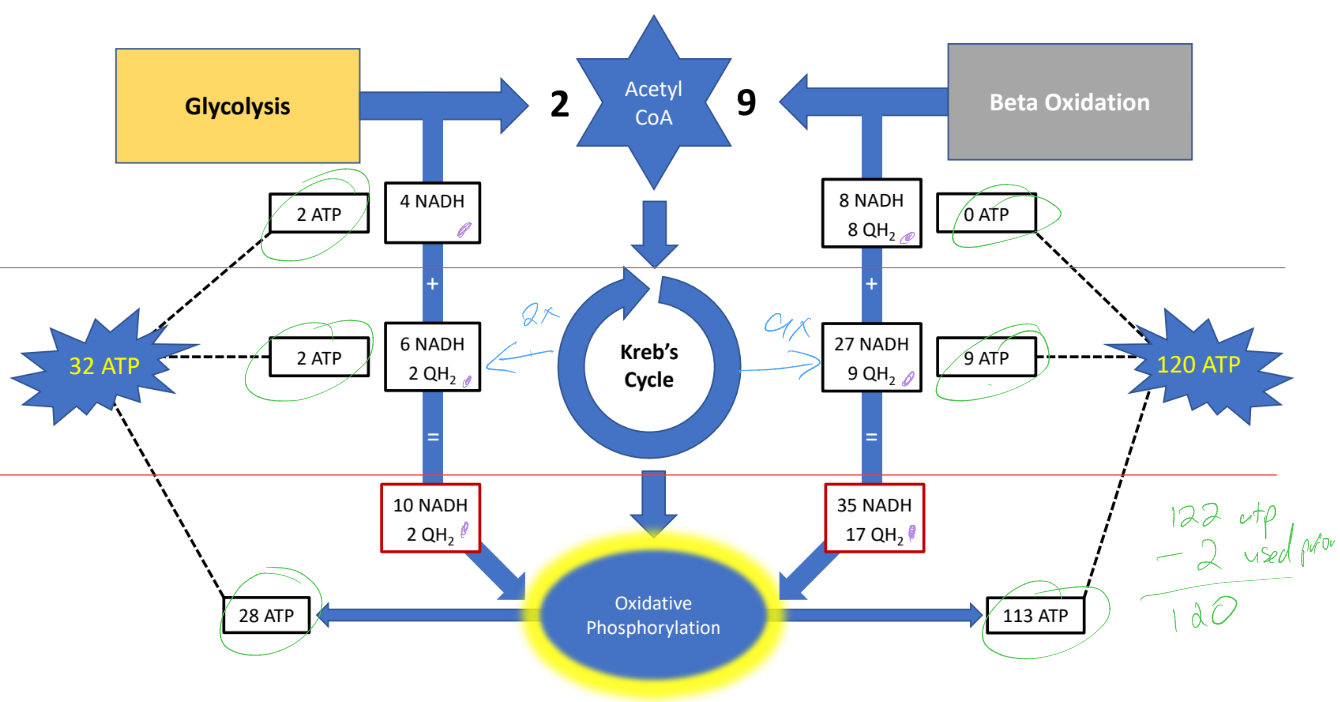
In cytoplasm glucose → converted into 2 pyruvic acid molecules, 2 ATP, 2 NADH
Aerobic metabolism in Mitochondria
2 pyruvic → 2 A.CoA + 2 NADH
Energy byproducts:
2 ATP
4 NADH (gives e- to O2 to form H2O)
2 Acetyl CoA
Anaerobic metabolism in cytoplasm
With no O2 do donate e-, pyruvic acid accepts instead → Lactic acid
Energy byproducts:
2 ATP
Lactic acid
Lipolysis - 3
Beta Oxidation - 4
Lipolysis in cytoplasm = Triglyceride → glycerol + 3 fatty acids
Glycerol go to liver for glycolysis or gluconeogenesis
Activation: fatty acids + 2 atp + A.CoA = 18 carbon fatty A.CoA w. carnitine shuttle
Beta Oxidation in mitochondria
For 18 carbon fatty A.CoA will yield after 8 rounds:
9 A.CoA (final round makes 2)
8 NADH
8 QH2 (FADH2)
Krebs Cycle (Citric Acid Cycle) - 4
in matrix of mitochondria
A.CoA + oxaloacetate → citrate → 1 atp + 3 NADH + 1 QH2 + 2CO2 + oxaloacetate
A.CoA consumed per cycle until gone
CO2 expelled into ECF
Oxidative Phosphorylation - 8
at the inner mitochondrial membrane
Electron Transport Chain (ETC) - creates gradient
NADH & QH2 accumulated under redox rxn releasing e- and H+
Oxygen is the final acceptor of the e- and turns into water
H+ flows through and comes back to create ATP
Creating:
28 vs 113 ATP
NAD+ & Q+ (missing H)
Water
FINAL ATP Diagram
Proteins - 6
Stereocenter
Amine = NH2
Carboxylic acid = COOH
alpha carbon =
Hydrogen
R - group (20 different ones)
Proteins link together via peptide bonds of COOH and NHH → H2O

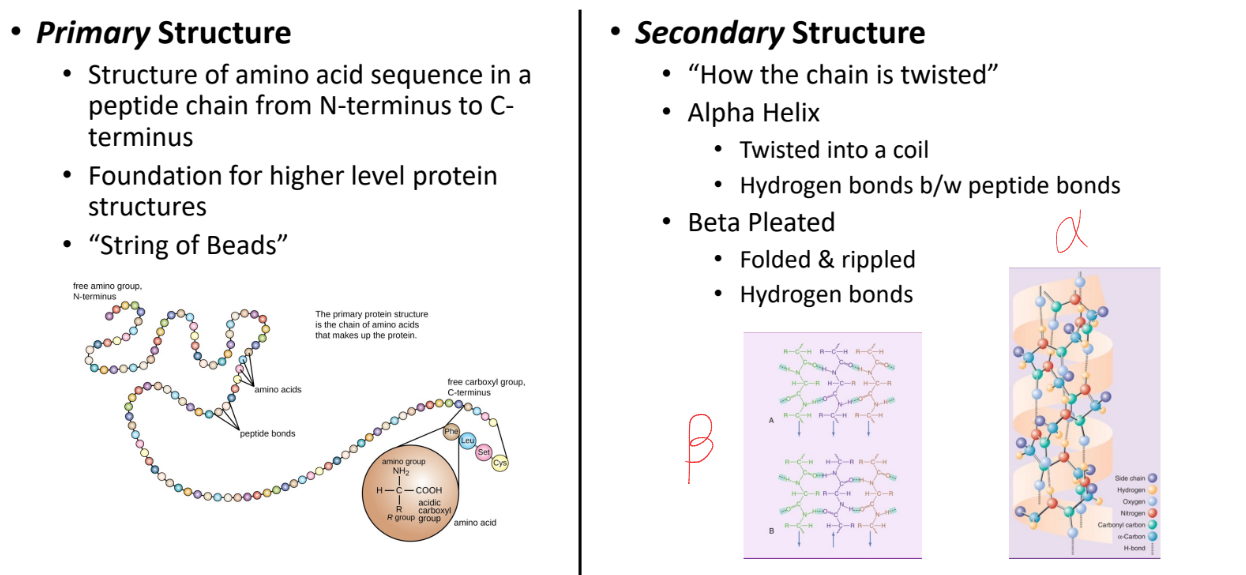
Protein Structure 1 & 2 - 3
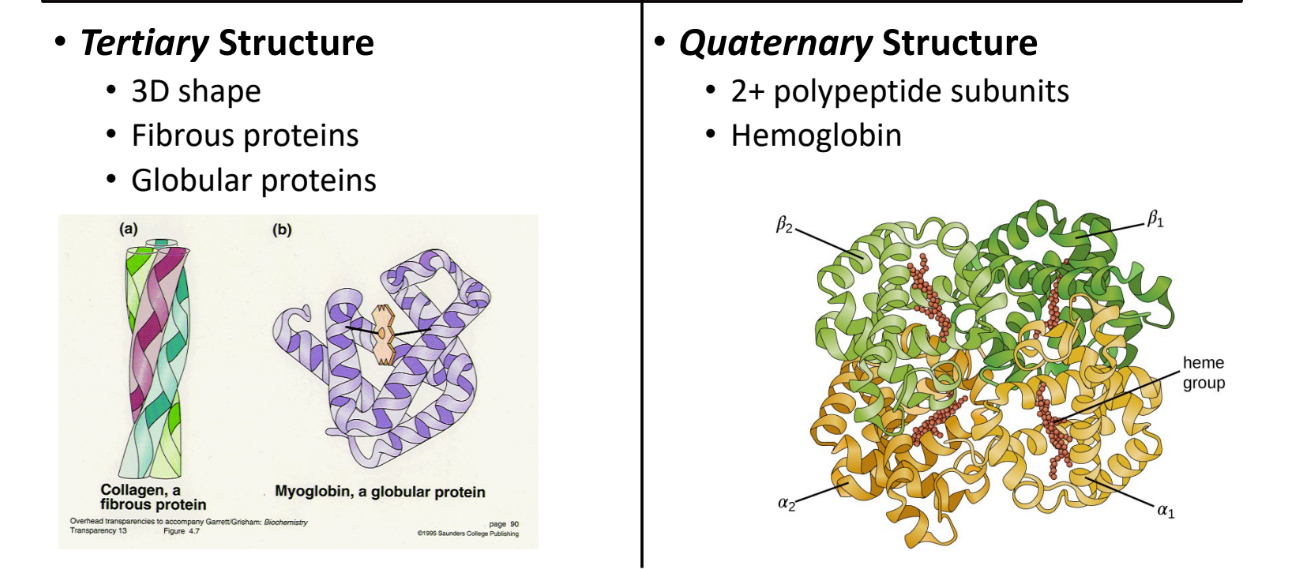
Protein Structure 3 & 4 - 4
Denaturation - 4
Unraveling proteins (lose 3D shape)
Caused by detergents, temperature, changes in pH
pH range = 7.0 -7.7
6℃ ↑ in body temp can be fatal
Enzymes are? 2
Globular Proteins (catalysts) End in ”-ase”
Enzyme-Substrate Specificity Models
Lock-and-Key Model
Rigid active sight
High specificity
Induced-Fit Model
More flexible active sight
Some enzymes catalyze multiple substrates
Nucleic Acids - 2 ex
Nucleosides
Sugar + nitrogenous base
DNA
Nucleotides
Nucleoside + phosphate ester group joined by phosphate ester linkages
ATP
Deoxyribonucleic Acid (DNA) - 2
Double-stranded alpha helix found in nucleus bounded via hydrogen bonds
4 nucleoside bases
Adenine = Thymine
Guanine = Cytosine
Ribonucleic Acid (RNA) - 2
Matches DNA inversely
4 nucleoside bases
Adenine = Uracil
Guanine = Cytosine
Translation - 1
Messenger RNA (m-RNA)
RNA polymerase “unzips” DNA, terminator sequence at the end forms a hairpin loop
Synthesized single chain of nucleotides in nucleus from DNA
Carry DNA-coded instructions into cytoplasm for Protein synthesis

Transfer RNA (t-RNA) - 2
Translation - 3
Codon: 3-base pair of m-RNA
start codon is AUG
stop codon is UAG, UGA, UAA
Anticodon: 3-base sequence = specific amino acid
Peptide bonds formed cost ATP
Goes to ER and Golgi after