Action Potentials + Refractory Periods
 Call Kai
 Learn
Learn Practice Test
 Spaced Repetition
 Match
Match Flashcards
 Knowt Play
1/12

There's no tags or description
Looks like no tags are added yet.
Name | Mastery | Learn | Test | Matching | Spaced | Call with Kai |
|---|
No analytics yet
Send a link to your students to track their progress
13 Terms
Action potential
Brief reversal of membrane potential of around 100 mV
for long distance signals → non decremental with constant magnitude
All or non principal of action potential
If threshold is reached, full action potential happens
if not, it doesn’t → no half action potential etc
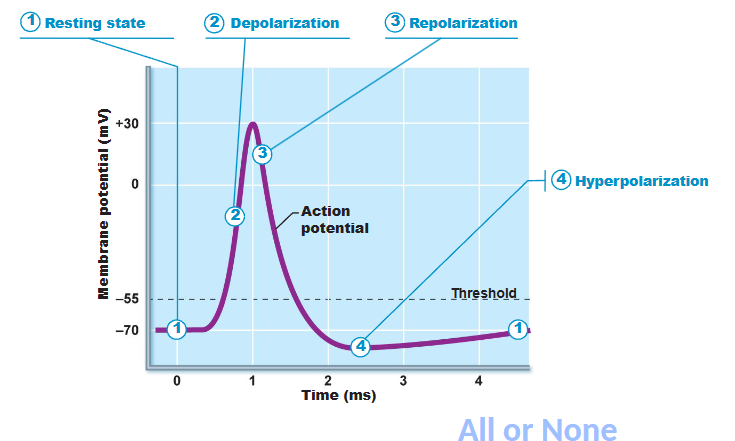
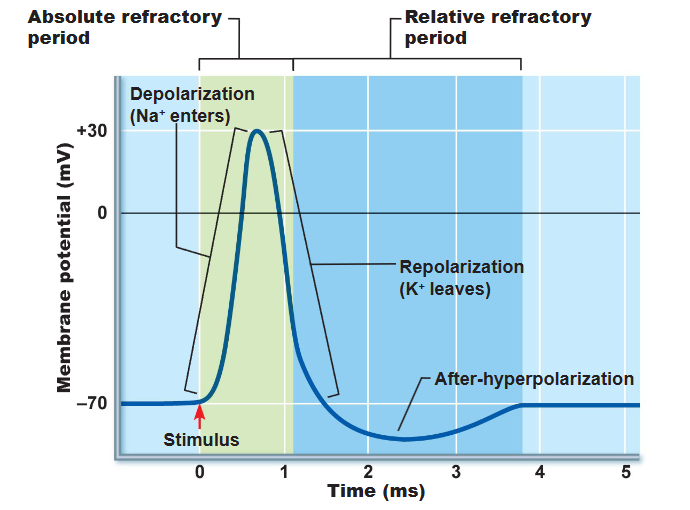
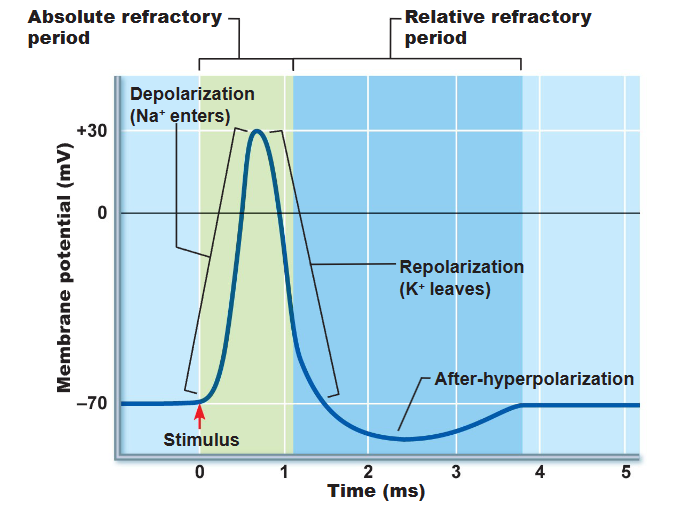
Four Phases of an Action Potential
Resting stage, depolarization, repolarization, hyperpolarization
Resting stage of action potential
resting membrane potential → -70
only leakage K+ and Na+ channels are open
gated channels are closed
positive outside negative inside
neuron is polarized
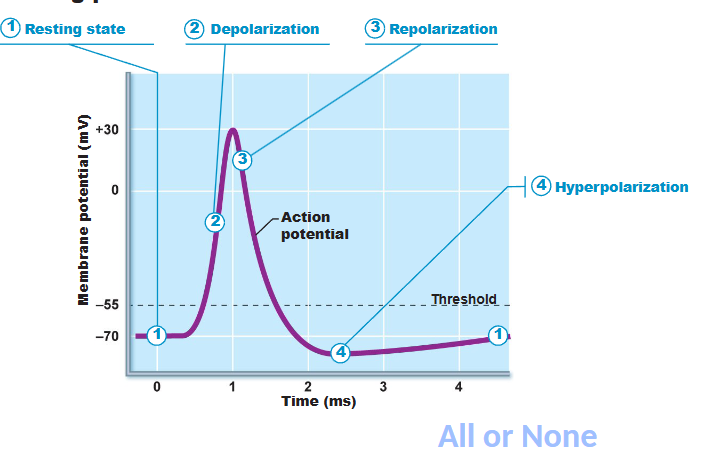
Depolarization stage of action potential
voltage gated Na+ channel opens → Na+ into cell → membrane potential becomes less negative (-70 → 30)
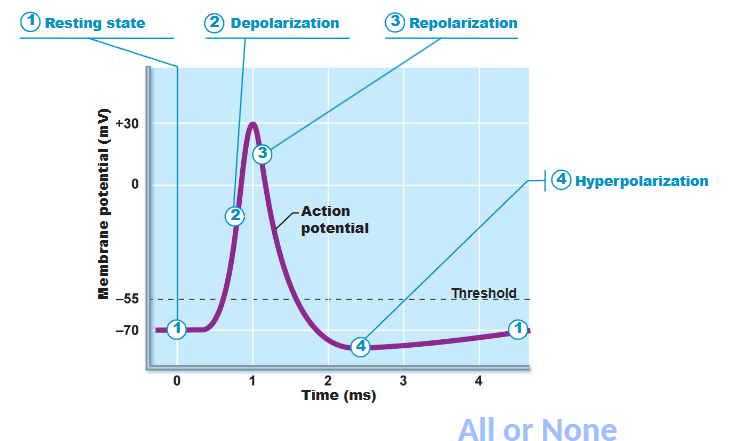
Repolarization stage of action potential
voltage gated Na+ channels close and voltage gated K+ channel opens → K+ exits cell → membrane potential becomes negative again
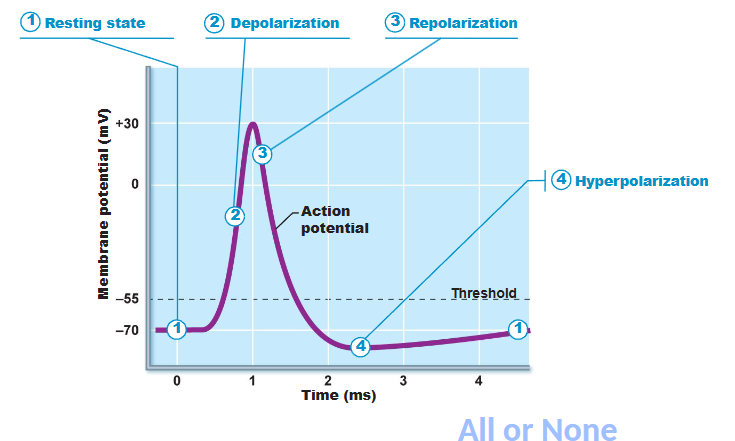
Hyperpolarization stage of action potential
K+ channels remain open for too long → too much K+ leaves so membrane potential is more negative than resting 70 mV
All action potentials are alike and are independent of
stimulus intensity
– How do we tell the difference between hot and light touch?
– How does CNS tell difference between a weak stimulus and a
strong one?
Based on frequency not magnitude
strong stimulus → lots of action potential close together
weak stimulus → few action potentials
Refractory period and what are the two types
period during or after an action potential when firing another action potential is difficult
absolute and relative
Absolute Refractory Period → when and what
During depolarization - from opening of Na+ channels till close → another action potential cannot be fired at all
Relative refractory period
while repolarization (late repolarization and hyperpolarization) is happening → threshold is slightly elevated → making it hard to fire another action potential
action potential can still be generated with a strong enough stimulus
Can action potential travel in more than one way and why
No, the signal can only move forward because of the refractory period since it cannot fire immediately again
Multiple Sclerosis
axon loss → Myelin sheath in CNS is damaged so action potential is slower or blocked